Timber-Frame House Construction Costs
By Housey · Last reviewed 11th of May 2026
Timber-Frame House Construction Costs
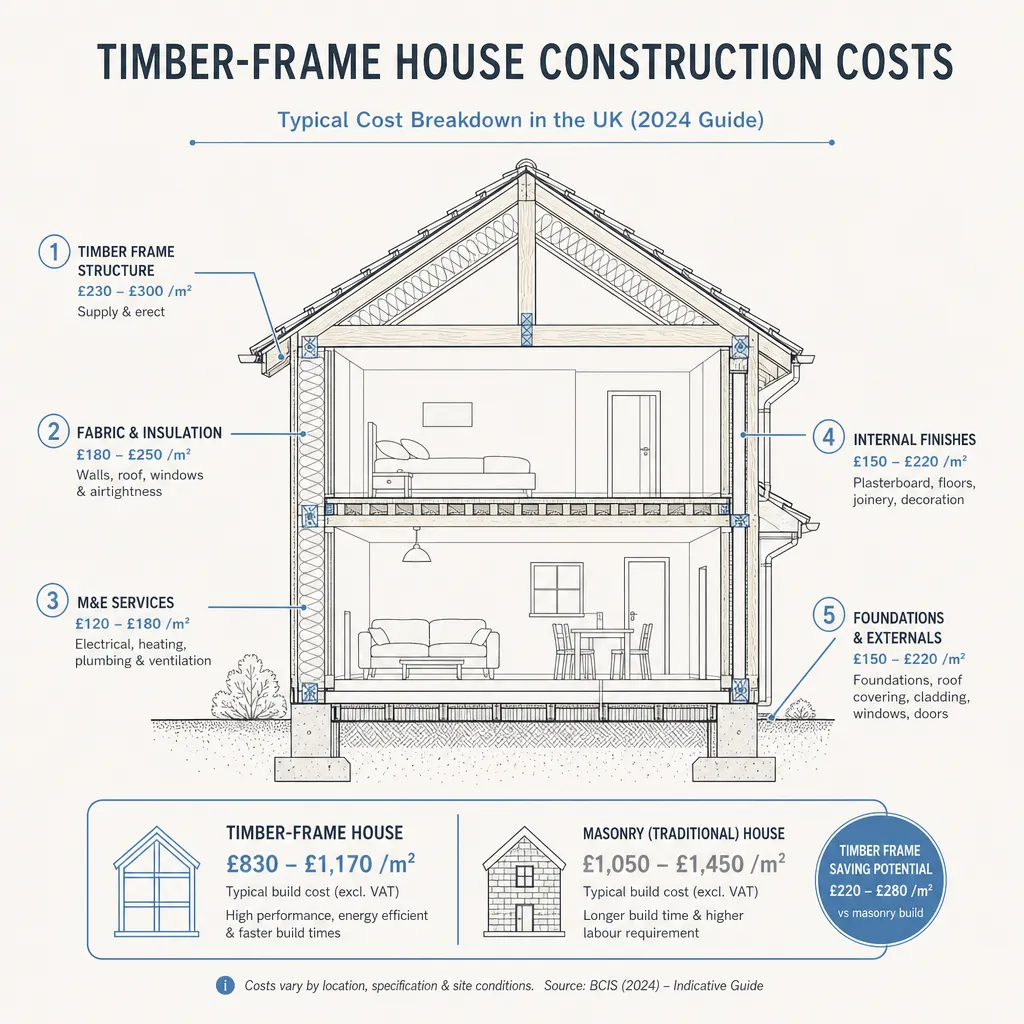
Timber-frame construction accounts for a significant and growing share of UK self-build completions, valued for its speed of erection, strong thermal performance, and the precision that off-site panel fabrication allows. For anyone planning a new-build home in England or Wales — whether commissioning a self-build or working with a developer — understanding how timber-frame costs are structured, how different systems compare, and what additional budget lines to plan for is essential before committing to a structural approach. Decisions made at this stage directly affect programme, energy compliance, contractor selection, and overall project viability.
Key points
- Indicative UK build costs for a timber-frame new build range from £2,000–£3,500 per m² of internal floor area, excluding land, professional fees, VAT, and site infrastructure (Indicative UK costs, last reviewed 2026-05-11).
- Building Regulations Part L (2021 edition, England) requires new dwellings to produce approximately 31% lower CO₂ emissions than the 2013 baseline; timber-frame systems often achieve this with standard insulation specifications.
- A Standard Assessment Procedure (SAP) energy calculation is required as part of the Building Regulations submission for all new dwellings in England and Wales.
- NHBC Buildmark, Premier Guarantee, and LABC Warranty are the principal 10-year structural warranty products for timber-frame new builds — most mortgage lenders require one before advancing funds.
- The Structural Timber Association (STA) accredits timber-frame system suppliers and contractors in the UK; using an STA-accredited supplier is widely recommended by NHBC and structural engineers.
How much does it cost to build a timber-frame house in the UK?
Build cost depends on specification level, location, chosen frame system, and ground conditions. The figures below cover the construction contract only, and exclude land, design fees, planning fees, SAP calculations, building control, site infrastructure, landscaping, and contingency.
Specification level | Cost per m² (UK average) | Notes |
|---|---|---|
Basic timber frame, standard spec | £2,000–£2,400 | Modest finishes, standard glazing, simple roof form |
Mid-spec timber frame | £2,400–£3,000 | Better windows, quality kitchen and bathroom, more complex roof |
High-spec or Passivhaus-influenced | £3,000–£3,500+ | Triple glazing, MVHR ventilation, premium finishes throughout |
Indicative UK costs, last reviewed 2026-05-11. London and the South East typically 20–30% higher. Abnormal groundworks — contamination, high water table, or unusual subsoil — may add £20,000–£60,000 or more to the total.
A 120 m² three-bedroom detached house at mid-specification, outside London, might carry a construction cost of around £290,000–£360,000 before land, professional fees (typically 10–15% of construction cost), and VAT — which is zero-rated for new residential builds when the main contractor is VAT-registered.
Timber-frame system types: which is right for your build?
Not all timber-frame systems are equivalent. The choice affects structural performance, programme, insulation strategy, cost, and how much your design team and contractor need to know about the technology.
System | How it works | Best for | Not ideal for | Indicative cost premium over open panel |
|---|---|---|---|---|
Open panel (stick frame) | Studwork frame erected on site, insulated in situ | Design flexibility, lower material cost | Tight programmes, cold or wet sites | Baseline |
Closed panel (insulated off-site) | Fully insulated and breather membrane-applied in factory | Fast weathering-in, high air-tightness | Sites with difficult access for large deliveries | 5–15% |
Structural Insulated Panels (SIPs) | Rigid foam core bonded between OSB skins | Very high air-tightness, fast erection | Curved forms, highly bespoke layouts | 10–20% |
Cross-Laminated Timber (CLT) | Solid engineered timber panels forming walls, floors, and roofs | Exposed timber aesthetic, multi-storey schemes | Cost-sensitive standard residential | 25–50%+ |
Which timber-frame system should you choose?
- Choose open panel if budget is the priority and your site has good contractor access and reasonable weather conditions during construction.
- Choose closed panel if programme is critical and you want reliable air-tightness without depending entirely on on-site workmanship quality.
- Choose SIPs if you are targeting very high energy performance — Passivhaus or equivalent — or if the design has a compact, straightforward geometry.
- Choose CLT if exposed structural timber is a design objective, or for multi-storey or mixed-use projects where fire performance and span capability matter.
- Consult a structural engineer before committing if your design involves complex geometry, large open spans, or more than two storeys.
- Ask your architect or SAP assessor to confirm that the proposed system's U-values and thermal bridging figures will meet Part L or your target EPC rating before placing a frame order.
What else does a timber-frame new build cost?
Construction cost is only part of the total project budget. A realistic self-build budget for a new timber-frame house should include:
- Land purchase — varies enormously by region; in most parts of England the largest single cost item
- Planning application fee — currently £578 for a new dwelling in England (2026); check the Planning Portal for current fees in Wales and Scotland
- Professional fees — architect, structural engineer, SAP assessor, party wall surveyor if applicable; typically 10–15% of construction cost
- Building control fee — roughly £1,000–£3,000 for a standard house, depending on floor area and submission route
- Site infrastructure — mains connections for water, electricity, gas or heat pump, and drainage; £15,000–£40,000 or more depending on distance from existing services
- VAT — new dwellings are zero-rated if built by a VAT-registered contractor; self-builders can reclaim VAT on eligible materials via HMRC's DIY reclaim scheme (form VAT431NB)
- Contingency — 10–15% of construction cost is standard professional advice; self-builds often carry higher uncertainty than developer-led schemes
Self-build new-build checklist
Before appointing a main contractor, ensure you have:
When to get professional help
Timber-frame house construction carries structural, thermal, planning, and financial complexity that makes professional input essential, not optional. Key advisors include:
- A structural engineer to check the frame design and foundation specification — required under Approved Document A and by most structural warranty providers.
- An architect to develop a scheme that works with the chosen structural system and satisfies planning requirements from the outset.
- A build cost estimator to produce pre-contract cost plans that reduce the risk of budget overruns before a main contractor is engaged.
- A planning consultant if the site is in a sensitive location — green belt, conservation area, AONB, or flood zone.
How Housey can help
Housey connects self-builders and developers with vetted architects, structural engineers, and build cost estimators experienced with timber-frame new builds. Compare specialist quotes and get your project on the right foundation from the outset.
Frequently asked questions
Do timber-frame houses have a shorter lifespan than brick-built homes?
No. Properly designed, built, and maintained, a timber-frame house can last as long as masonry — typically 60 years or more with normal maintenance, and considerably longer with a well-detailed external envelope. The critical factors are moisture management, vapour control layer installation, and keeping the cladding and roofing in good repair.
What Building Regulations apply to a timber-frame new build?
All relevant parts apply: Part A (Structure), Part B (Fire safety), Part E (Resistance to sound), Part F (Ventilation), Part L (Energy efficiency), Part M (Accessibility), and others depending on the scheme. A full plans application to local authority building control or a registered building inspector is the standard route for new dwellings in England and Wales.
Is timber frame suitable for a self-build project in the UK?
Yes. Timber frame is one of the most popular structural systems for UK self-builds because it erects quickly, achieves high energy performance with standard insulation, and many suppliers offer design-and-supply packages. Using an STA-accredited supplier and appointing a structural engineer to review the frame and foundations are standard recommendations.
Do I need a structural warranty for a timber-frame self-build?
Yes, in practice. Most mortgage lenders require a 10-year structural warranty before advancing funds — NHBC Buildmark, Premier Guarantee, and LABC Warranty are the main providers. Even cash purchasers should arrange a warranty, as it is a standard expectation from buyers and lenders when the property is eventually sold.
Sources and further reading
Useful next reads
 Planning & Pre-Build
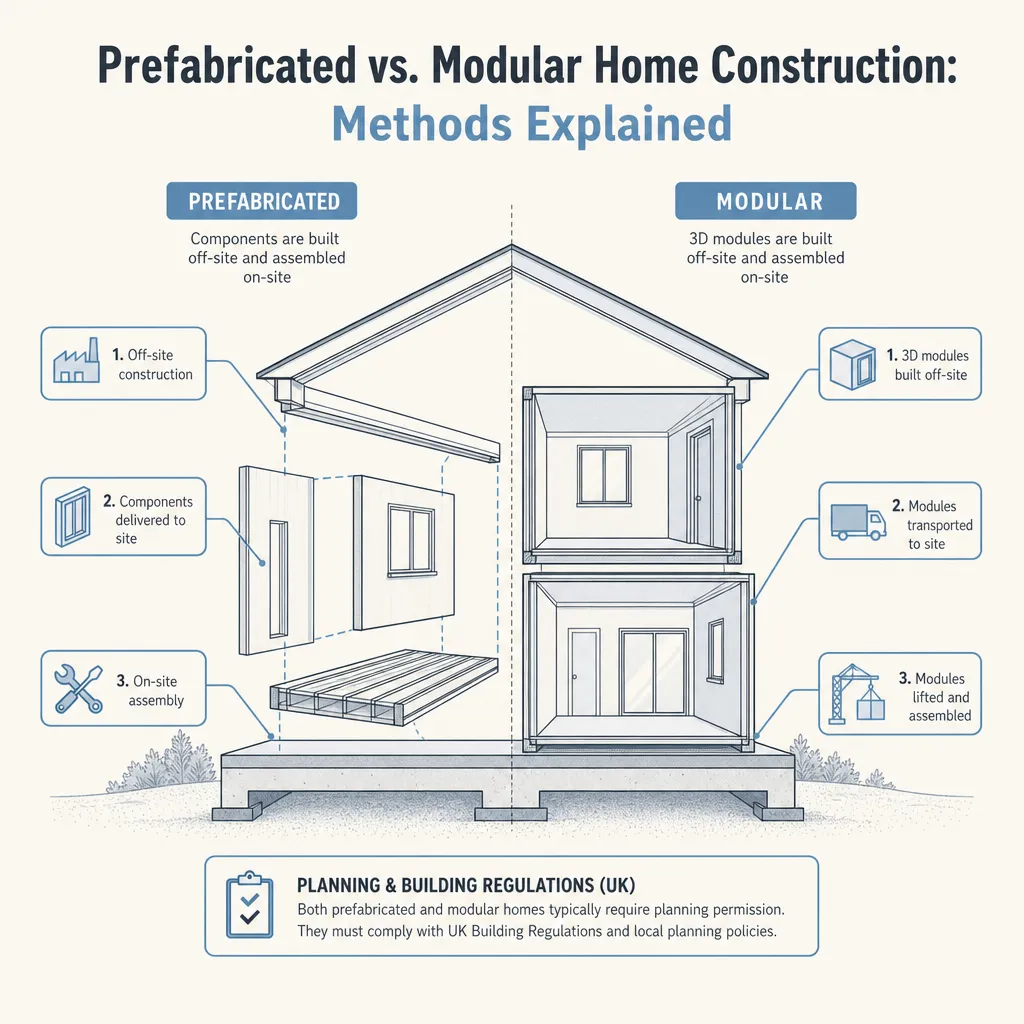
Prefabricated vs. Modular Home Construction: Methods Explained
Prefabricated construction covers any home built partly or fully off-site, while modular construction is a specific type where factory-built volumetric units are craned into position.
 Planning & Pre-Build
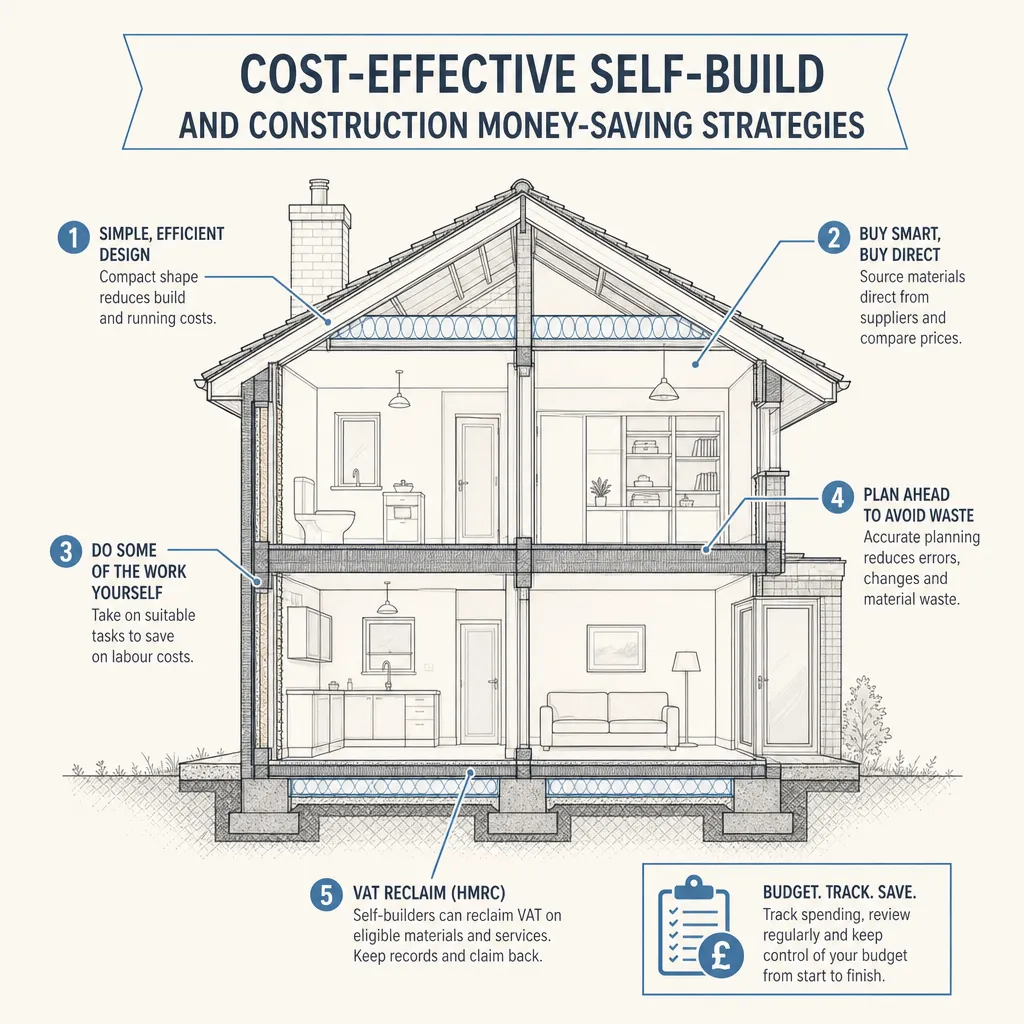
Cost-Effective Self-Build and Construction Money-Saving Strategies
The biggest self-build savings come from fixing the design early, selecting the right procurement route, and reclaiming VAT through HMRC's VAT431NB scheme.
 Planning & Pre-Build
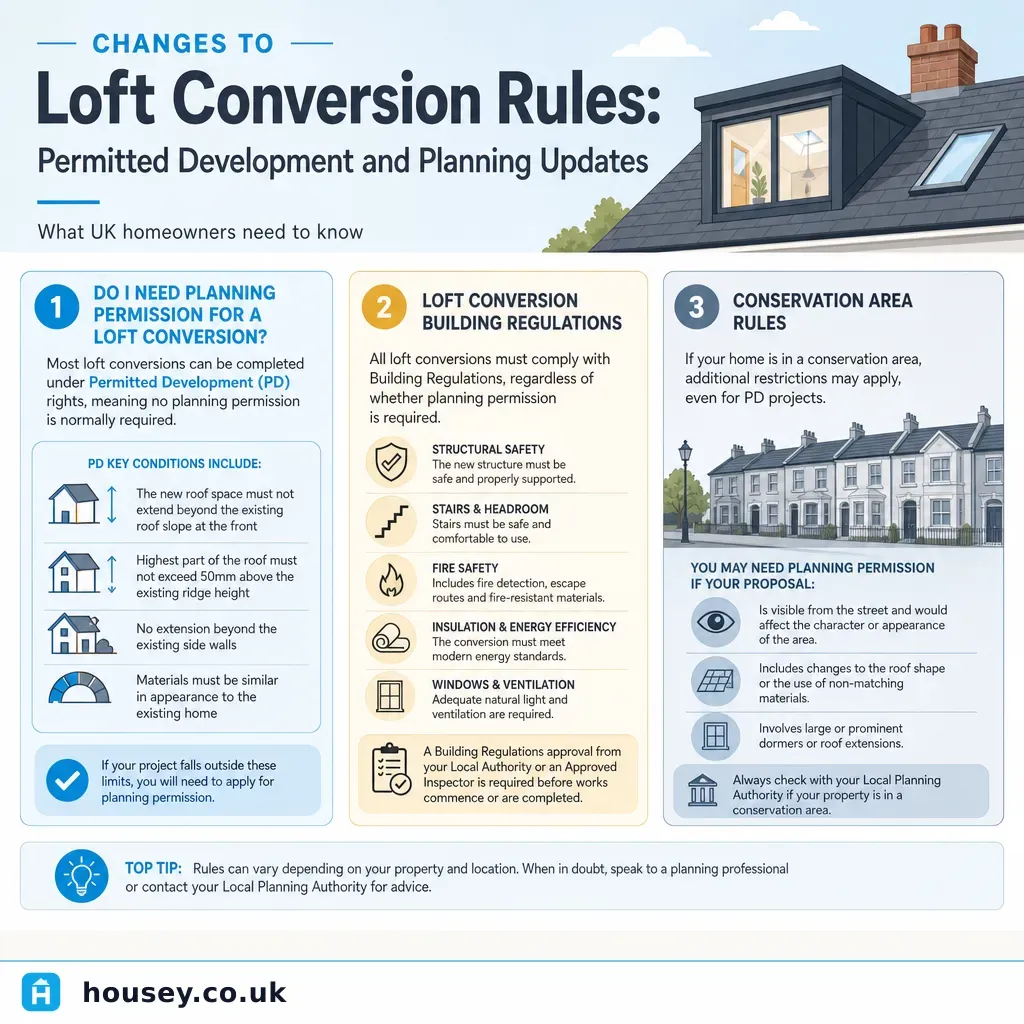
Changes to Loft Conversion Rules: Permitted Development and Planning Updates
In England, most loft conversions on standard houses qualify as Permitted Development under Class B of the GPDO 2015, allowing up to 40 cubic metres (terraced) or 50 cubic metres (detached or semi-detached) without a planning application — if conditions are met.
 Planning & Pre-Build
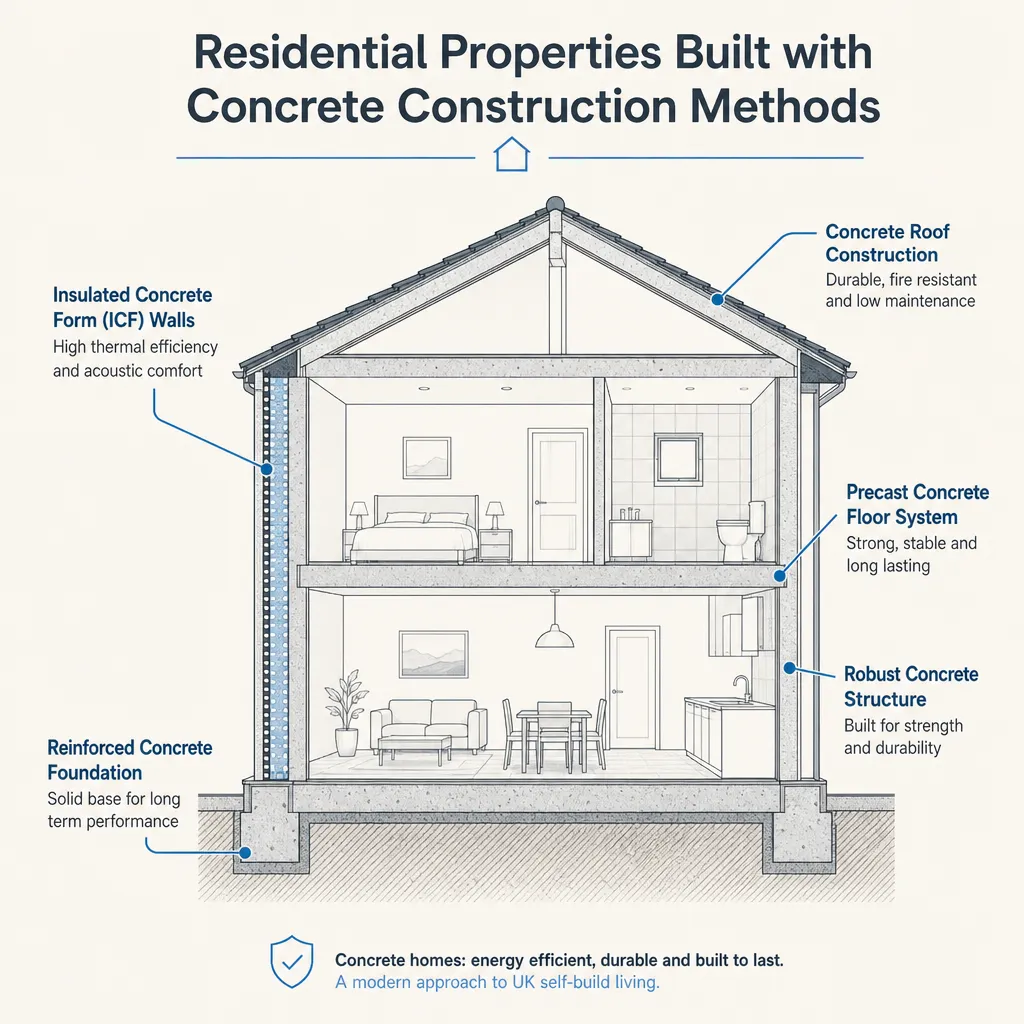
Residential Properties Built with Concrete Construction Methods
UK homes are built using several concrete methods: in-situ cast concrete, precast panel systems, insulating concrete formwork (ICF), and older non-traditional types such as Wimpey No-Fines and Laing Easiform.
 Planning & Pre-Build
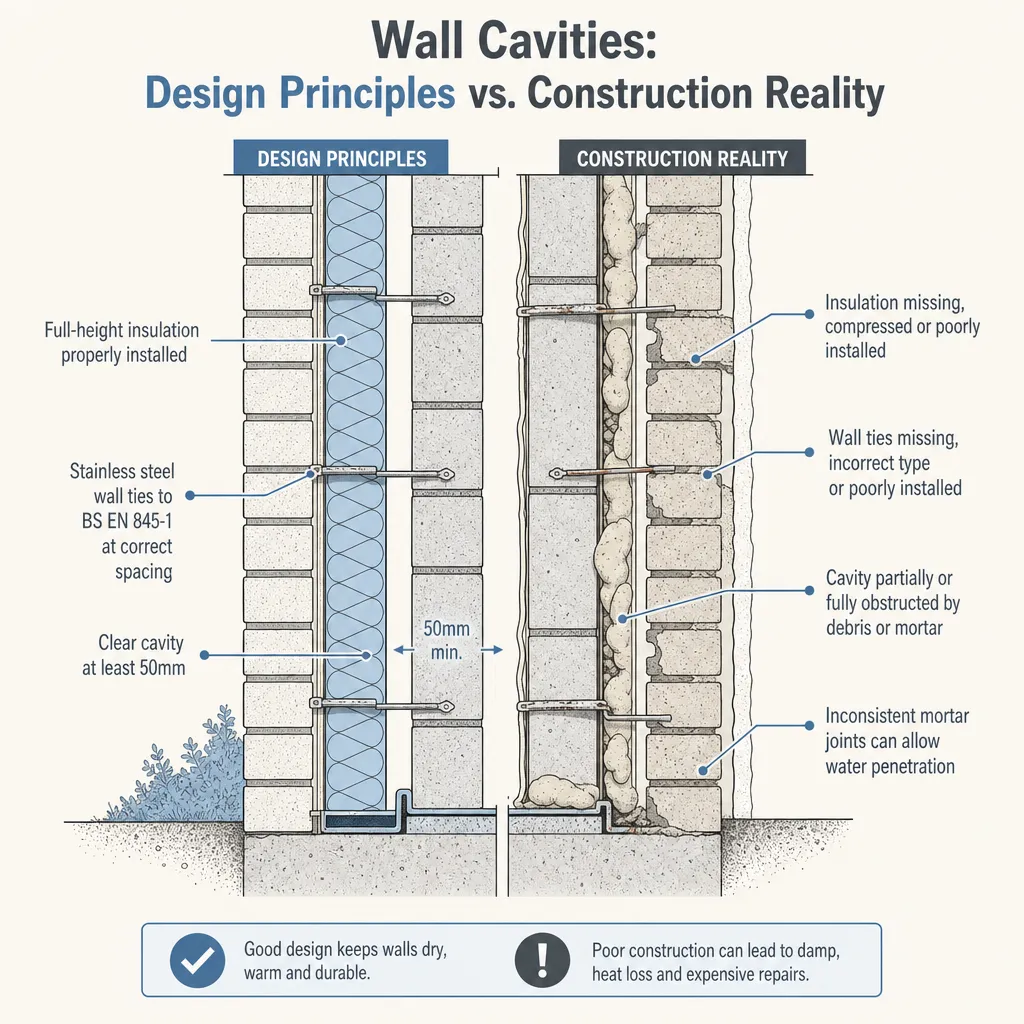
Wall Cavities: Design Principles vs. Construction Reality
A UK cavity wall is designed to resist weather, control heat loss, and structurally link two masonry leaves.