Preparing Your Property for a House Move: Planning and Logistics
By Housey · Last reviewed 30th of May 2026

Preparing Your Property for a House Move: Planning and Logistics
The period between accepting an offer and completion day is rarely as relaxed as it appears. Alongside the legal and financial work handled by solicitors, homeowners face a parallel task: methodically preparing a property — often one that has accumulated years of possessions — for handover. Starting this work early and in the right sequence reduces last-minute pressure and protects you from avoidable completion-day surprises.
Key points
- Book a removal company at least 4–6 weeks ahead; Friday completions and summer month-ends are the most in-demand and most expensive slots.
- Royal Mail Redirection takes up to 5 working days to set up and costs from £39.99 for three months — confirm current pricing at royalmail.com.
- FENSA certificates for replacement glazing, boiler service records, and planning permission or building regulations completion certificates should be located before exchange, not after.
- Storage can bridge a gap between vacating your old property and completing on your new one — particularly useful if chain delays are likely.
- Decluttering before estate agent photography improves visual impact; a well-presented, uncluttered home typically photographs and shows better than one still full of everyday clutter.
When to start preparing
Starting too late is the most common mistake. Use this timeline as a planning guide:
Weeks before completion | Tasks |
|---|---|
8–10 weeks | Declutter; book house clearance or charity collections; start packing non-essentials |
6–8 weeks | Book removal company; arrange storage if needed; collate key documents; photograph valuables |
4–6 weeks | Notify utilities; set up Royal Mail Redirection; notify employer, bank, DVLA, HMRC |
2–4 weeks | Deep clean; confirm removal company logistics; confirm parking suspension if needed |
1 week | Pack all but daily essentials; defrost fridge-freezer; confirm solicitor's completion timeline |
Moving day | Final meter readings; photograph every room; hand over keys |
This assumes a typical English or Welsh conveyancing process of 8–14 weeks between offer and completion. Adjust if your transaction is moving faster or slower.
Decluttering and clearance before you move
Moving is an opportunity to reduce. Items you carry to a new property and rarely use add moving cost and future clutter. Consider three categories: keep and pack, donate or sell, and dispose of.
A house clearance service can remove large volumes of unwanted items efficiently, including furniture, white goods, and garden equipment. For partial clearances, bulky items, or specific rooms, this is often more practical than multiple van hire trips.
If your property has not yet had listing photography taken, or if existing photos do not show it at its best, it may be worth arranging professional property photography once the major clearance is complete — a well-presented home typically attracts more online viewings and can reduce time on the market.
What not to assume about clearance:
- Charity shops do not collect everything — mattresses and most electrical goods are often declined.
- Skip hire requires a permit from your local council if the skip is placed on a public road (typically £25–£60 for one to two weeks — indicative UK costs, last reviewed 2026-05-30).
- Some clearance firms separate items for donation, recycling, and landfill disposal — ask specifically if this matters to you.
- Clearance costs vary significantly based on volume and access — obtain at least two quotes before committing.
Documents to gather before your move
Locating key documents early prevents last-minute scrambles and reduces the risk of delays in your conveyancing:
Property documents checklist:
Your solicitor will request many of these during conveyancing — having them to hand avoids delays and can prevent retentions at exchange.
Booking and briefing your removal company
A well-briefed removal company reduces damage, speeds up the day, and manages the unexpected. When comparing quotes:
What to ask | Why it matters |
|---|---|
What is included — packing, dismantling, reassembly? | Quotes vary widely in scope; compare like for like |
What Goods in Transit cover is in place, and what are the limits? | Essential if high-value items are being moved |
Is the firm a BAR (British Association of Removers) member? | BAR members have agreed standards and a dispute resolution scheme |
What is the waiting-time policy if completion is delayed? | Common on chain moves — know the hourly rate in advance |
Who carries out the work — employees or sub-contractors? | Affects accountability and quality consistency |
Is VAT included in the quoted price? | Some quotes are presented exclusive of VAT |
A reputable house removals provider will carry out a pre-move survey — in person or via video — before quoting. Treat any quote given without this assessment as indicative only.
Utilities, services, and address changes
Notify the following at least four weeks before moving:
Utilities: Gas and electricity supplier (provide final meter readings on moving day); water company; broadband and phone provider — check notice periods, as some require 30 days, and book your new connection early as installation slots can fill quickly.
Official notifications: DVLA (driving licence and vehicle registration); HMRC (self-assessment, tax credits, child benefit); electoral roll — register at your new address via GOV.UK; DWP if you receive state pension or benefits.
Financial and insurance: Banks and building societies; mortgage lender if porting; contents and buildings insurance providers; pension and investment providers.
Other: GP, dentist, and optician; vehicle insurance (address affects your premium); Royal Mail Redirection as a safety net for mail that slips through.
Packing strategy
Packing methodically saves time at both ends of the move:
- Label every box by destination room, not by contents alone — removal teams can then place boxes in the right room without asking.
- Pack heavy items in small boxes; lighter items in large boxes — protects both backs and the boxes themselves.
- Keep an essentials bag with you, not on the van — phone chargers, kettle, mugs, toiletries, medications, documents, keys, and a change of clothes.
- Wrap fragile items in clothing or linen — reduces packing material cost and waste.
- Disassemble flat-pack furniture before moving day where possible — moving assembled flat-pack often causes damage to joints and boards.
- Photograph electronic setups (TV cabling, router configuration) before dismantling so you can reassemble accurately at the other end.
When to get professional help
Most moving preparation is within a homeowner's capability, but seek professional support if:
- The volume of items to clear is beyond practical self-management — a professional clearance firm can often complete in a day what would take weeks otherwise.
- You are moving antiques, fine art, or valuable instruments — specialist movers carry appropriate insurance and packing expertise.
- A lease or tenancy agreement complicates your departure date — seek advice from a solicitor or Citizens Advice if you are unsure of your obligations.
- You discover paperwork gaps (missing building regulations sign-off, no FENSA certificate) during document gathering — your solicitor can advise on indemnity insurance options, but address this well before exchange.
How Housey can help
Housey makes it straightforward to find and compare vetted local house removals and house clearance professionals. Submit a job request with your property details and preferred dates, receive quotes from up to four local providers, and read verified reviews from other homeowners.
Frequently asked questions
How far in advance should I book a removal company?
For Friday completions or moves during July and August, aim for 6–8 weeks ahead. At quieter times or for mid-week moves, 3–4 weeks is often sufficient — but earlier is always safer. Some popular firms fill their Friday slots months in advance during the spring-summer peak, particularly in high-turnover areas.
What happens to my belongings if completion is delayed on the day?
If goods are on the van and completion does not happen as planned, the removal company will typically put them into short-term storage at their depot. Confirm this option — and the nightly storage rate — in your contract before moving day. Some firms include one night as a contingency measure.
Do I need to notify my mortgage lender when I move?
Yes, if you are porting your mortgage to a new property, your lender must approve the new property and may reassess your financial circumstances. If you are selling without buying again, the mortgage is repaid at completion. Your solicitor handles the mechanics, but notify the lender directly of your change of address for correspondence.
Is there anything I should not pack in the removal van?
Removal companies typically refuse flammable liquids such as paint, solvents, gas canisters, and aerosols. Keep prescription medications, valuable documents, cash, and jewellery with you rather than on the van. Some firms also decline plants — check the company's policy when booking, as exclusions vary.
Sources and further reading
- Moving home guidance — Citizens Advice
- Consumer advice for removals — British Association of Removers
- Royal Mail Redirection service — Royal Mail
- Register to vote at a new address — GOV.UK
- Change your driving licence address — GOV.UK
Useful next reads
 Buying & Moving
How to Plan a House Move: A Practical Guide to Residential Relocations
A UK house move goes more smoothly with planning that starts 6–8 weeks before moving day.
 Buying & Moving
Professional House Clearance Services for Your Home
A professional house clearance firm removes all or part of a property's contents and disposes of them at licensed facilities.
 Buying & Moving
Moving Day Logistics: A Guide to a Successful Home Relocation
On moving day, wait for your solicitor to confirm completion before collecting keys — there is no fixed handover time and most UK completions happen between 11am and 2pm.
 Buying & Moving
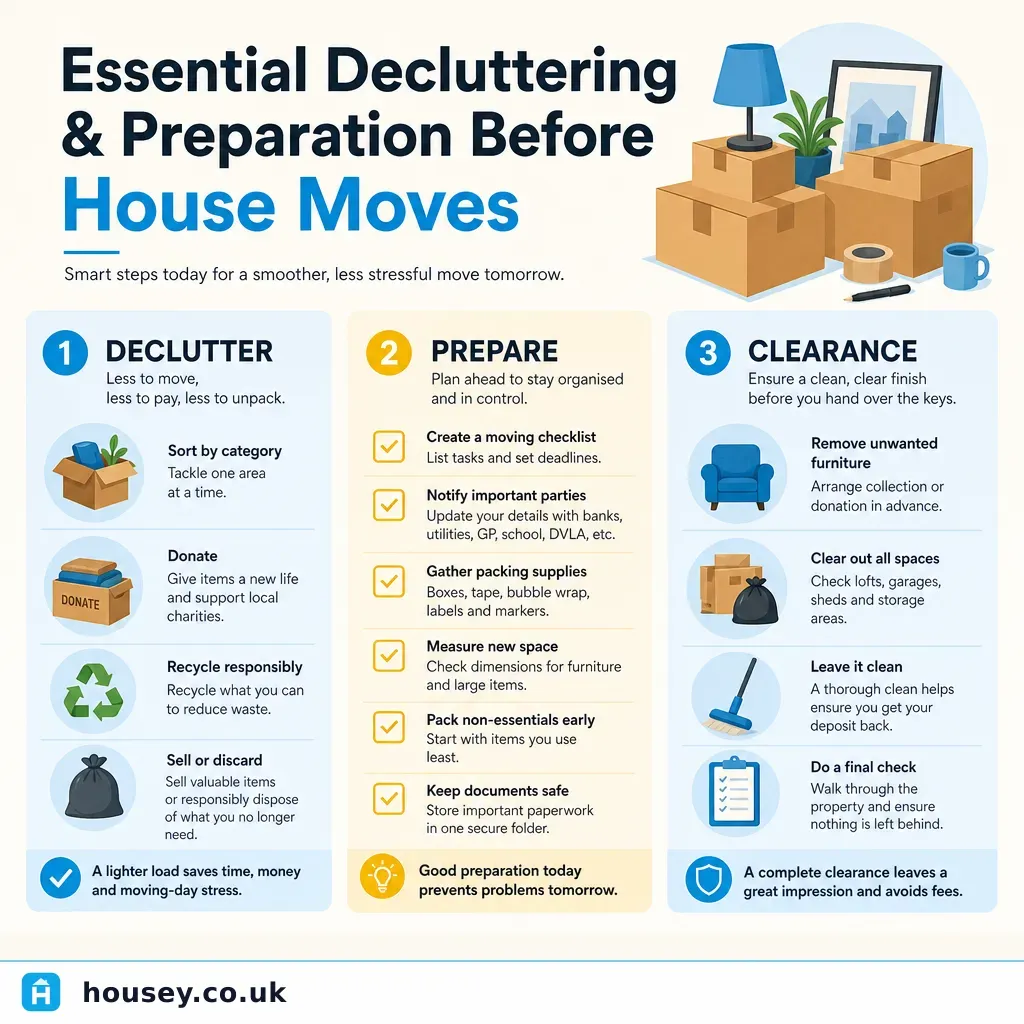
Essential decluttering and preparation before house moves
Decluttering before a house move reduces removal costs, improves property photographs, and simplifies unpacking.
 Buying & Moving
Rubbish Removal and House Clearance Costs
House clearance in the UK typically costs £150–£400 for a single room and £500–£1,500 for a full three-bedroom property, depending on volume, access, and hazardous items.