Preventing Draught Infiltration: External Foundation Insulation and Air Sealing
By Housey · Last reviewed 24th of May 2026
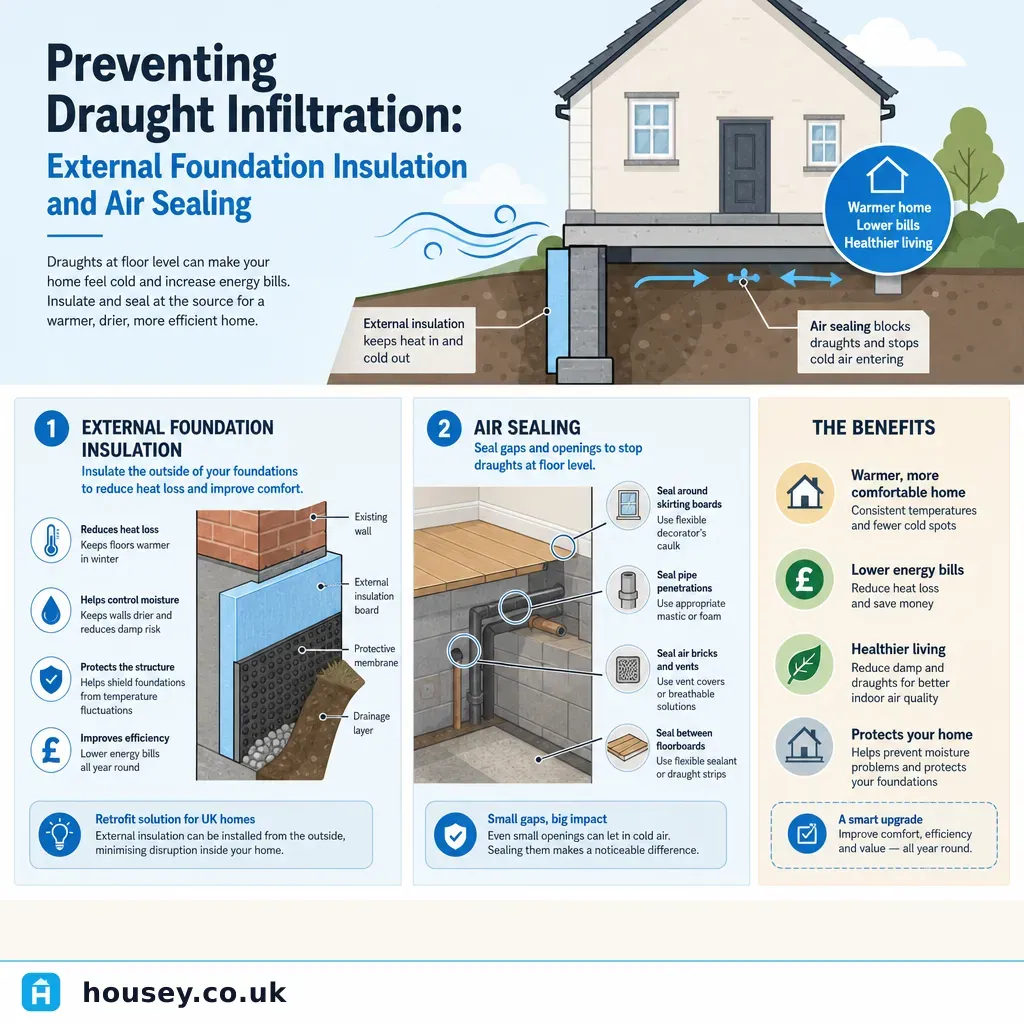
Preventing Draught Infiltration: External Foundation Insulation and Air Sealing
Draughts at ground-floor level are among the most overlooked sources of heat loss in UK homes. In older properties with suspended timber floors or solid masonry ground floors, cold air infiltration around the building's base — at floor-to-wall junctions, service penetrations, and subfloor voids — can account for a meaningful share of total fabric heat loss, yet this area typically attracts far less attention than loft insulation or window upgrades.
Key points
- Floor edge and foundation thermal bridges contribute to fabric heat loss in pre-1945 UK housing stock, particularly in solid-floor and suspended-floor dwellings, as documented in BRE research on heat loss through building fabric.
- PAS 2030:2019 and PAS 2035:2019 set quality standards for energy efficiency measures funded via ECO4 and the Great British Insulation Scheme; works under these schemes must be delivered by TrustMark-registered contractors.
- Perimeter floor insulation installed without adequate vapour control and ventilation management can trap moisture beneath ground-floor level and lead to timber decay or mould — a recognised retrofit moisture risk under PAS 2035.
- Air sealing at the wall–floor junction using flexible mastic, mineral wool packing, or proprietary draught strips is a low-cost first measure that can be carried out independently of full insulation works.
- External wall insulation (EWI) that extends below finished ground level requires careful detailing at the damp proof course (DPC) to avoid bridging moisture into the wall above.
What is external foundation insulation and air sealing?
External foundation insulation is thermal insulation applied to the outer face of the building substructure — the external wall at and below ground level. It is commonly installed as a downward extension of an external wall insulation (EWI) system, continuing the insulation board past the finished ground level to reduce the thermal bridge at the wall–floor junction.
Air sealing at foundation level addresses gaps and cracks through which cold external air enters the building. Common locations include:
- The junction between the ground floor slab or floor deck and the external wall.
- Service penetrations (pipes, cables) through the external wall or floor.
- Gaps around suspended floor voids, subfloor ventilation brickwork, and airbrick surrounds.
- Cracks in external masonry or render at low level.
Together, these measures reduce both conductive heat loss (through the building fabric) and infiltration heat loss (cold air entering the living space directly).
Which property types benefit most?
Property type | Common heat loss route | Typical measure |
|---|---|---|
Pre-1945 solid masonry, solid floor | Cold floor edges, air infiltration at skirting | Perimeter mastic sealing, insulated edge strip, EWI detail below DPC |
Pre-1945 suspended timber floor | Cold air circulation beneath floor deck | Subfloor draught sealing, airbrick management, perimeter joint sealing |
1945–1980 cavity wall, concrete slab | Thermal bridge at wall–floor junction | EWI continuing below DPC with proprietary thermal break detail |
Post-1980 insulated slab | Lower risk | Check service penetrations and expansion joint sealing |
Post-2006 new-build (Part L compliant) | Air tightness tested at completion | Service penetrations — confirm via building control completion certificate |
Retrofit moisture risk: what not to assume
This is a heightened-risk area because incorrect detailing can cause more harm than no treatment at all.
Do not assume that adding more insulation always improves the situation. Moving the dew point within a wall or floor construction can cause interstitial condensation — moisture forming inside the structure where it is not visible until damage has occurred.
Do not assume all subfloor ventilation can be sealed. Suspended timber floors in pre-1945 properties depend on cross-ventilation beneath the floor deck to prevent timber decay. Blocking airbricks entirely without a replacement strategy — such as passive ventilators or a mechanical underfloor system — can cause serious rot within a few years.
Do not assume EWI automatically protects the DPC. Insulation boards that bridge the damp proof course can wick ground moisture upward into the wall. A correctly installed system must maintain DPC integrity or include an engineered break.
Do not assume that mastic sealing alone constitutes an air-tightness strategy. Draught sealing at the base is most effective as part of a coordinated, whole-house retrofit plan assessed under PAS 2035.
Important limitations
This article provides general information for UK homeowners. Foundation insulation and air sealing involve moisture, structural, and regulatory considerations that vary significantly between property types, construction eras, local ground conditions, and existing building fabric. General guidance cannot substitute for a professional assessment of your specific property. For works within grant-funded schemes, a TrustMark-registered retrofit coordinator is required under PAS 2035.
When this becomes urgent
Seek professional advice promptly if:
- Damp patches, efflorescence (white salt deposits), or mould appear at low level on internal walls.
- Skirting boards or ground-floor floorboards feel soft or show visible signs of rot.
- Cold air is clearly entering through floor–wall junctions, service penetrations, or around skirting boards.
- Previous insulation works appear to have caused moisture problems elsewhere in the property.
What to ask a qualified professional
Before instructing a retrofit contractor or energy assessor:
- Is a whole-house retrofit assessment to PAS 2035 recommended before individual measures are specified?
- What moisture management strategy is proposed for the ground floor and subfloor void?
- Does the EWI specification maintain the existing DPC or include a proprietary thermal break?
- How will existing airbricks be treated — maintained, repositioned, or replaced with passive ventilators?
- What accreditations do you hold — TrustMark, MCS, CIGA, or other relevant schemes?
- Will the installation meet ECO4 or GBIS requirements, and will you provide the necessary certificates on completion?
When to get professional help
Foundation-level insulation and air sealing beyond simple mastic sealing of visible gaps should be assessed by a qualified professional. This applies particularly where:
- The property has a suspended timber floor and there is any risk of compromising subfloor ventilation.
- Damp has been identified at low level on internal walls or floors.
- Works form part of a wider EWI system where DPC detailing must be engineered correctly.
- The homeowner is applying for ECO4 or GBIS funding, which require TrustMark-registered contractors and PAS 2030/2035 compliance.
How Housey can help
Housey can connect you with accredited professionals for an insulation assessment covering ground-floor heat loss, subfloor conditions, and appropriate sealing measures. For a whole-house view, an energy-efficiency consultant can provide a PAS 2035-aligned assessment and a prioritised plan of improvements.
Frequently asked questions
What is external foundation insulation?
External foundation insulation is thermal insulation applied to the outer face of the building substructure — the external wall at and below ground level. It is often installed as a continuation of an external wall insulation system to reduce the thermal bridge at the wall–floor junction, lowering heat loss through the building's base and reducing the risk of cold spots and condensation at ground-floor level.
Will foundation insulation cause damp problems?
Incorrectly installed foundation insulation can cause damp, particularly if it bridges the damp proof course or if subfloor ventilation is compromised. Correctly designed systems include a DPC break or detailing that prevents moisture wicking, and maintain adequate cross-ventilation for suspended timber floors. A retrofit assessor should evaluate moisture risk before specification, in line with PAS 2035.
Can I get grant funding for foundation insulation?
Measures forming part of a coordinated whole-house retrofit may be eligible under ECO4 or the Great British Insulation Scheme, depending on property type, household income, and EPC band. Works must be specified and installed by TrustMark-registered contractors to qualify. Check current eligibility on GOV.UK and speak to an energy assessor about whether your property and proposed measures meet current criteria.
How much does air sealing at foundation level cost?
Indicative UK costs, last reviewed 2026-05-24: basic mastic air sealing around skirting boards and service penetrations typically costs under £500 in materials and labour for a mid-terraced house. More comprehensive perimeter insulation and EWI detailing forms part of broader works costing several thousand pounds depending on property size and scope. Obtain itemised quotes from TrustMark-registered contractors.
Sources and further reading
- PAS 2035:2019 — Retrofitting dwellings for improved energy efficiency — BSI Group
- GOV.UK — Energy Company Obligation (ECO4) — GOV.UK
- GOV.UK — Great British Insulation Scheme — GOV.UK
- TrustMark — Find a registered retrofit business — TrustMark
- Energy Saving Trust — Draught-proofing guidance — Energy Saving Trust
- BRE Group — Building research and thermal performance — BRE Group
Useful next reads
 Energy & Retrofit
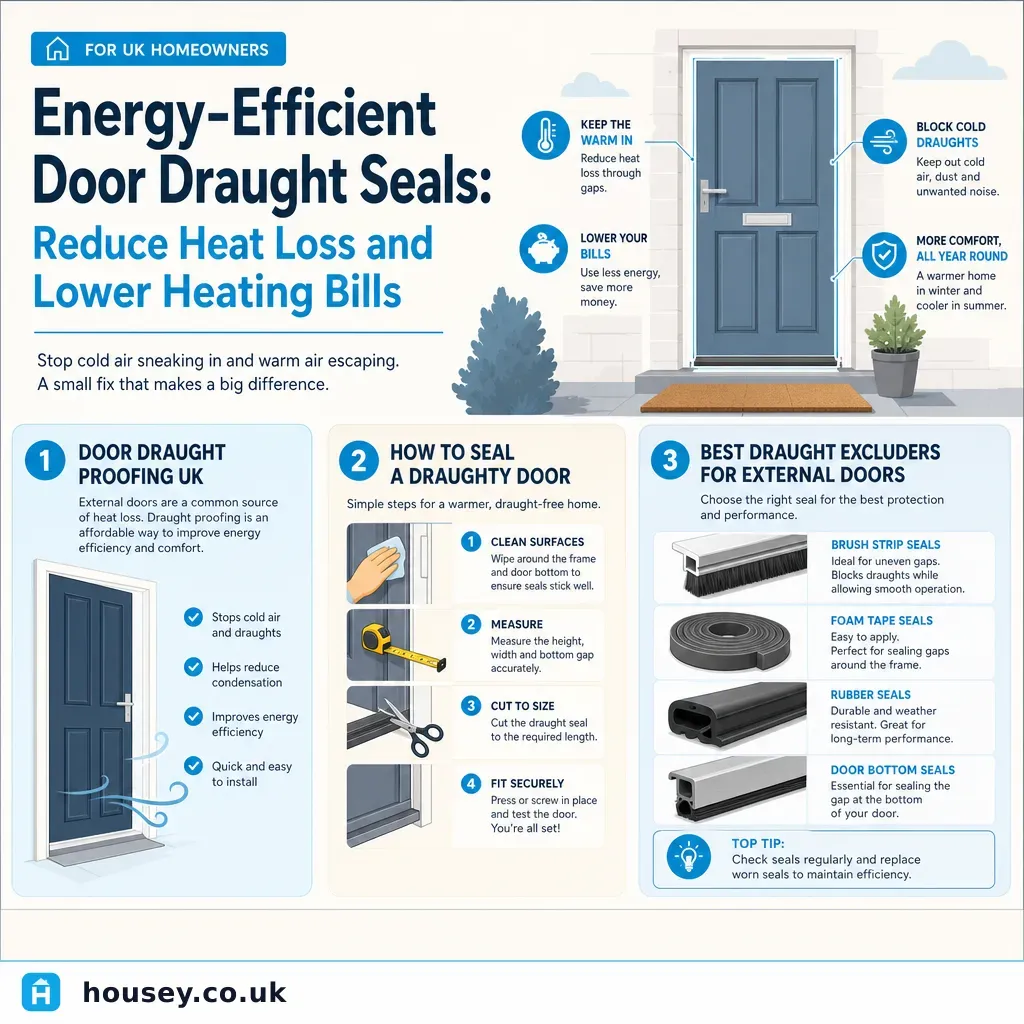
Energy-Efficient Door Draught Seals: Reduce Heat Loss and Lower Heating Bills
Door draught seals — brush strips, compression seals, threshold strips, and letterbox excluders — reduce heat loss through gaps in door frames.
 Energy & Retrofit
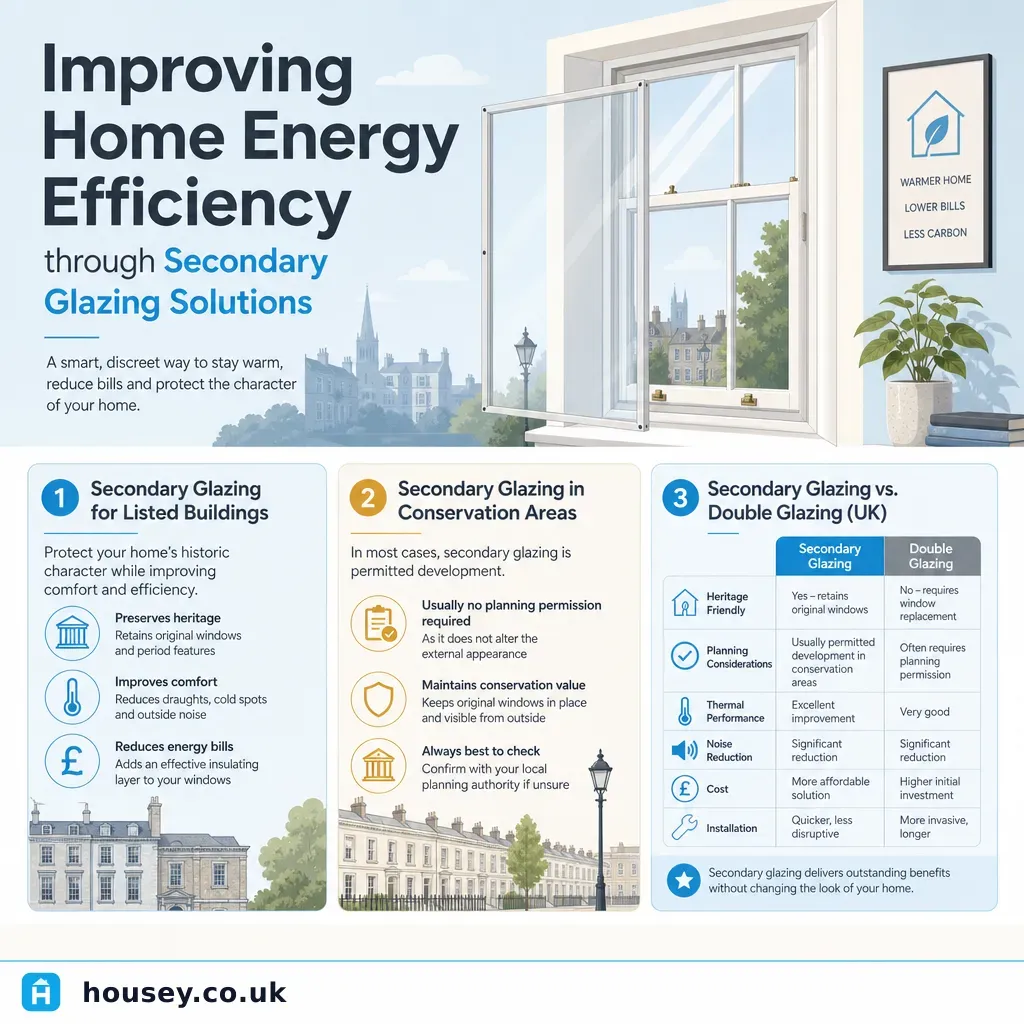
Improving Home Energy Efficiency through Secondary Glazing Solutions
Secondary glazing fits an additional pane inside your existing window reveal, reducing heat loss and noise without replacing the original frame.
 Energy & Retrofit
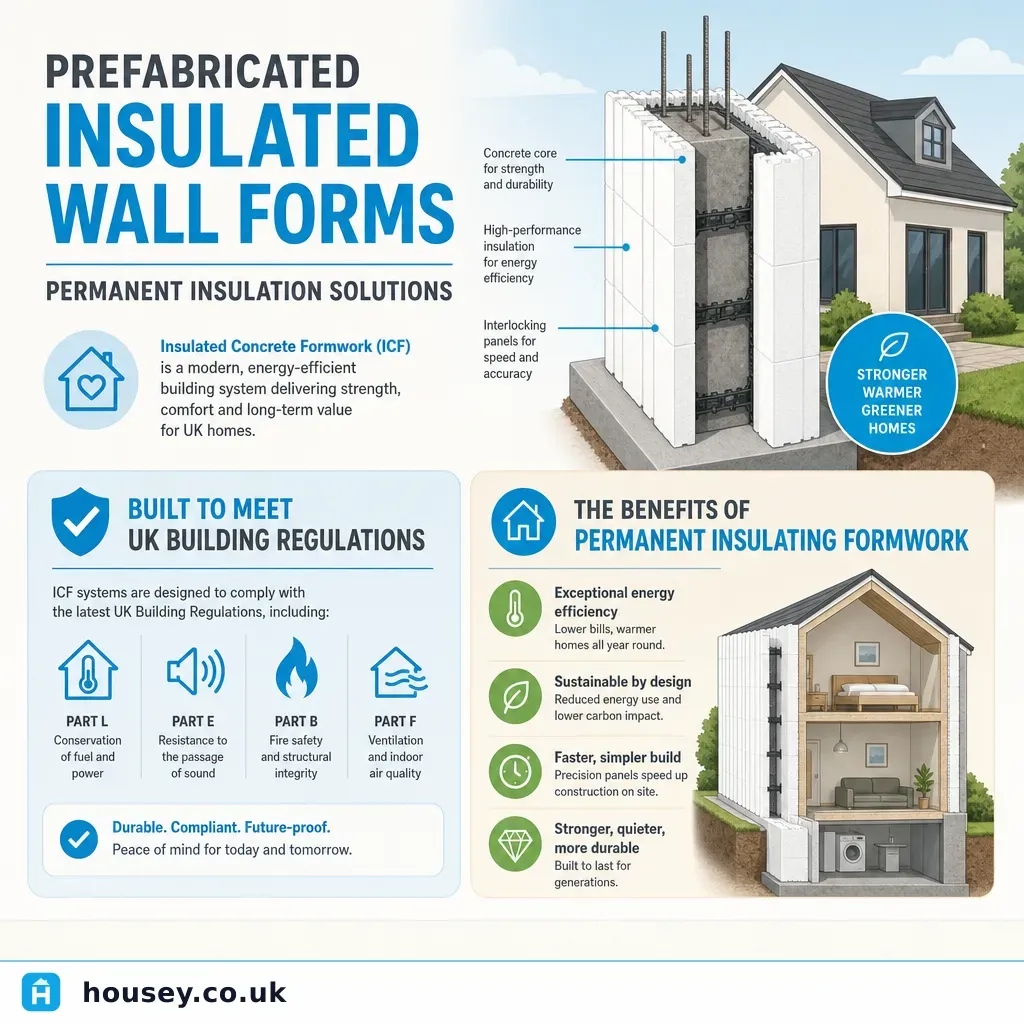
Prefabricated Insulated Wall Forms: Permanent Insulation Solutions
Prefabricated insulated wall forms — including ICF and SIPs systems — deliver high thermal performance by combining permanent insulation with structural concrete or timber in a single wall assembly.
 Energy & Retrofit
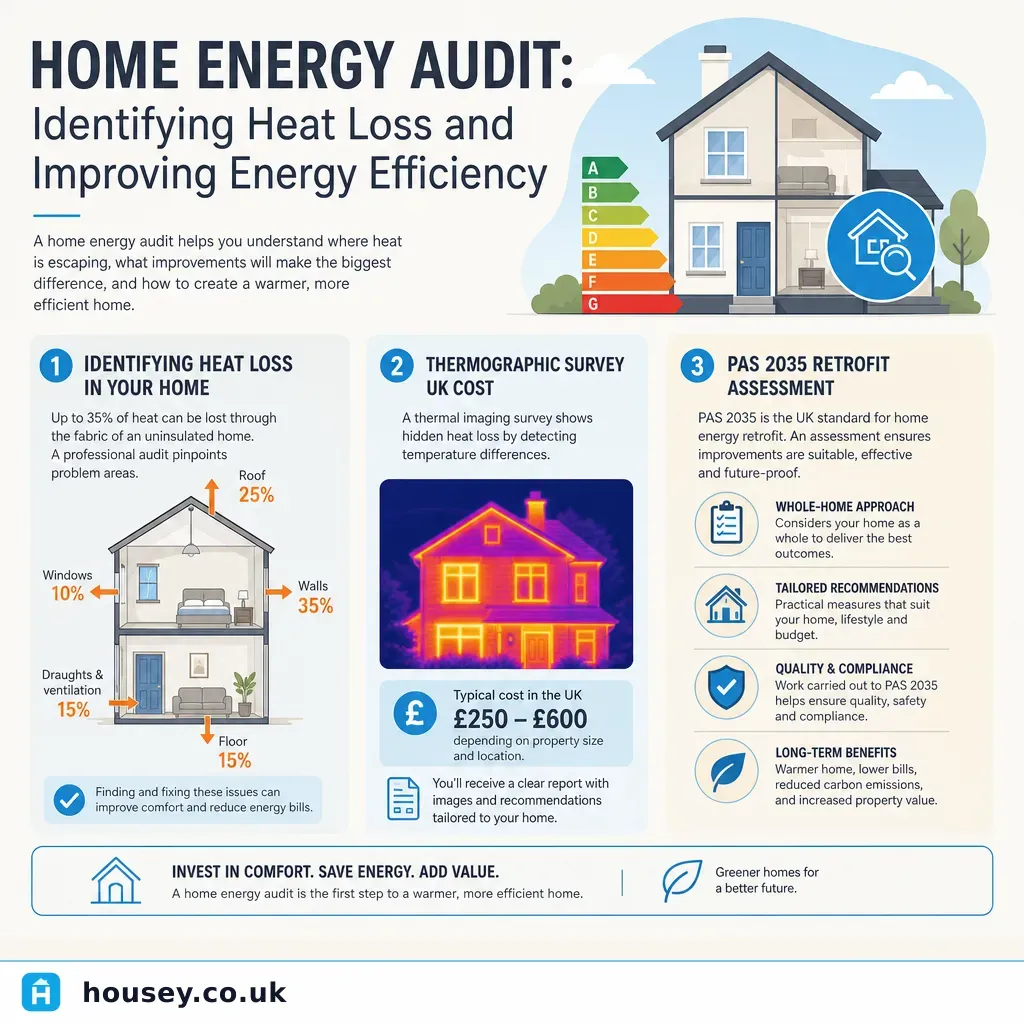
Home Energy Audit: Identifying Heat Loss and Improving Energy Efficiency
A home energy audit is a structured assessment of where your property loses heat and how efficiently it uses energy.
 Energy & Retrofit
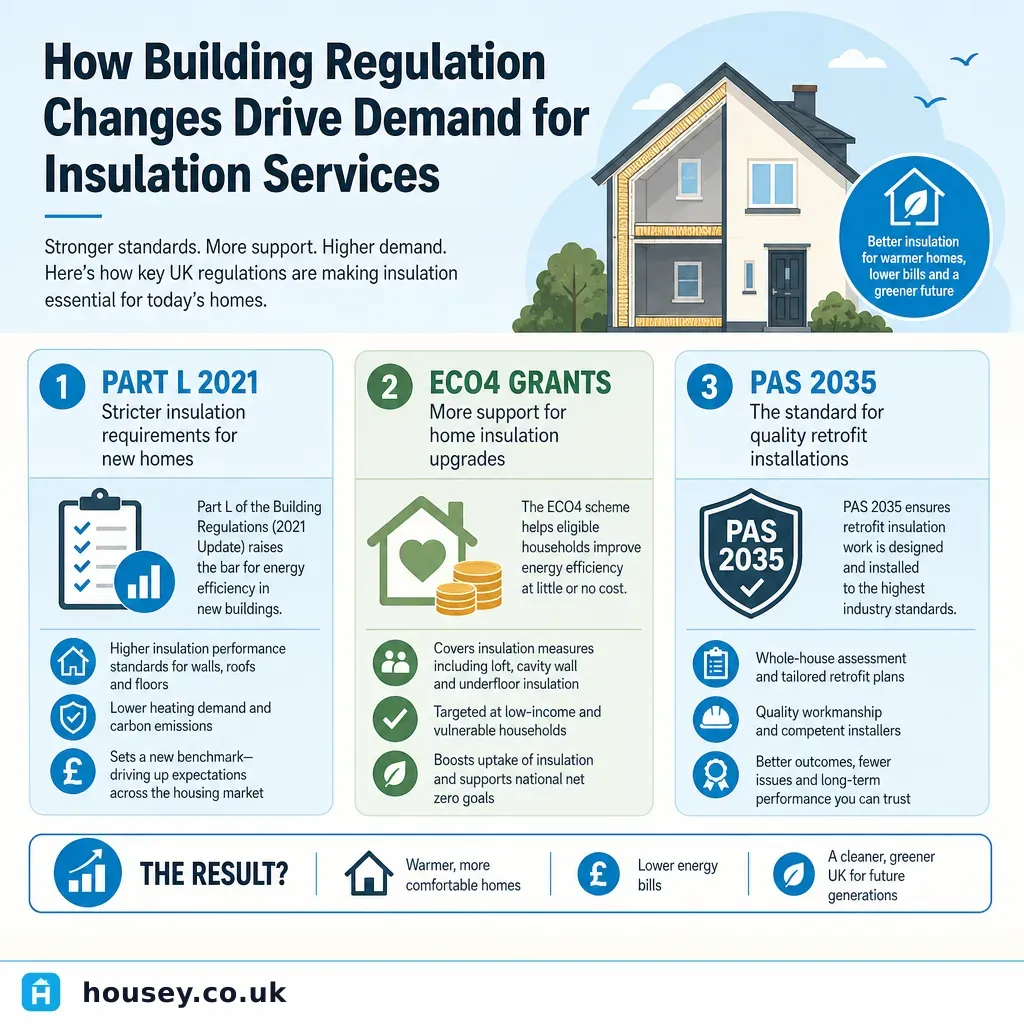
How Building Regulation Changes Drive Demand for Insulation Services
Building regulation changes — including 2021 updates to Approved Document L, ECO4 funding obligations, and proposed MEES tightening — are creating sustained demand for insulation services across the UK.