Professional Brick Cleaning and Restoration
By Housey · Last reviewed 5th of May 2026
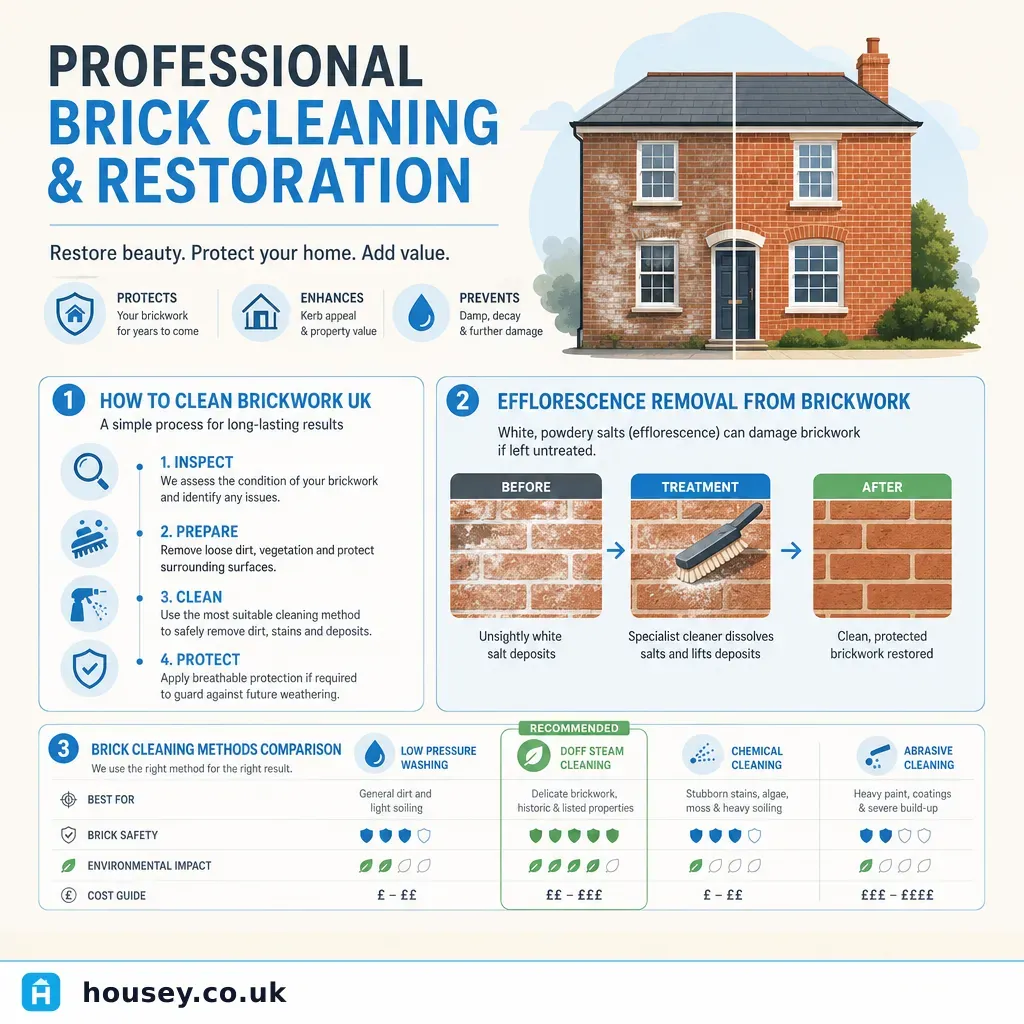
Professional Brick Cleaning and Restoration
Brickwork on UK homes accumulates decades of pollution, biological growth, and mineral deposits — particularly in urban and coastal locations. Homeowners often consider cleaning when preparing to sell, restoring a period property, or reversing the grime that builds up on south-facing and north-facing elevations alike. Choosing the wrong method can cause lasting damage to the brick face and mortar, so understanding the options before instructing a contractor matters.
Key points
- Chemical cleaning products must be matched to brick type; acid-based cleaners can damage soft Victorian and Edwardian handmade brickwork irreversibly.
- Efflorescence (white salt deposits) on UK brickwork usually indicates moisture movement within the wall, not just a surface issue.
- High-pressure washing above approximately 1,000 psi risks eroding mortar joints and softening the brick face on pre-1920 properties.
- Listed buildings and properties in conservation areas may require prior consent from the local planning authority before any external cleaning work begins.
- Re-pointing deteriorated mortar joints is often necessary after deep cleaning to restore weather resistance and prevent water ingress.
What professional brick cleaning involves
Professional brick cleaning is the controlled removal of staining, atmospheric deposits, efflorescence, algae, lichen, and mortar splashes from masonry without damaging the substrate. The process begins with a site assessment to identify brick type, mortar composition, and stain cause. A test patch — usually around 0.5 m² — is cleaned and inspected after drying before full work proceeds across the facade.
Restoration work goes further: re-pointing defective mortar joints, replacing spalled or damaged bricks with matching units, applying a breathable water-repellent treatment, or tinting stained areas to blend repairs with the surrounding masonry.
Choosing the right cleaning method
The correct approach depends on brick type, the age of the property, and what is causing the staining. No single method suits all situations.
Method | Best for | Not ideal for | Key risk |
|---|---|---|---|
Low-pressure chemical wash | Modern engineering bricks, dense Victorian stocks; heavy pollution staining | Soft handmade bricks; lime mortar joints | Chemical damage if wrong product used |
High-pressure water jetting | Recent-build dense brickwork; mortar splash removal | Pre-1920 properties; soft or friable bricks | Erosion of mortar and brick face |
Steam cleaning | Sensitive historic masonry; conservation-area properties | Large areas (slow and costly) | Operator skill-dependent results |
Poultice treatment | Localised deep stains — oil, rust, paint | Whole-facade cleaning | Time-intensive; unsuited to large areas |
Abrasive cleaning (TORC/JOS systems) | Gentle aggregate blast for historic buildings | Modern hard engineering bricks | Requires specialist operators |
For Listed Buildings, Historic England recommends consulting a conservation specialist before selecting any cleaning method.
Common UK brick staining problems
Efflorescence — the white, powdery or crystalline deposits that appear on brickwork — occurs when water moves through the wall, dissolves soluble salts, and deposits them on the surface as it evaporates. It is particularly common in new builds during their first two winters, and in older properties with defective flashings, gutters, or pointing. Brushing dry efflorescence off with a stiff brush is the usual first step. If it keeps recurring, ongoing moisture movement is the cause — cleaning alone will not resolve it.
Other common staining types on UK properties include:
- Atmospheric pollution deposits — black carbon staining on Victorian and Edwardian street-facing elevations.
- Biological growth — algae, lichen, and moss, especially on north-facing walls and in wetter regions.
- Mortar splashes from past pointing or building work.
- Rust staining from corroding wall ties or embedded metalwork.
- Paint or masonry sealant residues from previous treatments.
Red flags: when you need a professional, not a pressure washer
Several situations require professional assessment before any cleaning begins:
- Pre-1920 brickwork — soft handmade bricks and lime mortar are particularly vulnerable to pressure damage.
- Recurring staining despite previous cleaning — may signal active damp ingress, failed flashings, or rising damp.
- Spalling, crumbling, or friable brick faces — pressure or chemical cleaning will accelerate existing deterioration.
- Listed buildings or conservation areas — inappropriate methods can trigger enforcement action by the local planning authority.
- Extensive mortar joint failure — cleaning without re-pointing is cosmetic only and may worsen water ingress.
- Staining accompanied by interior damp patches — an independent damp survey should precede any cleaning work.
What to ask a brick cleaning contractor
Before accepting any quote, confirm the following with each contractor:
- What cleaning method do you recommend for this brick type, and why?
- Will you carry out a test patch and allow me to inspect it before full work proceeds?
- Are your operatives trained to CSCS standard and experienced with masonry of this age?
- What chemicals or equipment will you use, and are they appropriate for a property of this era?
- Will the work disturb mortar joints, and if so, what re-pointing is included?
- Is scaffolding or access equipment included in the price?
- What surface treatment, if any, do you recommend after cleaning?
- Is VAT included in your quote?
Indicative costs
Indicative UK costs, last reviewed 2026-05-05. Costs vary significantly by access requirements, brick type, extent of staining, and regional labour rates. Always obtain at least three written quotes before proceeding.
- Low-pressure chemical cleaning: approximately £8–£20 per m² of facade area.
- Steam cleaning (historic or conservation-area properties): approximately £15–£35 per m².
- Poultice treatment for localised staining: approximately £200–£600 per treatment area.
- Re-pointing after cleaning: approximately £35–£60 per m², depending on mortar type and joint depth.
Source: indicative ranges compiled from UK contractor pricing guides; individual quotes will vary.
When to get professional help
If your brickwork shows structural cracking, active water ingress, or significant mortar failure, arrange a structural or damp inspection before cleaning begins. Cleaning deteriorated brickwork without addressing the underlying cause is unlikely to provide lasting results and may obscure defects from future buyers or surveyors. A chartered building surveyor (RICS) can assess masonry condition and advise on the correct sequence of remedial works. Any cracking that is widening or stepped through brickwork should be inspected by a structural engineer before any facade work starts.
How Housey can help
Housey connects UK homeowners with vetted contractors for property maintenance and restoration work. If you are considering professional brick cleaning or facade restoration, use Housey to request quotes from local specialists, compare their recommended methods and pricing, and check their experience with properties of a similar age and construction before committing to any work.
Frequently asked questions
Can I clean brick myself with a pressure washer?
On modern, dense, machine-made brickwork in good condition, low-pressure washing below approximately 1,000 psi may be acceptable. However, on pre-1920 properties, soft handmade bricks, or brickwork with lime mortar joints, pressure washing risks irreversible damage. If in doubt, have a professional assess the brick type before hiring equipment.
How often does brickwork need professional cleaning?
There is no fixed schedule — it depends on location, aspect, and brick type. Urban properties in polluted areas may benefit from cleaning every 10–20 years. Biological growth on north-facing walls can recur every 3–5 years in wetter UK regions. Applying a breathable water-repellent treatment after cleaning may slow recontamination.
Do I need planning permission to clean my brickwork?
In most cases, no. However, if your property is listed or in a conservation area, check with your local planning authority before any external cleaning, as some methods may require consent. Inappropriate cleaning of a listed building can be an offence under the Planning (Listed Buildings and Conservation Areas) Act 1990.
What is efflorescence and can it be removed permanently?
Efflorescence is the white powdery deposit that appears when water moves through masonry, dissolves salts, and deposits them on the surface as it evaporates. Surface deposits can be brushed or washed off, but recurring efflorescence indicates ongoing moisture movement that cleaning alone will not resolve. The underlying moisture source must be identified and addressed.
What is the difference between brick cleaning and brick restoration?
Cleaning removes surface deposits such as staining, algae, and pollution. Restoration addresses underlying deterioration: replacing spalled bricks, re-pointing defective mortar, repairing lintels or weatherings, and applying protective treatments. Most professional restoration programmes include cleaning as the first stage, followed by repairs suited to the property's age and construction.
Sources and further reading
- Practical Building Conservation: Stone and Masonry — Historic England
- Planning (Listed Buildings and Conservation Areas) Act 1990 — legislation.gov.uk
- Work at Height Regulations 2005 — Health and Safety Executive
- RICS Building Survey guidance — Royal Institution of Chartered Surveyors
Useful next reads
 Improvement & Build
Driveway Cleaning and Surface Maintenance Costs
Professional driveway cleaning in the UK typically costs £100–£300 for pressure washing an average single driveway, rising to £300–£600 if block paving sealing and re-jointing are included.
 Improvement & Build
Exterior Painting for Your Home
Exterior painting protects your home from the UK's wet climate and can significantly boost kerb appeal.
 Improvement & Build
Window cleaning costs: what to budget
Window cleaning in the UK typically costs £5–£15 per visit for a small terraced house and £15–£40 or more for a larger detached property, depending on the number of windows, access difficulty, and frequency.
 Improvement & Build
Maintaining And Caring For Thatched Properties
A thatched roof needs inspection by a master thatcher every one to two years, with ridge replacement every 10–15 years and a full re-thatch every 25–40 years depending on the material.
 Improvement & Build
Protecting Your Property from Winter Frost and Freeze Damage
Protecting your home from winter frost damage mainly involves insulating exposed pipes, lagging outdoor taps, maintaining a minimum indoor temperature in unoccupied properties, and clearing drains before cold spells.