Professional Installation of Asphalt Roof Shingles: Best Practice Standards
By Housey · Last reviewed 1st of June 2026
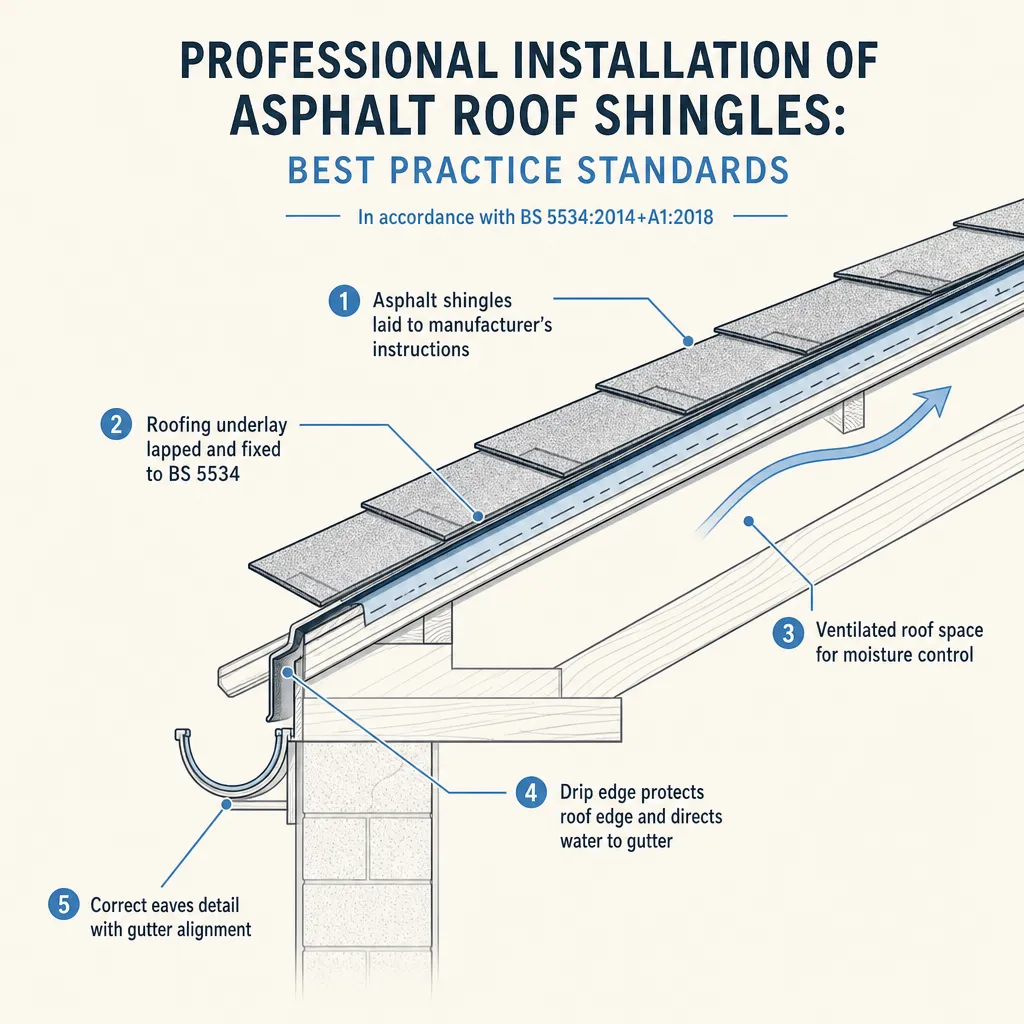
Professional Installation of Asphalt Roof Shingles: Best Practice Standards
Asphalt (bitumen) strip shingles are a recognised roofing material in the UK, available from manufacturers including IKO and Tegola and used on residential properties, garages, extensions, and outbuildings. Although clay tiles, concrete tiles, and natural slate remain the dominant pitched-roof coverings across England and Wales, shingles offer a cost-effective and relatively lightweight alternative for certain roof types, pitches, and structures. Choosing a qualified installer and understanding what a compliant installation looks like is essential — a poorly specified or executed roof can fail within a few years, void the product warranty, and allow water ingress that causes serious structural damage below.
Key points
- BS 5534:2014+A2:2018 is the British Standard for pitched roof slating and tiling, including bitumen (asphalt) shingles; it specifies underlay selection, batten gauge, nail fixing patterns, and wind uplift requirements.
- All work on a roof must comply with the Work at Height Regulations 2005 — professional installers must use scaffolding or an approved working platform, not ladders alone for a full re-roofing project.
- Breathable (vapour-permeable) underlay is required under BS 5534 for most modern installations; traditional impermeable bitumen felt is no longer appropriate for new work.
- Re-roofing a dwelling may require notification to Building Control as a controlled service under Building Regulations — check with your local authority or approved inspector before starting.
- Most asphalt shingle products carry 20–50 year manufacturer warranties, which are typically voided if installation does not comply with both the manufacturer's guide and BS 5534.
Are asphalt shingles right for a UK roof?
Asphalt strip shingles suit pitched roofs of approximately 17.5° or above (specific minimum pitches vary by product; always verify against the manufacturer's installation guide). They are lighter than clay or concrete tiles, which can make them appropriate for roof structures not designed to carry heavier coverings.
Asphalt shingles are less commonly specified in much of England than in Scotland and Northern Ireland, and local planning authorities or conservation area officers may have preferences regarding appearance. If the property is listed or in a conservation area, seek planning advice before specifying a shingle roof — material choices on a principal elevation can affect permitted development rights.
Asphalt shingles versus other UK pitched roof coverings
Material | Typical lifespan | Indicative installed cost (per m²) | Min. pitch | Approx. weight | Key limitation |
|---|---|---|---|---|---|
Bitumen/asphalt strip shingles | 20–40 years | £25–£55 | 17.5° | 8–14 kg/m² | Less common; possible planning or visual restrictions |
Concrete interlocking tiles | 30–50 years | £30–£65 | 12.5° | 40–50 kg/m² | Heavy; requires adequate roof structure |
Clay plain tiles | 60–100+ years | £50–£120 | 35° | 60–80 kg/m² | Steep pitch required; higher cost |
Natural slate | 80–150 years | £60–£150 | 20° | 25–35 kg/m² | Cost; specialist fixing skills required |
Fibre cement slates | 30–50 years | £35–£75 | 15° | 20–25 kg/m² | Less traditional in appearance |
Indicative UK costs, last reviewed 2026-06-01. Prices vary significantly by region, roof complexity, access requirements, and contractor. Obtain at least three quotes.
UK standards and regulatory requirements
BS 5534:2014+A2:2018 sets minimum requirements for pitched roof work, including:
- Underlay specification: breathable, vapour-permeable underlay is required unless the roof design incorporates a vented cold roof with adequate cross-ventilation
- Batten gauge: the centre-to-centre batten spacing must match the shingle's headlap requirement as set out in the manufacturer's instructions
- Nail fixing: a minimum of two nails per shingle is required; nail length, material (hot-dip galvanised or stainless steel), and pattern must match the specification
- Wind uplift: calculations may be required for exposed locations, referencing BS EN 1991-1-4 for wind loads
For dwellings, re-roofing can constitute a material alteration under Building Regulations if it affects structural integrity or weathertightness. Approved Document A (structure) and Approved Document C (site preparation and resistance to moisture) are relevant. Some local authority building control bodies require notification even for like-for-like replacement — verify before starting.
Under the Work at Height Regulations 2005, all roof work must be properly planned, supervised, and carried out using appropriate equipment. A professional roofer should arrive with scaffolding or a scaffold tower — edge protection on a ladder alone is not sufficient for a full re-roofing project.
What professional installation involves
A properly managed shingle roofing project typically follows this sequence:
- Roof survey: the installer inspects the existing deck, battens, sarking boards, and rafter structure before specifying the replacement system
- Scaffold erection: edge protection or full scaffold is erected before any work begins at roof level
- Strip and dispose: old covering, underlay, and battens are stripped; waste is disposed of legally via a skip or licensed waste carrier
- Structural inspection and repair: rafters and any timber deck are checked; damaged or rotten timber is replaced before the new covering is applied
- Breathable underlay installation: underlay is fixed horizontally from eave to ridge with minimum 150mm side laps and 100mm head laps, per BS 5534
- Batten installation: pressure-treated timber battens are fixed at the specified gauge
- Shingle installation: a starter strip is applied at the eave; shingles are laid in staggered courses working upward; nails are driven through the adhesive strip zone per the product guide
- Flashings and details: lead or approved alternative flashings are formed at abutments, valleys, chimneys, and any roof penetrations
- Check and sign-off: completed work is verified against the manufacturer's installation guide; Building Control inspection is arranged if required
What to ask before accepting a quote
- Is the quote based on a physical inspection of the existing roof structure, or a remote estimate from the ground?
- Which underlay specification will be used, and does it comply with BS 5534?
- What nail type, length, and fixing pattern will be used for this product?
- Will the work be carried out from full scaffold, a scaffold tower, or from ladders only?
- Are strip-out and waste disposal included, and will a licensed waste carrier be used?
- What is the manufacturer's warranty period for the specified product, and will warranty documentation be provided at completion?
- Will Building Control be notified if it is required for this property?
- Is public liability insurance in place — can you provide a copy of the certificate?
- Is VAT included in the quoted price?
- What is the payment schedule — be cautious of contractors requesting full payment before work begins?
Red flags during and after installation
Watch for these signs that an installation may not meet best practice:
- No scaffolding: working from a ladder alone on a full re-roof suggests non-compliance with the Work at Height Regulations 2005
- No structural inspection: beginning to lay new materials immediately without checking the deck or battens below
- Impermeable felt underlay: use of traditional black bitumen felt where breathable underlay is required by the current specification
- Incorrect nail placement: nails driven through the tab face of the shingle rather than through the specified adhesive strip zone per the product guide
- Misaligned courses or visible gaps: poor alignment reduces weather resistance and wind uplift performance
- Makeshift flashings: mortar fill at a chimney abutment instead of properly formed stepped lead or an approved alternative product
- No written documentation: a legitimate contractor provides a written quote, invoice, and warranty certificate at completion
When to get professional help
Always use a qualified, insured roofing contractor for roof replacement or re-roofing work. Working above 2m carries a serious fall risk — this is not work to undertake as DIY. If you notice any of the following after installation, ask the contractor to return before making final payment:
- Water ingress observed internally within weeks of the new roof being completed
- Shingles lifting or curling at the edges, which may indicate incorrect nail placement or insufficient fixing
- Missing shingles after the first significant wind event
- Daylight visible through the roof when inspecting from inside the loft
If a contractor is unresponsive to concerns, check whether they are a member of the National Federation of Roofing Contractors (NFRC) — this organisation operates a dispute resolution process for member firms.
How Housey can help
Housey connects homeowners with vetted, insured professional roofers who can carry out bitumen shingle installation to BS 5534 standards. Submit your job details, compare quotes, and review contractor profiles before appointing anyone to work on your roof.
Frequently asked questions
Do asphalt shingles need planning permission in the UK?
In most cases, replacing a roof covering on a standard residential property falls within permitted development rights and does not require a planning application. Exceptions apply for listed buildings, properties in conservation areas, and situations where a change of material would significantly alter the appearance of a principal elevation. Check with your local planning authority if you are uncertain.
How long do asphalt shingles last in the UK climate?
Most bitumen shingle products are rated for 20 to 40 years under UK conditions, though actual lifespan depends on the product grade, installation quality, roof pitch, and local exposure to wind and rain. Higher-specification laminated or architectural shingles typically carry longer manufacturer warranties than standard three-tab strip shingles.
Can asphalt shingles be installed over existing roof tiles?
In most cases, no. Best practice requires stripping the existing covering to inspect the structure below before any new roof covering is applied. Overlaying adds dead load and conceals potential defects. Some products permit installation over a sound timber deck, but the structure must first be assessed by the installer. Any contractor proposing to overlay without inspecting the existing deck warrants further questioning.
What is the minimum roof pitch for asphalt shingles in the UK?
Manufacturers' minimum pitch recommendations typically range from 17.5° to 20° for standard strip shingles. Below this threshold, rainwater can track back under the shingle tabs in driving rain or high winds. Always verify the specific product's installation guide and cross-reference with BS 5534 requirements for your location's wind exposure zone.
Sources and further reading
- BS 5534:2014+A2:2018 — Slating and tiling for pitched roofs and vertical cladding — BSI Group
- Work at Height Regulations 2005 — legislation.gov.uk
- Approved Document A: Structure — GOV.UK
- National Federation of Roofing Contractors: find a member — NFRC
- Planning Portal: permitted development for householders — Planning Portal
Useful next reads
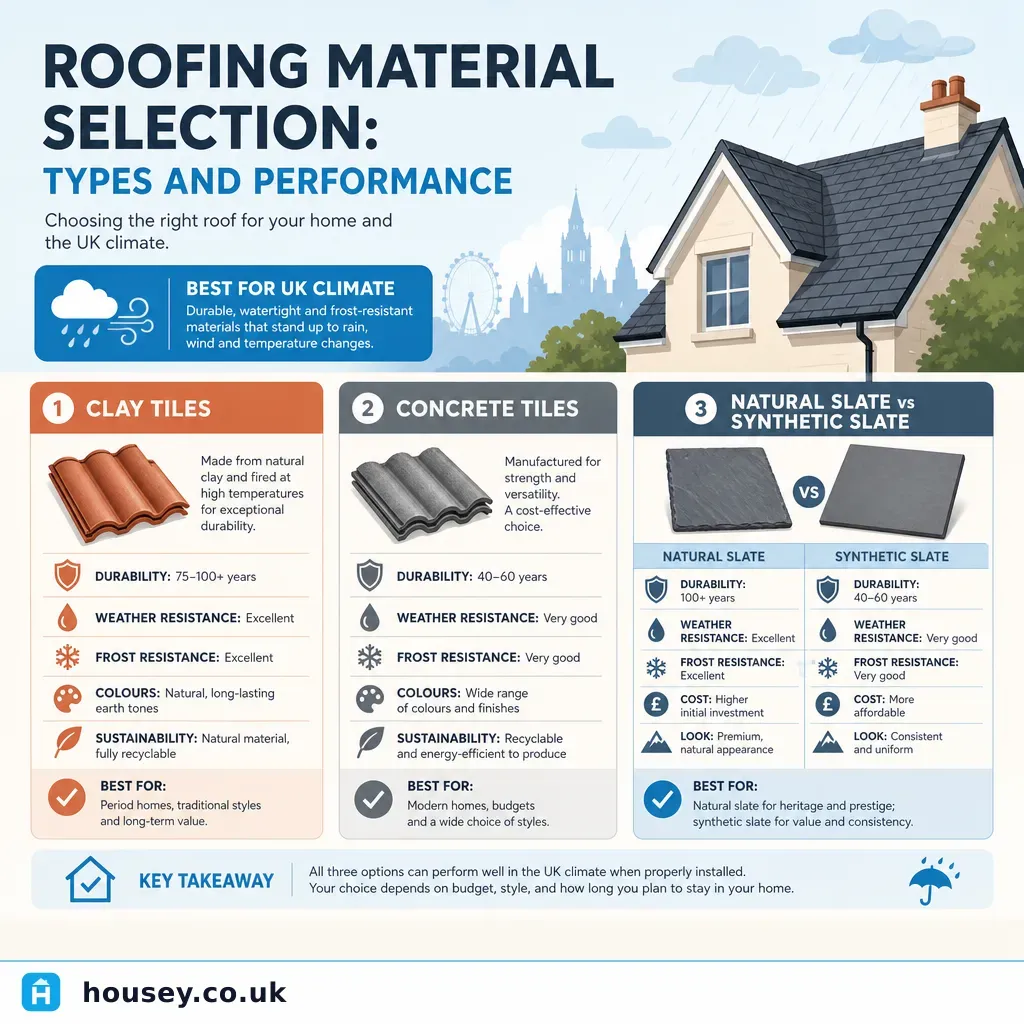 Improvement & Build
Roofing Material Selection: Types and Performance
The right roofing material depends on your roof pitch, property type, local planning requirements, and budget.
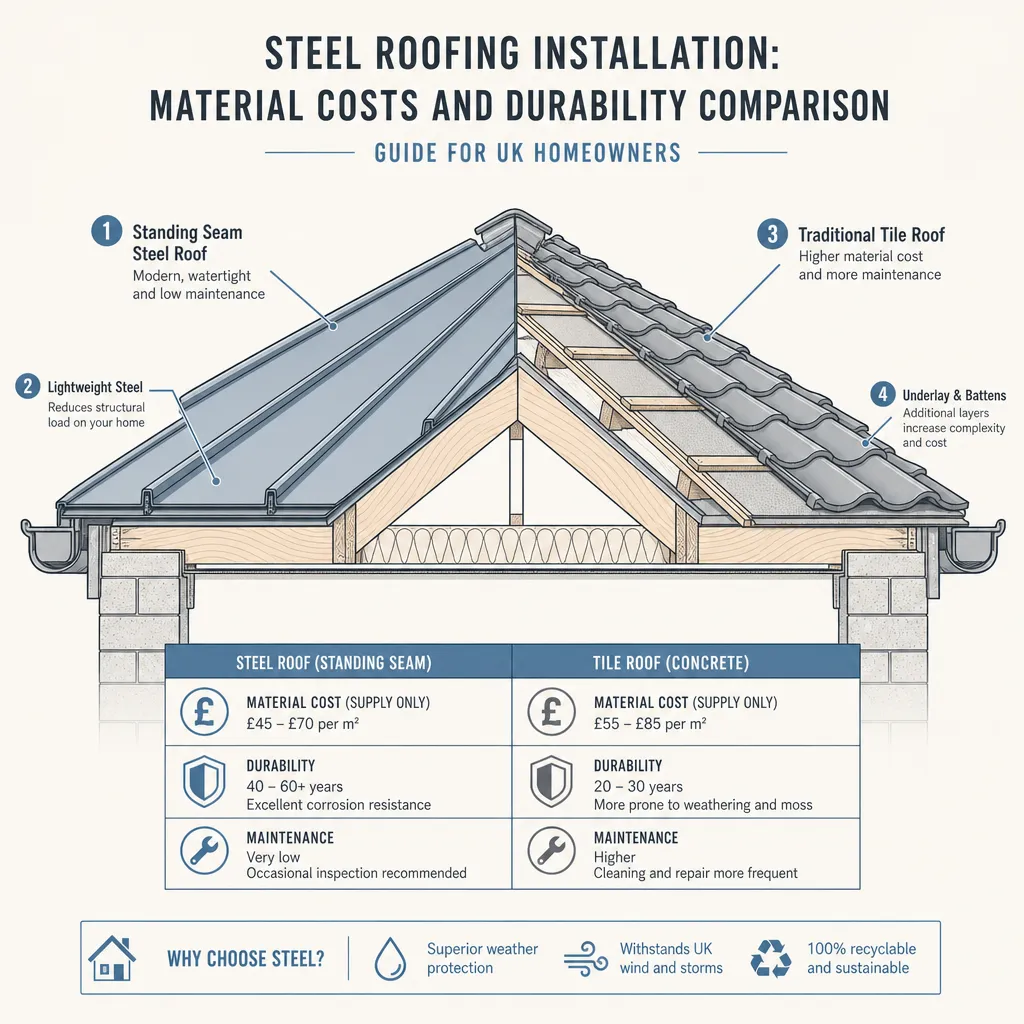 Improvement & Build
Steel Roofing Installation: Material Costs and Durability Comparison
Steel roofing comes in three main types for UK homes: standing seam (best for low-pitch contemporary roofs, 40–60 year lifespan), composite metal tile (traditional appearance), and corrugated sheet (outbuildings).
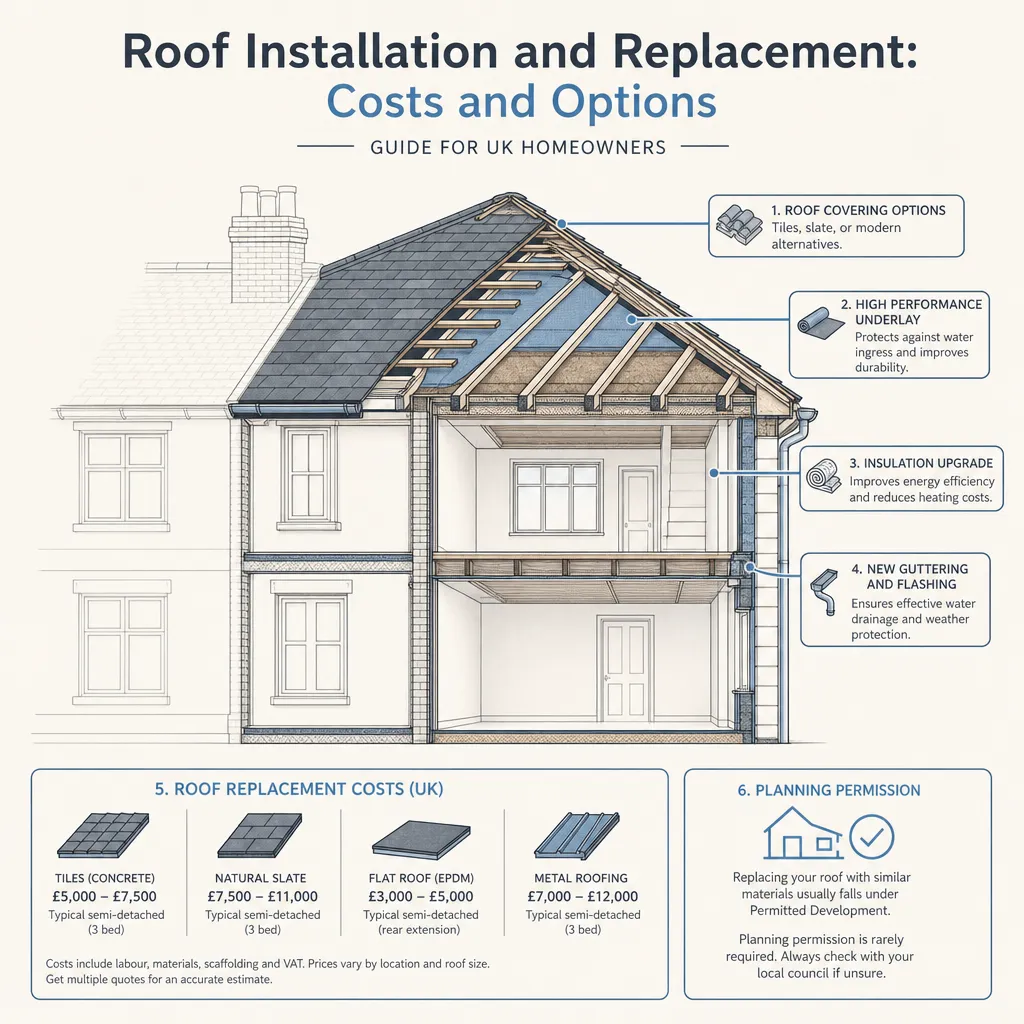 Improvement & Build
Roof Installation and Replacement: Costs and Options
A full pitched roof replacement on a UK semi-detached house typically costs £5,000–£12,000 depending on materials, roof complexity, and structural condition.
 Improvement & Build
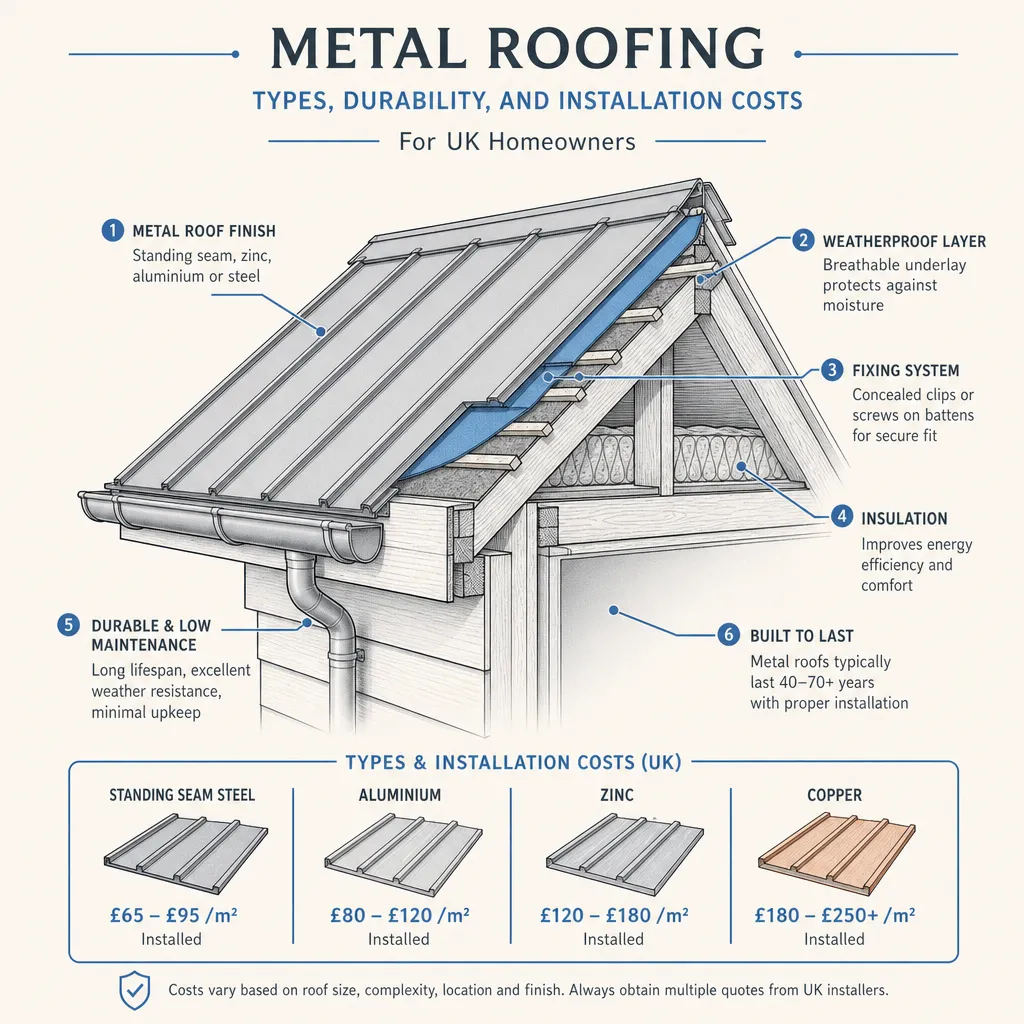
Metal Roofing: Types, Durability, and Installation Costs
Metal roofing in the UK includes standing seam, corrugated sheet, and metal tile systems in steel, aluminium, zinc, or copper.
 Improvement & Build
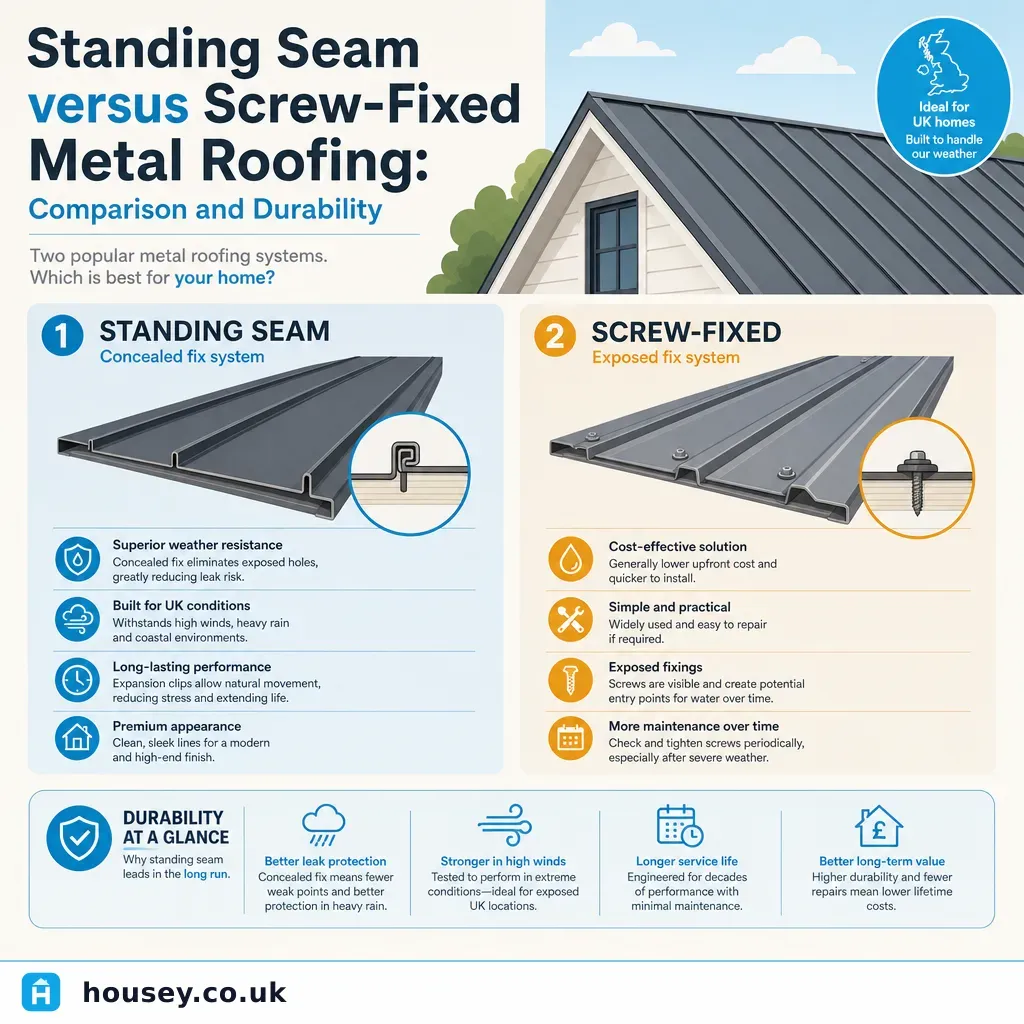
Standing Seam versus Screw-Fixed Metal Roofing: Comparison and Durability
Standing seam uses concealed clips to hold panels, keeping all fasteners out of the weatherline and giving a design life of 40–60 years or more.