Steel Roofing Installation: Material Costs and Durability Comparison
By Housey · Last reviewed 24th of May 2026
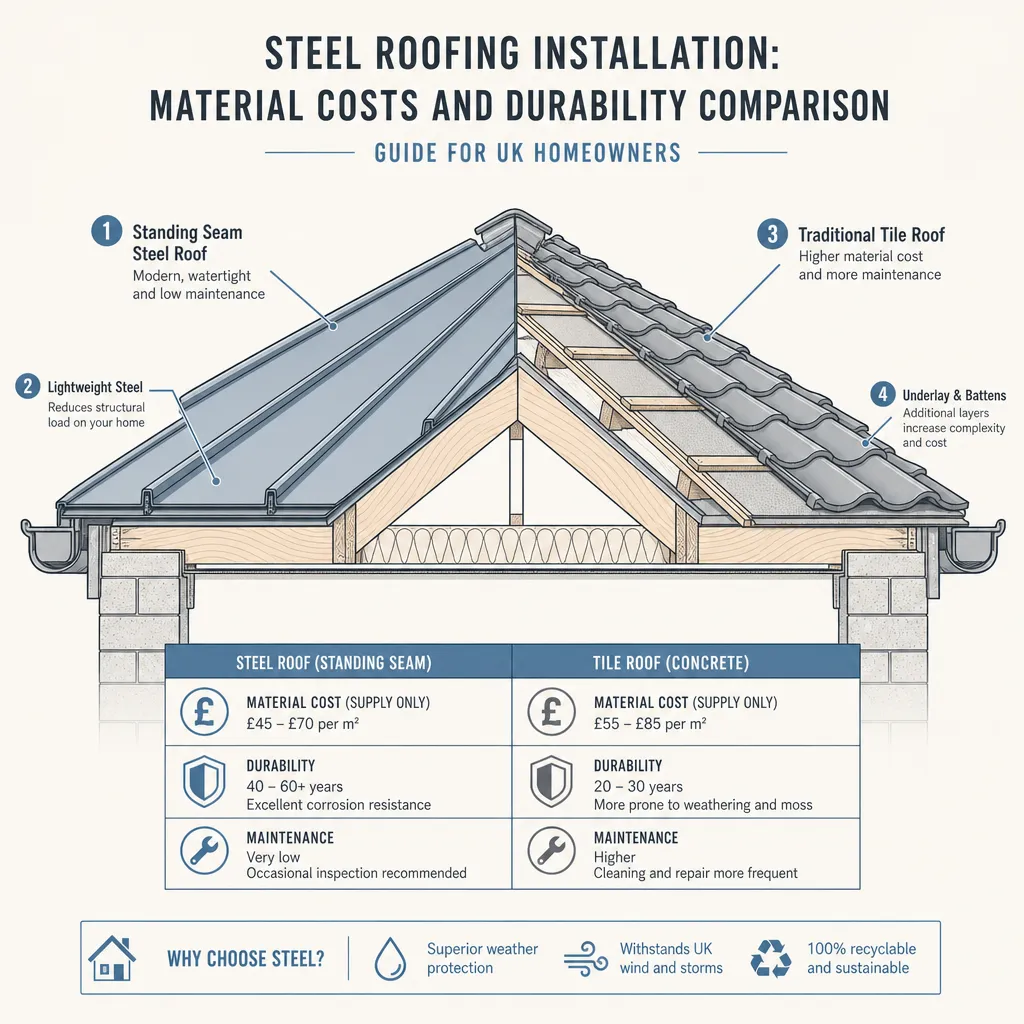
Steel Roofing Installation: Material Costs and Durability Comparison
Reroofing decisions are rarely straightforward, and steel is increasingly being specified for domestic extensions, new-build projects, outbuildings, and full reroof jobs on flat or low-pitch roofs where traditional tiles would not drain properly. Questions about cost, lifespan, and suitability commonly arise during the planning stage, when sourcing a roofing contractor, or after encountering steel roofing on a neighbouring conversion or barn development.
Key points
- Standing seam steel roofing typically carries a manufacturer-stated lifespan of 40–60 years; galvanised corrugated steel sheet may last 25–40 years depending on coating specification and exposure level.
- Building Regulations Part L (conservation of fuel and power) applies to all roofing work on existing UK dwellings — insulation requirements must be addressed alongside the choice of roof covering.
- Indicative supply-and-fit costs for standing seam steel roofing range from approximately £80–£150 per m² depending on profile, gauge, and roof complexity (Indicative UK costs, last reviewed 2026-05-24).
- Most factory-coated steel roofing systems achieve a non-combustible Class A1 or A2 fire classification under BS EN 13501-1 — an advantage where fire performance is specified as a planning condition.
- Planning permission may be required if steel roofing changes the appearance of a principal elevation or falls outside permitted development rights — check with your local planning authority before proceeding.
What types of steel roofing are available in the UK?
Steel roofing systems used in UK domestic and light-commercial construction fall broadly into three categories.
Standing seam — interlocking steel panels with concealed fixings, typically used on low-pitch roofs (down to 1–3°) on contemporary homes, extensions, and barn conversions. This is the premium end of the steel roofing market and delivers excellent weather performance and a clean contemporary aesthetic suitable for residential use.
Corrugated and trapezoidal sheet — traditional profiled steel, most common on agricultural buildings, garages, and outbuildings. Lower cost but less suited to primary residential roofs unless a contemporary industrial appearance is intended by the designer or is acceptable to the local planning authority.
Composite metal tile — pressed or stone-chip coated steel tiles designed to replicate the appearance of clay, slate, or cedar shingles. A middle-ground option used where planning conditions require a more traditional roof appearance, or where the existing structure was designed for tile loads.
Each system has different requirements for battens, insulation, vapour control layers, and fixings — the correct specification should be agreed with a qualified roofing contractor before ordering materials.
How does steel compare with other common roofing materials?
Material | Typical lifespan | Indicative cost (supply and fit, per m²) | Minimum pitch | Fire class | Planning notes |
|---|---|---|---|---|---|
Standing seam steel | 40–60 years | £80–£150 | 1–3° | Class A1/A2 | Check if appearance change needs permission |
Concrete interlocking tile | 30–50 years | £40–£70 | 17.5° | Class A1 | Usually permitted development |
Clay plain tile | 60–100 years | £60–£100 | 35–45° | Class A1 | May be required in conservation areas |
EPDM rubber membrane | 25–50 years | £30–£60 | Flat to 10° | Varies by product | Common for flat-roof extensions |
GRP fibreglass | 25–40 years | £35–£65 | Flat | Varies by product | Common for porches and dormers |
Indicative UK costs, last reviewed 2026-05-24. Figures vary by region, roof complexity, access, and contractor. Obtain at least three quotes before instructing.
Steel's primary advantages over tiles are its suitability for low-pitch applications, long product warranties, and non-combustible classification. Its main limitations are higher upfront cost compared with entry-level tiles, potential for noise in heavy rain if underlay and insulation are inadequate, and possible planning constraints in conservation areas or on listed buildings.
How much does steel roofing cost in the UK?
Cost varies significantly by the system chosen, roof area, pitch, complexity, access requirements, and the contractor's region.
Indicative UK cost ranges (supply and fit, last reviewed 2026-05-24):
- Corrugated steel sheet (outbuilding or agricultural): £20–£45 per m²
- Composite metal tile: £50–£100 per m²
- Standing seam steel (domestic): £80–£150 per m²
- Insulated panel systems (warm roof): £90–£180 per m²
These figures exclude scaffolding (which may add £1,000–£3,000 or more depending on height and access difficulty), structural repairs, disposal of existing roof covering, and VAT at 20%.
What to ask when getting quotes
- Is the quote based on a full site survey or measurements only?
- Does it include removal and disposal of the existing roof covering?
- What steel grade, gauge, and coating specification is being supplied?
- What warranty covers materials, and is the installer an approved contractor for that manufacturer?
- Is VAT included in the quoted price?
- What allowance is made for structural repairs discovered during works?
- What insulation specification will meet Part L of the Building Regulations for this roof type?
Which steel roofing system should you choose?
- Choose corrugated or trapezoidal steel sheet if the roof is on an outbuilding, garage, or agricultural structure where cost is the primary consideration and appearance is secondary.
- Choose composite metal tile if planning conditions require a traditional tile appearance, or if the existing roof structure was designed for tile loads and cannot be readily strengthened.
- Choose standing seam if the roof has a low pitch and requires a long-term, low-maintenance solution — particularly for contemporary extensions, barn conversions, or new-build roofs where tiles are not appropriate.
- Consult a structural engineer if there is any doubt about whether the existing roof structure can carry the new system, particularly on older or modified properties.
- Check with your local planning authority before specifying steel on a front elevation or within a conservation area — permitted development allows like-for-like replacements but not always material changes.
How long does steel roofing last, and what maintenance is needed?
Factory-coated standing seam steel systems typically carry 30–40 year manufacturer warranties on finish and 25 years on weathertightness when installed by an approved contractor. With correct installation, lifespans of 40–60 years are commonly achievable.
Maintenance requirements are relatively low compared with tiled roofs:
- Carry out an annual inspection of flashings, gutters, and any penetrations such as rooflights or vents.
- Check the coating for surface damage — scratches or unprotected cut edges can allow corrosion to develop gradually if left untreated.
- Clear debris accumulation from valleys or around penetrations to prevent ponding water.
Galvanised corrugated steel on outbuildings may require recoating or replacement of fixings every 15–20 years, depending on exposure level and proximity to the coast.
When to get professional help
Steel roofing installation is not suitable as a DIY project. Working at height above 2 m, handling large metal panels, and achieving correct flashings all require trained operatives with appropriate equipment and insurance.
Seek professional advice if:
- You are unsure whether the roof structure can carry the proposed steel system without strengthening works.
- The property is listed or in a conservation area — a planning officer or heritage consultant may need to approve the specification before work begins.
- The existing roof shows signs of rot, sagging, or structural movement — these must be assessed and addressed before any new covering is installed.
- The roof covers a habitable room and you are uncertain whether the proposed insulation meets Part L of the Building Regulations.
How Housey can help
Housey connects homeowners with vetted, local roofers who can survey your roof, recommend the appropriate steel system, and provide itemised, comparable quotes. Use Housey to check contractor credentials and compare pricing before instructing anyone to start work.
Frequently asked questions
Does steel roofing need planning permission?
Like-for-like roof replacements are usually permitted development in England, but if the material change alters the appearance of a principal elevation, or the property is in a conservation area or is listed, planning permission may be required. Always confirm with your local planning authority before proceeding with any work that changes the external appearance of your roof.
Is steel roofing noisy in the rain?
Without adequate insulation and acoustic underlay, steel roofing can transmit more rain noise than tiled roofs. Modern standing seam systems with rigid insulation and breather membrane significantly reduce this effect. Properly insulated warm-roof installations are generally comparable to tiled alternatives in acoustic performance during heavy rainfall.
Can steel roofing be installed over existing tiles?
In some cases a steel system can be installed over existing tiles if the structure can carry the combined load — a structural assessment is needed before proceeding. Removing the existing covering is usually preferable to allow proper inspection of the structure and to ensure compliance with Building Regulations requirements.
What is the VAT rate on steel roofing installation?
New-build roofing is zero-rated for VAT. Repair, maintenance, and improvement work on existing dwellings is typically charged at 20% VAT, though some energy-saving materials and installation may qualify for reduced rates. Confirm the applicable rate with your contractor and check GOV.UK for current guidance on VAT on construction services.
Sources and further reading
- Building Regulations Approved Document L — GOV.UK, conservation of fuel and power requirements for roofing work
- Planning Portal: roof alterations and permitted development — Planning Portal
- HSE: working at height regulations — Health and Safety Executive
- BS EN 13501-1 fire classification for construction products — BSI Group
Useful next reads
 Improvement & Build
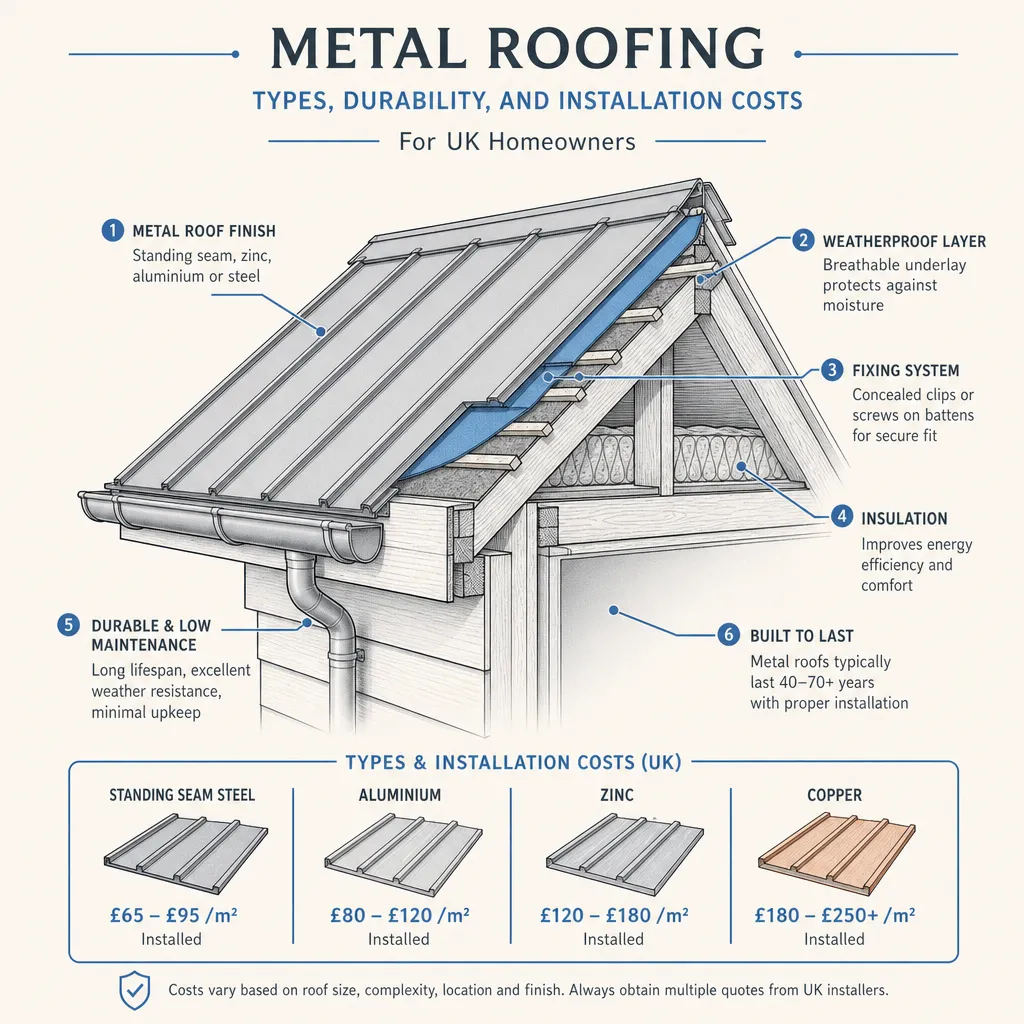
Metal Roofing: Types, Durability, and Installation Costs
Metal roofing in the UK includes standing seam, corrugated sheet, and metal tile systems in steel, aluminium, zinc, or copper.
 Improvement & Build
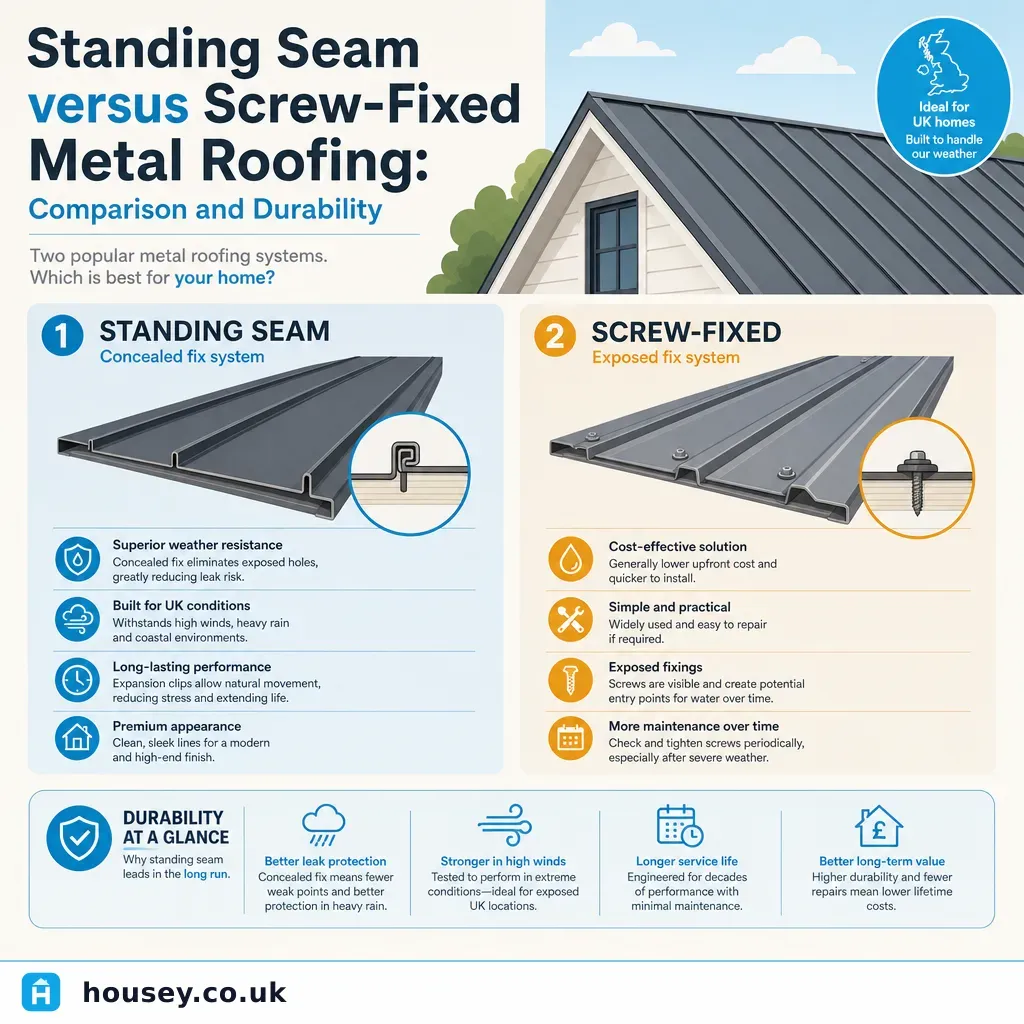
Standing Seam versus Screw-Fixed Metal Roofing: Comparison and Durability
Standing seam uses concealed clips to hold panels, keeping all fasteners out of the weatherline and giving a design life of 40–60 years or more.
 Improvement & Build
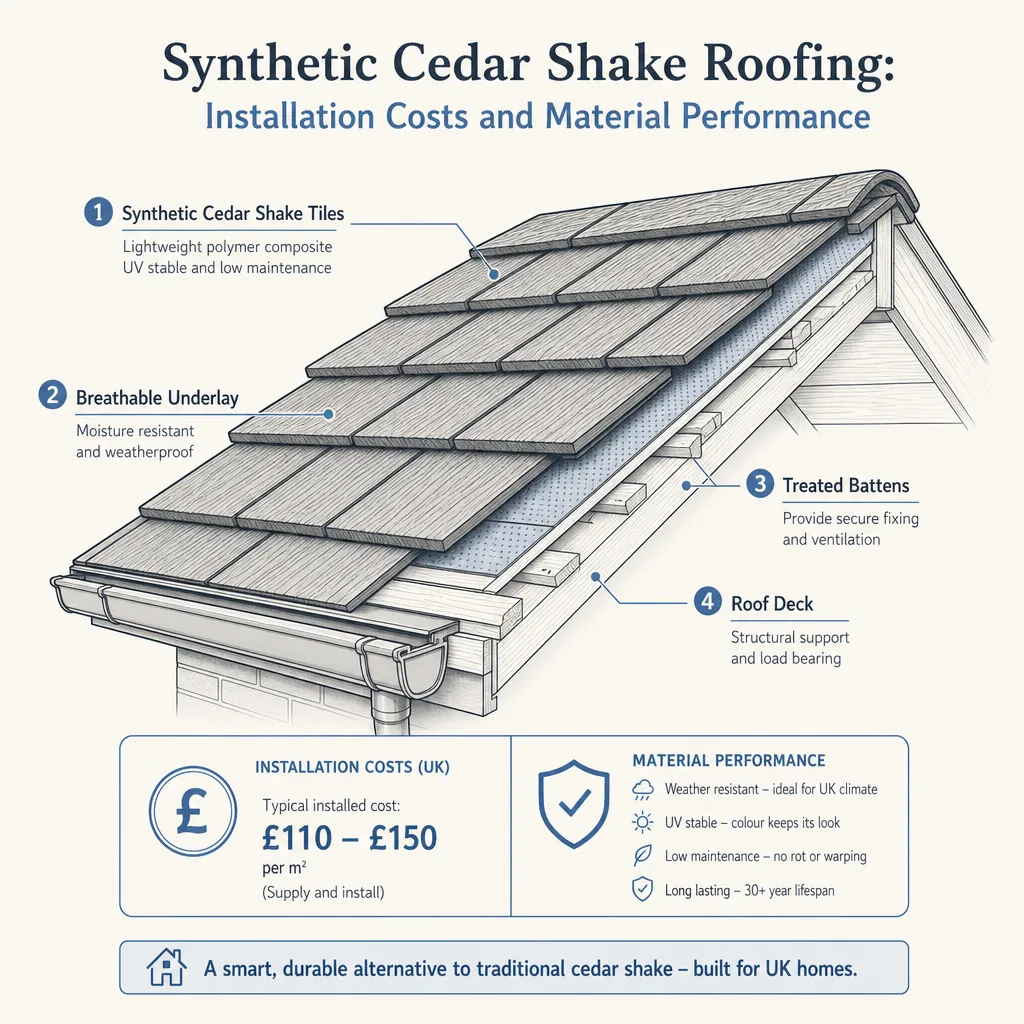
Synthetic Cedar Shake Roofing: Installation Costs and Material Performance
Synthetic cedar shake roofing uses polymer composite, rubber, or fibre-cement tiles to replicate the look of natural cedar wood shingles.
 Improvement & Build
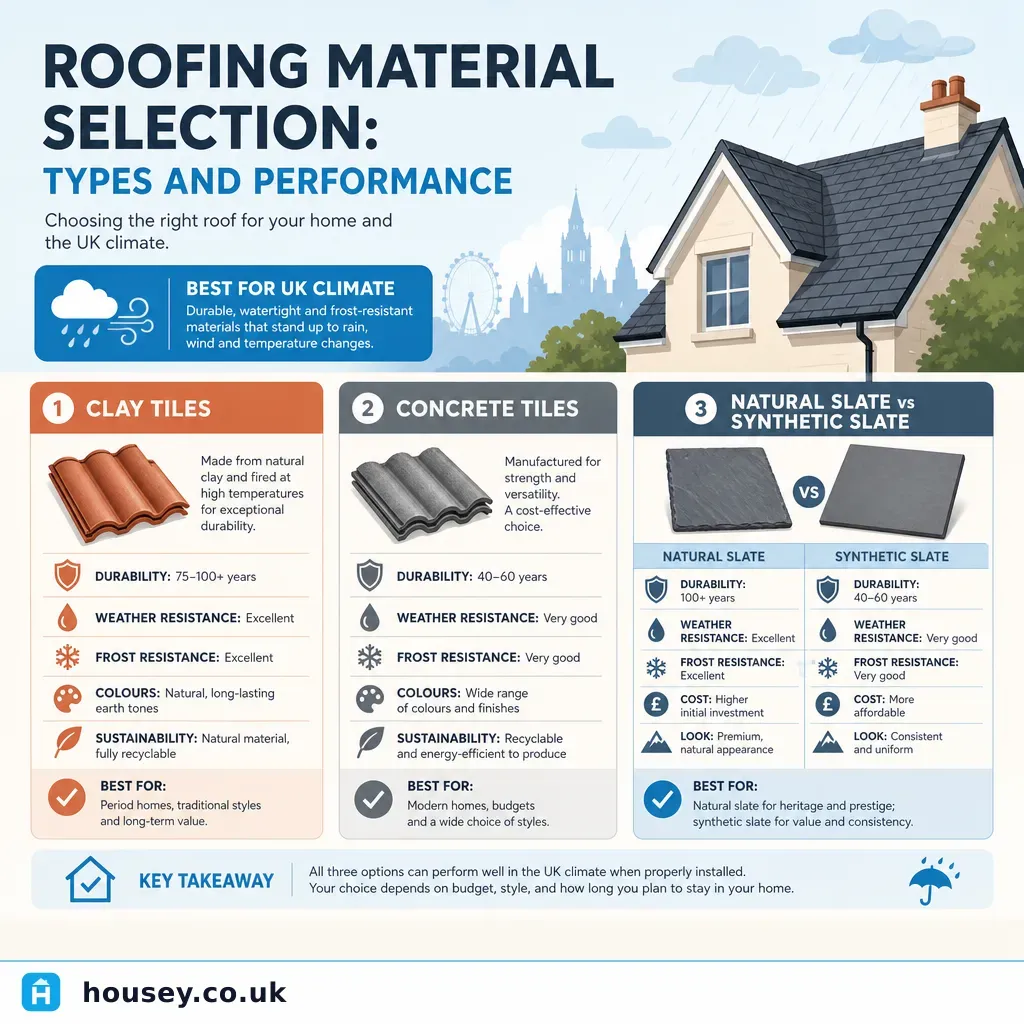
Roofing Material Selection: Types and Performance
The right roofing material depends on your roof pitch, property type, local planning requirements, and budget.
 Improvement & Build
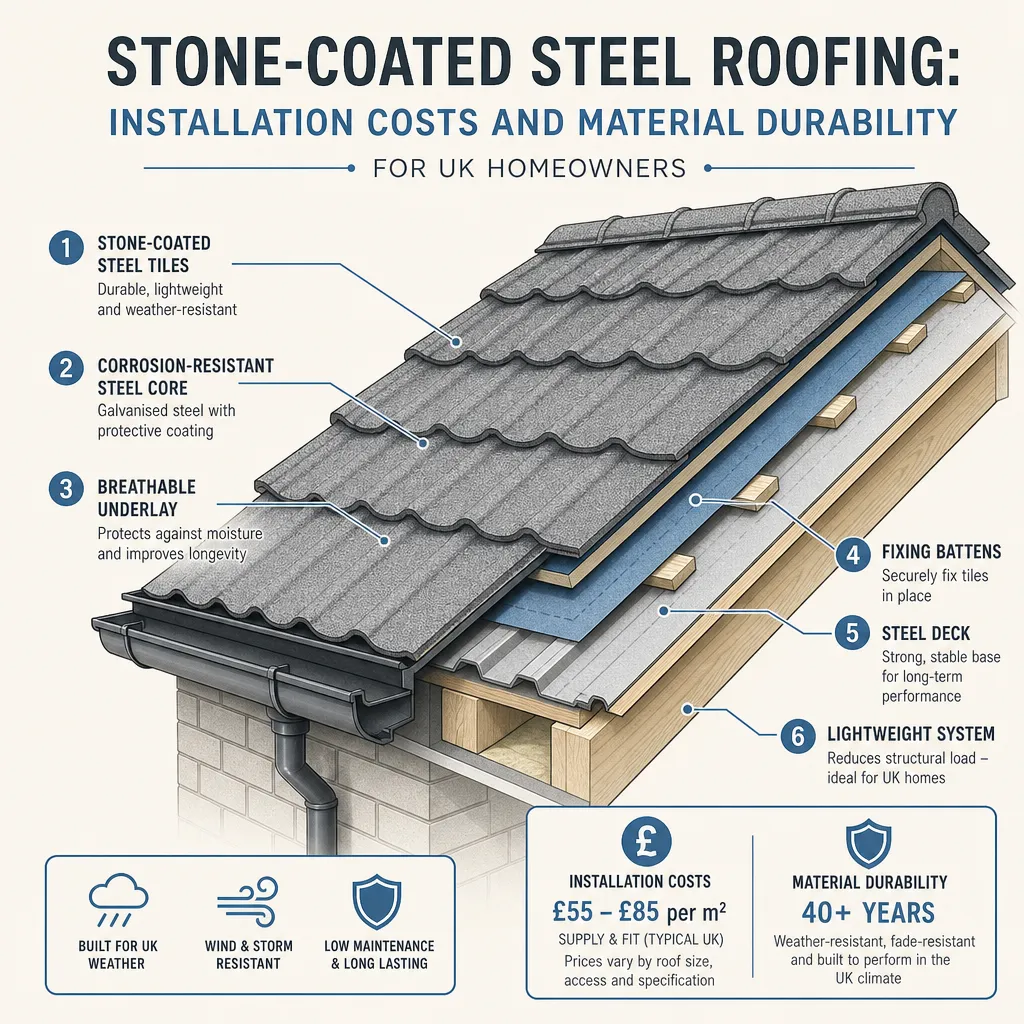
Stone-Coated Steel Roofing: Installation Costs and Material Durability
Stone-coated steel roofing uses a galvanised steel core embedded with acrylic resin and stone granules, creating a durable, lightweight alternative to traditional tiles.