Roofing Material Selection: Types and Performance
By Housey · Last reviewed 30th of May 2026
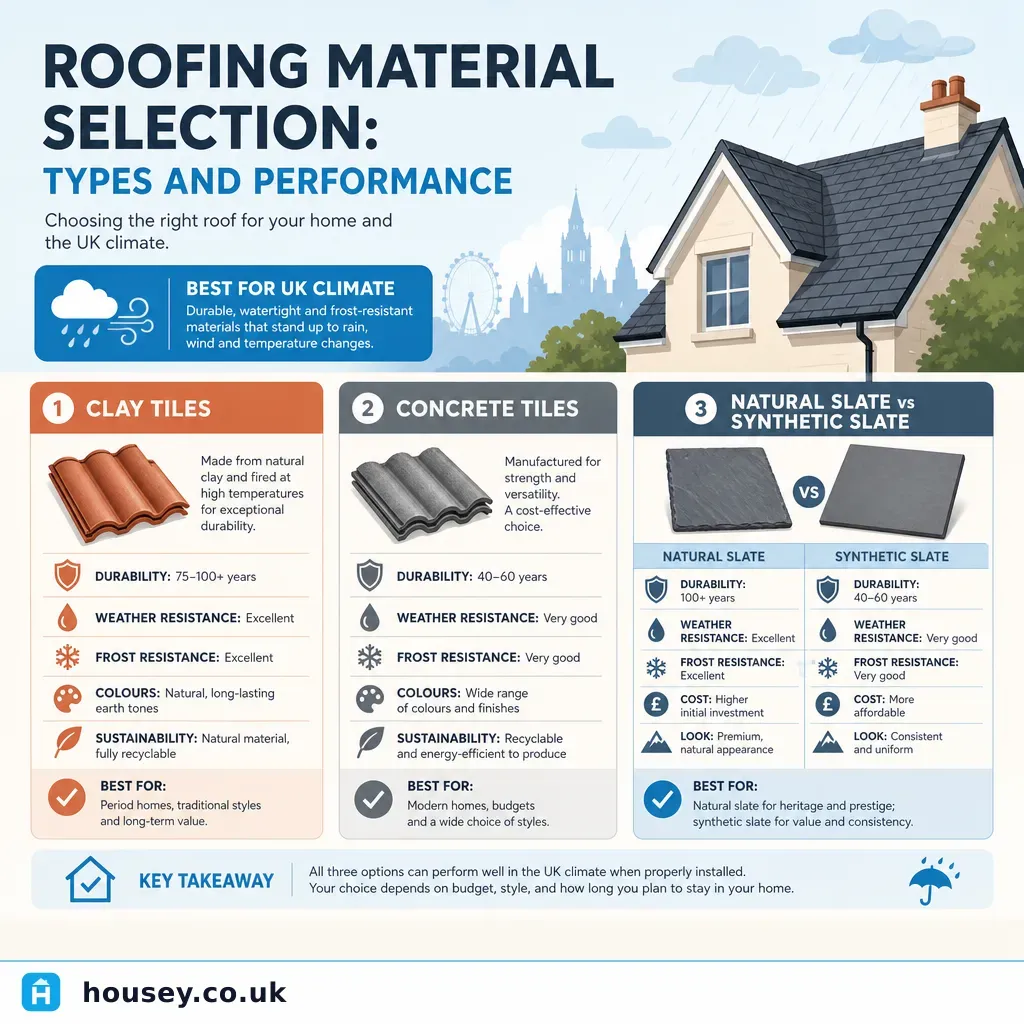
Roofing Material Selection: Types and Performance
The choice of roofing material shapes a property's performance and appearance for decades. For UK homeowners, the decision is further influenced by the country's high annual rainfall, freeze-thaw cycles in upland and northern regions, and planning requirements that apply to conservation areas, listed buildings, and properties within national parks or areas of outstanding natural beauty. Whether you are reroofing a Victorian terrace, extending a 1930s semi, or specifying a flat roof for a new rear addition, understanding the main material options before instructing a roofer avoids costly specification mistakes.
Key points
- Clay roof tiles to BS EN 1304 and concrete interlocking tiles to BS EN 490 are the two most widely used pitched roofing materials in England and Wales; clay tiles cost more initially but carry a longer design life of 80–100 years versus 40–60 years for concrete.
- Natural Welsh and Spanish slate typically carries a design life of 80–150 years and is frequently required by local planning conditions for properties in conservation areas or for listed buildings — always check with your local planning authority (LPA) and refer to Historic England guidance before specifying an alternative material.
- Building Regulations Approved Document L requires that when a roof covering is replaced over more than 25% of the total roof area, the thermal element should be upgraded to meet current U-value targets (0.16 W/m²K for pitched roofs in England).
- Flat roof membranes — EPDM (ethylene propylene diene monomer), GRP (glass-reinforced polyester), and modified bitumen — each have distinct cost, lifespan, and detailing profiles; EPDM and GRP are currently favoured by most UK roofing contractors for new residential flat roof installations.
- The National Federation of Roofing Contractors (NFRC) advises that all roof work is carried out by a competent contractor with scaffolding erected in compliance with the Construction (Design and Management) Regulations 2015.
UK roofing material comparison
Material | Typical lifespan | Best for | Not ideal for | Indicative installed cost per m² | Planning notes |
|---|---|---|---|---|---|
Concrete interlocking tiles | 40–60 years | 1960s–present standard pitched roofs; cost-effective re-roofing | Listed or traditionally characterful properties; very low pitches (below c.17.5°) | £40–£80 | Usually permitted development; verify in conservation areas |
Clay plain tiles | 80–100+ years | Victorian, Edwardian, and Interwar properties | Budget-sensitive projects; heavier than concrete | £70–£130 | Often required by conservation area planning conditions |
Natural slate (Welsh or Spanish) | 80–150 years | Older properties, conservation areas, listed buildings | Budget-sensitive projects; requires skilled fixing | £80–£150 | Frequently required by LPA planning conditions |
Synthetic (fibre cement) slate | 30–50 years | Budget alternative where natural slate appearance is needed | Listed buildings; conservation areas without LPA approval | £50–£90 | Check with LPA before specifying in conservation areas |
Standing seam zinc | 80–100+ years | Contemporary extensions, low-pitch roofs, modern builds | Traditional pitched roofs in conservation areas | £120–£250 | May require LPA approval in conservation areas |
Standing seam aluminium or steel | 40–70 years | Contemporary extensions, outbuildings, commercial-style designs | Traditional pitched roofs in conservation areas | £80–£180 | As above |
EPDM membrane | 25–50 years | Flat or low-pitch roofs (below c.10°) | Pitched roofs | £40–£80 | Usually permitted development |
GRP (fibreglass) membrane | 25–40 years | Flat roofs, dormers, balconies | Very large flat roof areas with complex joint detailing | £50–£100 | Usually permitted development |
Modified bitumen (felt) | 15–25 years | Garage roofs; budget flat roof replacement | High-performance or long-life requirements | £30–£60 | Usually permitted development |
Indicative UK costs, last reviewed 2026-05-30. Costs vary significantly by region, roof complexity, access, and contractor. Obtain a minimum of three quotes from NFRC member or equivalent qualified roofers.
Which roofing material should you choose?
- Choose clay or concrete interlocking tiles if your property was built from the 1950s onwards with a pitched roof of 22.5° or greater, the project is not subject to conservation area or listed building requirements, and value over a 40–60 year horizon is the priority.
- Choose clay plain tiles if your property is Victorian, Edwardian, or Interwar, if the roof is plain-tiled at present, or if matching the character of neighbouring properties in a traditional street matters.
- Choose natural slate if you are in a conservation area, the property is listed, or if planning conditions specify a traditional material. Natural Welsh slate is the preferred specification for period properties.
- Choose synthetic (fibre cement) slate if budget constraints make natural slate unviable and your LPA confirms that a synthetic alternative is acceptable for the property and location.
- Choose standing seam zinc or aluminium for a contemporary extension, a low-pitch porch, or a single-storey rear addition where a modern aesthetic and long lifespan are priorities.
- Choose EPDM or GRP for flat roofs, low-pitch extensions, and dormers. EPDM is well-regarded for ease of installation and long-term UV stability in UK conditions.
- Ask your LPA and a structural engineer before specifying a material if the property is listed, in a conservation area, or if the new material differs significantly in weight from the existing covering — switching from concrete interlocking tiles to natural slate increases dead load and may require a structural assessment.
Performance in UK conditions
Water resistance and weathertightness depend as much on installation quality as material specification. All materials in the comparison table perform adequately when correctly installed to the relevant British Standard — BS 5534:2014+A2:2018 for slates and tiles, and BS 8747 for reinforced bitumen membranes. Lap dimensions, batten spacing, underlay specification, and flashing detailing at abutments, valleys, and penetrations are the most common sources of long-term failure.
Freeze-thaw durability: Specify tiles and slates to their relevant EN product grade. Low-grade concrete tiles and certain imported natural slates can suffer surface spalling after repeated freeze-thaw cycling in upland or northern locations. Ask your contractor to confirm the product grade is appropriate for your site's exposure category.
Wind resistance: In exposed locations — coastal, upland, or high wind zones under BS 5534 — mechanical fixing at verges, ridges, and eaves is required rather than reliance on mortar bedding alone. Confirm with your roofer that the fixing specification accounts for your site's wind exposure.
Thermal performance (Part L): Re-roofing more than 25% of the roof area may trigger a requirement to upgrade insulation to meet the current 0.16 W/m²K U-value target for pitched roofs in England. This is an opportunity to improve energy performance in older properties with limited existing roof insulation. Confirm with your building control officer whether this requirement applies to your specific project.
Red flags when specifying roofing materials
- A quote that does not identify the specific tile, slate, or membrane product, its grade, or its relevant BS or EN standard.
- No mention of underlay specification or batten gauge in the scope of works.
- No scaffolding included, or a suggestion the work can be done safely from ladders — contrary to CDM 2015 requirements for roof work at height.
- A very low per-m² price for natural slate, below approximately £80/m² installed — a signal of low-grade, uncertified, or inadequately inspected material.
- No discussion of planning requirements before work begins on a conservation area property or a listed building.
- No mention of building control notification when re-roofing more than 25% of the roof area.
What to ask a roofer before accepting a quote
- Which specific tile, slate, or membrane product are you specifying, and to which British or European Standard does it conform?
- How will fixing be carried out at verges, ridges, and valleys — mechanical fixing or mortar bedding, and why?
- What underlay is included, and is it a breathable membrane or traditional felt?
- Will you notify building control if the works trigger Part L requirements?
- Have you confirmed with the local planning authority that the proposed material is acceptable for this property and location?
- Is scaffolding included, and will it comply with the Construction (Design and Management) Regulations 2015?
- What separate guarantees do you provide on materials and workmanship, and for how long?
- Is VAT included in the quoted price?
When to get professional help
All roof work at height should be carried out by a qualified roofer with appropriate scaffolding — this is not a DIY task for the vast majority of residential properties. Beyond the safety imperative, seek specialist professional input when:
- The property is listed. Works to a listed building may require listed building consent in addition to any planning permission. Consult your LPA conservation officer and review Historic England guidance before any re-roofing.
- The property is in a conservation area. Your LPA conservation officer can confirm whether the chosen material meets conservation area requirements. Failing to check before instructing a roofer can result in enforcement action and costly remediation.
- The roof structure may need assessment. If switching between materials of significantly different weight, a structural engineer should confirm the roof structure can carry the changed load.
- Lead, parapet, or chimney detailing is involved. These areas account for a disproportionate share of roof failures; confirm your roofer has demonstrated experience with the specific detailing your property requires.
How Housey can help
Housey connects you with vetted roofers across the UK who can advise on material selection, confirm local planning requirements, and carry out re-roofing and new roof projects for a wide range of property types and budgets. Describe your project on Housey and receive comparable quotes from local contractors experienced in your property type and area.
Frequently asked questions
How long do roof tiles last in the UK?
Concrete interlocking tiles have a typical design life of 40–60 years; clay tiles 80 to 100 years or more in normal UK conditions. Natural slate can last 80–150 years, though realised lifespan depends heavily on slate origin, grade, and fixing quality. Prompt replacement of broken or slipped tiles, regular gutter maintenance, and attention to ridge and verge mortar significantly affect how long a roof performs without major intervention.
Do I need planning permission to change my roofing material?
Re-roofing with the same material, colour, and profile is generally permitted development for most houses in England and does not require planning permission. If you are in a conservation area, the local planning authority may require the material to match the original or an approved alternative. Works to listed buildings require listed building consent regardless of whether the material matches. Always check with your LPA before committing to a different material or colour.
Is natural or synthetic slate better for a Victorian terrace?
Natural Welsh or Spanish slate is the preferred choice for a Victorian terrace and is frequently required by planning conditions in conservation areas. Synthetic fibre cement slates have improved and may satisfy planning conditions in some locations, but they are generally not accepted for listed buildings. Confirm with your local planning authority conservation officer before specifying synthetic slate on any period property.
What is the best flat roof material for a UK home extension?
EPDM and GRP are currently the most widely specified materials for residential flat roofs in the UK. EPDM is lightweight, flexible, and resistant to UV degradation; GRP is extremely durable and can be laid seamlessly on complex shapes with few joints. Modified bitumen systems remain a lower-cost option with a shorter effective lifespan of 15–25 years. Correct detailing of upstands, outlets, and pipe penetrations matters as much as material choice.
Does re-roofing trigger Building Regulations?
In England, re-roofing more than 25% of the total roof area typically triggers a requirement to upgrade the thermal element to meet current standards under Building Regulations Approved Document L, with a target U-value of 0.16 W/m²K for pitched roofs. You should notify your local building control authority before starting. Like-for-like repairs to small areas generally do not require notification, but confirm this with your local authority before proceeding.
Sources and further reading
- Approved Document L: Conservation of fuel and power — GOV.UK
- BS 5534: Code of practice for slating and tiling — BSI
- Roof alterations and planning permission — Planning Portal
- National Federation of Roofing Contractors — NFRC
- Roofing and lead work on historic buildings — Historic England
- Construction (Design and Management) Regulations 2015 — HSE
Useful next reads
 Improvement & Build
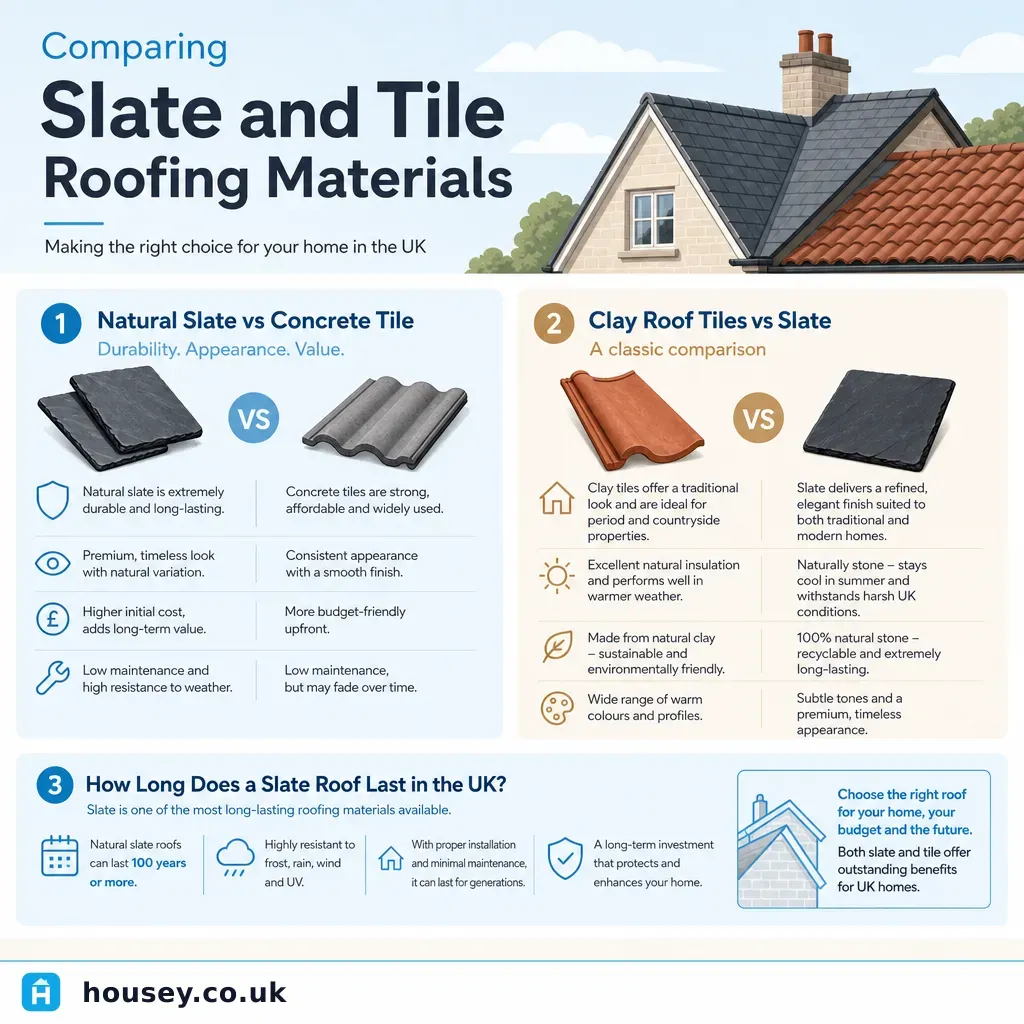
Comparing Slate and Tile Roofing Materials
Natural slate typically lasts 80–150 years and suits period and listed UK properties, while clay tiles offer 60–100 years and remain historically appropriate for Victorian and Edwardian stock.
 Improvement & Build
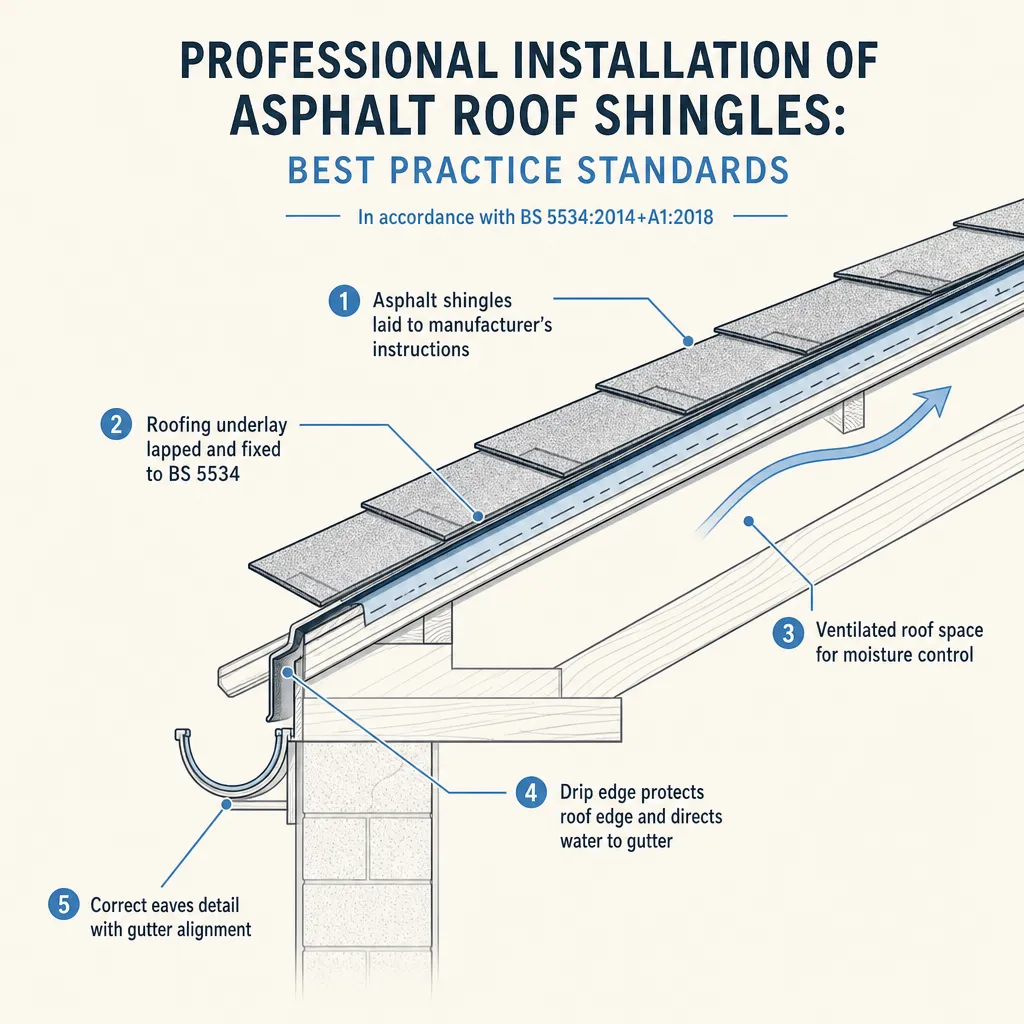
Professional Installation of Asphalt Roof Shingles: Best Practice Standards
Professional asphalt shingle installation in the UK must comply with BS 5534:2014+A2:2018, which sets requirements for breathable underlay, batten gauge, and nail fixing patterns.
 Improvement & Build
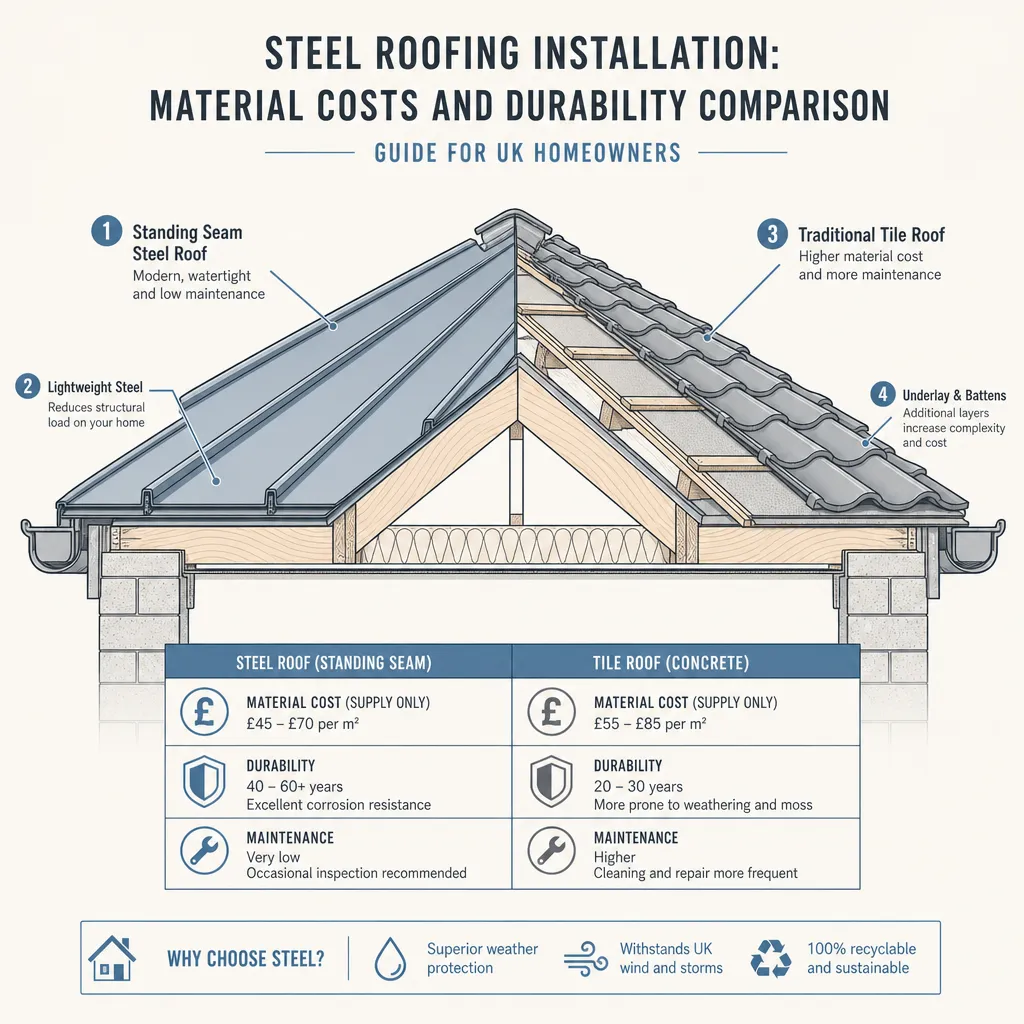
Steel Roofing Installation: Material Costs and Durability Comparison
Steel roofing comes in three main types for UK homes: standing seam (best for low-pitch contemporary roofs, 40–60 year lifespan), composite metal tile (traditional appearance), and corrugated sheet (outbuildings).
 Improvement & Build
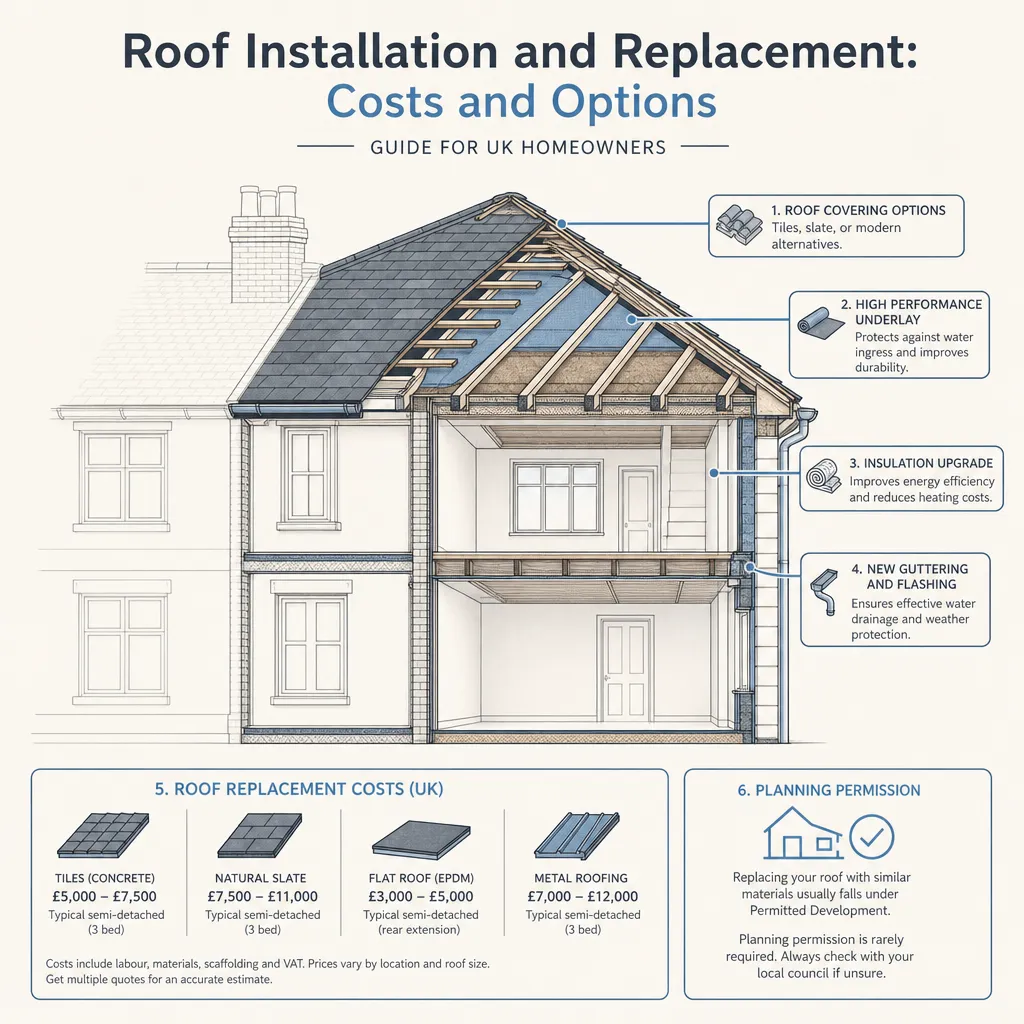
Roof Installation and Replacement: Costs and Options
A full pitched roof replacement on a UK semi-detached house typically costs £5,000–£12,000 depending on materials, roof complexity, and structural condition.
 Improvement & Build
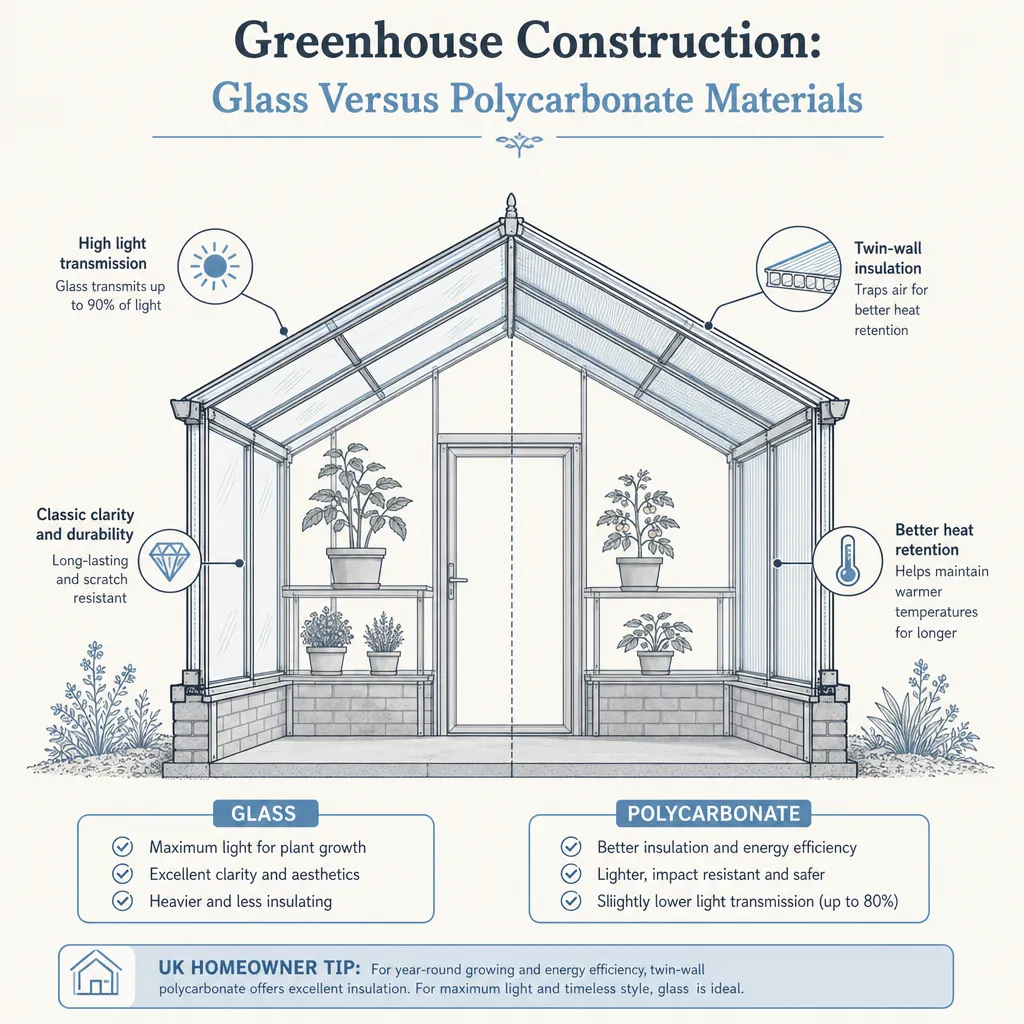
Greenhouse Construction: Glass Versus Polycarbonate Materials
Glass transmits around 90% of available light and lasts indefinitely if unbroken, but insulates poorly and shatters into sharp fragments.