Roof Installation and Replacement: Costs and Options
By Housey · Last reviewed 10th of May 2026
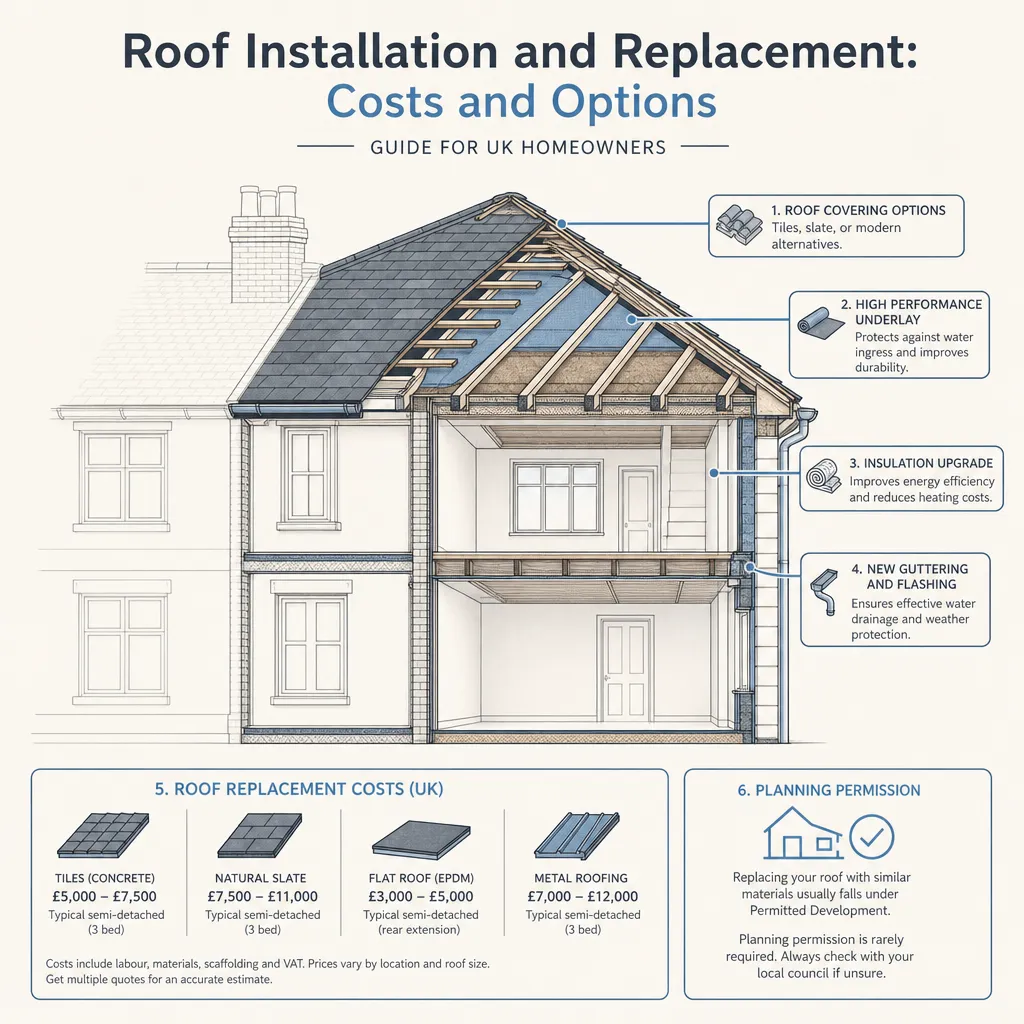
Roof Installation and Replacement: Costs and Options
A full roof replacement is one of the most significant building projects a UK homeowner can undertake, combining structural decisions, material choices, planning questions, and contractor selection. Whether a roof is at the end of its serviceable life, has suffered storm damage beyond economic repair, or is being replaced as part of a major renovation, understanding the costs and process in advance makes the difference between a well-managed project and an expensive surprise.
Key points
- Replacing a standard pitched roof on a UK semi-detached house typically costs £5,000–£12,000 depending on materials and access (Indicative UK costs, last reviewed 2026-05-10).
- Clay plain tiles have a lifespan of 60–100+ years; modern concrete tiles 30–60 years; natural Welsh or Spanish slate 80–100+ years — material choice directly affects long-term cost.
- Roof replacement on most dwellings does not require planning permission under permitted development rights, but conservation areas, listed buildings, and flat-roof changes may require consent.
- Building Regulations approval under Part A (Structure), Part C (Moisture Resistance), and Part L (Energy Efficiency) is required for a roof replacement in England and Wales.
- Part L requires insulation to be upgraded when re-roofing, making a replacement project an opportunity to improve a property's thermal performance significantly.
What does a roof replacement involve?
A full installation or replacement involves stripping the existing covering, inspecting and repairing or replacing structural roof timbers (rafters, purlins, ridge board, wall plates), installing insulation to current Building Regulations standards, laying new underlay, battens, and roof coverings, and finishing flashings, ridges, valleys, hips, verges, gutters, and fascias.
The project scope can vary significantly:
- Strip and re-tile only: existing timbers in sound condition — the most straightforward scenario.
- Full structural overhaul: damaged or undersized rafters, spread at the eaves, or failing purlins require a structural engineer's assessment and timber repairs before re-covering.
- Flat roof replacement: involves specialist membranes (GRP/fibreglass, EPDM rubber, or built-up felt) and drainage design.
Roofing material options
Material | Typical lifespan | Relative cost | Best for | Key considerations |
|---|---|---|---|---|
Concrete interlocking tiles | 30–60 years | Low–Medium | 1960s–1990s estate houses | Heavier than slate; structural check may be needed |
Clay plain tiles | 60–100+ years | Medium | Victorian and Edwardian terraces | Traditional appearance; conservation area favourite |
Natural Welsh or Spanish slate | 80–100+ years | Medium–High | Period properties, conservation areas | Lightweight; natural colour variation |
Reconstituted slate | 30–50 years | Medium | Where natural slate is restricted | May not satisfy conservation officers |
GRP/fibreglass (flat roof) | 25–30 years | Medium | Flat roof extensions, garage roofs | Seamless; requires correct drainage fall |
EPDM rubber (flat roof) | 20–50 years | Low–Medium | Flat roofs with limited access | Lightweight; UV resistant |
Lifespan estimates assume correct installation and regular maintenance. Source: NFRC guidance on roofing materials.
How much does a roof replacement cost in the UK?
The following ranges cover fully completed projects including labour, materials, scaffold hire, and waste disposal:
Property type | Approximate cost range |
|---|---|
Terraced or small semi-detached (2–3 bed) | £5,000–£9,000 |
Larger semi-detached or detached (3–4 bed) | £8,000–£14,000 |
Large detached or complex multi-plane roof | £12,000–£25,000+ |
Flat roof (single garage or small extension) | £1,500–£4,000 |
Flat roof (whole rear addition or bungalow) | £3,000–£8,000 |
Indicative UK costs, last reviewed 2026-05-10. Costs vary significantly by region, material specification, access, and structural condition. Obtain at least three quotes from NFRC-member contractors.
VAT on qualifying residential roofing renovation work is charged at the reduced rate of 5% under HMRC rules — confirm the applicable rate with your contractor before signing a contract.
Do you need planning permission or building regulations approval?
Planning permission is generally not required to replace a roof on a dwelling in England under permitted development rights, provided:
- The replacement materials are similar in appearance to the existing roof.
- The work does not materially alter the shape of the roof.
- The property is not a listed building or in a designated area where restrictions apply.
Always check with your local planning authority (LPA) if the property is in a conservation area, an Area of Outstanding Natural Beauty, or if the project involves dormers or a change from pitched to flat.
Building Regulations approval is required in England and Wales for a roof replacement. Notify your local building control body before works commence. Key Approved Documents:
- Part A (Structure): structural repairs or reinforcement must meet load-bearing requirements.
- Part C (Site Preparation and Resistance to Moisture): weatherproofing and moisture resistance.
- Part L (Conservation of Fuel and Power): insulation must be upgraded to meet current minimum standards when re-roofing, unless technically or functionally not feasible.
A worked UK scenario: 1930s semi-detached roof replacement
A homeowner in Coventry owns a 1930s semi-detached with an original concrete tile roof. A RICS Level 3 Building Survey flagged widespread nail sickness (corroded fixing nails causing tiles to slip), rafter spread at the eaves, and failing ridge mortar.
Works required:
- Structural engineer's assessment of rafter and wall plate condition — approximately £400–£700.
- Scaffold erection for safe access — approximately £1,000–£1,500.
- Strip existing tiles; repair rafters and replace wall plates where spread has occurred.
- Install 100mm PIR insulation between and above rafters to meet Part L requirements.
- Lay new breathable underlay, tanalised battens, and clay plain tiles to satisfy conservation area guidance.
- Replace ridge, hip tiles, and valley flashings; renew fascias and gutters.
Total indicative project cost: £10,000–£15,000. A building regulations completion certificate was obtained from the local authority building control (LABC) on completion.
What to ask before accepting a quote
- Is the quote for strip and re-tile only, or does it include structural repairs, insulation, and fascia and gutter renewal?
- Are you a member of the NFRC or another recognised trade body?
- Do you carry public liability insurance (minimum £1m recommended) and employer's liability insurance?
- Will you notify building control and obtain the necessary approvals?
- What underlay, batten, and tile or slate specifications will you use?
- Is scaffold included in the price or quoted separately?
- Will all waste be disposed of legally (asbestos requires a licensed contractor)?
- Is VAT included, and at which rate?
- What workmanship guarantee do you offer?
When to get professional help
A roofer experienced with the relevant material type can manage most re-roofing projects. Involve additional professionals if:
- There is evidence of rafter spread, undersized timbers, or structural movement — instruct a chartered structural engineer before covering works begin.
- The property is listed or in a conservation area — check with your local planning authority and consider a planning consultant.
- The project involves removing or disturbing asbestos-containing materials (common in pre-1980s properties with corrugated cement sheets or some older felt) — a licensed asbestos contractor is required.
- You plan to add solar PV at the same time — coordinate with an MCS-certified installer before the new covering is laid.
How Housey can help
Housey connects UK homeowners with qualified roofers who can assess your property, provide itemised quotes, and carry out compliant re-roofing projects. If your project involves structural questions, our network includes structural engineering professionals, and building control consultants can guide you through the approvals process from notification to completion certificate.
Frequently asked questions
How long does a roof replacement take?
Most standard residential re-roofing projects take 3–7 days of on-roof working, assuming scaffold is in place and no significant structural repairs are required. Larger or more complex roofs, or those needing structural timber work, can take 2–4 weeks. Weather delays are common, particularly in autumn and winter.
Can I get a grant to help replace my roof?
There is no mainstream government grant specifically for roof replacement in England. However, if re-roofing forms part of a whole-house retrofit, energy schemes such as the Great British Insulation Scheme or ECO4 may contribute to insulation costs. Check the Energy Saving Trust grant finder for current eligibility and regional variations.
What is nail sickness in a roof?
Nail sickness occurs when the original steel fixing nails used in concrete or clay tiles corrode over time, causing tiles to slip or fall. It is extremely common in roofs from the 1950s to 1980s. Re-nailing or a full re-tile using modern stainless steel nails and hooks is usually the only lasting solution.
Will replacing my roof add value to my property?
A newly tiled roof in sound condition is a baseline expectation for buyers; a near-end-of-life roof is a significant negative in a survey. Replacing a failing roof protects property value rather than adding a premium. Using premium materials such as natural slate or clay tiles may support value in areas where buyers prize period character.
Sources and further reading
- National Federation of Roofing Contractors — industry standards, member search, and consumer guidance on roofing work
- GOV.UK: Planning permission — permitted development and planning rules for roof alterations
- GOV.UK: Approved Document L — insulation requirements when re-roofing under Building Regulations
- HSE: Asbestos in buildings — identifying and managing asbestos-containing materials in older properties
Useful next reads
 Improvement & Build
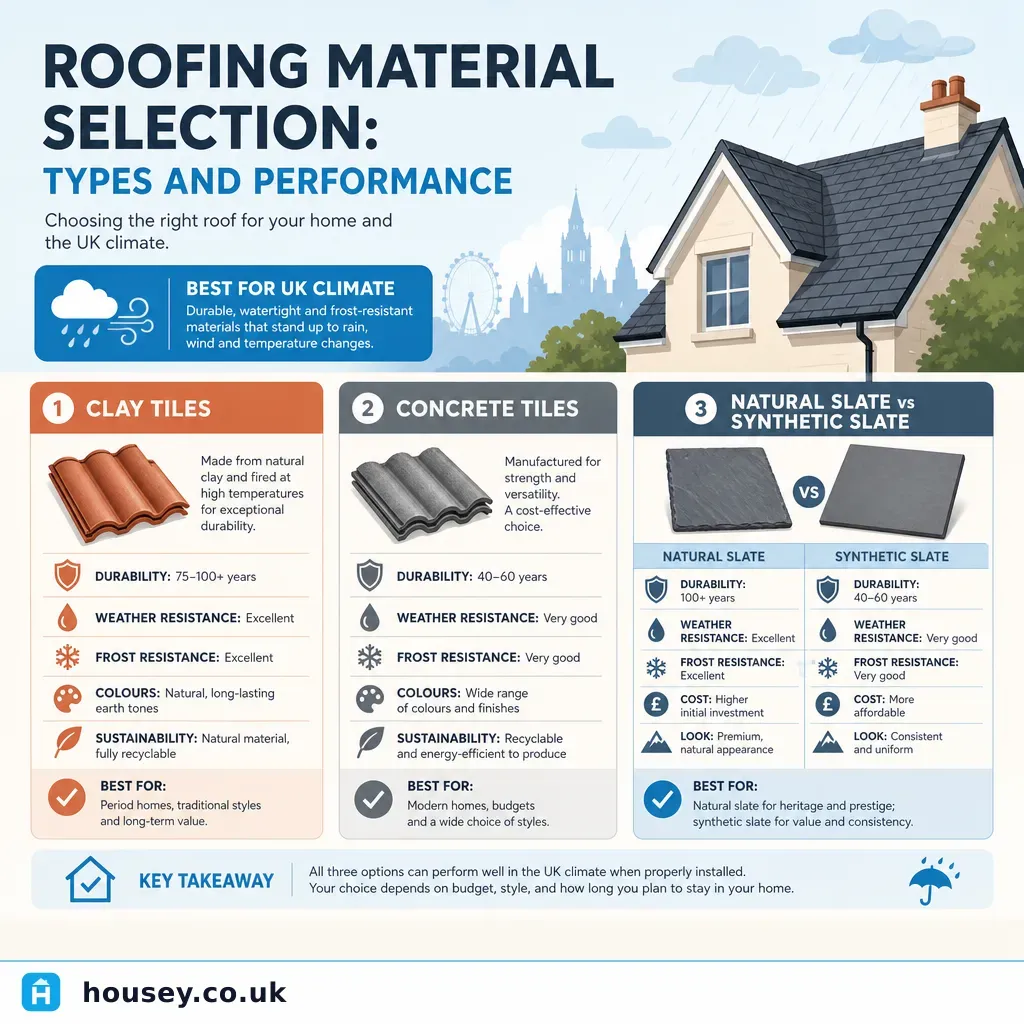
Roofing Material Selection: Types and Performance
The right roofing material depends on your roof pitch, property type, local planning requirements, and budget.
 Improvement & Build
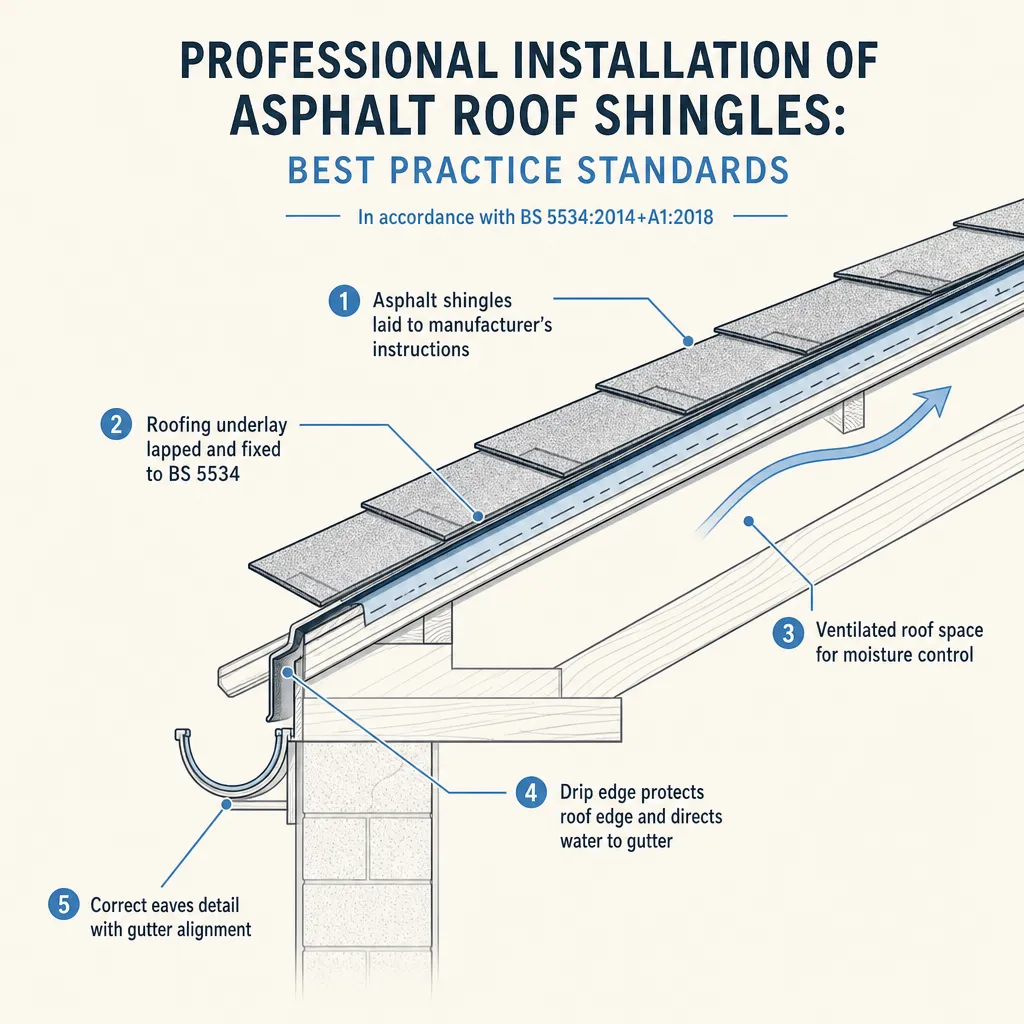
Professional Installation of Asphalt Roof Shingles: Best Practice Standards
Professional asphalt shingle installation in the UK must comply with BS 5534:2014+A2:2018, which sets requirements for breathable underlay, batten gauge, and nail fixing patterns.
 Improvement & Build
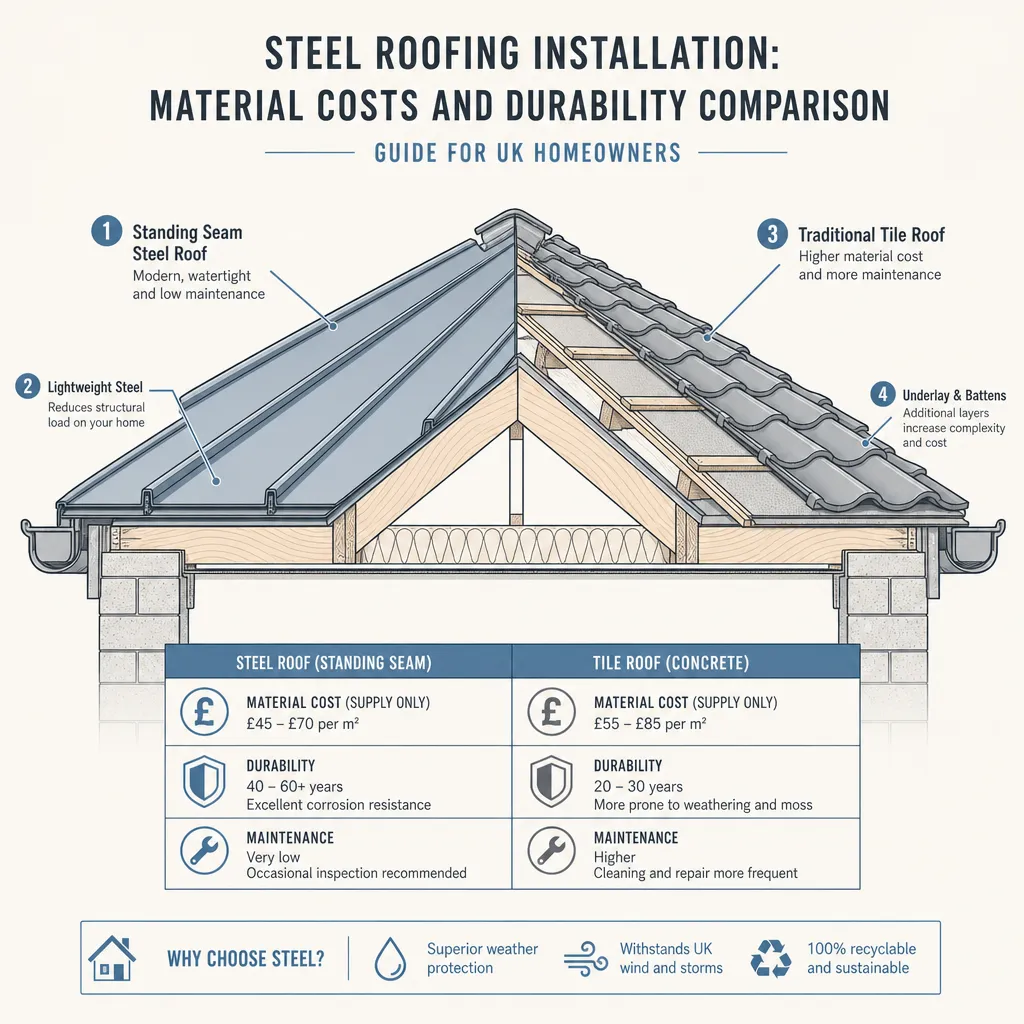
Steel Roofing Installation: Material Costs and Durability Comparison
Steel roofing comes in three main types for UK homes: standing seam (best for low-pitch contemporary roofs, 40–60 year lifespan), composite metal tile (traditional appearance), and corrugated sheet (outbuildings).
 Improvement & Build
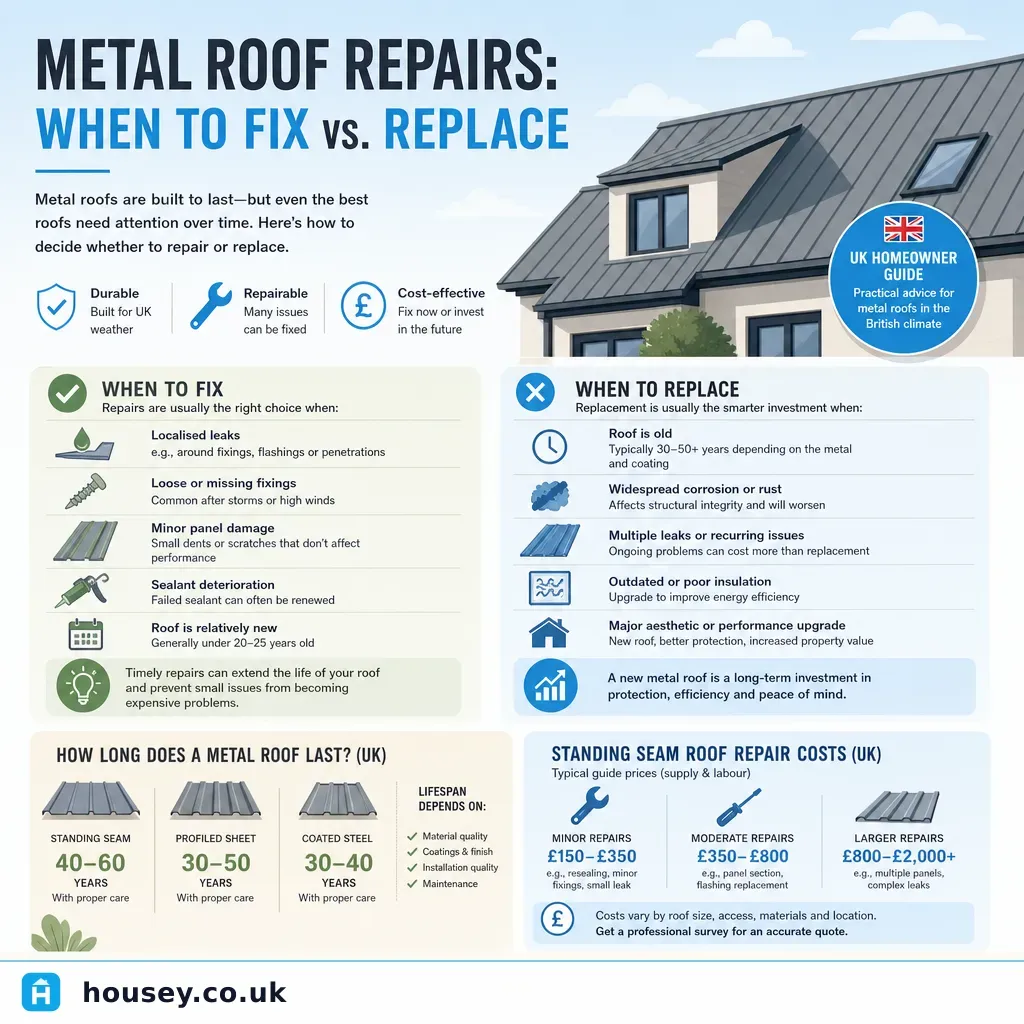
Metal Roof Repairs: When to Fix vs. Replace
For a metal roof, repair is usually right when damage is localised — a failed flashing, isolated corrosion, or one or two damaged panels.
 Improvement & Build
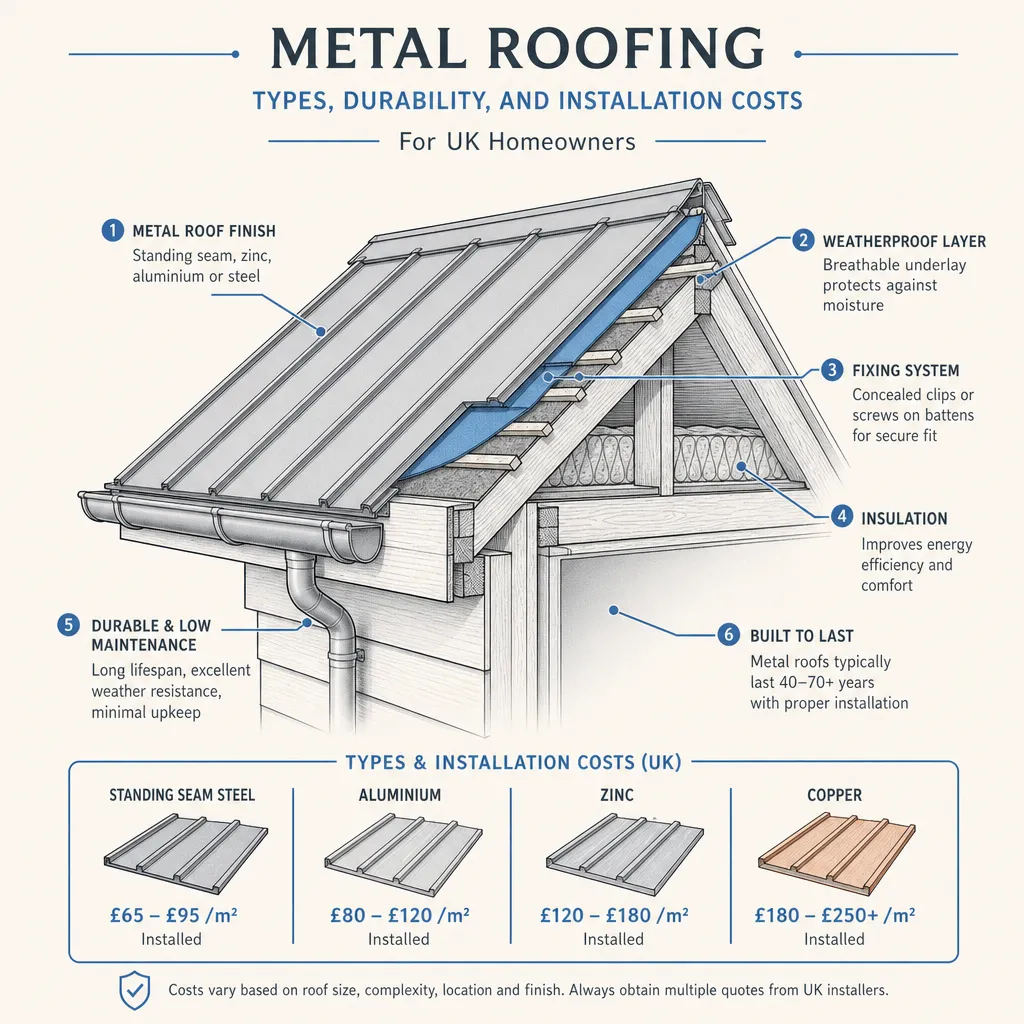
Metal Roofing: Types, Durability, and Installation Costs
Metal roofing in the UK includes standing seam, corrugated sheet, and metal tile systems in steel, aluminium, zinc, or copper.