What Documentation Should Your Contractor Provide During Work
By Housey · Last reviewed 31st of May 2026
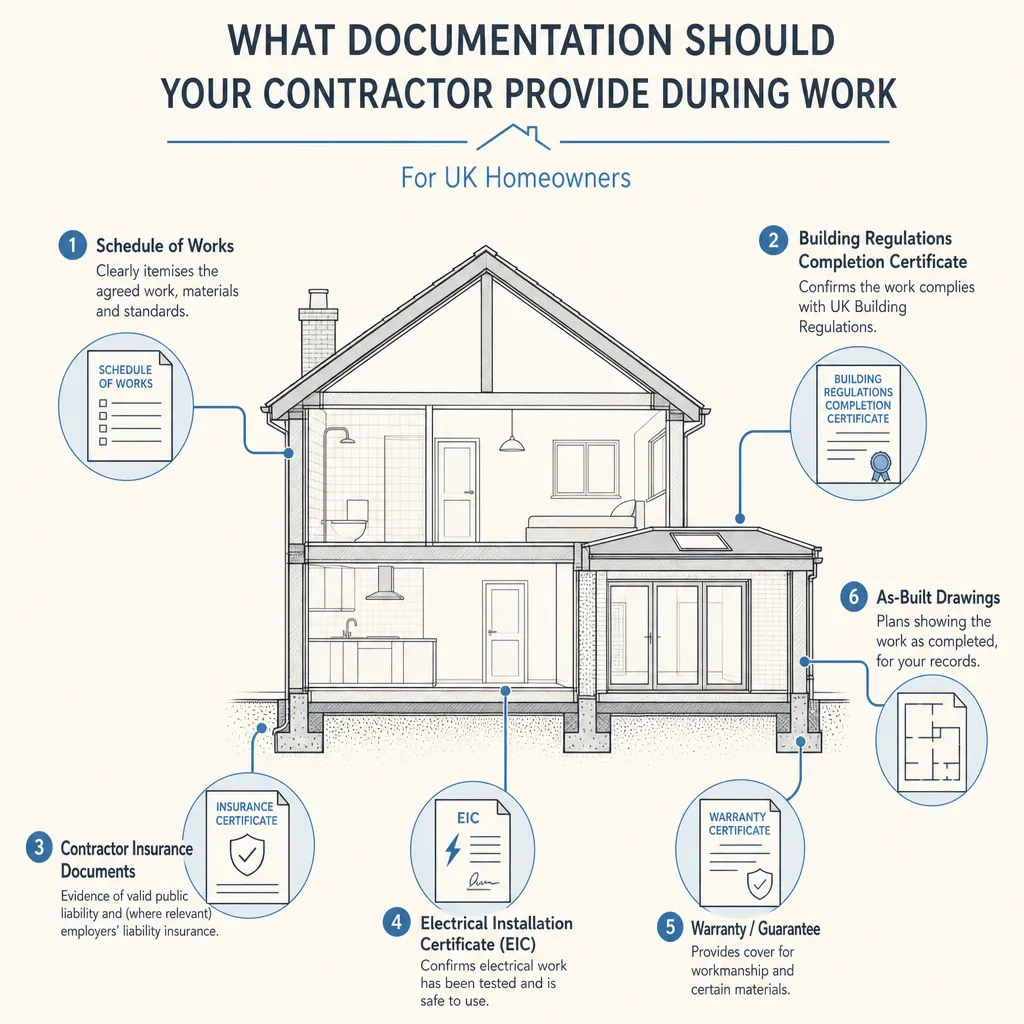
What Documentation Should Your Contractor Provide During Work
When you commission building work in the UK — whether a loft conversion, kitchen extension, rewire, or full new build — the documentation your contractor provides is as important as the physical work itself. Inadequate paperwork can cause problems with building control sign-off, complicate your home insurance, reduce your property's saleability, and leave you without recourse if defects appear years later. Questions about contractor documentation most often arise when a building inspector visits, when a dispute develops over variations, or when preparing to sell a property where records are incomplete.
Key points
- The Consumer Rights Act 2015 requires services to be carried out with reasonable care and skill; a written contract is the primary document establishing what was agreed between you and your contractor.
- For notifiable building work, a building notice or full plans application must be submitted to local authority building control (or an Approved Inspector), and a completion certificate is issued after a satisfactory final inspection.
- Electrical work notifiable under Part P of the Building Regulations must be certified by an electrician registered with a competent persons scheme (NICEIC, NAPIT, or equivalent) or separately inspected by building control.
- Gas work must be carried out by a Gas Safe registered engineer, who must issue a Gas Safe installation certificate for any new gas appliance or pipework.
- Structural warranties from providers such as NHBC, Build-Zone, or Premier Guarantee run for 10 years and are typically required by mortgage lenders for new builds and major structural works.
Before work starts: documents to obtain upfront
Getting documentation in order before work begins protects you throughout the project and creates a clear record of what was agreed.
Pre-start document checklist
- Signed written contract: covering scope of works, specification of materials and finishes, agreed price (or basis for calculation), payment schedule, start and completion dates, and the defects liability period.
- Proof of public liability insurance: minimum £1 million cover; £2 million or more is common for larger projects. Ask for the insurance certificate directly — not just a verbal assurance.
- Proof of employers' liability insurance (where the contractor employs workers other than as a sole trader): legally required under the Employers' Liability (Compulsory Insurance) Act 1969.
- Building regulations application reference: a copy of the building notice or full plans application number from the local authority or Approved Inspector.
- Planning permission decision notice (where applicable): the formal decision notice from the local planning authority confirming permission has been granted.
- Competent persons scheme registration details: Gas Safe number, NICEIC number, FENSA registration, or whichever scheme is relevant to the work being undertaken.
During work: documents your contractor should provide or log
As the project progresses, certain documents should be generated, shared, or kept on file as each milestone is reached.
- Variation orders: any change to the agreed scope, specification, or price must be confirmed in writing and signed by both parties before the variation work proceeds. Verbal variations are one of the most common causes of construction disputes between homeowners and contractors.
- Interim valuations and payment certificates: for projects lasting more than a few weeks, payments should be linked to completed and inspected stages. An interim certificate or valuation should specify exactly what has been certified for payment and what retention, if any, is being held.
- Building control inspection records: building control carries out stage inspections at key milestones — foundations, damp-proof course, floor structure, roof, insulation, and final. Ask your contractor to confirm when inspections have been booked and passed at each stage.
- Delivery notes and material specifications: for significant materials such as structural timber, roof insulation, or replacement windows, keep delivery notes showing the product name and grade. These support future warranty claims and EPC assessments.
- Structural engineer's calculations or approval notes: if structural work is involved — removing a load-bearing wall, creating a large opening, or inserting a steel beam — the engineer's stamped calculations or approval note should be kept on file.
- Party Wall Award (if applicable): if works affect a shared wall or boundary under the Party Wall etc. Act 1996, the agreed Award is a key legal document for both you and your neighbour.
At completion: what your contractor must hand over
Document | Who issues it | Why you need it |
|---|---|---|
Building regulations completion certificate | Local authority building control or Approved Inspector | Confirms work meets regulations; essential for sale and re-mortgaging |
Gas Safe installation certificate | Gas Safe registered engineer | Required for any new gas appliance or pipework |
Electrical Installation Certificate (EIC) or Minor Works Certificate | NICEIC or NAPIT registered electrician | Confirms electrical work is safe and compliant with BS 7671 |
FENSA certificate (or equivalent) | FENSA-registered window or door installer | Required for replacement glazing; proves compliance with Part L |
Structural warranty | NHBC, Build-Zone, Premier Guarantee, or similar | Required by lenders for new builds or major structural works; typically 10 years |
Manufacturers' installation certificates | Contractor or product manufacturer | Activates product warranties (boilers, roofing systems, windows) |
Operation and maintenance manuals | Contractor or manufacturer | Needed for ongoing maintenance and future contractors or owners |
Defects liability period notice | Contractor | States the period (usually 6–12 months) during which defects will be rectified at no extra charge |
Final account statement | Contractor | Confirms all payments made and any retention amounts released |
Red flags: warning signs that documentation is inadequate
Watch out for these indicators that a contractor may not be operating to the required standard:
- No written contract offered before work starts: a reputable contractor will always provide one before work begins.
- No building control application for notifiable work: most structural alterations, extensions, new electrics, and gas appliances require notification — unnotified work cannot be certified as compliant.
- Cash-only payments with no invoice or receipt: this may indicate unregistered work and will leave you without a documentation trail.
- No insurance certificate provided: if a worker is injured on your property and the contractor has no liability insurance, you may be exposed to a claim.
- Changes to scope agreed verbally only: disputes about additional or varied work are among the most common causes of litigation between homeowners and contractors.
- Completion certificate never issued: common where a building notice was used but the final inspection was never booked. Do not release final payment until the certificate is provided or you have a clear plan to obtain it.
What to ask before work starts
- Are you registered with a competent persons scheme relevant to this work (Gas Safe, NICEIC, FENSA, NAPIT)?
- Can I see your current public liability insurance certificate before work begins?
- Will you provide a signed written contract covering scope, price, payment stages, and the defects liability period?
- How will building control inspections be managed, and who will book them at each stage?
- What documentation will I receive at the end of the project, and in what form?
- How will variations and additional costs be documented and agreed during the build?
- What is the defects liability period, and what is the process for raising issues under it?
When to get professional help
For significant projects — a large rear extension, a structural conversion, or a new build — consider appointing a project manager to oversee documentation, sign off stage payments, and liaise with building control on your behalf. An architect acting as contract administrator can formally certify payments and ensure the documentation trail remains complete throughout the build.
If a contractor refuses to provide a building regulations completion certificate at practical completion, contact your local authority building control department before releasing final payment. You may also wish to seek legal advice about your rights under the contract.
How Housey can help
Housey connects homeowners with vetted extension builders and experienced project managers who understand UK documentation requirements and can help ensure your project completes with a full, well-organised handover pack.
Frequently asked questions
What should a building contract include in the UK?
A building contract should include a description of the scope of works, specification of materials and finishes, agreed price or basis for calculation, payment schedule, start and completion dates, defects liability period, insurance details, and a dispute resolution process. The JCT (Joint Contracts Tribunal) publishes standard contracts for domestic building works that are widely used and recognised by solicitors and surveyors.
What is a practical completion certificate?
A practical completion certificate is issued by the contract administrator — typically an architect or project manager — when the works are substantially complete and the building is fit for its intended use, even if minor snagging items remain. It starts the defects liability period and triggers the release of any retention held by the client against the contractor.
Do I need to keep contractor documents when selling my home?
Yes. Completion certificates, Gas Safe certificates, electrical certificates, FENSA certificates, and structural warranties are all routinely requested during conveyancing. Missing certificates for notifiable work can delay or derail a sale. Store originals securely and keep digital copies as backup in case originals are mislaid.
What happens if my contractor does not provide a completion certificate?
If building control was notified and the work complies with regulations, contact your local authority or Approved Inspector to arrange a late final inspection. If the work was never notified, you may need to apply for a regularisation certificate through local authority building control in England. Unregularised notifiable work is a significant obstacle when selling.
Sources and further reading
- Building regulations approval: overview — GOV.UK
- Gas Safe Register: find a registered engineer — Gas Safe Register
- NICEIC: find a registered electrician — NICEIC
- Party Wall etc. Act 1996: guidance — GOV.UK
- Consumer Rights Act 2015 — legislation.gov.uk
- JCT domestic building contracts — Joint Contracts Tribunal
Useful next reads
 Improvement & Build
Understanding Service Guarantees: Protection for Your Home Improvement Project
Home improvement guarantees fall into three main forms: workmanship guarantees issued by the contractor, insurance-backed guarantees (IBGs) underwritten by a third party and valid even if the contractor closes, and manufacturer warranties on installed products.
 Improvement & Build
Professional Licensing Requirements for Tree Removal Specialists
Tree surgery in the UK has no single statutory licence, but chainsaw operators must hold recognised NPTC/City & Guilds certificates, and work near overhead lines requires specialist training.
 Improvement & Build
Loft Safety Railings and Protective Equipment Costs
Loft safety railings typically cost £300–£1,800 for a standard balustrade run, depending on material and length.
 Improvement & Build
Landlord Property Maintenance and Upkeep Essentials
Landlords in England must maintain the structure and exterior, and gas, water, and electrical installations under the Landlord and Tenant Act 1985.
 Improvement & Build
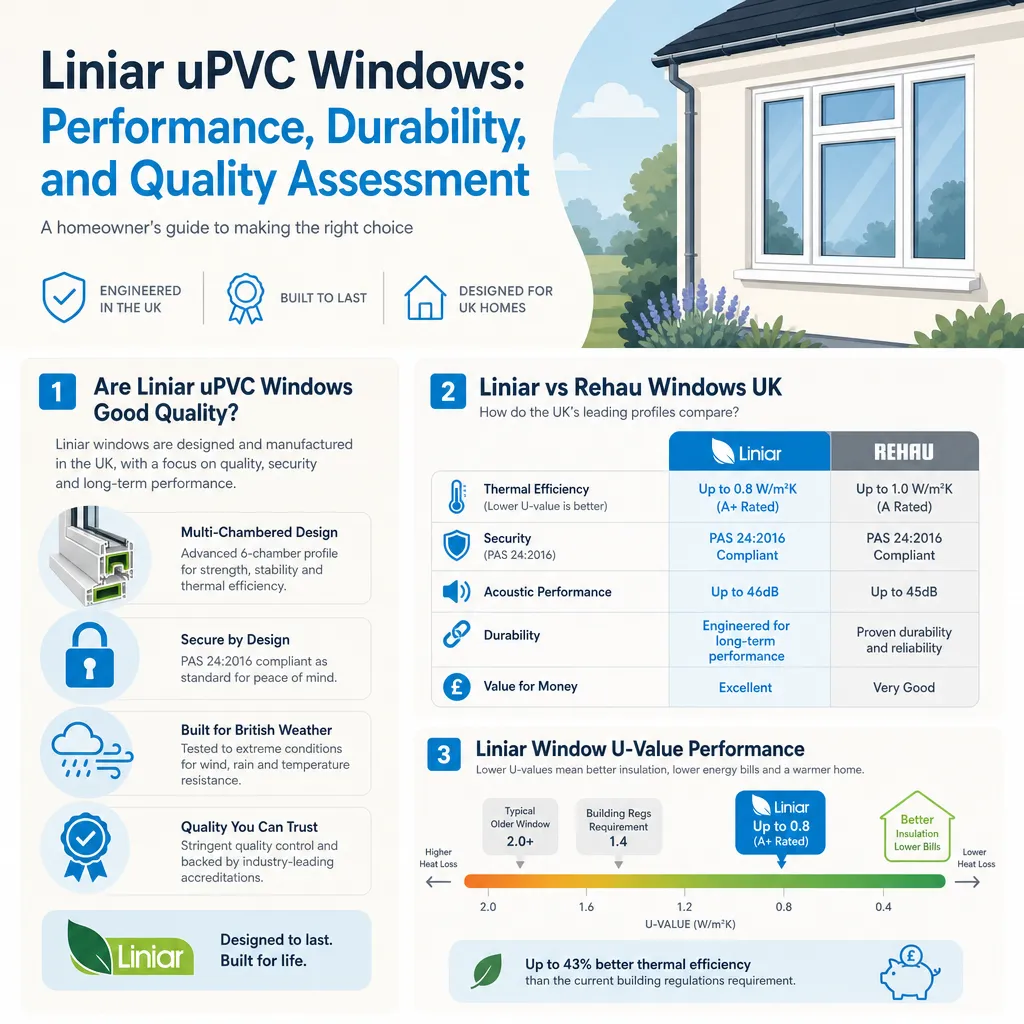
Liniar uPVC Windows: Performance, Durability, and Quality Assessment
Liniar uPVC window profiles are manufactured in the UK using multi-chambered, foamed frames.