Professional Tree Surgery and Arborist Services for Your Property
By Housey · Last reviewed 24th of May 2026
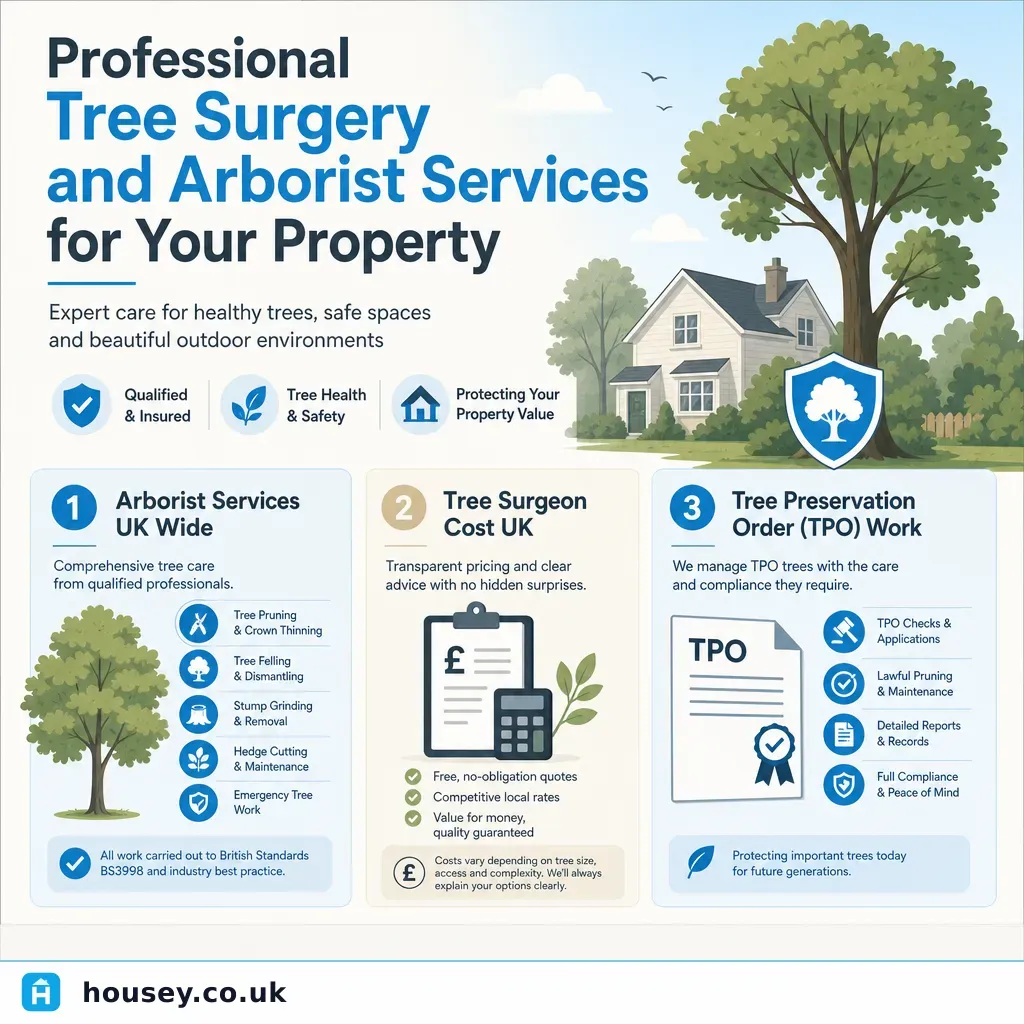
Professional Tree Surgery and Arborist Services for Your Property
Tree work on residential properties is one of the most frequently misunderstood areas of home improvement in the UK. Homeowners often discover — sometimes only after work has begun — that a tree in their garden is subject to legal protections requiring formal permission before any pruning, felling, or root work can take place. Whether you have a mature oak casting shade over your garden, a tree with diseased limbs posing a risk to your property, or crowns encroaching on neighbouring land, understanding the regulatory context and the professional standards that apply is essential before instructing anyone.
Key points
- Trees subject to a Tree Preservation Order (TPO) require written consent from your local planning authority before any work, including crown reductions or pruning — not just felling.
- Trees in conservation areas with a stem diameter above 75mm at 1.5m height require six weeks' prior written notice to the local planning authority before any work begins.
- A qualified arborist should hold LANTRA Awards or City & Guilds Level 2/3 in arboriculture; membership of the Arboricultural Association provides an additional benchmark for professional standards.
- Professional tree surgeons working on residential properties should carry public liability insurance of at least £5 million — always ask to see the certificate before work starts.
- The Wildlife and Countryside Act 1981 makes it an offence to damage or destroy an active bird's nest; tree work is generally avoided between February and August unless a pre-work nest survey confirms no active nests.
Do you need permission before starting tree work?
The answer depends on whether the tree is subject to a Tree Preservation Order (TPO) or falls within a conservation area.
A TPO is a formal legal protection made by the local planning authority (LPA) under the Town and Country Planning (Tree Preservation) (England) Regulations 2012. It can apply to individual trees, groups of trees, or woodlands of any species. If your tree has a TPO, you must submit an application to the LPA and receive written consent before carrying out any work — including crown thinning, crown reduction, or removal of deadwood. Carrying out work without consent can result in a substantial fine on conviction under the Town and Country Planning Act 1990.
In conservation areas, a notification system applies. For trees with stems over 75mm in diameter (measured at 1.5m above ground level), you must give six weeks' written notice to the LPA before starting work. The council may issue a TPO within that period if it considers the tree worthy of preservation. If six weeks pass without a response, you may generally proceed.
To check whether your tree is protected, contact your local planning authority directly or search via the Planning Portal. Exemptions exist for dead, dying, or dangerous trees and for certain minor maintenance, but the burden of proof rests with the property owner — consult the LPA before relying on any exemption.
What services does a tree surgeon provide?
A qualified arborist can carry out a broad range of works:
Service | Description | When typically needed |
|---|---|---|
Crown reduction | Reduces overall canopy size while preserving the tree's shape | Overgrowth, light obstruction, proximity to structures |
Crown thinning | Removes internal branches to improve light penetration and airflow | Dense canopy, wind resistance, improving tree health |
Crown lifting | Removes lower branches to increase clearance beneath the canopy | Access, sight lines, building proximity |
Tree felling | Complete removal, usually in sections from the top | Disease, structural failure, new development (TPO consent required) |
Stump grinding | Mechanical removal of the stump after felling | To allow replanting or hard landscaping |
Root surveys | Assesses root spread for planning or insurance purposes | Subsidence concerns, proximity to foundations |
Tree surveys (BS 5837) | Formal arboricultural assessment to British Standard | Planning applications, mortgage surveys, neighbour disputes |
Choosing a qualified arborist
The Arboricultural Association maintains a directory of approved contractors and consultants assessed against professional standards. Membership is voluntary but is recognised by local authorities, insurers, and planning departments across the UK.
What to ask before hiring a tree surgeon
- What qualifications do the operatives hold? LANTRA Awards or City & Guilds Level 2/3, including chainsaw and aerial rescue units, are the standard for climbing and felling work.
- What is the level and scope of your public liability insurance, and can I see a current certificate?
- Are you registered with the Arboricultural Association or another recognised professional body?
- Have you confirmed whether this tree is subject to a TPO or conservation area notification requirement?
- Will you provide a written quotation detailing what work will be carried out and what will happen to the arisings (logs, brash, chippings)?
- Is a site visit included before the quote is finalised?
- What will happen if complications are discovered on the day, such as internal rot or proximity to utilities?
Red flags to watch for
- No evidence of public liability insurance, or unwillingness to provide a current certificate.
- A quote given without a site visit for substantial or complex work.
- Pressure to begin immediately without confirming TPO or conservation area status.
- No written quotation provided before work commences.
- Proposed methods that do not follow BS 3998:2010 Recommendations for Tree Work.
- Operatives without relevant chainsaw or aerial rescue certifications.
Indicative costs
Indicative UK costs, last reviewed 2026-05-24. Costs vary significantly by tree size, species, access, location, and complexity.
- Crown reduction (small tree, up to 5m): £150–£350
- Crown reduction (large tree, over 10m): £400–£1,000+
- Tree felling (small to medium): £200–£600
- Tree felling (large tree, difficult access): £800–£2,500+
- Stump grinding: £60–£300 depending on stump diameter
- Arboricultural survey / BS 5837 report: £250–£800+
Always obtain at least three written quotes. For TPO work, a formal application to your LPA is also required, and some councils charge an application fee.
Important limitations
This article provides general information about tree surgery and arboricultural services in England. Regulations, permitted development rights, and conservation area designations vary by local authority. The only definitive way to establish whether a tree is protected is to check with your local planning authority. This guide does not constitute legal or planning advice. Rules in Wales, Scotland, and Northern Ireland differ.
What to ask a qualified professional
For formal arboricultural assessments needed for planning, insurance, or legal purposes, instruct a consultant who is an Arboricultural Association Registered Consultant or holds Chartered Arboriculturalist status.
- Ask whether the tree's condition warrants a BS 5837 survey before any work is planned.
- If you are planning an extension or other development near trees, ask whether an Arboricultural Impact Assessment will be required by the LPA.
- If you suspect a tree is causing subsidence, ask for a root investigation report before instructing removal, as your buildings insurer may have a specific process to follow.
When to get professional help
Always use a qualified arborist for any work involving climbing, aerial cutting, or chainsaw operations. The Working at Height Regulations 2005 and the Provision and Use of Work Equipment Regulations 1998 (PUWER) set legal standards for this work that are beyond the scope of DIY activity.
Contact the Arboricultural Association or a qualified consultant if:
- You are not certain whether your tree is subject to a TPO or conservation area requirement.
- The tree shows signs of serious structural decay, split unions, or fungal fruiting bodies at the base.
- Roots appear to be affecting your foundations, drains, or neighbouring structures.
- You are planning a construction project near existing trees.
- A boundary dispute with a neighbour involves a tree on or near the shared boundary.
How Housey can help
Housey connects homeowners with vetted, qualified tree surgeons and landscapers across the UK. Describe your tree work requirements, receive competing quotes from local professionals, and compare them at your own pace — without committing to the first contractor who approaches you.
Frequently asked questions
Do I need permission to cut down a tree in my garden?
Only if the tree is protected by a Tree Preservation Order or located in a conservation area. For TPO trees, you must apply to your local planning authority for consent before any work, including pruning. In conservation areas, give six weeks' written notice for trees with stems over 75mm in diameter. For unprotected trees outside conservation areas, no formal permission is generally required, though planning conditions or restrictive covenants may apply.
How much does tree surgery cost in the UK?
Costs vary widely by tree size, species, access, and type of work. Crown reductions on small trees typically start from around £150–£350; felling a large tree with difficult access can exceed £2,500. Always obtain at least three written quotes from qualified, insured arborists. Indicative costs, last reviewed 2026-05-24.
What qualifications should a tree surgeon have?
Operatives carrying out aerial work or chainsaw operations should hold LANTRA Awards or City & Guilds Level 2 or Level 3 certificates in arboriculture, including relevant chainsaw and climbing units. Membership of the Arboricultural Association is a recognised professional benchmark. Always ask to see proof of qualifications and a current public liability insurance certificate.
What is the difference between a tree surgeon and an arborist?
In practice the terms are often used interchangeably. "Tree surgeon" usually refers to operatives carrying out physical work such as pruning, felling, and stump removal. "Arborist" more often implies broader expertise including surveys, risk assessments, and planning reports. A Registered Consultant or Chartered Arboriculturalist holds higher-level qualifications and is appropriate for formal surveys and planning-related assessments.
How do I know if my tree has a Tree Preservation Order?
Contact your local planning authority directly or use the Planning Portal to search for TPOs in your area. Your LPA's tree officer can confirm whether any orders apply to trees on your property. If you are purchasing a property, your conveyancer should check for TPOs as part of the standard local authority searches.
Sources and further reading
- Tree Preservation Orders and trees in conservation areas — GOV.UK
- Find an Arboricultural Association approved contractor — Arboricultural Association
- Wildlife and Countryside Act 1981 — legislation.gov.uk
- Working at Height Regulations 2005 — Health and Safety Executive
- BS 3998:2010 Recommendations for tree work — BSI Group
Useful next reads
 Improvement & Build
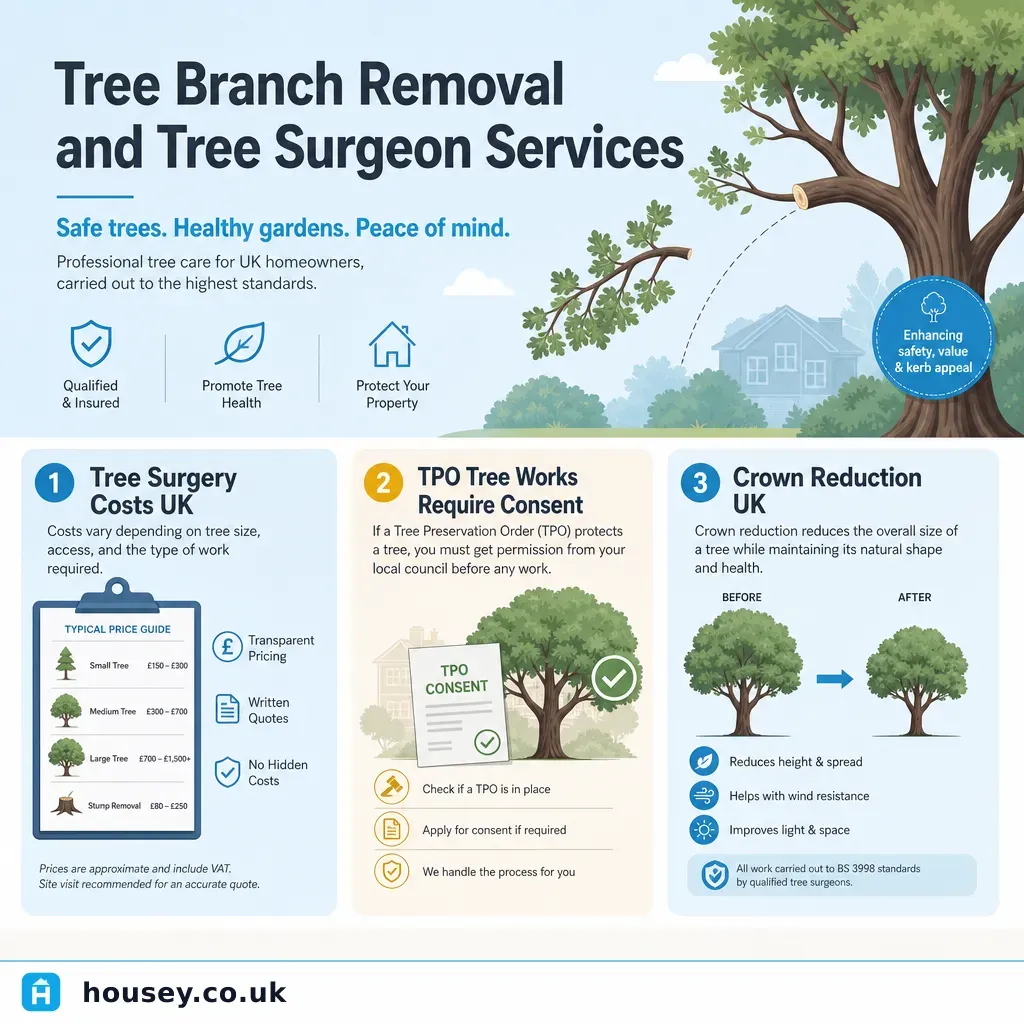
Tree Branch Removal and Tree Surgeon Services
Tree surgery — from deadwooding and crown reduction to branch removal and felling — must be carried out by qualified, insured contractors in the UK.
 Improvement & Build
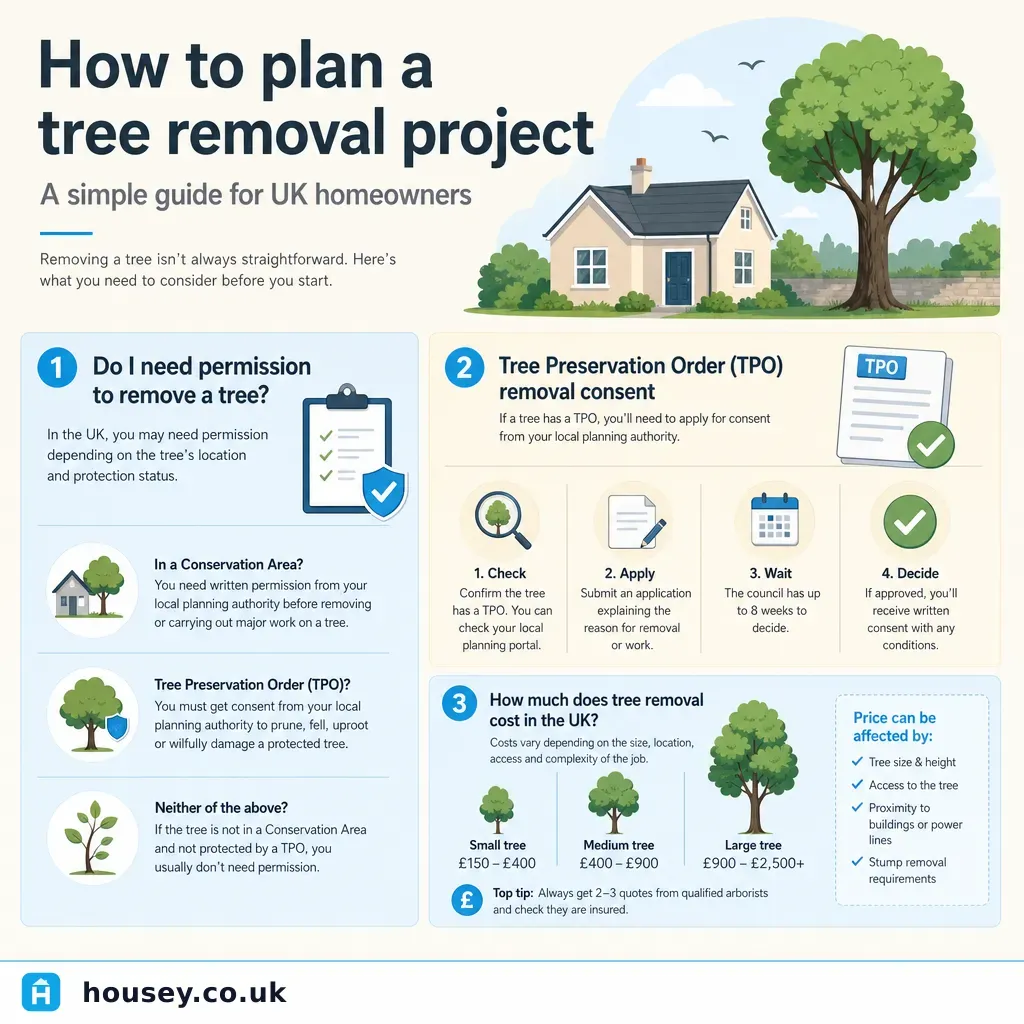
How to plan a tree removal project
Planning a tree removal project starts with checking whether the tree is protected by a Tree Preservation Order or sits in a conservation area, as both require council consent before any work begins.
 Improvement & Build
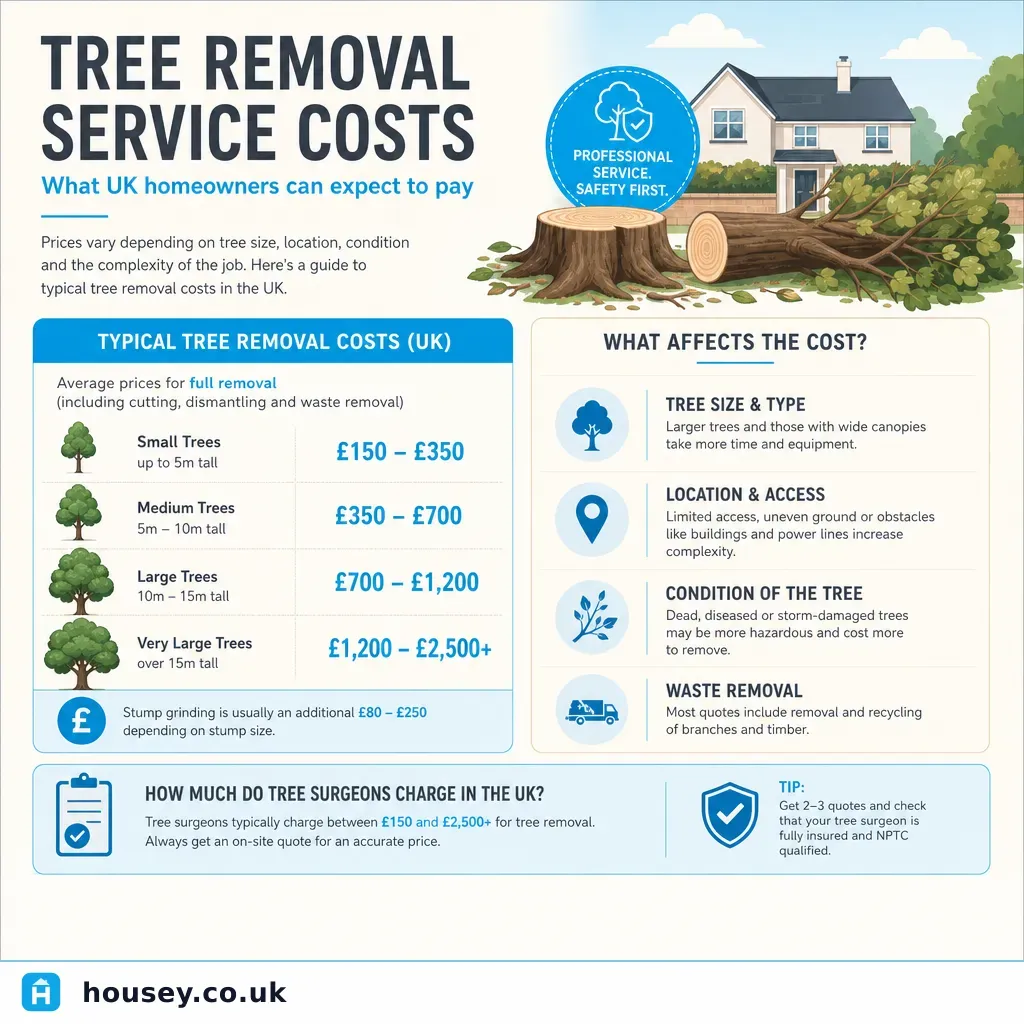
Tree Removal Service Costs
Professional tree removal costs in the UK depend on tree height, access, species, and the scope of work included.
 Improvement & Build
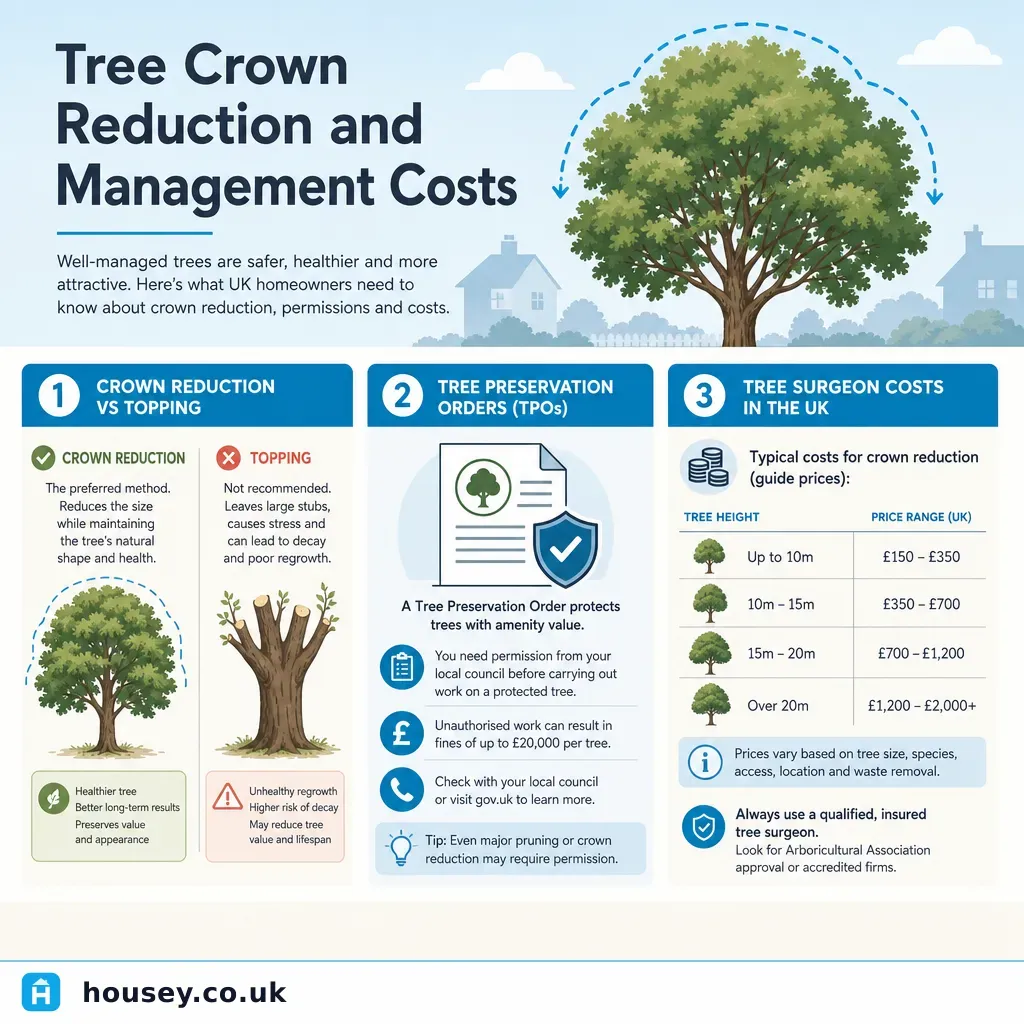
Tree Crown Reduction and Management Costs
Crown reduction reduces a tree's overall size by 15–30% while preserving its natural shape, and must follow BS 3998:2010.
 Improvement & Build
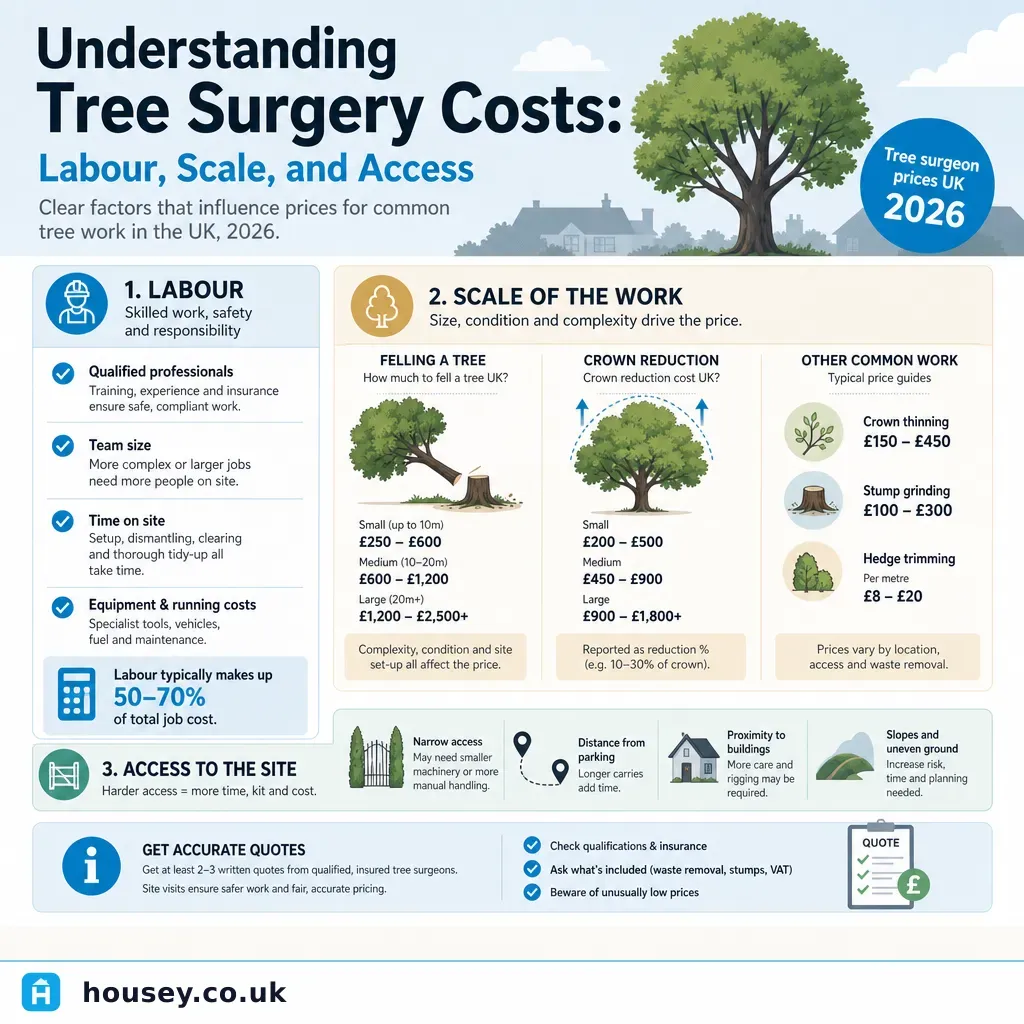
Understanding Tree Surgery Costs: Labour, Scale, and Access
Tree surgery costs in the UK depend on tree height, species, condition, and site access.