Tree Branch Removal and Tree Surgeon Services
By Housey · Last reviewed 11th of May 2026
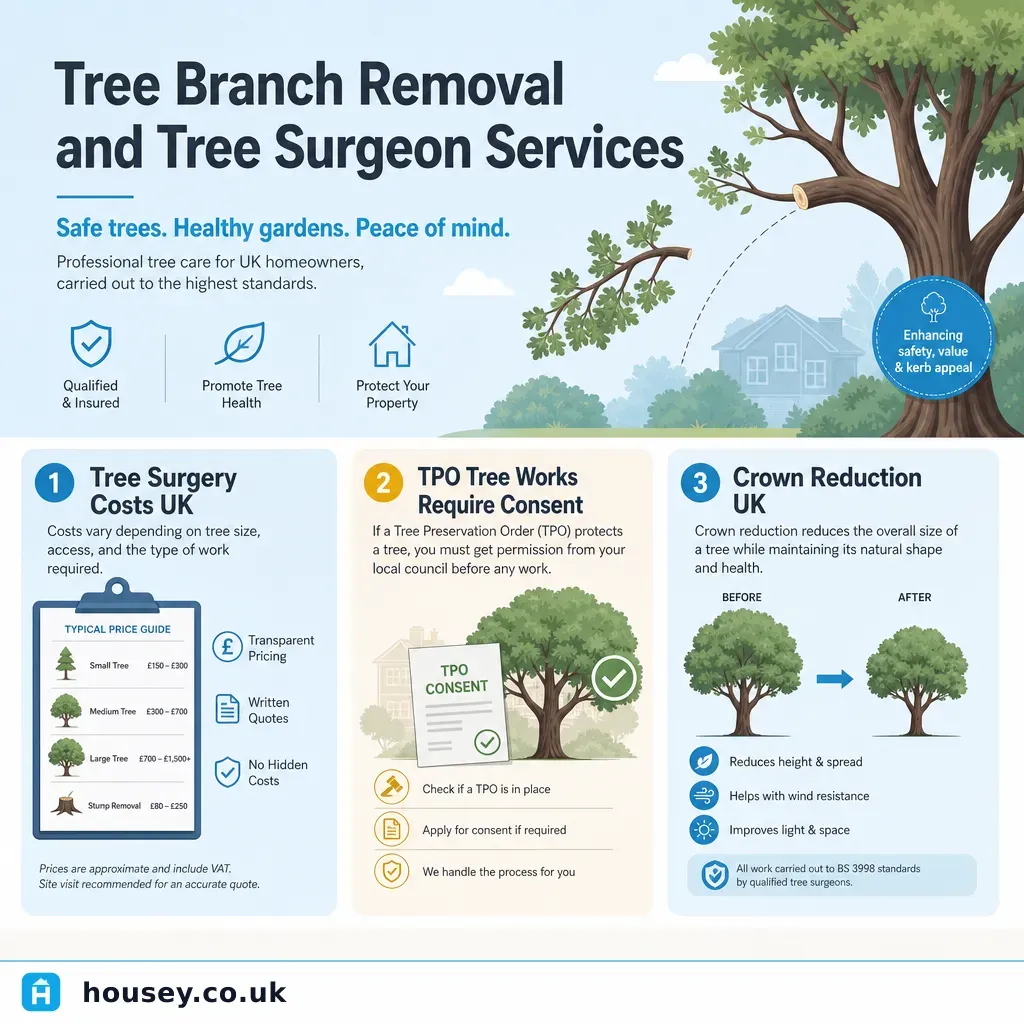
Tree Branch Removal and Tree Surgeon Services
Overhanging branches, deadwood, and structurally weak limbs are among the most common reasons UK homeowners contact a tree surgeon. The work may look manageable from the ground, but professional tree surgery combines arboricultural knowledge, rope-and-harness climbing skills, rigging expertise, and chainsaw certification — all subject to UK health and safety legislation. Critically, any work to a tree with a Tree Preservation Order (TPO) requires prior written consent from the local planning authority, and proceeding without it is a criminal offence under the Town and Country Planning Act 1990.
Key points
- All commercial tree surgery involving chainsaws requires operators to hold relevant NPTC (City & Guilds) chainsaw units — at minimum Unit 201 (chainsaw maintenance and crosscutting) — and appropriate working-at-height certification under the Work at Height Regulations 2005.
- Carrying out works to a TPO tree without local planning authority consent is a criminal offence, with fines of up to £20,000 or an unlimited fine on indictment under the Town and Country Planning Act 1990.
- Trees in conservation areas with a trunk diameter over 75 mm at 1.5 m height are automatically protected: a Section 211 Notice must be submitted to the local planning authority at least six weeks before any works begin.
- Deadwood removal, crown reduction, crown lifting, and crown thinning are distinct operations — specifying which you need allows accurate quote comparison and reduces the risk of over-pruning.
- A contractor's public liability insurance should cover a minimum of £5 million for tree surgery work near buildings, roads, or neighbouring properties.
Important limitations
This article provides general information about tree surgery services in the UK. It is not a substitute for a professional arboricultural assessment of your specific trees, property, or circumstances. Tree surgery involves significant risk of personal injury, property damage, and legal liability. Rules on TPOs, conservation areas, and planning consent vary by local planning authority and property. A qualified arborist should assess your trees and their condition before any works are instructed.
What is tree surgery and when is it needed?
Tree surgery — arboriculture in its professional form — covers a range of operations on established trees:
Operation | What it involves | Typical reason |
|---|---|---|
Crown reduction | Reducing overall height and spread of the canopy | Overhanging buildings, power lines, or neighbours |
Crown lifting | Removing lower branches to raise the canopy base | Access, light, or clearance beneath the tree |
Crown thinning | Selectively removing branches within the crown | Improved light and air movement; reduced wind loading |
Deadwooding | Removing dead, dying, or diseased branches | Safety — deadwood can fall without warning |
Specific branch removal | Removing one or more identified branches | Structural weakness, pest damage, or obstruction |
Pollarding | Cutting back to a defined framework, repeated on a cycle | Established management of certain species such as lime or willow |
Felling | Removing the tree entirely or in controlled sections | Disease, death, hazard, or development |
Stump grinding | Mechanically removing the stump below ground level | Replanting, hard landscaping, or access |
Who carries out tree surgery in the UK?
Tree surgeons (arborists) are not regulated by a single statutory body, but professional membership and qualification standards are well established:
- Arboricultural Association (AA): Membership indicates professional standing. AA Approved Contractors have met quality, safety, and insurance standards assessed by the Association.
- NPTC / City & Guilds: Award chainsaw and tree surgery qualifications (Units 201, 203, 206, 208, and others) that represent the industry competency standard.
- ISA (International Society of Arboriculture): ISA Certified Arborist is internationally recognised; the AA remains the primary UK professional body.
- TrustMark: Government-endorsed quality scheme; some tree surgeons register under the landscaping and arboriculture category.
Always verify chainsaw certifications, current public liability insurance (at least £5 million), and professional body membership before instructing a contractor.
TPOs, conservation areas, and planning consent
Before instructing any tree work, you must establish whether the tree is legally protected.
Tree Preservation Orders
A TPO is issued by the local planning authority and makes it an offence to cut, uproot, top, lop, or carry out any works to a protected tree without prior written consent. To check whether a tree has a TPO:
- Contact your local council's planning or tree officer directly.
- Search your local planning authority's TPO register — most councils publish interactive TPO maps online.
- Search MAGIC Map (DEFRA's geographic information service) at magic.defra.gov.uk.
Conservation areas
Trees with a trunk diameter over 75 mm at 1.5 m from ground level, in a conservation area, receive automatic protection equivalent to a TPO. Submit a Section 211 Notice to your LPA at least six weeks before starting work. The LPA may make a full TPO during that period.
Exemptions
Certain minor works may be exempt — for example, removing dead branches in specific circumstances. The exemptions are specific and not always straightforward; confirm with your LPA tree officer before assuming any exemption applies.
Decision guide: what kind of help do you need?
- Contact an AA Approved Contractor for crown reductions, deadwooding, or branch removal near a building, road, or overhead line.
- Contact your local planning authority before any work if the tree may have a TPO or is in a conservation area — do not rely solely on your contractor's assessment of this.
- Commission an arboricultural consultant (not a contractor) for an independent tree condition report, a legal dispute assessment, or a tree report for planning purposes.
- Request an urgent risk assessment if the tree is visibly leaning, has fungal growth at the base, cracks in the root plate, or a sudden increase in deadwood — do not delay.
- Contact the relevant utility company before work near overhead power lines — lines must be disconnected or protected before tree surgery can proceed safely.
When this becomes urgent
Treat tree work as urgent if you observe any of the following:
- Visible soil heave or root plate cracking around the base of the tree.
- A sudden or progressive lean that was not previously present.
- Significant crown dieback or a large increase in deadwood appearing within a single growing season.
- Large hanging or partially detached branches.
- Extensive fungal fruiting bodies at or near the tree's base, indicating internal decay.
- Any tree that has been struck by lightning or significantly damaged in a storm.
In these circumstances, contact a qualified arborist promptly. Do not attempt to assess the tree's structural condition yourself, and keep people and property away from the risk zone until a professional has inspected it.
What to ask a qualified professional
Before instructing a tree surgeon, ask:
- What NPTC/City & Guilds chainsaw qualifications do your climbers and ground workers hold, and are they current?
- What level of public liability insurance do you carry — and can I see the current certificate?
- Are you an Arboricultural Association Approved Contractor?
- Have you checked whether this tree has a TPO, and who is responsible for obtaining any necessary consent before works begin?
- Can you provide a written specification of the exact work proposed — which branches, what operation, and what the outcome will look like?
- How will the arisings (cut branches and timber) be managed — chipped on site, removed, or left?
- What happens to the stump — is grinding included, or quoted separately?
- Is VAT included in your quote?
Red flags when hiring a tree surgeon
Be cautious if a contractor:
- Cannot produce evidence of NPTC chainsaw certification or current public liability insurance when asked.
- Quotes to remove a tree without checking for a TPO.
- Recommends "topping" — heavy, indiscriminate crown reduction — as a routine treatment. This is widely considered poor arboricultural practice and can destabilise the tree's long-term structure.
- Offers a price significantly lower than all other quotes without a clear explanation of what is excluded.
- Uses climbing spikes on a tree that is not being felled — spike climbing damages the cambium of living trees and is not acceptable practice on retained trees.
- Cannot or will not provide a written specification before starting work.
When to get professional help
Tree surgery always requires qualified professional contractors. The Work at Height Regulations 2005 apply to any work at or above 2 m, and chainsaw operation requires NPTC certification. Professional help is non-negotiable for:
- Any work involving a chainsaw.
- Work at height above 2 m — which covers virtually all tree surgery.
- Trees near buildings, roads, overhead utilities, or neighbouring properties.
- Any tree that may be subject to a TPO or conservation area protection.
- Any situation where the tree's structural integrity is uncertain.
How Housey can help
Housey connects you with vetted and insured tree surgeons across the UK. Compare quotes from qualified local arborists for branch removal, crown work, and felling — with professional qualifications and insurance confirmed before they quote on your job.
Frequently asked questions
Do I need permission to remove a branch from a tree in my garden?
Not usually, unless the tree has a Tree Preservation Order or is in a conservation area. If a TPO applies, you need written consent from your local planning authority before carrying out any works. For trees in conservation areas with a trunk over 75 mm diameter, you must give six weeks' prior notice under Section 211 of the Town and Country Planning Act 1990.
How much does tree surgery cost in the UK?
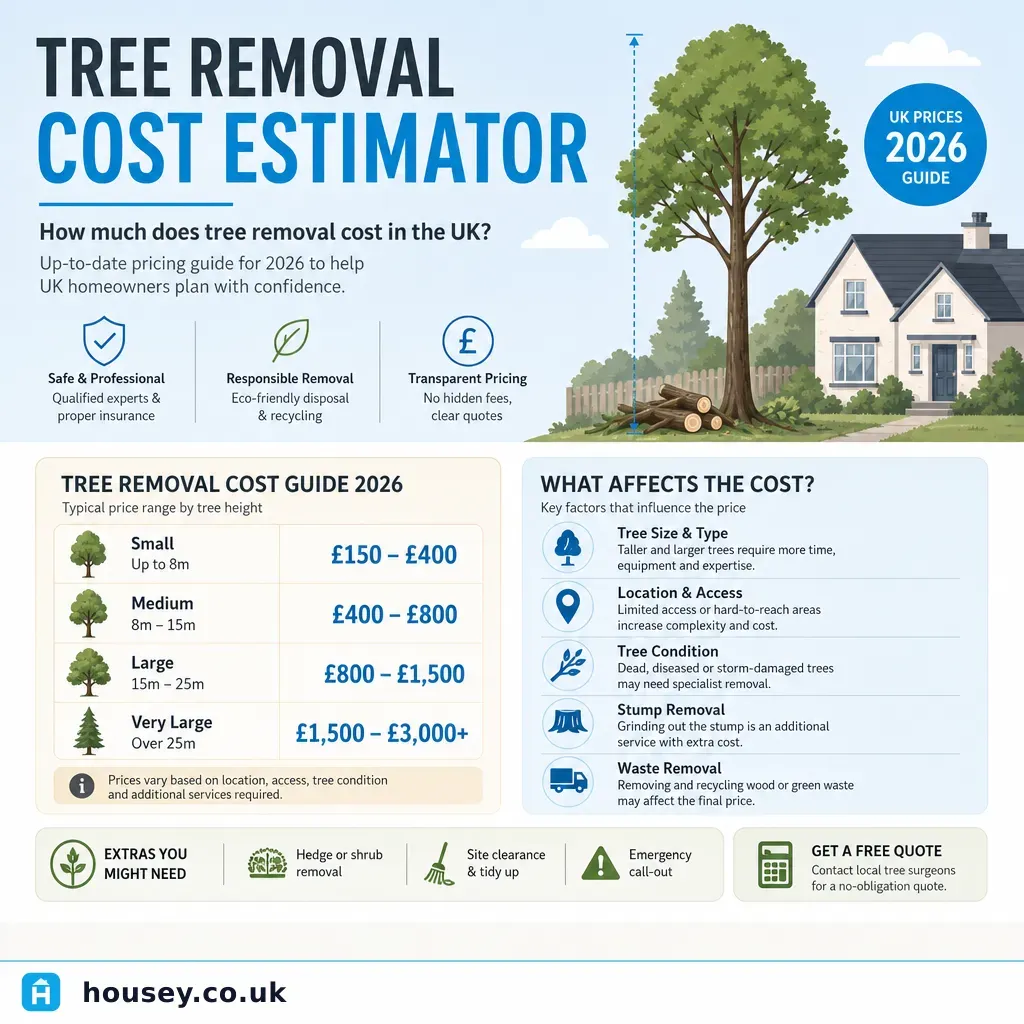
Indicative UK costs, last reviewed 2026-05-11. Costs vary with species, tree size, access, and operation. Simple branch removal on a small tree may cost £150–£300; crown reduction on a large tree typically ranges from £500 to £1,500+; felling and stump grinding of a large mature tree may cost £1,000–£3,000+. Obtain at least two itemised quotes and confirm VAT is included.
Can my neighbour cut back branches overhanging their property?
Under common law, a neighbour may cut back branches or roots that cross the boundary up to that boundary line, at their own expense. They are not entitled to enter your property without permission or cut beyond the boundary. Any cut material belongs to you as the tree owner. Check whether the tree has a TPO before they proceed, as the legal position changes if it does.
What qualifications should a tree surgeon hold?
Look for NPTC/City & Guilds chainsaw certification (Units 201, 203, 206, 208 as relevant to the work), current public liability insurance of at least £5 million, and Arboricultural Association Approved Contractor status. Always ask to see the insurance certificate and certificates of competency before work begins.
Sources and further reading
- Tree Preservation Orders and Trees in Conservation Areas — GOV.UK Planning Practice Guidance
- Work at Height Regulations 2005 — legislation.gov.uk
- Arboricultural Association — Approved Contractors — Arboricultural Association
- Town and Country Planning Act 1990 — legislation.gov.uk
- Chainsaws at Work — Health and Safety Guidance — HSE
Useful next reads
 Improvement & Build
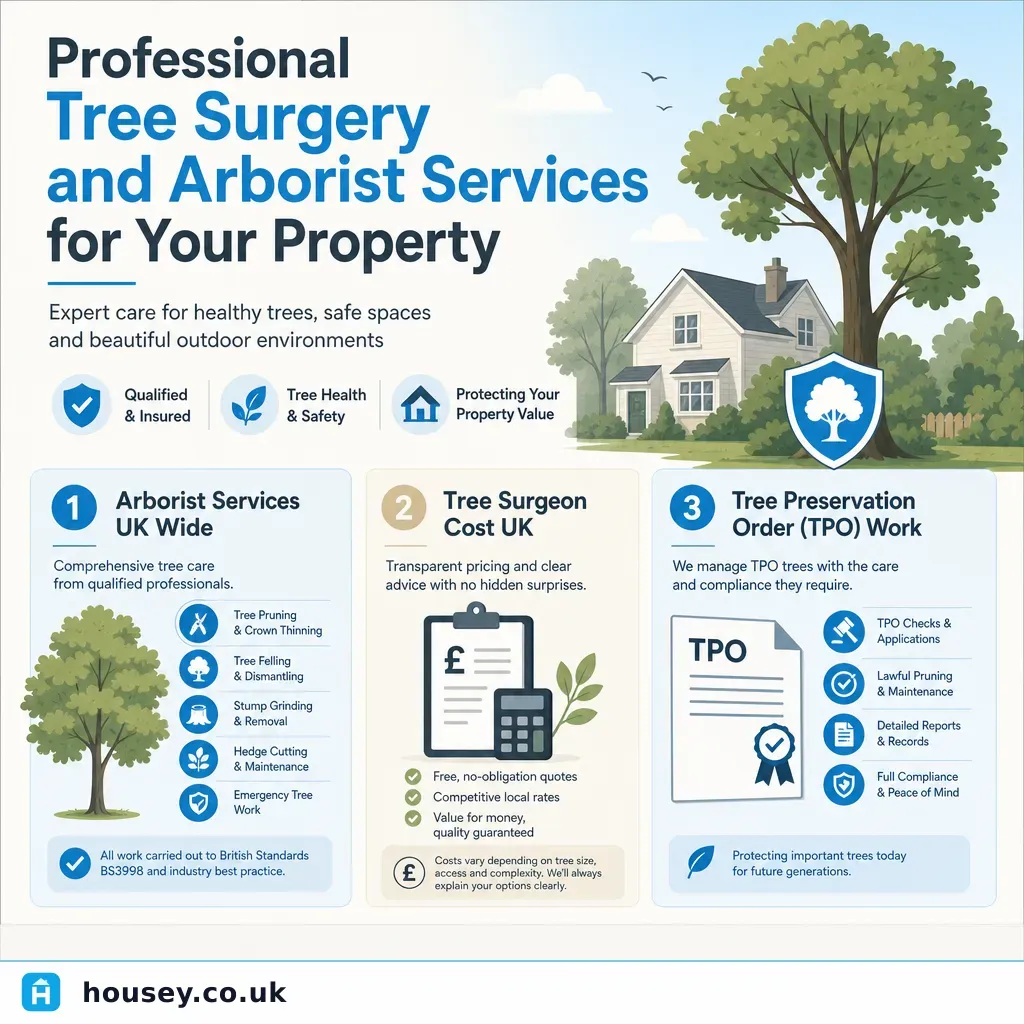
Professional Tree Surgery and Arborist Services for Your Property
A qualified arborist can safely prune, reduce, or fell trees on your property.
 Improvement & Build
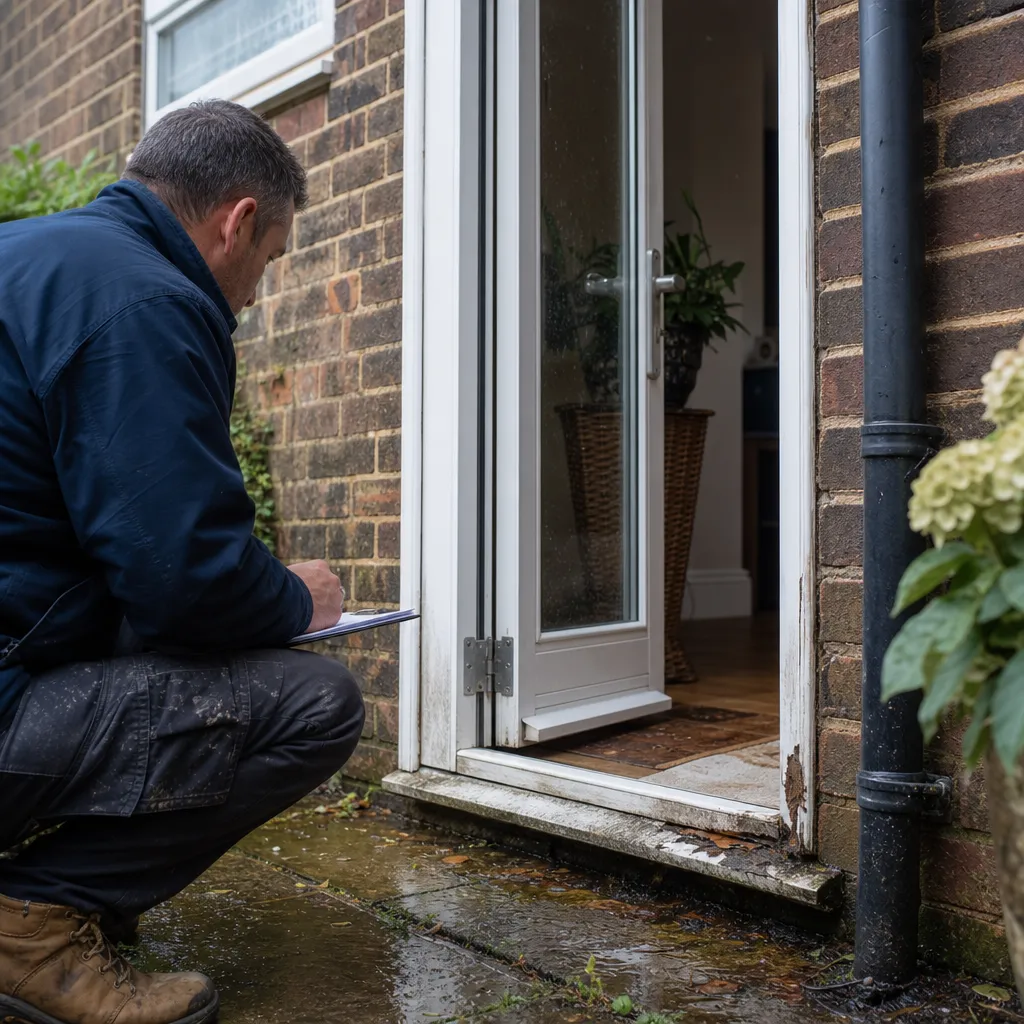
Fixing Leaking Back Doors and Water Ingress
Most leaking back doors in UK homes fail at one of three points: the threshold or door sill joint, the frame-to-masonry mastic seal, or the door weatherstrip.
 Improvement & Build
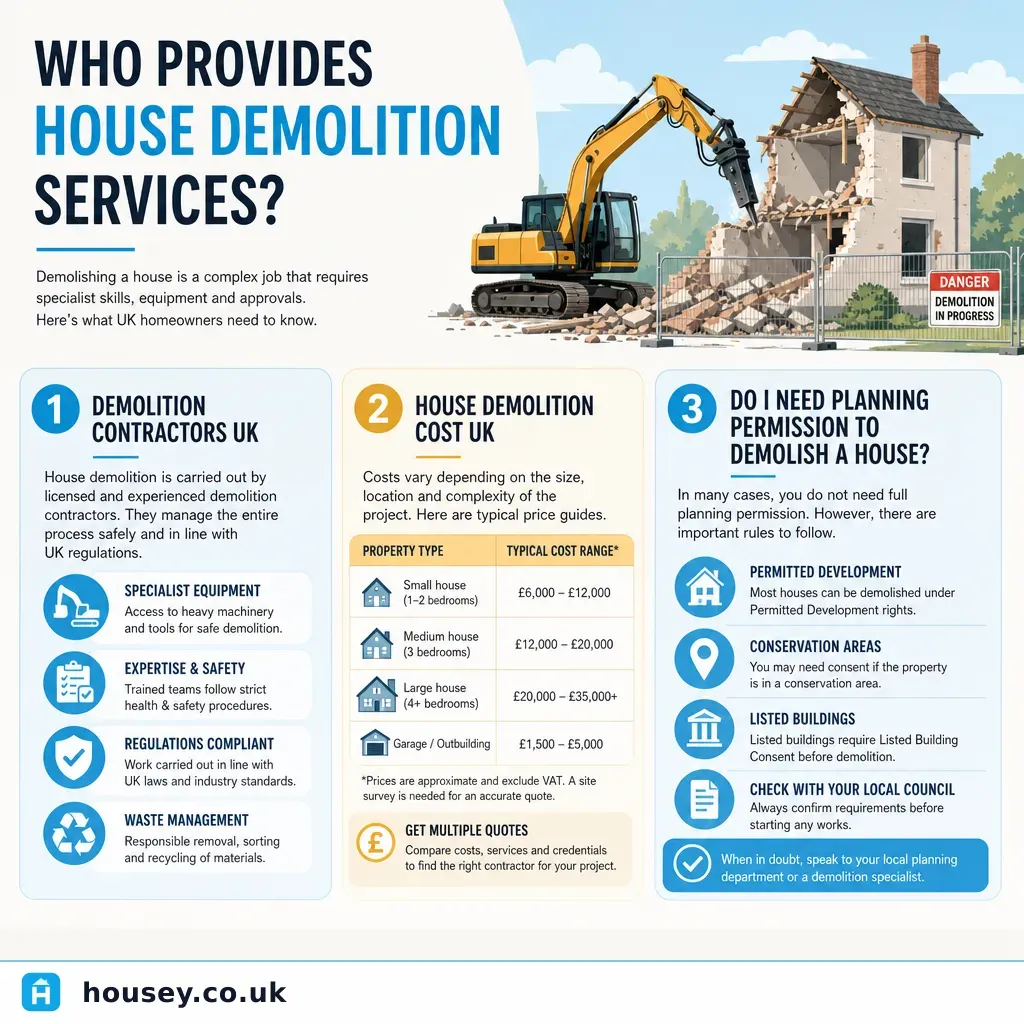
Who Provides House Demolition Services
House demolition in the UK is carried out by specialist demolition contractors, often members of the National Federation of Demolition Contractors (NFDC).
 Improvement & Build
Tree Removal Cost Estimator
Tree removal in the UK costs roughly £150 to £5,000 or more, depending on the tree's height, species, access conditions, and whether stump removal is needed.
 Improvement & Build
Watering Large Trees: Techniques and Frequency for Establishment
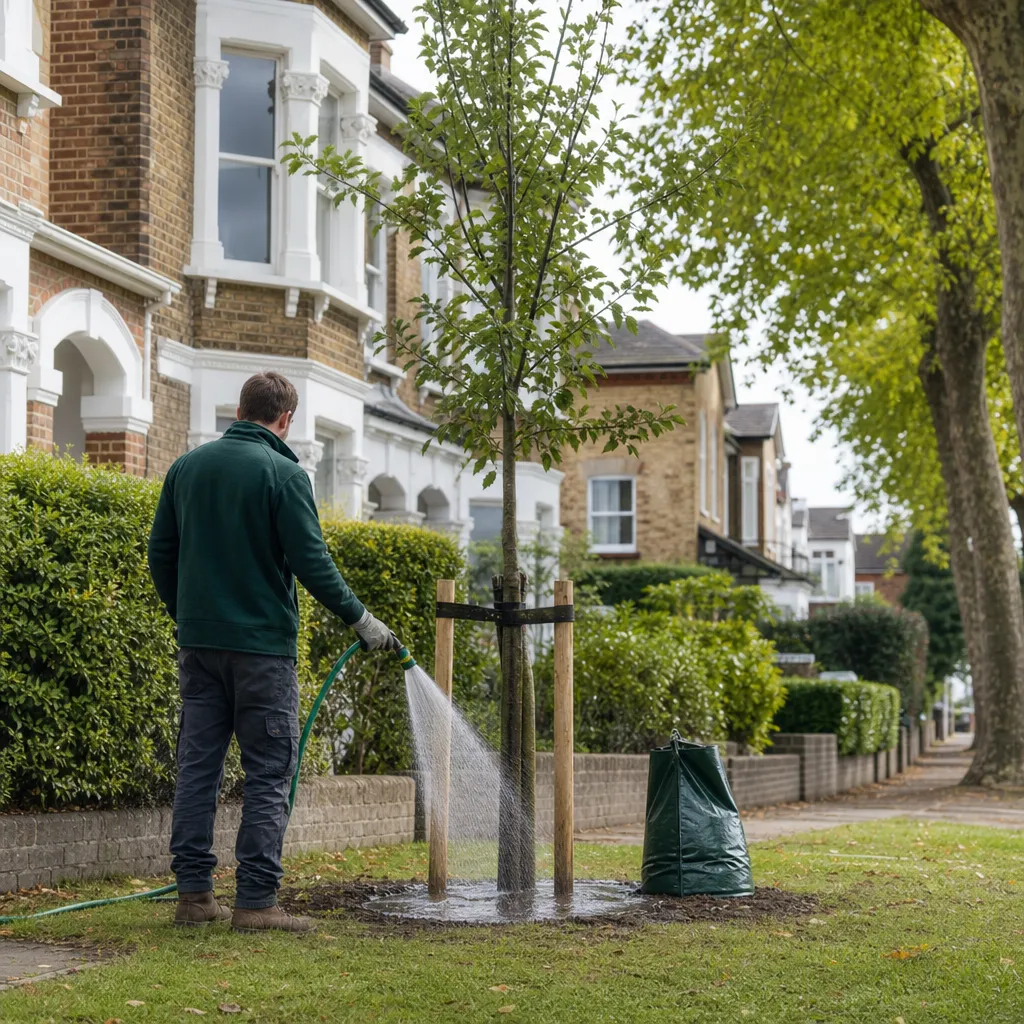
Newly planted large trees typically need 50–90 litres of water per week during the growing season for the first two to three years.