Understanding Tree Surgery Costs: Labour, Scale, and Access
By Housey · Last reviewed 11th of May 2026
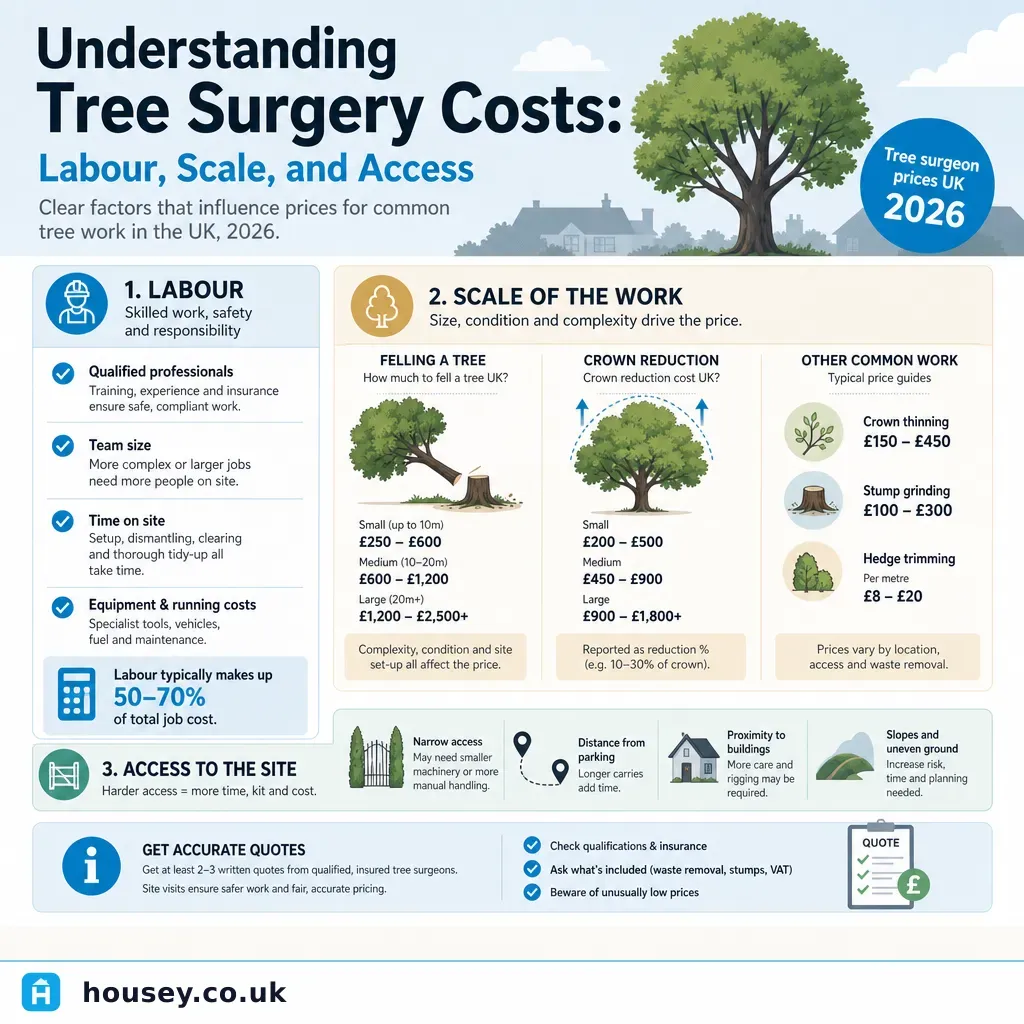
Understanding Tree Surgery Costs: Labour, Scale, and Access
When a tree on your property needs attention — whether because of storm damage, disease, overcrowding, or simply outgrowing its position — the cost of professional tree surgery can vary considerably across the UK. Most homeowners request quotes without a clear picture of what drives the price, which makes it difficult to compare quotations fairly or to spot a quote that omits important elements such as stump grinding or waste removal.
Key points
- The Arboricultural Association recommends using arborists who hold at minimum a City & Guilds Level 3 Award in Arboriculture or equivalent NPTC/LANTRA qualification, alongside appropriate public liability insurance.
- Tree Preservation Orders (TPOs) require Local Planning Authority (LPA) consent before most works; carrying out unauthorised work on a TPO tree is a criminal offence under section 210 of the Town and Country Planning Act 1990, carrying an unlimited fine.
- Trees within a Conservation Area require prior notification to the LPA — typically six weeks' notice — before most works, even without a formal TPO in place.
- Stump grinding is almost always quoted separately from felling or reduction; confirm disposal of green waste and logs in writing before works begin.
- Indicative UK costs, last reviewed 2026-05-11: crown reduction on a small tree £150–£400; felling a large tree in restricted conditions £800–£2,000+; stump grinding £60–£200 per stump. Costs vary significantly by region, access, and complexity.
What drives tree surgery costs?
Tree surgery is not a commodity service. Two trees of the same species and approximate height can attract very different quotes depending on several factors that affect the time, equipment, and skill required.
Tree height and species
Taller trees require more time, more equipment, and — on confined sites — sectional dismantling from the top down rather than a straight fell. Dense hardwoods such as oak, beech, and ash are more demanding to work through than softwoods. Mature fruit trees often require more careful and time-consuming surgery to preserve their productive form and long-term health.
Condition of the tree
A diseased, hollow, or structurally compromised tree may need additional rigging and more cautious sectional removal to prevent uncontrolled movement. Identifying decay often requires extra assessment time and increases job complexity significantly.
Site access
A tree standing in an open back garden with easy vehicular access is far cheaper to work on than one overhanging a house, within a walled or terraced garden, adjacent to overhead power lines, or near listed structures. Restricted access means more climbing time, smaller equipment, and — in some cases — crane-assisted operations, each of which adds cost.
Works required
Crown reduction (reducing overall height and spread while maintaining form), crown thinning (removing selected branches to improve light and airflow), deadwooding (removing dead or dying branches), and full felling each carry different time requirements and disposal obligations. The combination of works required is often a greater cost driver than tree size alone.
Timber and green waste disposal
Some arborists chip green waste on site and remove it; others leave logs for the homeowner to use as firewood. Some charge separately for removal; others include it. Clarify your requirements and confirm disposal arrangements in writing before accepting any quote.
Tree surgery cost comparison table
Work type | Typical tree size | Indicative cost range (UK, 2026) | Notes |
|---|---|---|---|
Crown reduction | Small (up to 6 m) | £150–£400 | Straightforward access assumed |
Crown reduction | Medium (6–12 m) | £350–£700 | More crew time and rigging required |
Crown reduction | Large (12 m+) | £600–£1,500+ | Sectional dismantling likely |
Crown thinning | Small to medium | £150–£500 | Skill-intensive; varies by canopy density |
Deadwooding | Any size | £100–£400 | Often combined with other works |
Felling (open site) | Small | £100–£300 | Stump excluded |
Felling (restricted site) | Medium to large | £600–£2,000+ | Complex rigging or crane access |
Stump grinding | Per stump | £60–£200 | Diameter and access dependent |
Emergency call-out | Any | £300–£1,000+ | Includes out-of-hours premium |
Indicative UK costs, last reviewed 2026-05-11. Costs vary significantly by region, site conditions, tree condition, and contractor. Obtain a minimum of three written, itemised quotes.
Checking for Tree Preservation Orders and Conservation Area restrictions
Before instructing any tree work, confirm whether the tree is subject to a TPO or sits within a Conservation Area. Your Local Planning Authority holds TPO records; most councils provide an online map or respond to enquiries within a few working days. The Planning Portal and your council's website are the starting points.
Carrying out notifiable works without consent or prior notice can result in prosecution and an unlimited fine in the Magistrates' Court. Some works to protected trees are exempt — for example, removing a branch that poses an immediate safety threat to a person — but these exemptions are narrow. Check the specifics with your LPA before relying on them.
What to ask before accepting a quote
- What qualifications does the operative hold? Seek City & Guilds Level 3, LANTRA, or NPTC certification; Arboricultural Association Approved Contractor status is a useful quality indicator.
- Can you provide evidence of public liability insurance and employer's liability insurance?
- Does the quote include waste removal and stump grinding, or are these priced separately?
- What methodology will be used — straight fell, sectional dismantling, or crane-assisted?
- Have you confirmed whether the tree is subject to a TPO or is within a Conservation Area, and will you obtain any necessary consents?
- What assumptions has the quote been based on, and what could change the price or timeline?
- Is VAT included in the quoted price?
- What happens if the tree is found to be more structurally compromised or diseased than it appears?
When to get professional help
All tree surgery involving work above approximately 2 m, chainsaw operation, or aerial rigging must be carried out by a qualified professional — there is no safe DIY approach to felling or reducing trees of any significant size. If a tree shows sudden lean, major branch failure, fungal brackets at the base, or is in close proximity to a building, road, or overhead line, treat the situation as potentially urgent and contact a qualified arborist without delay. Out-of-hours emergency services are available from most established tree surgery firms.
How Housey can help
Housey connects UK homeowners with insured, qualified tree surgeons in their local area. You can request quotes, compare qualifications and experience, and read reviews from other homeowners — making it easier to find the right professional for your tree, your site, and your budget.
Frequently asked questions
Do I need permission to cut down a tree in my garden?
Not always, but you must check before instructing any work. If the tree is subject to a Tree Preservation Order or is within a Conservation Area, you need Local Planning Authority consent or must give six weeks' prior notice. Even trees on private land can be legally protected. Check with your local council before commissioning any work.
How many quotes should I get for tree surgery?
At minimum three written, itemised quotes. Price alone should not be the deciding factor — check qualifications, insurance, methodology, and what is included. Very low quotes may indicate inadequate insurance, unlicensed operatives, or undisclosed extra charges for waste removal and stump grinding.
Is tree surgery VAT-exempt?
No. Professional tree surgery is subject to the standard rate of VAT, currently 20%. Confirm whether quotes are inclusive or exclusive of VAT before comparing them. A legitimate contractor will clearly state whether VAT is included.
Can an arborist refuse to work on a TPO tree?
Yes. Responsible arborists will decline to carry out works on a protected tree without evidence that appropriate Local Planning Authority consent or prior notification has been obtained. The legal risk for unauthorised works sits with the tree owner, not the contractor.
Sources and further reading
- Tree Preservation Orders and trees in Conservation Areas — GOV.UK
- Find an approved arborist — Arboricultural Association
- Town and Country Planning Act 1990 — tree provisions — legislation.gov.uk
Useful next reads
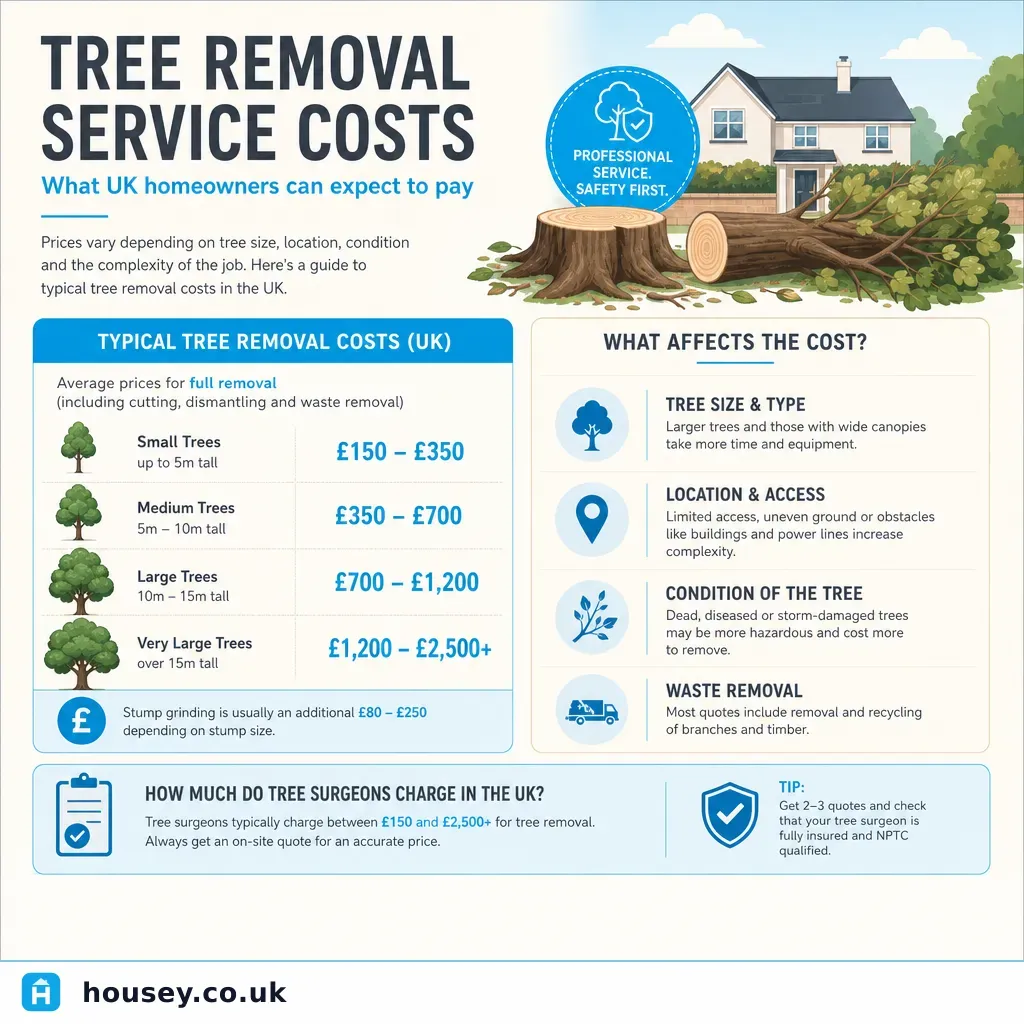 Improvement & Build
Tree Removal Service Costs
Professional tree removal costs in the UK depend on tree height, access, species, and the scope of work included.
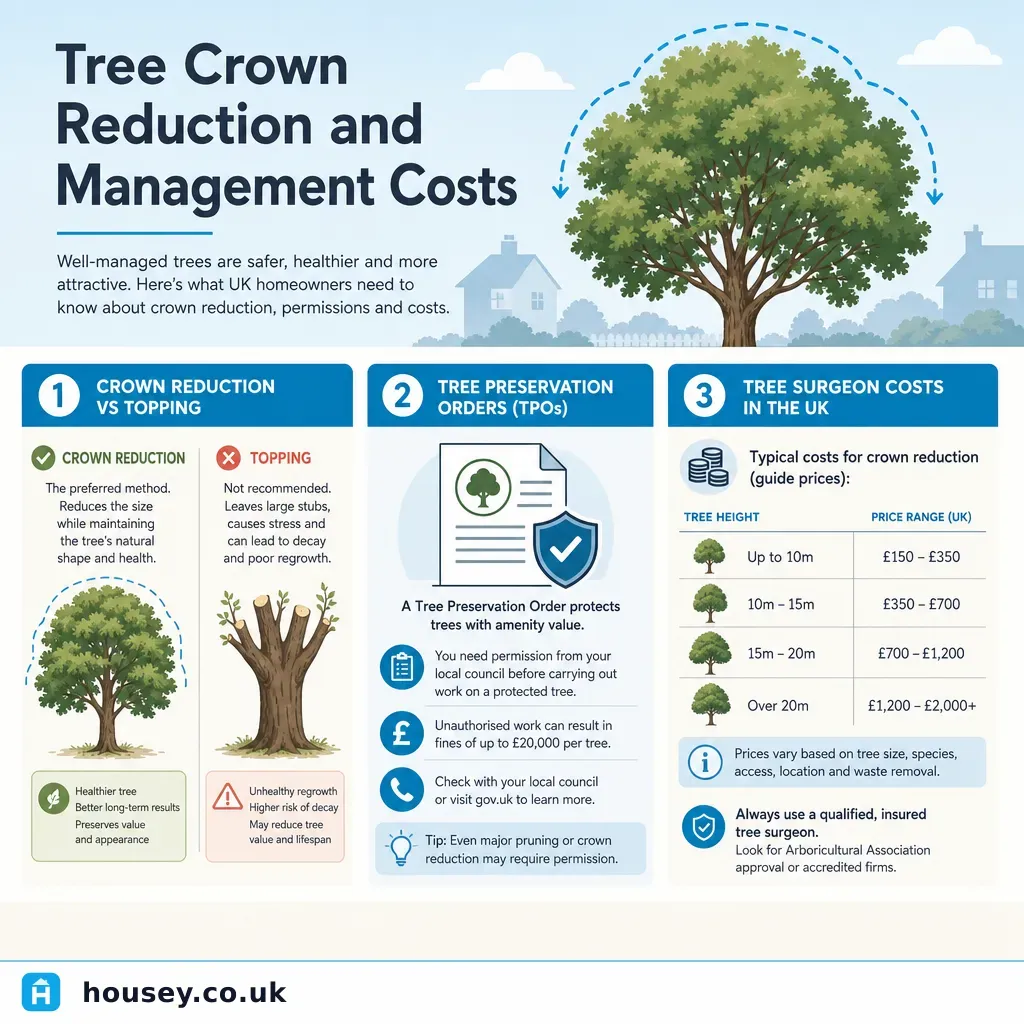 Improvement & Build
Tree Crown Reduction and Management Costs
Crown reduction reduces a tree's overall size by 15–30% while preserving its natural shape, and must follow BS 3998:2010.
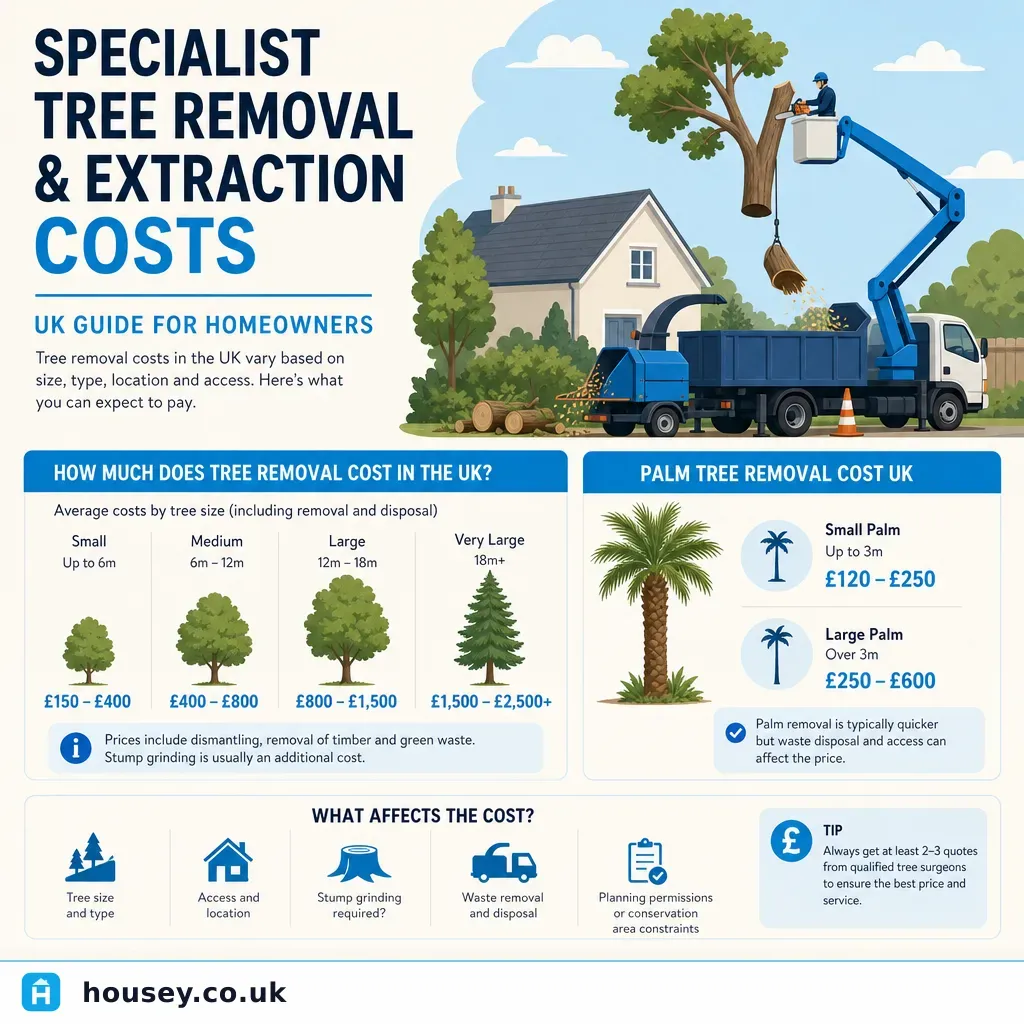 Improvement & Build
Specialist Tree Removal and Extraction Costs
Specialist tree removal costs in the UK range from around £150 for small trees to £3,000 or more for large mature specimens, with palm trees typically costing more due to specialist technique.
 Improvement & Build
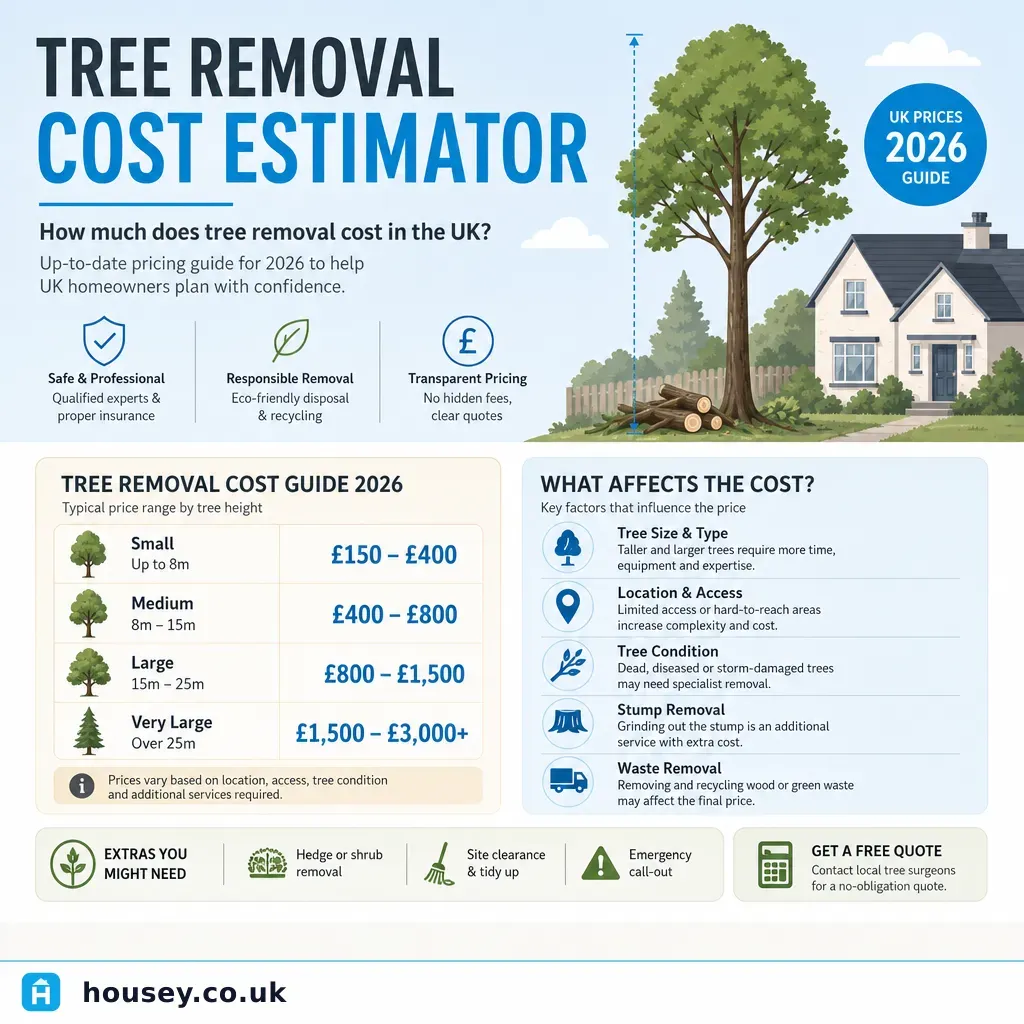
Tree Removal Cost Estimator
Tree removal in the UK costs roughly £150 to £5,000 or more, depending on the tree's height, species, access conditions, and whether stump removal is needed.
 Improvement & Build
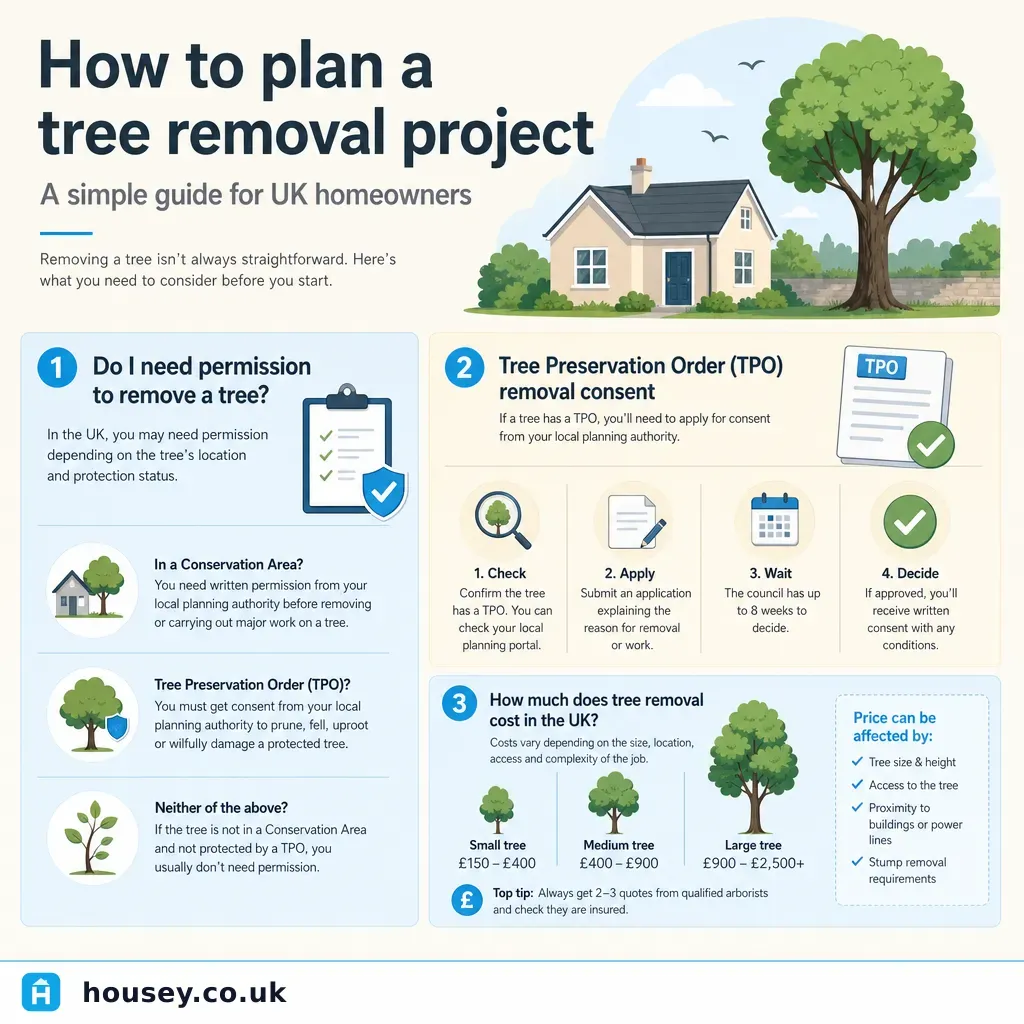
How to plan a tree removal project
Planning a tree removal project starts with checking whether the tree is protected by a Tree Preservation Order or sits in a conservation area, as both require council consent before any work begins.