Professional Tree Trimming and Limb Removal Equipment Explained
By Housey · Last reviewed 30th of May 2026
Professional Tree Trimming and Limb Removal Equipment Explained
Trees on UK residential properties require careful management — whether a limb has come down in a storm, a branch is rubbing against the guttering, or a mature tree needs crown reduction to remain in good health. Understanding the specialist equipment that qualified tree surgeons use helps homeowners ask better questions, assess contractor credentials, and spot when a quote is missing something important.
Key points
- BS 3998:2010 is the British Standard for tree work, setting out best-practice requirements for pruning, crown reduction, and felling on amenity trees.
- Chainsaw operators must hold a valid NPTC/Lantra qualification — typically City & Guilds units CS30 (safe use of a chainsaw), CS31 (felling trees up to 380 mm), and CS38 (aerial chainsaw work).
- Trees subject to a Tree Preservation Order (TPO) or located within a conservation area require prior consent from the local planning authority before any pruning or removal takes place.
- The Work at Height Regulations 2005 require tree surgeons working above 2 m to carry out a risk assessment and use appropriate access equipment such as rope-access systems or mobile elevated work platforms.
- The Arboricultural Association's Approved Contractor register is the recognised UK benchmark for vetting tree surgery contractors.
What equipment does a professional tree surgeon use?
Professional arborists select equipment based on the tree, the available access, and the proximity of the work to structures. A simple crown lift in an open garden requires different kit from a controlled limb removal over a conservatory.
Cutting and pruning tools
- Hand pruning saws — used for branches up to around 75 mm diameter where a chainsaw is not warranted or practicable.
- Pole pruners — extend reach up to approximately 4–6 m from the ground without climbing; useful for light pruning below the main canopy.
- Top-handle chainsaws — compact saws used by trained climbers working within the canopy; operators must hold the relevant NPTC chainsaw certification and wear full PPE.
- Rear-handle bar chainsaws — used at ground level for sectional felling, log processing, and large-limb removal.
Access equipment
The access method chosen affects price, ground impact, and the degree of control the arborist has over where cut material falls.
Equipment type | Typical use case | Main advantage | Key limitation |
|---|---|---|---|
Rope-access climbing (SRT or DdRT) | Crown reduction, selective pruning, limb removal in canopy | Flexible; low ground disturbance | Requires a trained aerial arborist |
Mobile elevated work platform (MEWP / cherry picker) | Roadside trees, urban or restricted access sites | Stable working platform | Needs firm ground access; plant hire adds cost |
Pole pruner (no climbing) | Light pruning up to around 6 m | No access equipment required | Not suitable for heavy or structural limbs |
Ladder | Minor low-branch work only | Low cost | Not appropriate above 2 m for significant tree work under Work at Height Regulations 2005 |
Ground-support equipment
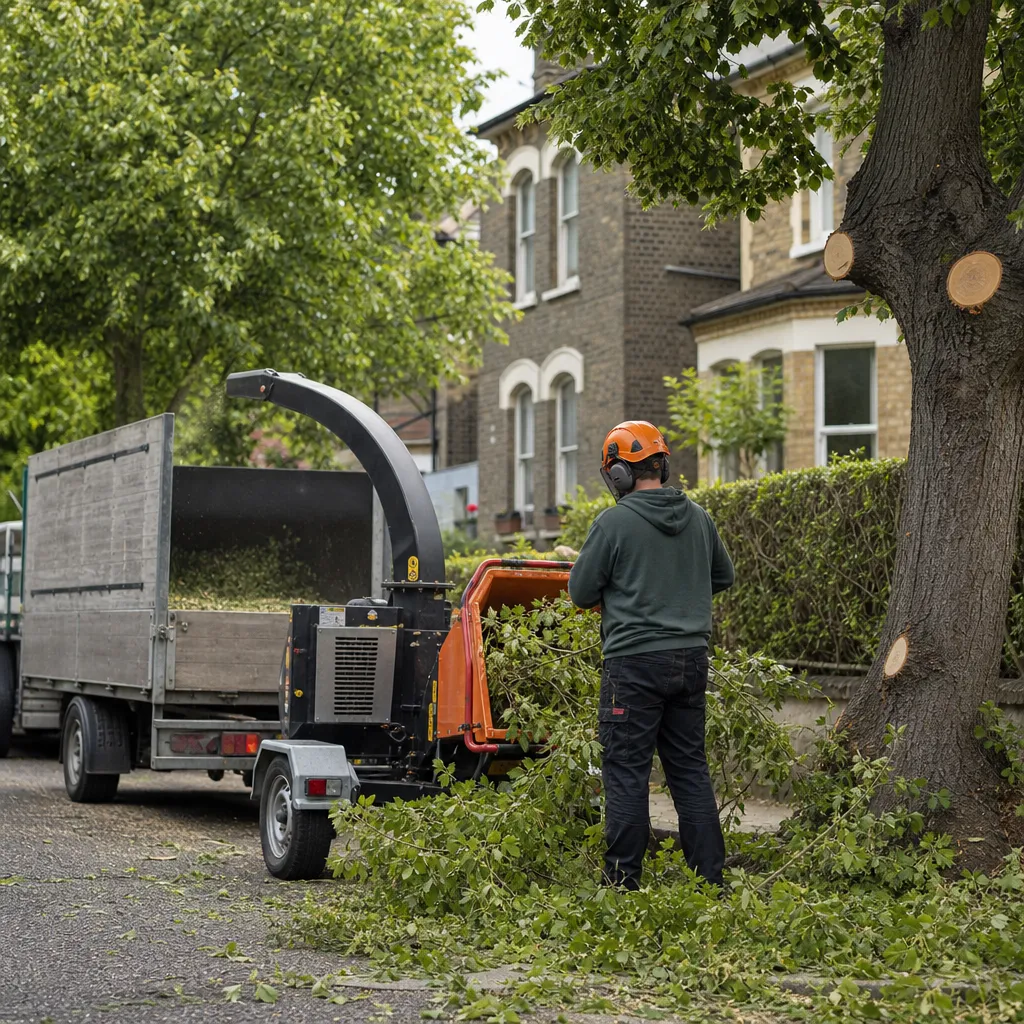
- Wood chippers — convert cut branches and brush into chip on site, significantly reducing haulage volume.
- Stump grinders — remove stumps to below ground level after felling, preventing regrowth and leaving the area ready for replanting or hard landscaping.
- Rigging lines and lowering devices — control the descent of large limbs during sectional removal, protecting lawns, fencing, and structures below.
When does tree work require specialist equipment?
Most homeowners underestimate the complexity of professional tree work. Situations that specifically require specialist equipment include:
- Limb removal near buildings or boundaries — rigging is needed to lower sections in a controlled direction rather than allowing them to fall freely.
- Felling in a confined garden — a full fell is rarely possible in a typical UK back garden; sectional dismantling from the top down is standard practice.
- Work near overhead cables — Distribution Network Operators maintain exclusion zones around overhead lines; a power disconnection may need to be arranged before work begins.
- Storm-damaged or dead wood — material under tension or in advanced decay behaves unpredictably; specialist tension assessment and rigging techniques are essential.
Which professional do you need?
Situation | Professional to engage | Key credential to check |
|---|---|---|
Routine pruning, crown lift, or thinning | Arborist or tree surgeon | AA Approved Contractor; NPTC chainsaw units |
TPO or conservation area trees | Arborist with planning experience | Familiarity with LPA consent process |
Large-scale felling or emergency tree failure | Specialist arboricultural contractor | CS31 felling qualification; minimum £5 million public liability insurance |
Root or structural impact on adjacent buildings | Consulting arboriculturalist | ISA or AA professional membership; may produce an Arboricultural Impact Assessment |
Homeowner checklist: before you hire a tree surgeon
When to get professional help
Any limb removal above 2 m, work close to a building or overhead cable, or work on a TPO or conservation area tree must be carried out by a qualified arborist. Do not attempt significant tree work yourself.
Red flags when choosing a tree surgeon:
- Cannot produce evidence of current chainsaw qualifications or public liability insurance.
- Suggests topping (indiscriminate cutting back of the main stem) without a clear crown management rationale — this is widely regarded as poor practice and incompatible with BS 3998:2010.
- Offers to start work without a site visit or written specification.
- Applies pressure to begin work immediately after a storm without conducting a proper assessment.
- Cannot confirm whether a TPO or conservation area consent is required before starting.
How Housey can help
Housey connects homeowners with vetted tree surgeons across the UK. Submit your job details, receive written quotes from qualified arborists, and compare credentials, insurance, and pricing — all in one place, without obligation.
Frequently asked questions
Do I need permission to prune a tree in my garden?
Usually no, for routine maintenance of trees not subject to a Tree Preservation Order and not in a conservation area. However, if either condition applies, you must obtain consent from your local planning authority before any pruning or removal, including minor work. Failure to comply is a criminal offence under the Town and Country Planning Act 1990.
What chainsaw qualifications should a tree surgeon hold?
Look for NPTC/Lantra-certified operators with City & Guilds units CS30 (safe use of a chainsaw), CS31 (felling trees up to 380 mm), and CS38 (aerial chainsaw work). For climbing and aerial pruning, City & Guilds Level 3 in Accessing Trees Using Rope and Harness is the relevant qualification. Membership of the Arboricultural Association Approved Contractor scheme provides additional vetting.
How much does professional tree trimming cost in the UK?
Costs vary based on tree size, access, and scope of work. Indicative UK costs, last reviewed 2026-05-30: minor crown lifts from around £80–£150; crown reduction on a medium tree from approximately £300–£800; full removal of a large tree from £800–£2,500 or more. Always obtain at least three written quotes. Costs vary considerably by region and site conditions.
Is a stump grinder always needed after tree felling?
Not always. Stump grinding is recommended if you plan to replant, lay turf, or install hard landscaping over the area. If the stump is out of the way, some homeowners allow it to decay naturally, which can take 10–20 years depending on the species. Your arborist can advise based on the stump's location and your plans for the space.
Sources and further reading
- Tree Preservation Orders and trees in conservation areas — GOV.UK
- Work at Height Regulations 2005 — legislation.gov.uk
- Chainsaw safety — Health and Safety Executive (HSE)
- Find an Approved Contractor — Arboricultural Association
- BS 3998:2010 Recommendations for Tree Work — BSI Group
Useful next reads
 Improvement & Build
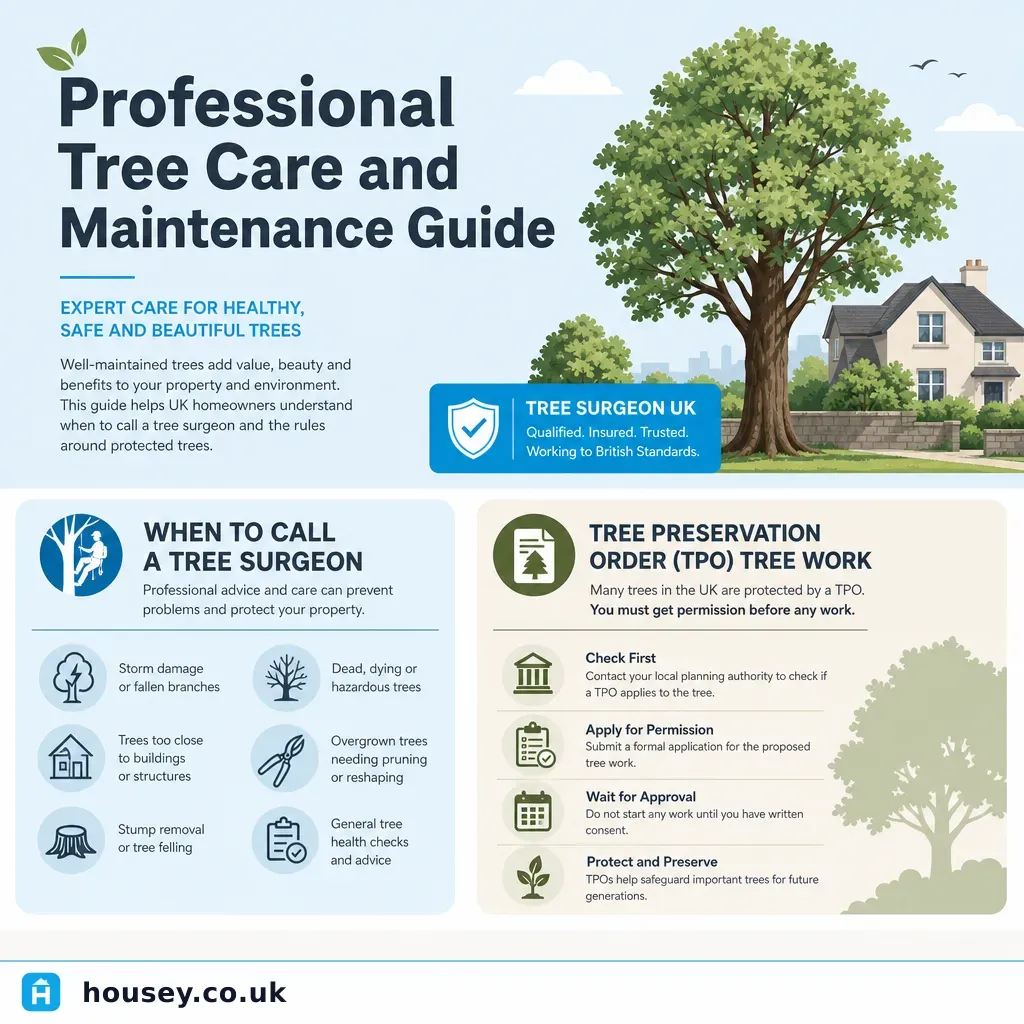
Professional Tree Care and Maintenance Guide
Professional tree care covers pruning, crown reduction, felling, and health assessments carried out by qualified arborists.
 Improvement & Build
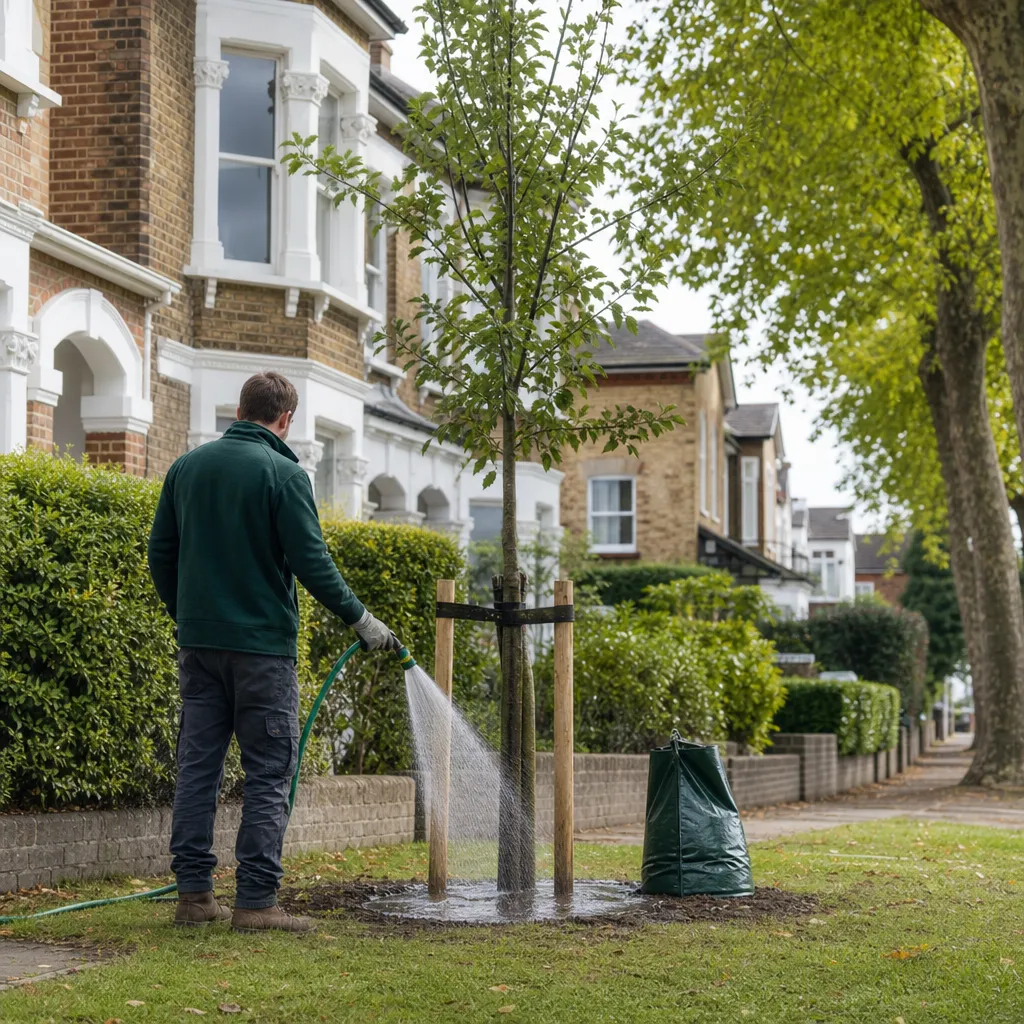
Watering Large Trees: Techniques and Frequency for Establishment
Newly planted large trees typically need 50–90 litres of water per week during the growing season for the first two to three years.
 Improvement & Build
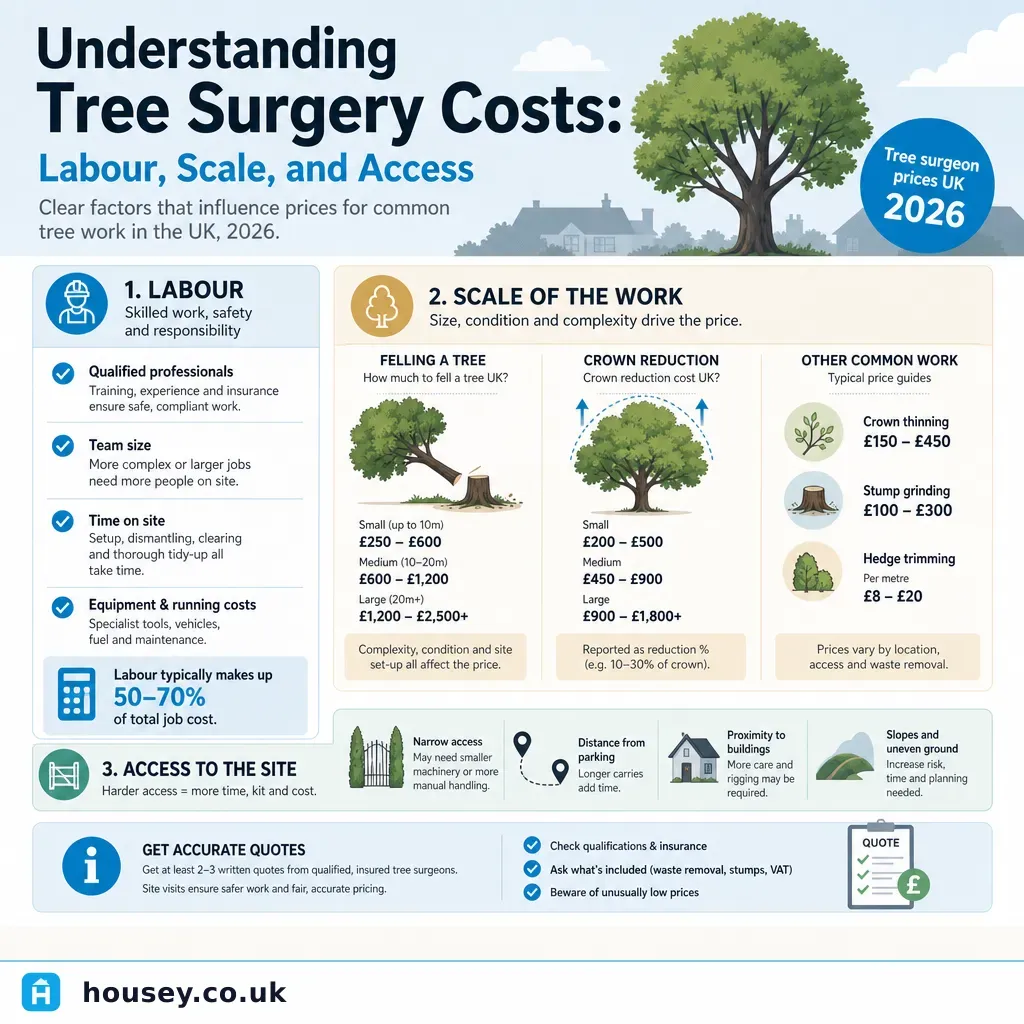
Understanding Tree Surgery Costs: Labour, Scale, and Access
Tree surgery costs in the UK depend on tree height, species, condition, and site access.
 Improvement & Build
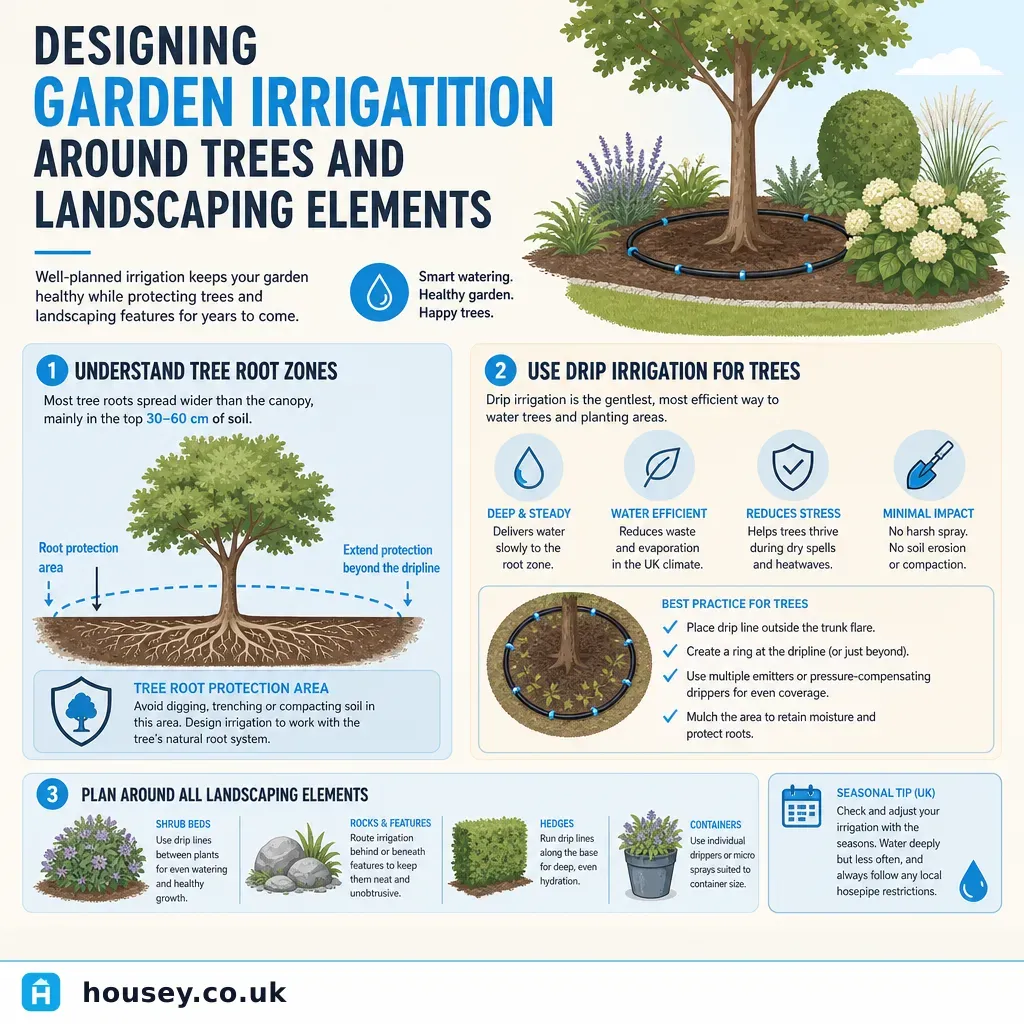
Designing Garden Irrigation Around Trees and Landscaping Elements
Design irrigation around trees by respecting the root protection area defined under BS 5837:2012, using drip or leaky pipe delivery rather than spray heads, and putting the tree zone on its own circuit.
 Improvement & Build
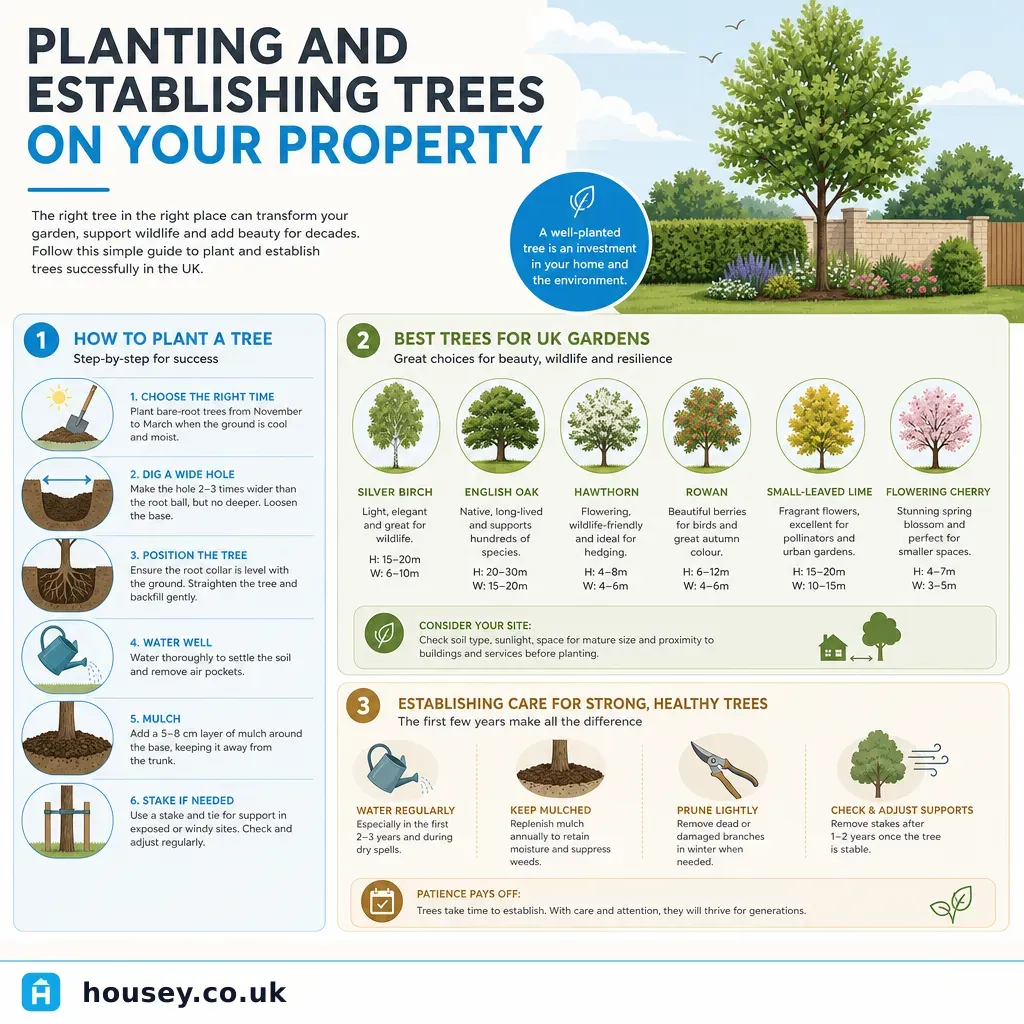
Planting and Establishing Trees on Your Property
Trees planted in the right season (October to March for bare-root stock), in well-prepared ground, and with appropriate staking and aftercare will establish most successfully.