Professional Versus DIY Door Hanging: Decision Guide
By Housey · Last reviewed 11th of May 2026
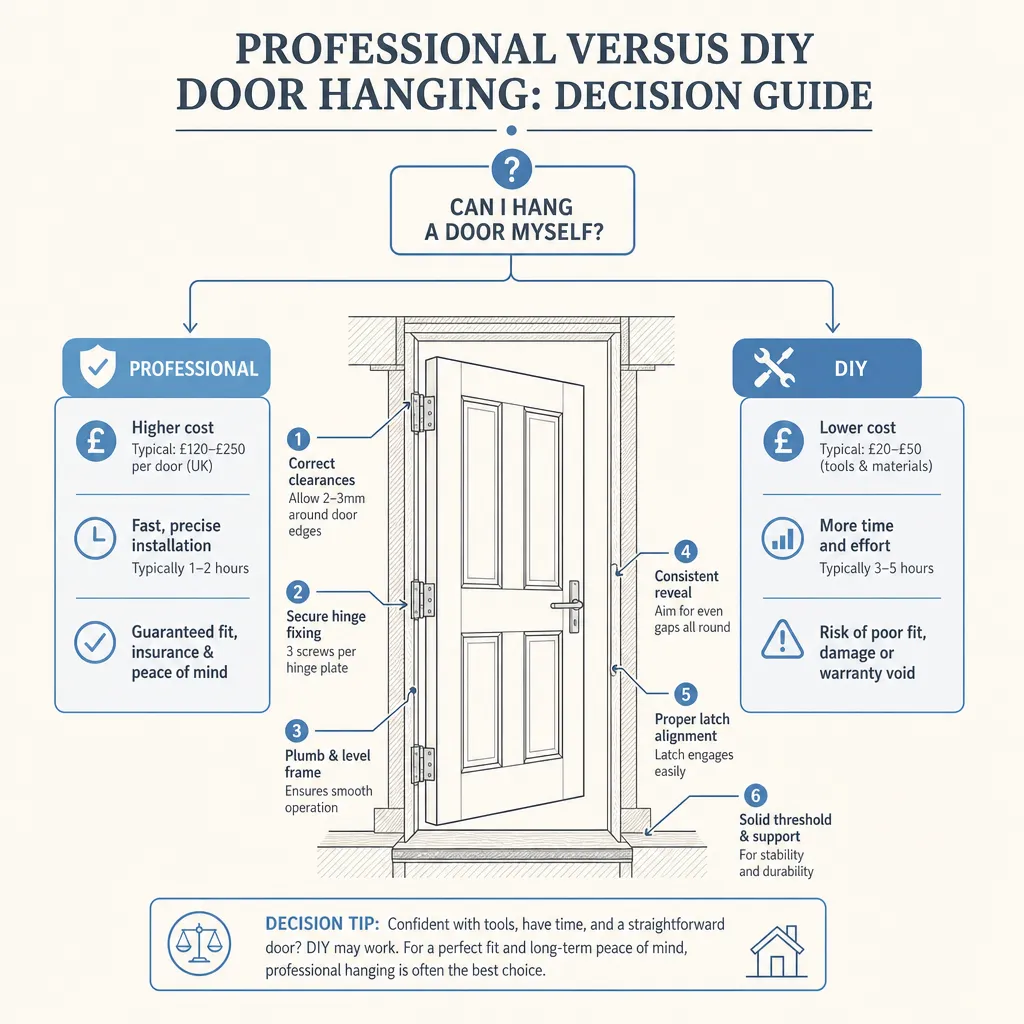
Professional Versus DIY Door Hanging: Decision Guide
Hanging a door sits in an interesting middle ground of home improvement: skilled enough to go wrong in frustrating ways, yet achievable enough that many UK homeowners tackle it successfully each weekend. The question typically arises after a loft conversion, extension, or renovation — or when an existing door warps, sticks, or no longer closes flush. The choice affects cost, time, and whether the finished result is draught-free, secure, and, where required, compliant with Building Regulations.
Key points
- Internal door hanging is generally within reach of a competent DIYer; external door installation involves weatherproofing, security hardware, and more precise tolerances.
- Fire doors in rented and HMO properties must be installed by a competent person under the Regulatory Reform (Fire Safety) Order 2005, and the work should be documented.
- A professional door fitter in the UK typically charges £50–£150 per door (labour only), varying by region, door type, and frame condition. Indicative UK costs, last reviewed 2026-05-11.
- Out-of-square or damaged frames substantially increase difficulty and often tip the decision toward professional installation.
- FENSA certification applies to replacement windows and glazed doors containing more than 50% glass — it does not apply to solid timber internal or external doors.
Internal versus external doors: how do the challenges differ?
Internal doors — such as a standard 35 mm hollow-core or solid door on an existing frame — are the most forgiving DIY project. The tolerances are wider, the weight lower, and there is no weatherproofing to manage. Most DIYers with a sharp plane, a decent set of chisels, and a drill can achieve an acceptable result on a first attempt, provided the frame is reasonably square and the opening is close to standard dimensions (typically 762 mm × 1,981 mm or 838 mm × 1,981 mm).
External doors are a different matter. They must seal against weather, often weigh 40–80 kg or more, and require precise fitting to prevent draughts, damp ingress, and security vulnerabilities. Composite and uPVC external doors frequently require specialist tooling and the manufacturer's own installation method to maintain any warranty.
Decision tree: DIY or hire a professional?
- Choose DIY if: the door is internal, the frame is square (check with a spirit level), you have the tools (plane, chisel, drill, fitting kit), and you are comfortable with basic carpentry.
- Choose a professional if: the door is external, composite, or glazed; the frame is damaged or out of square; the door is a fire door in a rented property; or you have not hung a door before and the margin for error is small.
- Always use a professional if: the door requires compliance with fire safety legislation, you are in a listed building where original joinery must be respected, or Building Regulations sign-off is required.
- Ask a specialist if: the opening is non-standard (for example, a barn conversion or pre-1919 property with irregular frames) or the door is heritage-grade hardwood above 40 kg.
DIY versus professional door fitting: a comparison
Factor | DIY | Professional fitter |
|---|---|---|
Typical cost | £10–£50 (tools, fixings, hinge pack) | £50–£150 labour per door (indicative, 2026) |
Best for | Standard internal doors, sound frames, confident DIYer | External, fire, heavy, glazed, or non-standard doors |
Not ideal for | Out-of-square frames, fire doors in rentals, composite externals | Simple internal swaps where budget is tight |
Time | 2–5 hours for a first attempt | 45–90 minutes for an experienced fitter |
Risk if wrong | Door does not close properly, draughts, hinge bind | Low — professional carries liability |
Tools needed | Plane, chisels, drill, spirit level, try square | Supplied by fitter |
Indicative UK costs, last reviewed 2026-05-11.
What tends to go wrong with DIY door hanging?
The most common DIY problems are:
- Hinge positions set too deep or too shallow, causing the door to bind against the frame or swing open unexpectedly.
- Insufficient planing, leaving the door too tight in summer humidity when timber swells.
- Not checking the frame for square, resulting in a visible gap at one corner that no amount of adjustment will fix.
- Latches misaligned with the strike plate, so the door does not catch properly.
- Under-sized fixings into ageing timber frames that cannot hold the hinge screws under repeated use.
Taking time to check the frame with a spirit level and a try square before starting, and marking the hinge recesses carefully with a marking gauge, resolves the majority of these issues.
Fire doors: where professional fitting is not optional
Under the Regulatory Reform (Fire Safety) Order 2005 and the Fire Safety Act 2021, landlords and building managers of multi-occupied residential buildings are legally required to maintain fire doors in working order. Fitting or replacing a fire door in a rented property must be carried out by a competent person — typically someone holding BWF-CERTIFIRE or BM TRADA Q-Mark certification — and records should be kept.
For owner-occupiers carrying out renovations that require fire separation under Building Regulations (such as a garage conversion to habitable space), the installer must demonstrate the door meets the required FD30 or FD60 standard. A professional with appropriate certification can provide the documentation a building control officer may request.
Red flags: when to stop and call a professional
- The frame is visibly rotten, cracked, or pulling away from the wall.
- The opening is more than 5 mm out of square over the door height.
- The door is a fire door required in a rented or licensed property.
- The external door sits in a brick reveal with a lintel you cannot inspect clearly.
- The door weighs more than 40 kg and you are working alone.
- You have removed the old door and found unexpected structural timbers or a hidden lintel issue.
When to get professional help
A professional door fitter brings speed, the right tooling, and — for fire and external doors — the assurance that the result meets performance requirements. If you have any doubt about the frame condition, the door type, or regulatory requirements, getting a quote costs nothing and protects you from work you will need to have redone.
How Housey can help
Housey connects UK homeowners with vetted window and door installers who can quote on door supply and fitting, including fire doors, composite external doors, and non-standard openings. Compare quotes from local professionals in one place.
Frequently asked questions
Do I need planning permission to replace a door in the UK?
Planning permission is not usually required to replace an internal or external door on a standard residential property in England, as it falls within permitted development. However, if your home is listed or in a conservation area, you may need listed building consent or prior approval before changing external doors. Always check with your local planning authority.
What does a professional door fitter charge in the UK?
Indicative UK costs (last reviewed 2026-05-11): expect £50–£150 per door in labour, depending on door type, region, and frame complexity. Supply-and-fit packages for composite external doors typically start from £600–£1,200 all-in. Always obtain at least three quotes and confirm whether VAT is included.
Can I hang a fire door myself?
In owner-occupied homes undergoing building work, a competent person can hang a fire door, but must use the correct hinges, intumescent strips, and smoke seals specified for that door set and demonstrate compliance with the required standard. In rented or HMO properties, fire doors must be installed by a certified professional, and the work should be documented.
How long does it take to hang a door?
An experienced professional typically takes 45–90 minutes to hang a pre-hung internal door, or up to 2–3 hours for an external door with a new frame. A first-time DIYer should allow a full day for an internal door to account for measuring, planing, and adjustment.
Sources and further reading
- Regulatory Reform (Fire Safety) Order 2005 — legislation.gov.uk
- Fire safety in purpose-built blocks of flats — GOV.UK
- BWF-CERTIFIRE fire door certification — British Woodworking Federation
- Permitted development rights for householders: technical guidance — GOV.UK
- Fire Safety Act 2021 — legislation.gov.uk
Useful next reads
 Improvement & Build
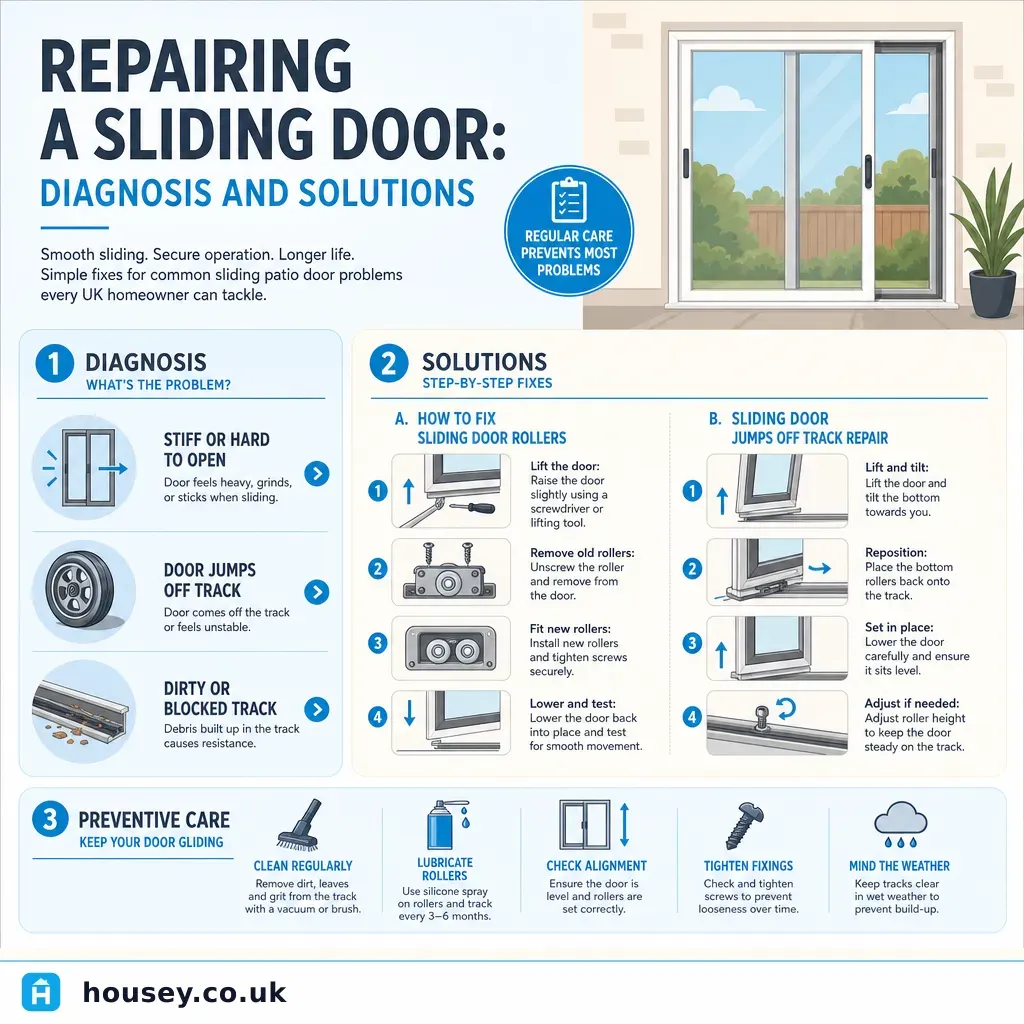
Repairing a Sliding Door: Diagnosis and Solutions
Most sliding door problems — stiffness, jumping off track, or draughts — are caused by dirty tracks, worn rollers, or misaligned guides.
 Improvement & Build
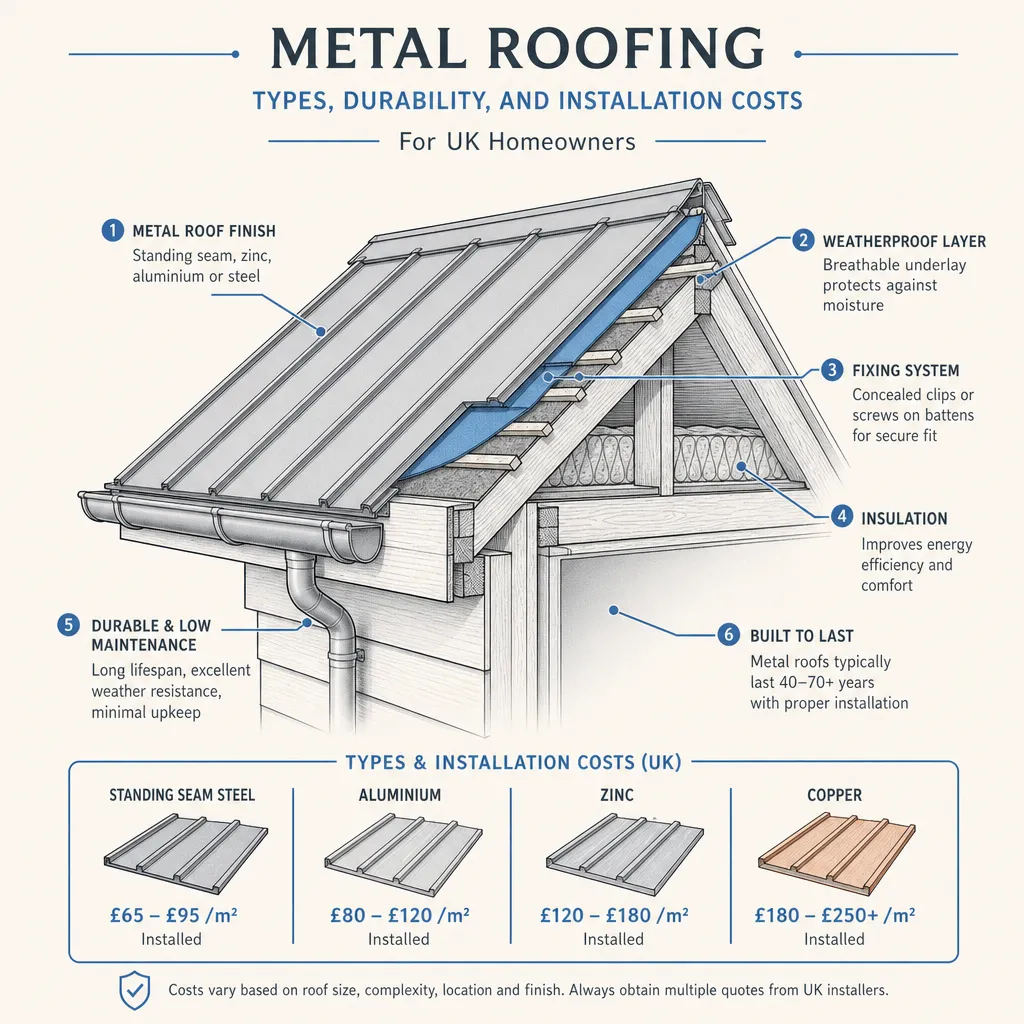
Metal Roofing: Types, Durability, and Installation Costs
Metal roofing in the UK includes standing seam, corrugated sheet, and metal tile systems in steel, aluminium, zinc, or copper.
 Improvement & Build
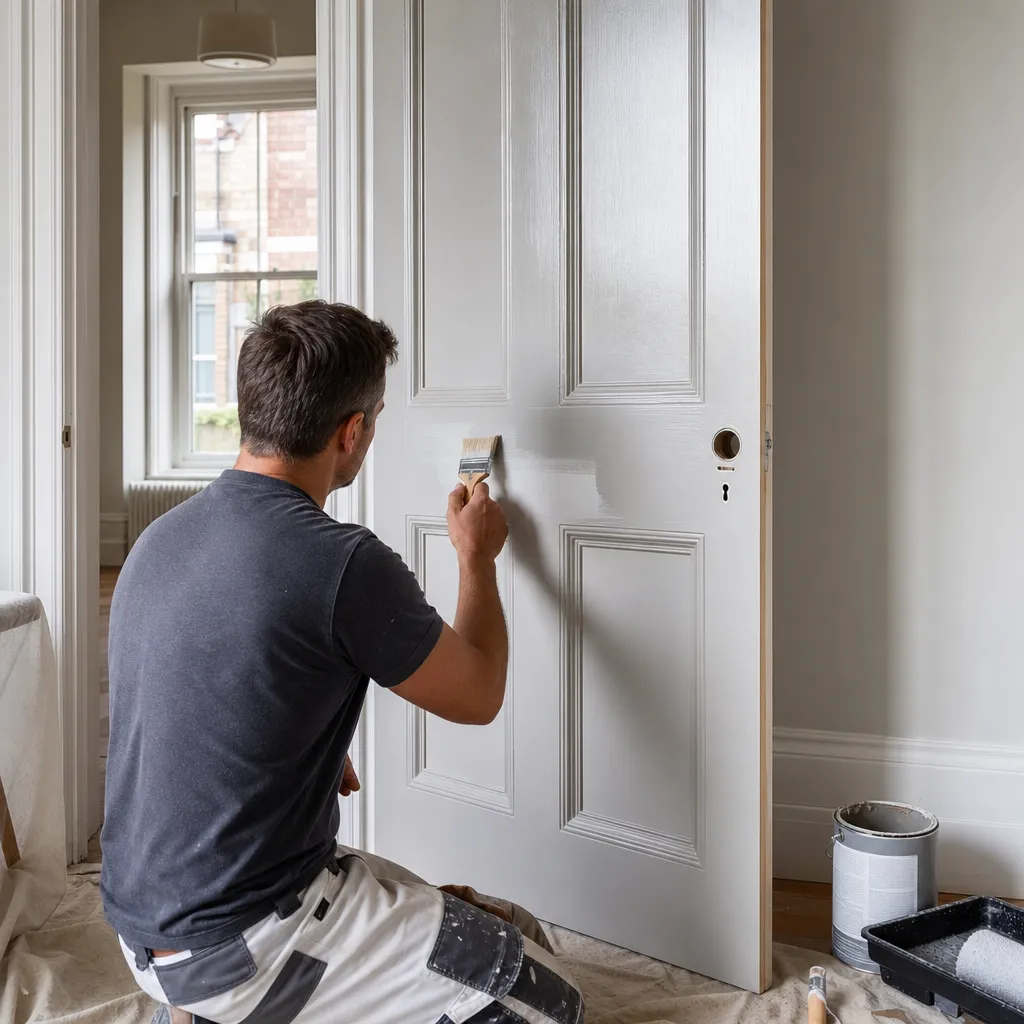
Painting Interior Doors: Preparation and Technique
Painting interior doors well depends on preparation rather than paint choice.
 Improvement & Build
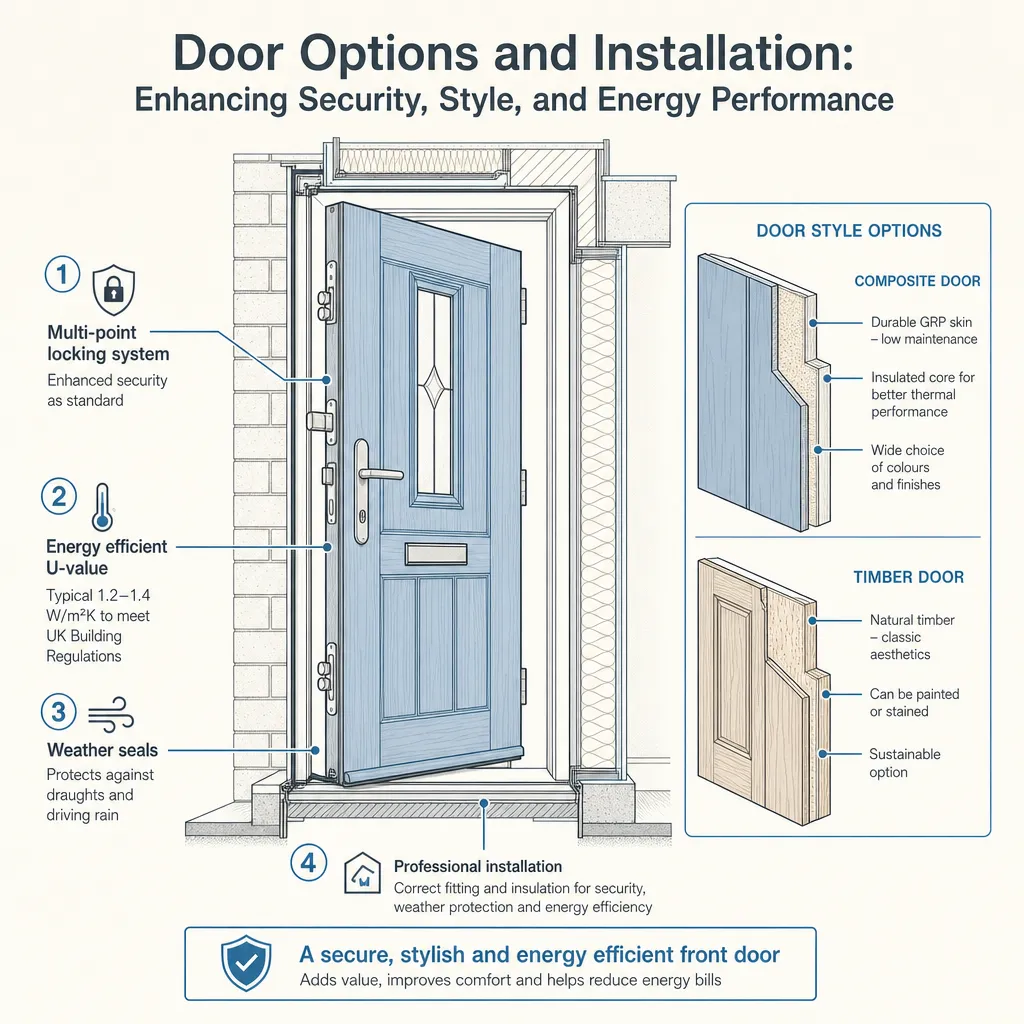
Door Options and Installation: Enhancing Security, Style, and Energy Performance
Choosing a new external door involves balancing security ratings, thermal performance, and style.
 Improvement & Build
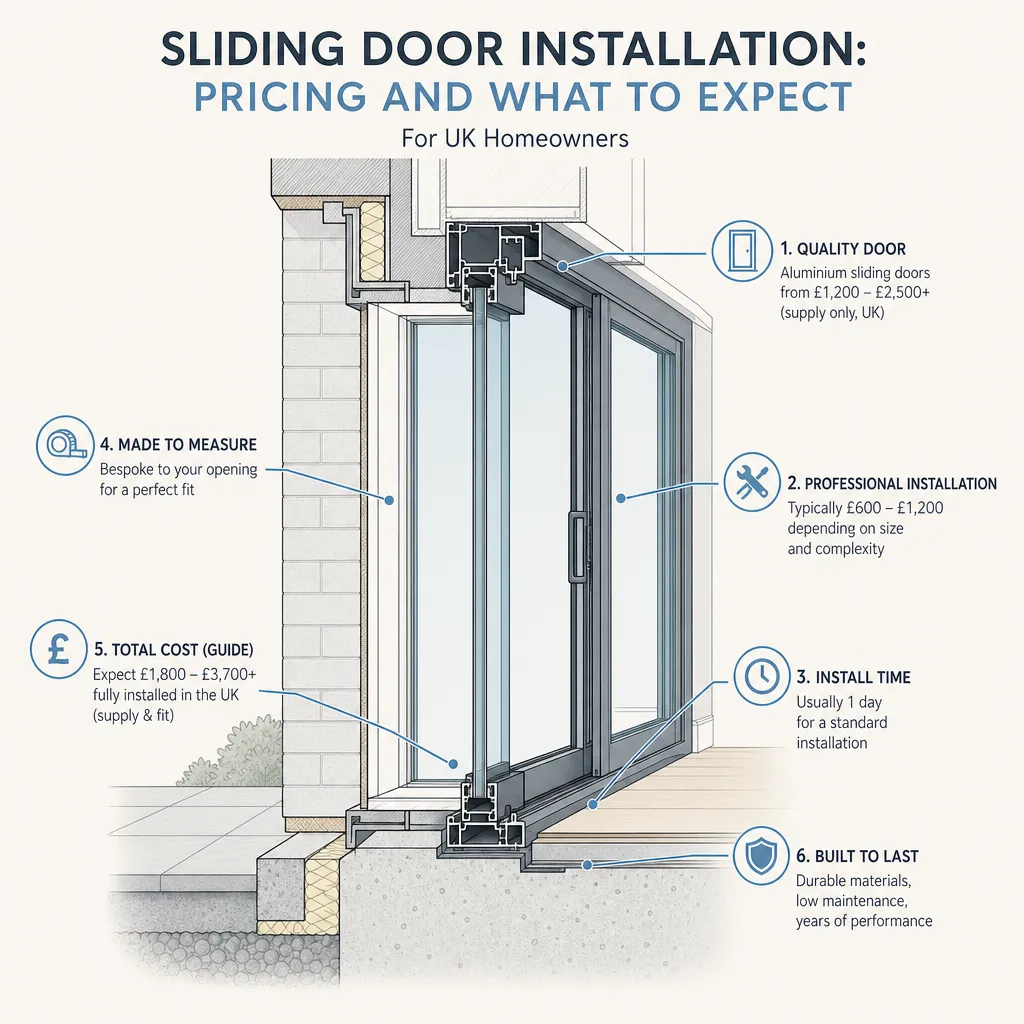
Sliding door installation: pricing and what to expect
A new sliding patio door in the UK typically costs £800–£3,000 fully installed, depending on size, material, and glazing specification.