Property Investment and Development: Identifying Potential Before Purchase
By Housey · Last reviewed 30th of May 2026
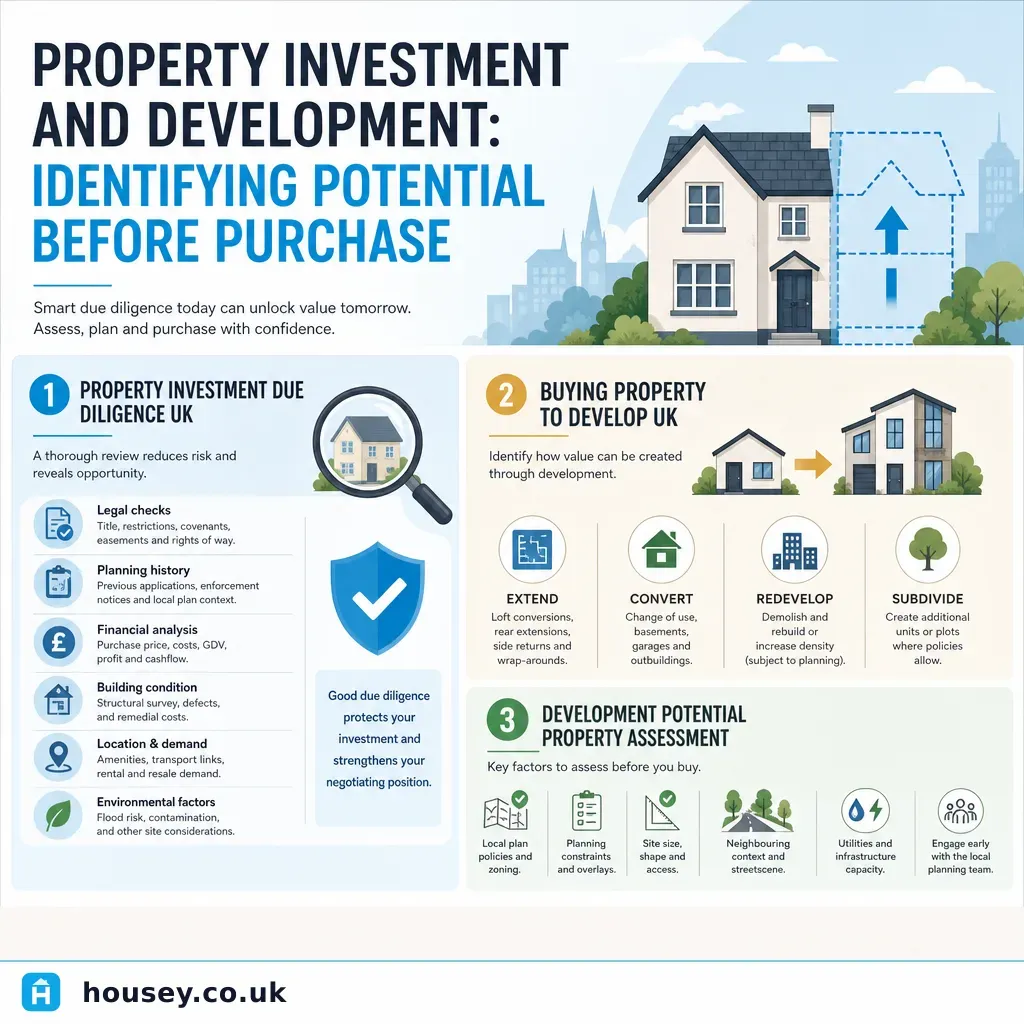
Property Investment and Development: Identifying Potential Before Purchase
Buying a property with development potential — whether that means converting a loft, building in a garden, subdividing a large house into flats, or undertaking a full structural renovation — is fundamentally different from buying a home to occupy as-is. The margin for error is smaller, the upfront professional costs are higher, and the consequences of misreading planning, structural, or legal factors before exchange can be significant. This article outlines the assessment process that experienced investors and developers apply before committing to purchase.
Key points
- Gross Development Value (GDV) — the projected open-market value of the completed or converted property — is the starting point for any development appraisal; all costs must sit comfortably below it to leave a viable return.
- Planning permission is not guaranteed; even where permitted development rights appear to apply, prior approval may be required, and local planning authorities can remove permitted development rights through an Article 4 Direction.
- A measured building survey to RICS standards is typically required before architects can produce planning drawings or contractors can price accurately for refurbishment or conversion work.
- HM Land Registry title documents, downloadable for £3 per title, reveal ownership, covenants, easements, and rights of way that can prevent or significantly complicate development.
- Build cost estimates obtained before exchange — not after — are essential for a reliable development appraisal; hidden structural defects discovered during works can erode margins entirely.
How to read a property's development potential
Not every property described as having development potential actually has it. The phrase is used loosely in sales particulars; assessing it rigorously before purchase is the investor's responsibility.
Decision tree: which type of development are you assessing?
- Loft conversion: Does the property have a suitable roof structure and sufficient ridge height? Does it benefit from permitted development for a loft extension, or has this right been removed by an Article 4 Direction? Check the local planning authority (LPA) before assuming permitted development applies.
- Rear or side extension: Does the property benefit from householder permitted development rights? Check whether it is in a conservation area, is listed, or is a flat — flats do not benefit from standard householder permitted development rights.
- Garage conversion: Usually permitted development for a change of use within the curtilage of a dwelling house; confirm whether the garage is attached or detached and check its position relative to the property boundary.
- Subdivision into flats: Almost always requires full planning permission; check the LPA's housing policies and parking standards, and the title for any restrictive covenants against subdivision.
- New dwelling in the garden: Requires planning permission in nearly all cases; check the LPA's local plan policies on backland or garden development — many authorities have adopted policies resisting what is sometimes called "garden grabbing."
- Commercial-to-residential conversion: Permitted Development Class MA may apply; prior approval is required and is not automatic. Check for any Article 4 Direction covering the specific location before proceeding.
- Consult a planning consultant before making an offer if the property is listed, in a conservation area, on Green Belt land, or in a flood zone — permitted development rarely applies in these contexts and the planning risk is material.
Planning history and permitted development rights
The planning history of any property is publicly searchable on the local planning authority's website. Before making an offer on a development property, review:
- All previous applications and their decisions (approved, refused, or withdrawn)
- Any conditions attached to existing planning permissions
- Any enforcement notices or planning contravention notices against the property
- Any Article 4 Directions covering the property or the surrounding area
The Planning Portal provides a useful general guide to what does and does not typically require permission, but the Portal's information is generic: individual properties may have specific restrictions not reflected in general guidance. A planning consultant with knowledge of the relevant LPA can provide a pre-application opinion on planning prospects before you commit to a purchase price.
Surveys and professional assessments you need
Assessment | Purpose | When to commission |
|---|---|---|
RICS Level 3 Building Survey | Structural condition, past alterations, damp, drainage, roof | Before exchange on any older, altered, or non-standard property |
Measured building survey | Accurate floor plans and dimensions for planning drawings and contractor pricing | Before instructing an architect on conversion or extension projects |
Structural engineer's report | Diagnosis of specific suspected defects — subsidence, cracking, roof spread | When the Level 3 survey flags structural concerns or visible movement is present |
Planning consultant's appraisal | Opinion on planning prospects for the proposed development | Before making an offer, especially for speculative planning-gain scenarios |
Build cost estimate (quantity surveyor) | Reliable cost estimate for proposed works | Before exchange — essential for testing the development appraisal |
Environmental and conveyancing searches | Flood risk, contaminated land, radon, ground stability, local authority notices | As part of conveyancing — ensure coverage includes development-specific risks |
Calculating whether the numbers work
A development appraisal is the financial model that determines whether a project is viable. At its simplest:
GDV − (purchase price + purchase costs + build costs + finance costs + professional fees + contingency + target profit) = residual value
If the residual is negative or insufficient to justify the risk, the purchase price is too high for the proposed development. The key variables to establish before exchange are:
- GDV: Based on comparable completed sales of similar properties in the same location — not asking prices or agents' opinions. RICS-registered valuers provide formal comparable evidence.
- Build costs: Vary considerably by property type, specification, and region. The BCIS (Building Cost Information Service, part of RICS) publishes benchmark rates; a quantity surveyor provides a project-specific estimate.
- Contingency: Industry standard for refurbishment projects is 10–20% of the build cost; for structural or older properties, allow towards the upper end.
- Profit margin: Developers typically target 15–20% of GDV; below 15% is generally considered insufficient to justify speculative development risk.
Important limitations
This article provides general information about how property development appraisals and due diligence work in the UK. It is not legal advice, valuation advice, or planning advice. Property values, planning policies, build costs, and regulatory conditions change regularly and vary significantly by location, property type, and market conditions.
Do not rely on this article as a substitute for:
- A formal RICS valuation of the property using comparable market evidence
- Legal advice from a solicitor experienced in property and conveyancing
- A planning consultant's opinion on a specific site and specific proposal
- A structural engineer's or RICS surveyor's assessment of the physical condition of the building
When to get professional help
Obtain professional advice before exchange of contracts in all cases involving development potential. Specific situations that make professional involvement critical:
- You are purchasing primarily for planning gain — buying at current use value on the expectation of securing planning permission and reselling or developing at a higher value
- The property shows visible signs of structural movement, subsidence, or significant damp that could render development unviable or require far greater expenditure than initially estimated
- The title shows complex ownership, rights of way, restrictive covenants, or unusual tenure such as short leasehold or shared freehold
- The property is listed, in a conservation area, in a flood zone, or on the Green Belt
- You are assessing a commercial-to-residential conversion — Class MA permitted development is subject to prior approval on specific criteria assessed by the LPA
- You are unfamiliar with the local planning authority's published policies and track record on the type of development you are proposing
What to ask a qualified professional
Before instructing a RICS surveyor, planning consultant, quantity surveyor, or solicitor in connection with a development purchase, ask:
- Do you have experience with this type of property and this specific type of development — conversion, extension, subdivision, or change of use?
- Have you worked in or near this local planning authority area, and are you familiar with their current policies and recent committee decisions?
- What does your report or appraisal cover, and what does it explicitly exclude?
- What assumptions is your cost estimate or planning opinion based on, and what specific factors could change them materially?
- What contingency allowance do you recommend for this property's type, age, and condition?
- Are there any red flags in the planning history or land title that I should investigate or resolve before making an offer?
- What is the realistic planning timeline for this type of proposal, including pre-application discussions with the LPA?
How Housey can help
Housey connects property investors with vetted professionals at the assessment stage. Whether you need a valuation survey to establish current and completed values, a measured building survey to support planning drawings and accurate contractor pricing, or build cost estimating to stress-test your development appraisal before you exchange, Housey can help you assemble the right professional team before you commit.
Frequently asked questions
What surveys do I need before buying a development property?
As a minimum, commission a RICS Level 3 Building Survey for structural condition and a measured building survey if you plan to extend, convert, or subdivide. A planning consultant's pre-purchase appraisal is valuable for speculative cases. A quantity surveyor's build cost estimate should be obtained before exchange to validate your financial model against the realistic cost of proposed works.
How do I check planning history and development potential for a property?
Search the local planning authority's planning register via the council website using the property address. Download the HM Land Registry title for £3 to check for covenants, easements, and restrictions. Review the Planning Portal for general permitted development guidance, then consult a planning consultant for a property-specific opinion on planning prospects before making an offer.
What is gross development value (GDV) and why does it matter?
GDV is the estimated open-market value of the property after development — the price it would achieve once works are complete. It is calculated using comparable evidence from recent sales of similar completed properties in the same area, typically provided by a RICS-registered valuer. GDV anchors the development appraisal: all costs must be deducted from it to leave a viable profit margin and justify the purchase price.
Sources and further reading
- HM Land Registry: Search for land and property information — HM Land Registry
- Planning Portal: Do I need planning permission? — Planning Portal
- RICS: Surveys and home reports — Royal Institution of Chartered Surveyors
- BCIS: Build cost data — Building Cost Information Service (RICS)
- GOV.UK: Planning permission guidance — GOV.UK
- GOV.UK: When is planning permission required? — Planning Practice Guidance, GOV.UK
Useful next reads
 Planning & Pre-Build
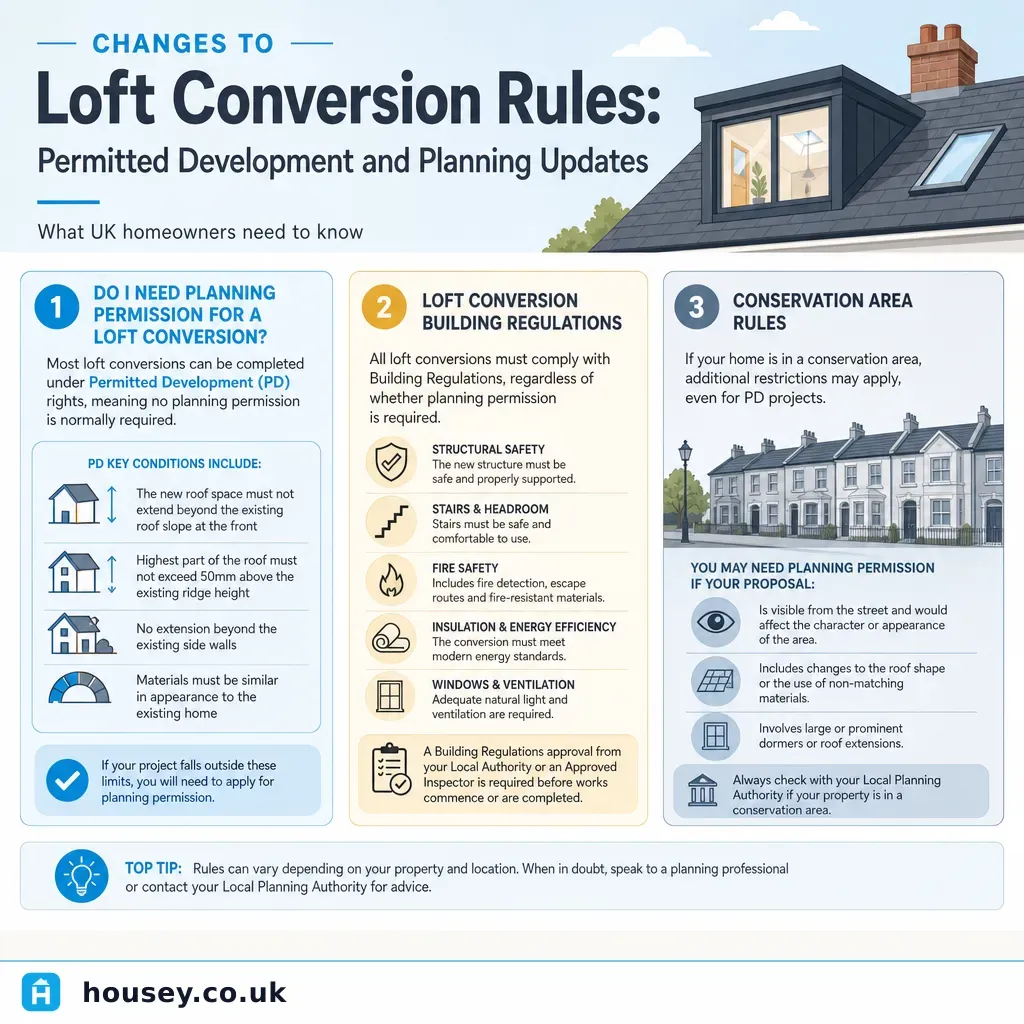
Changes to Loft Conversion Rules: Permitted Development and Planning Updates
In England, most loft conversions on standard houses qualify as Permitted Development under Class B of the GPDO 2015, allowing up to 40 cubic metres (terraced) or 50 cubic metres (detached or semi-detached) without a planning application — if conditions are met.
 Planning & Pre-Build
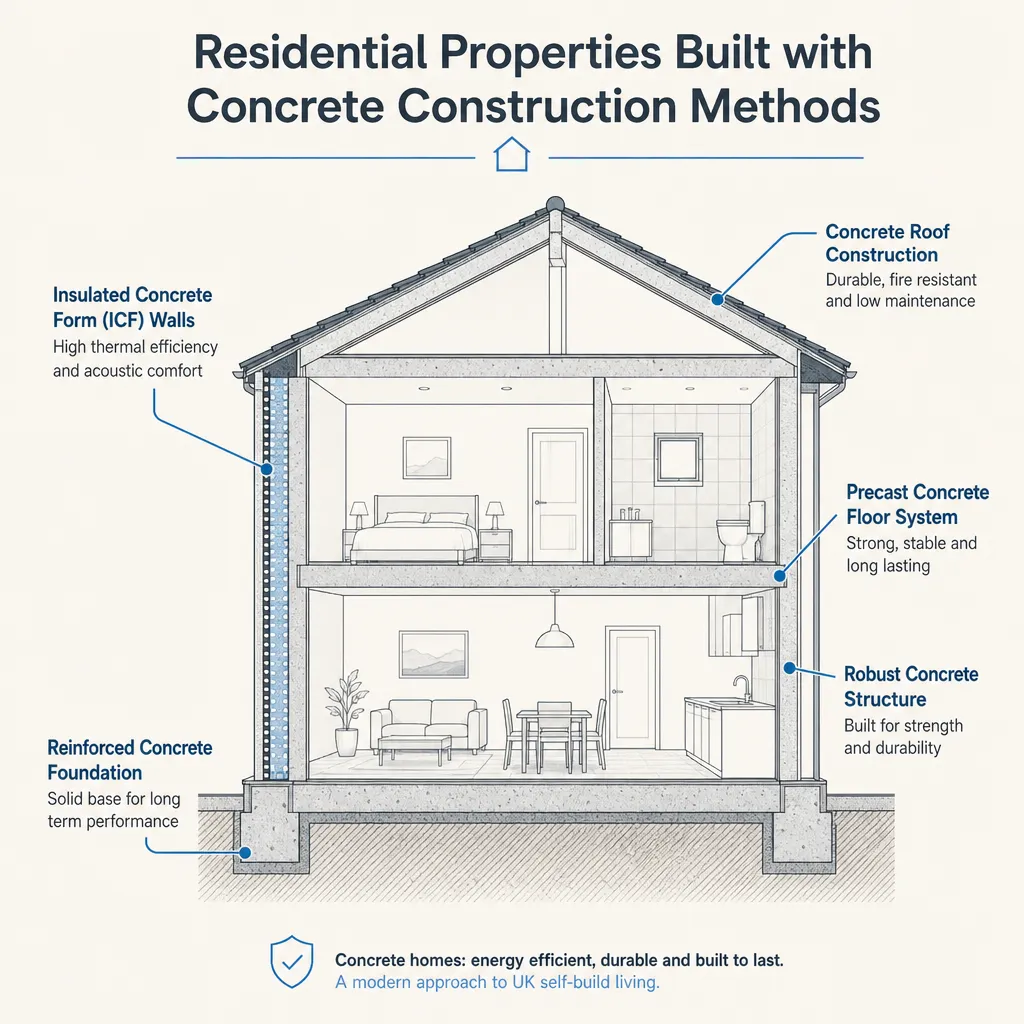
Residential Properties Built with Concrete Construction Methods
UK homes are built using several concrete methods: in-situ cast concrete, precast panel systems, insulating concrete formwork (ICF), and older non-traditional types such as Wimpey No-Fines and Laing Easiform.
 Planning & Pre-Build
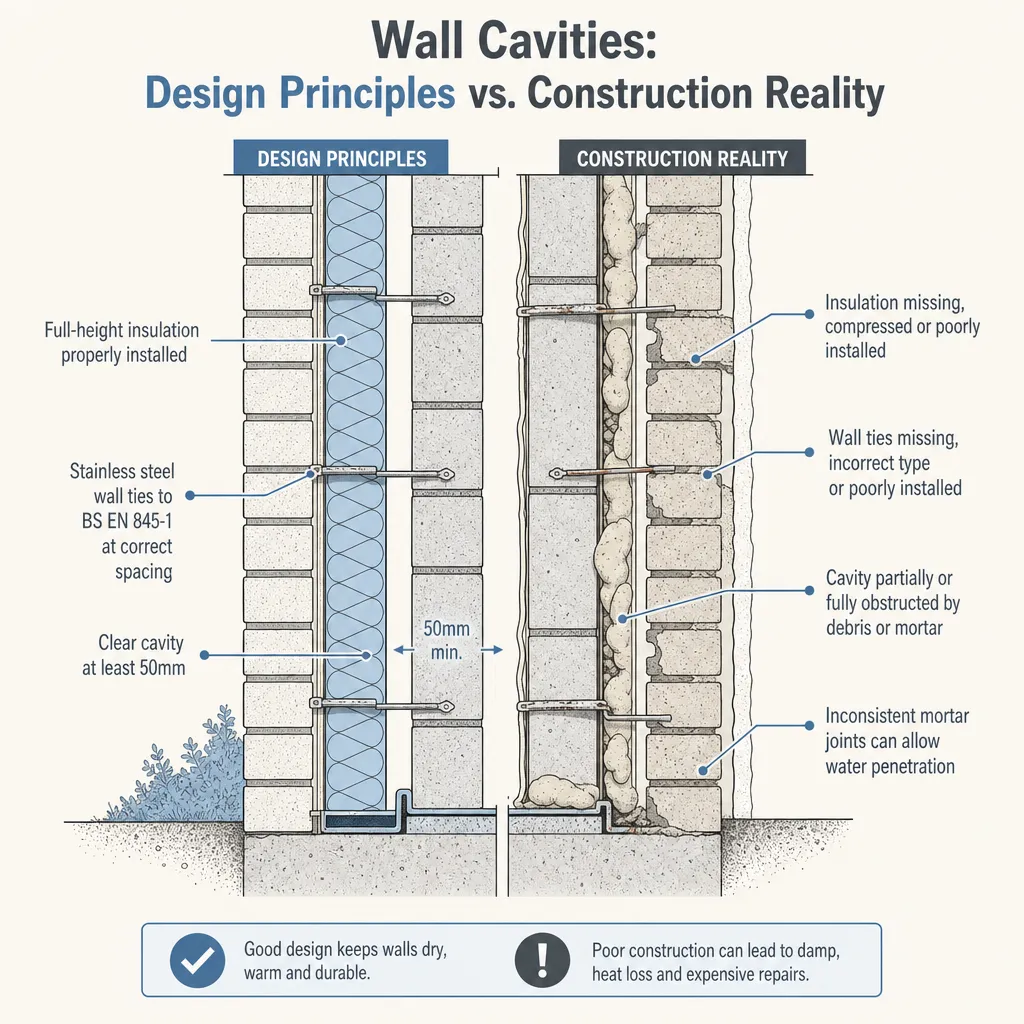
Wall Cavities: Design Principles vs. Construction Reality
A UK cavity wall is designed to resist weather, control heat loss, and structurally link two masonry leaves.
 Planning & Pre-Build
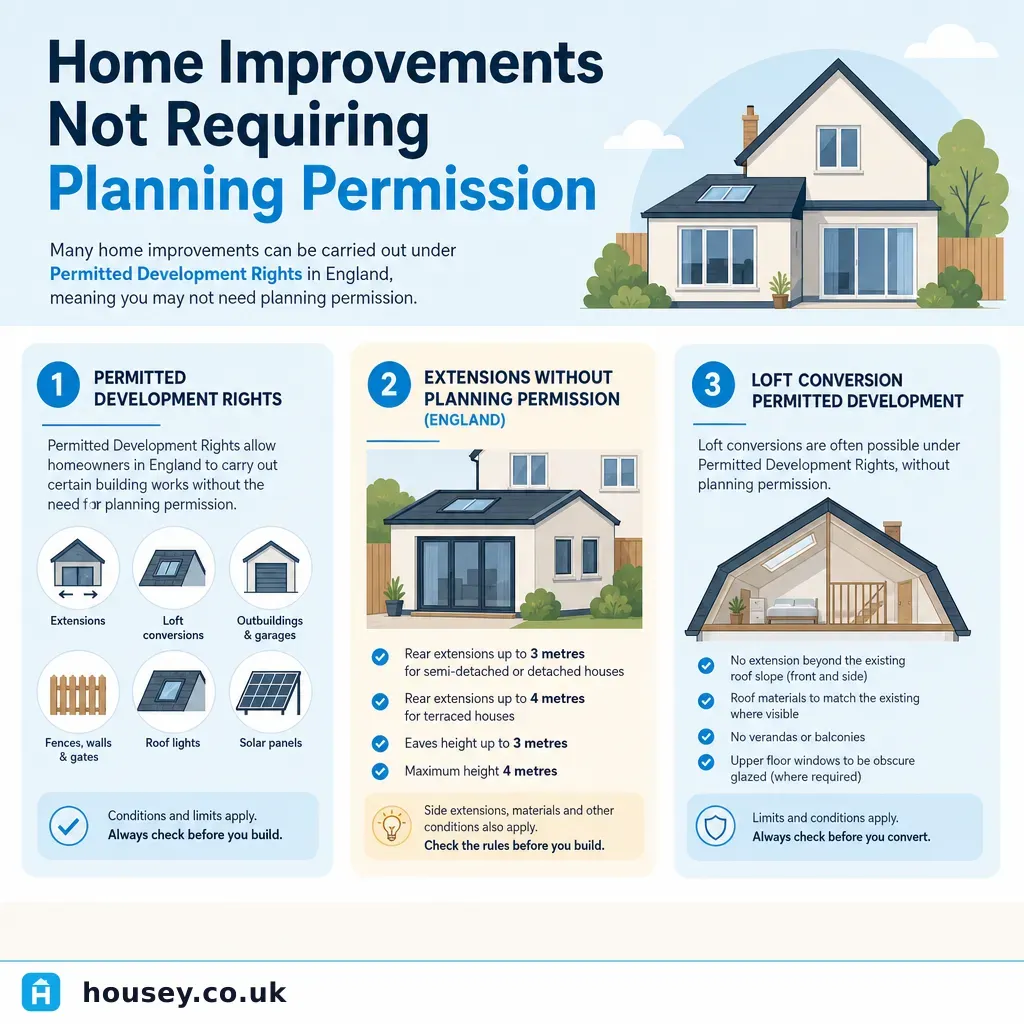
Home Improvements Not Requiring Planning Permission
Many common home improvements in England fall under Permitted Development Rights and do not require a planning application.
 Planning & Pre-Build
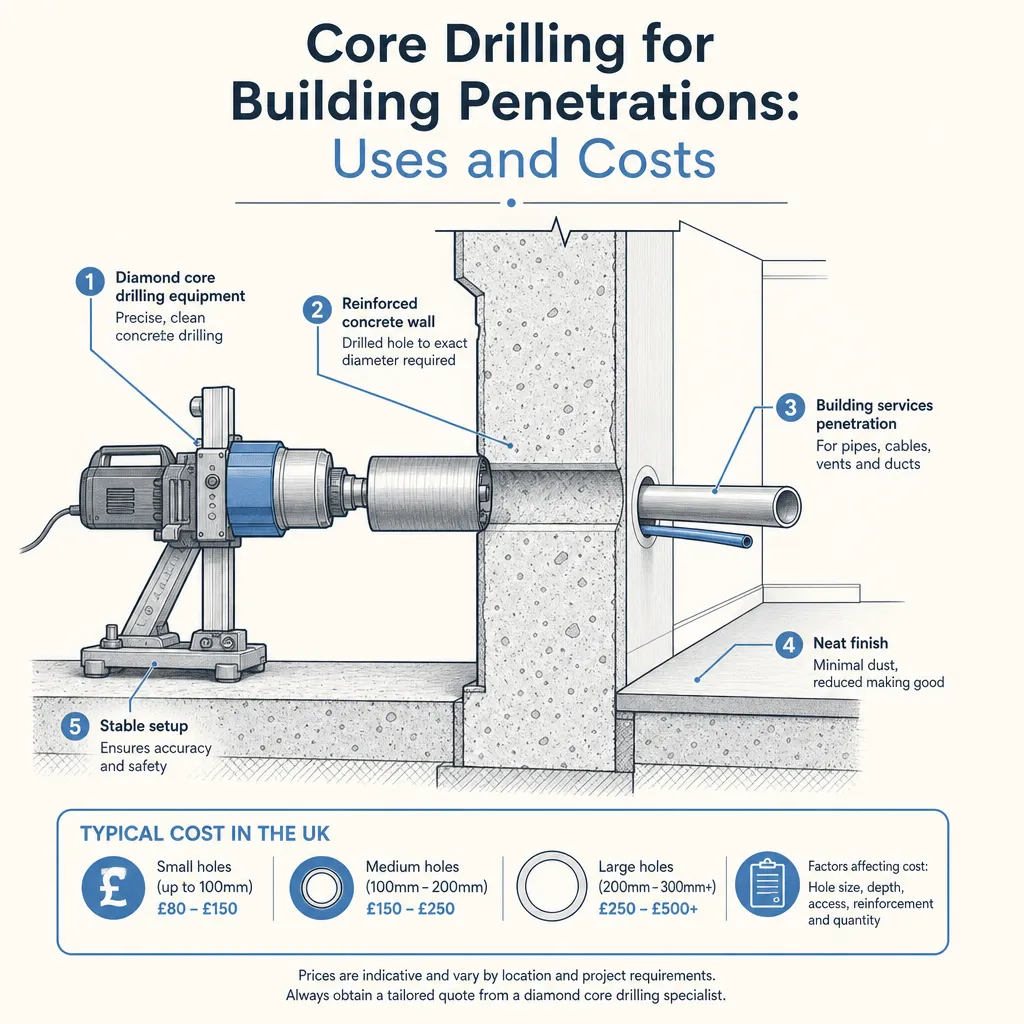
Core Drilling for Building Penetrations: Uses and Costs
Core drilling uses diamond-tipped equipment to cut clean holes through concrete, masonry, or block for pipes, ducts, cables, and building services.