Protecting Masonry: Waterproofing Inner Leaf Walls
By Housey · Last reviewed 11th of May 2026
Protecting Masonry: Waterproofing Inner Leaf Walls
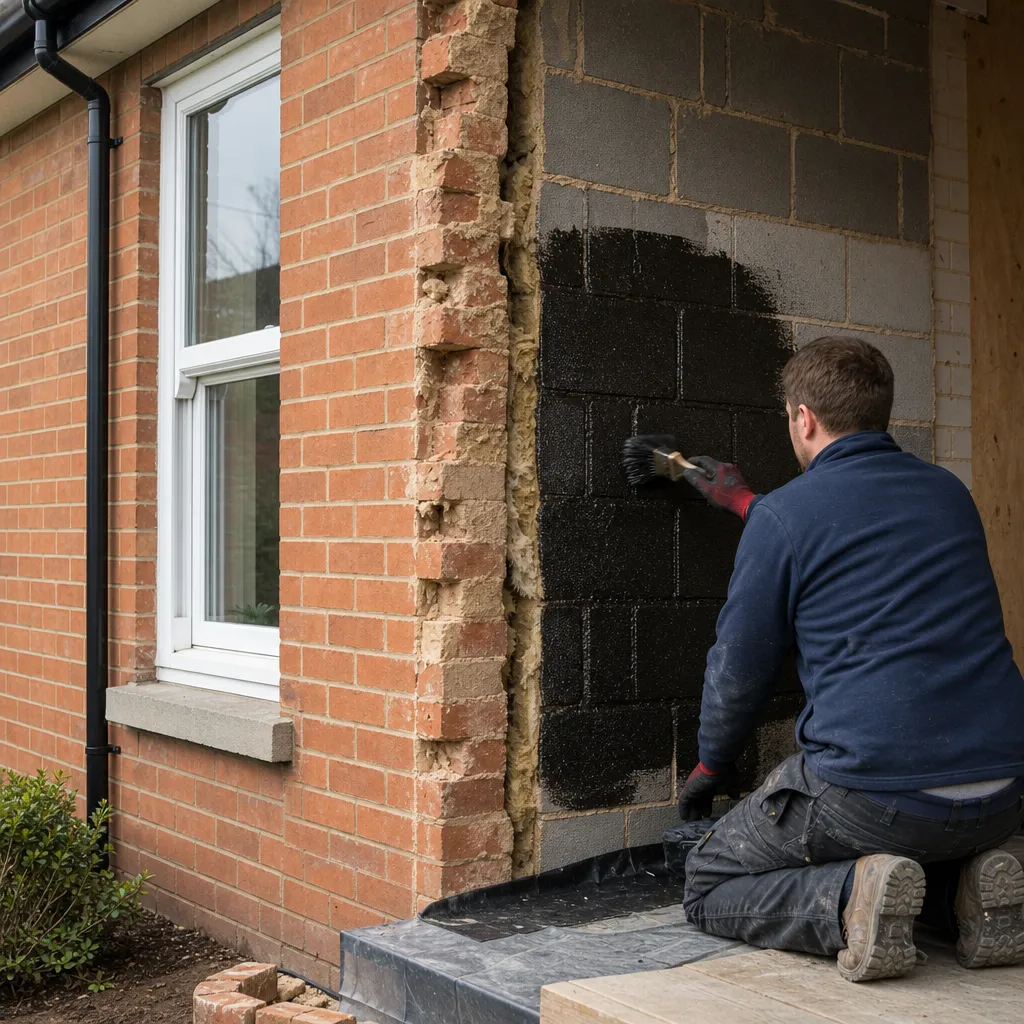
Questions about waterproofing the inner leaf of a cavity wall typically arise when a homeowner is dealing with persistent penetrating damp, planning a cavity insulation removal or upgrade, or converting a garage or outbuilding where the original wall construction may not meet residential performance standards. The inner leaf is not designed to be the primary weather barrier — that role belongs to the outer leaf, the cavity, and the cavity drainage arrangement. Understanding why waterproofing may or may not be appropriate for the inner leaf is essential before any treatment is applied.
Key points
- In standard UK cavity wall construction, the outer leaf is the weather-facing element: Building Regulations Approved Document C and BS EN 1996 (Eurocode 6) address weather resistance at the outer leaf and cavity, not the inner leaf.
- Cavity wall insulation must not be installed in properties where penetrating damp is already present at the inner leaf: the CIGA suitability survey process is intended to identify this as a disqualifying condition before installation proceeds.
- A masonry water repellent (silane or siloxane treatment) applied to the inner face reduces moisture absorption but is not a waterproofing barrier and does not address the underlying cause of water ingress.
- Cementitious tanking applied internally creates a Type A waterproofing surface under BS 8102:2022, which introduces a vapour-retarding layer and must be designed to avoid interstitial condensation within the wall construction.
- Any works that alter moisture management within a cavity wall — including inner leaf treatments — should be assessed for compliance with Building Regulations Part C and for condensation risk before proceeding.
Why consider waterproofing the inner leaf?
In a well-functioning cavity wall, the inner leaf rarely requires dedicated waterproofing treatment. Several common scenarios lead homeowners to explore it:
- Persistent penetrating damp that has been traced to the outer leaf or cavity, but where full external repair is not immediately feasible — for example, in a leasehold or terraced property where the outer face is shared or difficult to access.
- Cavity wall insulation removal or remediation, where insulation has acted as a moisture bridge and the inner leaf has become persistently damp.
- Garage or outbuilding conversion, where the original construction may have thinner or single-skin masonry that requires improved weather resistance to achieve habitable standards.
- Listed or conservation area properties, where external masonry treatments are restricted or inappropriate, leaving internal treatment as the primary available option.
- Retrofit energy upgrade projects, where additional internal insulation is being applied and moisture management of the inner face must be addressed as part of a PAS 2035-compliant design.
Comparing inner leaf waterproofing approaches
Approach | How it works | Best for | Key limitation |
|---|---|---|---|
Masonry water repellent (silane/siloxane) | Penetrating treatment hydrophobicises the pores of the masonry without sealing the surface; allows the wall to remain vapour-open | Reducing intermittent moisture absorption where the substrate is dry and the source is surface absorption through the masonry | Not a barrier against bulk water ingress; ineffective if water is entering through cracks, joints, cavity bridges, or failed trays |
Cementitious tanking | Cement-based slurry or render applied to the inner face; resists positive or negative water pressure | Persistent damp in habitable rooms where some hydrostatic pressure is involved and the substrate is structurally sound | Introduces a vapour-retarding layer; condensation risk if not designed with a full moisture analysis; fails if substrate is friable or cracked |
Cavity drain membrane (Type C) | Studded HDPE membrane applied to the inner face channels water that enters to a perimeter drain or sump pump | Where water ingress is expected to continue and drainage management is the strategy rather than exclusion | Takes up internal space; requires drainage connection; needs ongoing pump maintenance if a sump is installed |
External masonry treatment | Water repellent or repointing applied to the outer face; addresses the weather face directly | Where source moisture is surface absorption through the outer leaf and external access is available | May not be permitted on listed or conservation area properties; can mask underlying defects if not combined with thorough investigation |
Cementitious tanking and cavity drain membranes applied to the inner leaf are classified as Type A and Type C waterproofing systems respectively under BS 8102:2022 and should be designed by a qualified professional.
The risk of interstitial condensation
Interstitial condensation is one of the most important reasons to seek specialist advice before waterproofing the inner face of a cavity wall. When a vapour-retarding layer is introduced on the warm internal face, the dew point — the temperature at which moisture in warm internal air condenses — shifts into the wall construction itself. This can result in:
- Moisture accumulating within the masonry or behind the waterproofing layer, invisible from either face until significant damage has occurred.
- Deterioration of mortar, brick, or any organic material present within the construction.
- Mould growth on the cold side of the tanking or membrane, particularly in poorly ventilated spaces.
A condensation risk analysis — typically carried out using the methodology of BS EN ISO 13788 or through dynamic hygrothermal simulation — should be part of any specification introducing a vapour-retarding layer to an external wall's inner face. A Retrofit Assessor, waterproofing designer, or suitably experienced damp specialist can carry out or commission this analysis.
Inner leaf waterproofing in PAS 2035 retrofit projects
If your property is undergoing energy efficiency improvement under ECO4, the Great British Insulation Scheme, or any other publicly funded retrofit programme, the works must comply with PAS 2035 (Retrofitting dwellings for improved energy efficiency). PAS 2035 requires a Retrofit Assessor to identify moisture and structural risks before measures are specified, and a Retrofit Coordinator to oversee delivery. Inner leaf waterproofing introduced as part of a retrofit package must be consistent with the project's overall moisture management strategy — it cannot be added to a funded energy measure without the Retrofit Assessor's knowledge and sign-off.
Important limitations
This article provides general information about the principles and options for waterproofing the inner leaf of cavity walls in UK homes. It does not constitute structural, damp, or building engineering advice. Inner leaf waterproofing interacts with the full moisture management of the wall construction — including the outer leaf condition, cavity drainage, existing or proposed insulation, vapour management, and ventilation. Incorrect specification can direct moisture into the structure rather than excluding it, causing damage that may remain invisible for months or years. A qualified damp specialist, waterproofing designer, or PAS 2035 Retrofit Assessor should assess your specific situation before any treatment is applied.
When to get professional help
Commission a specialist assessment before proceeding with inner leaf waterproofing if:
- There is visible damp, staining, or mould on the inner face of an external wall
- The property has existing or previously failed cavity wall insulation that may have caused moisture bridging
- The affected wall forms part of a habitable room, bedroom, or conversion project
- The property is listed, in a conservation area, or has non-standard construction such as rubble-fill cavity, stone walls, or an absent DPC
- You are undertaking a publicly funded energy retrofit and are unsure whether moisture risks have been formally assessed by a Retrofit Assessor
What to ask a qualified professional
Before instructing a damp or waterproofing specialist for inner leaf treatment, ask:
- What is causing moisture to reach the inner leaf — is the problem at the outer face, within the cavity, or at the DPC or cavity tray level?
- Will waterproofing the inner face address the root cause, or only manage the symptom?
- Have you carried out or commissioned a condensation risk analysis for the proposed treatment?
- Is the proposed product suitable for the substrate condition and the level of moisture currently present?
- Does the specification need to be consistent with PAS 2035 if this forms part of a wider retrofit project?
- What surface preparation is required, and what are the implications if the substrate is more damaged than currently visible?
- What is the expected service life of the treatment, and does the product hold a BBA or equivalent third-party certificate?
How Housey can help
Housey can connect you with experienced damp proofing specialists who can assess the source of moisture at the inner leaf and recommend an appropriate treatment strategy, and with roofers where the moisture pathway involves the roof, parapet, or chimney abutment directing water down into the wall construction. Submit your project details to receive quotes from vetted local professionals.
Frequently asked questions
Is it possible to waterproof a single-skin brick wall from inside?
Single-skin walls present a greater challenge than cavity walls because the masonry carries the full burden of weather resistance. Internal cementitious tanking or cavity drain systems can be applied, but any vapour-retarding layer on the warm face of a cold wall creates a significant interstitial condensation risk. A specialist moisture and condensation risk assessment is strongly recommended before proceeding with any internal waterproofing on a solid or single-skin wall.
Will a masonry water repellent on the inner leaf solve my damp problem?
A masonry water repellent reduces moisture absorption through the surface of the inner leaf but will not prevent water entering through cracks, failed mortar joints, bridged cavities, or failed cavity trays. If the root cause is in the outer leaf or cavity construction rather than surface absorption through the inner leaf itself, a water repellent is unlikely to resolve the problem and may temporarily mask symptoms while the underlying cause continues.
Do I need building regulations approval to waterproof my inner leaf walls?
Applying a waterproofing treatment to an existing internal wall surface does not typically require a building regulations application. However, if the work forms part of a conversion to habitable use, a retrofit energy improvement under a funded scheme, or involves structural changes, building regulations or PAS 2035 compliance may apply. Check with your local building control body or Retrofit Coordinator if you are uncertain.
How does failed cavity wall insulation contribute to inner leaf moisture?
Poorly installed or degraded cavity wall insulation can act as a moisture bridge, allowing water that penetrates the outer leaf to wick across the cavity to the inner leaf rather than running down and draining away. This is a documented cause of penetrating damp in properties where CWI was installed in unsuitable conditions or where pre-existing cavity drainage deficiencies were not identified at the time of the installation survey.
Sources and further reading
- Approved Document C — Site preparation and resistance to contaminants and moisture — GOV.UK / MHCLG
- BS 8102:2022 — Code of practice for protection of below ground structures against water from the ground — BSI British Standards
- PAS 2035 — Retrofitting dwellings for improved energy efficiency — BSI / DESNZ
- CIGA — Cavity wall insulation guarantee and suitability guidance — Cavity Insulation Guarantee Agency
- Property Care Association — guidance on damp investigation and waterproofing — Property Care Association
Useful next reads
 Improvement & Build
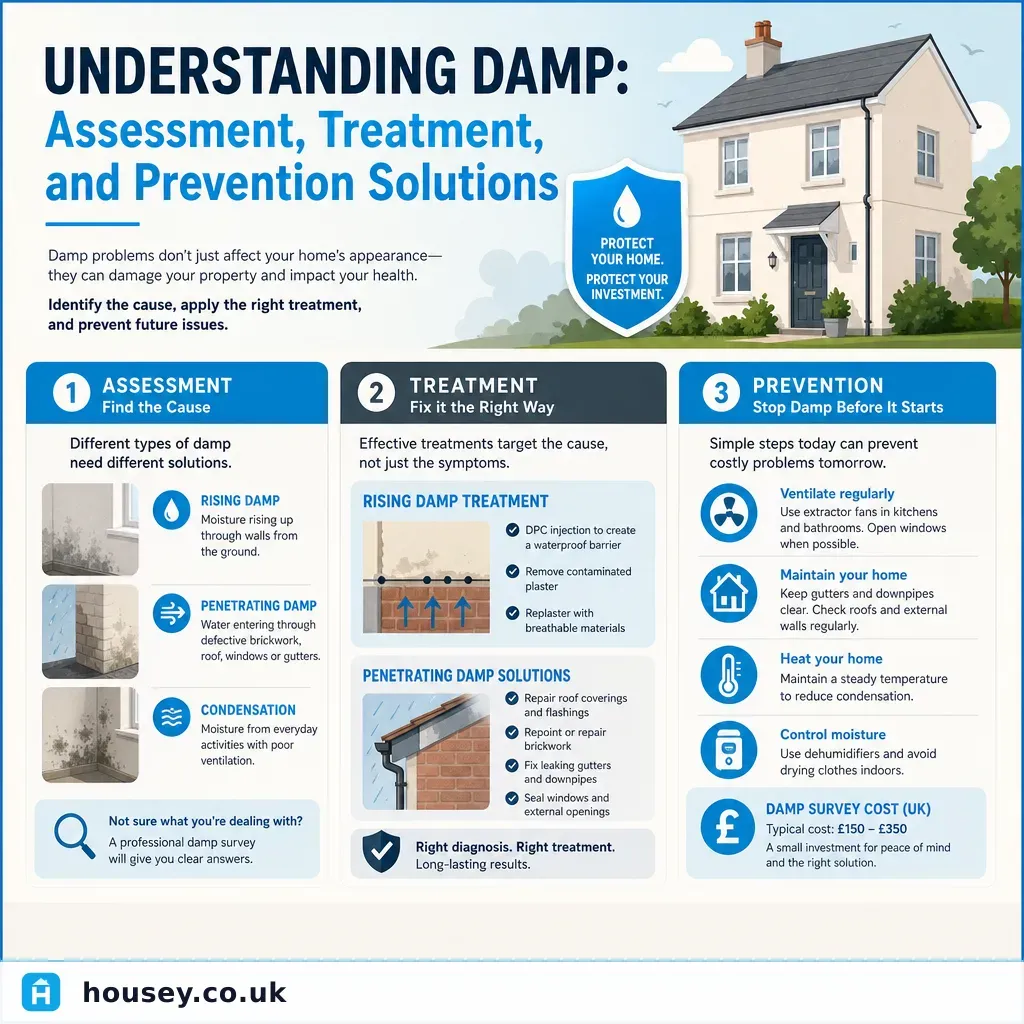
Understanding Damp: Assessment, Treatment, and Prevention Solutions
Damp in UK homes usually falls into three categories — rising damp, penetrating damp, and condensation — each requiring a different remedy.
 Improvement & Build
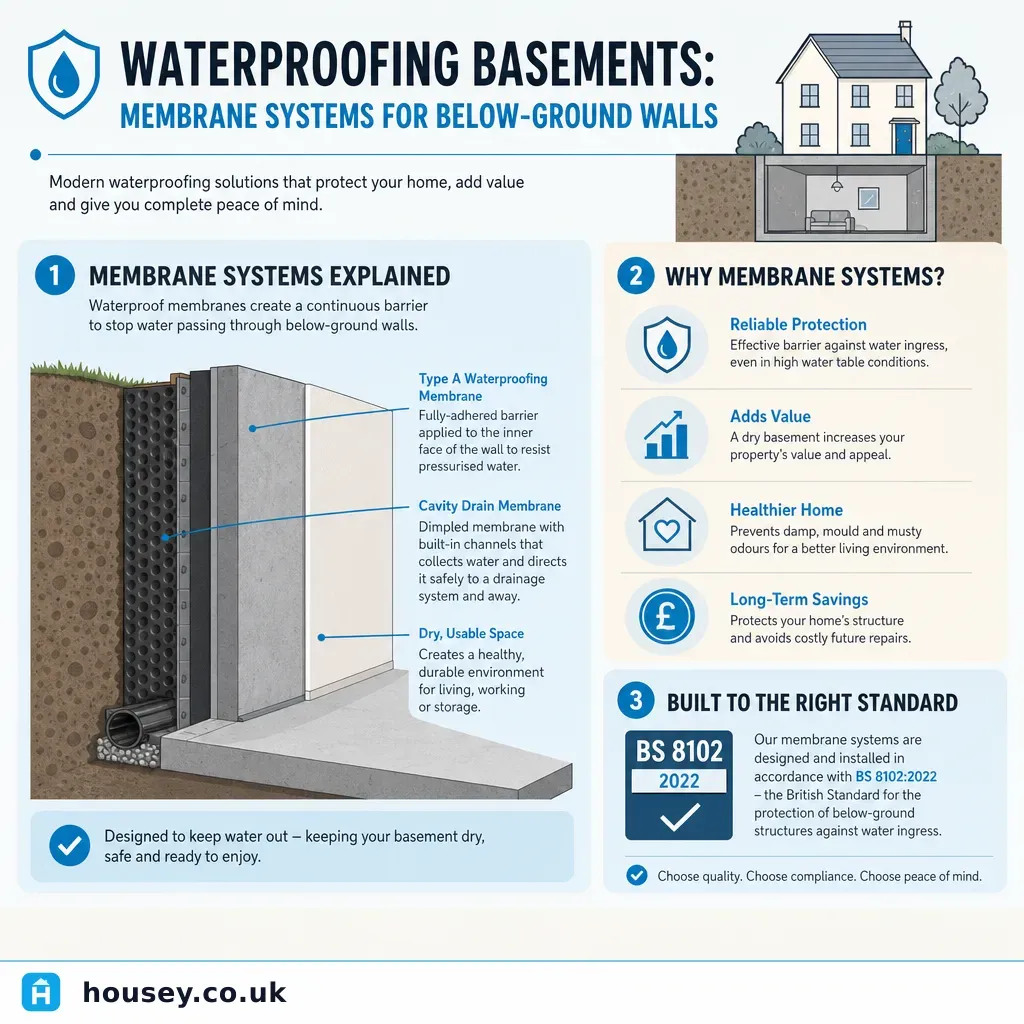
Waterproofing Basements: Membrane Systems for Below-Ground Walls
The three principal below-ground waterproofing systems under BS 8102:2022 are Type A (barrier membranes such as tanking or crystalline coatings), Type B (structurally integral waterproof concrete), and Type C (cavity drain membranes that collect and redirect water).
 Improvement & Build
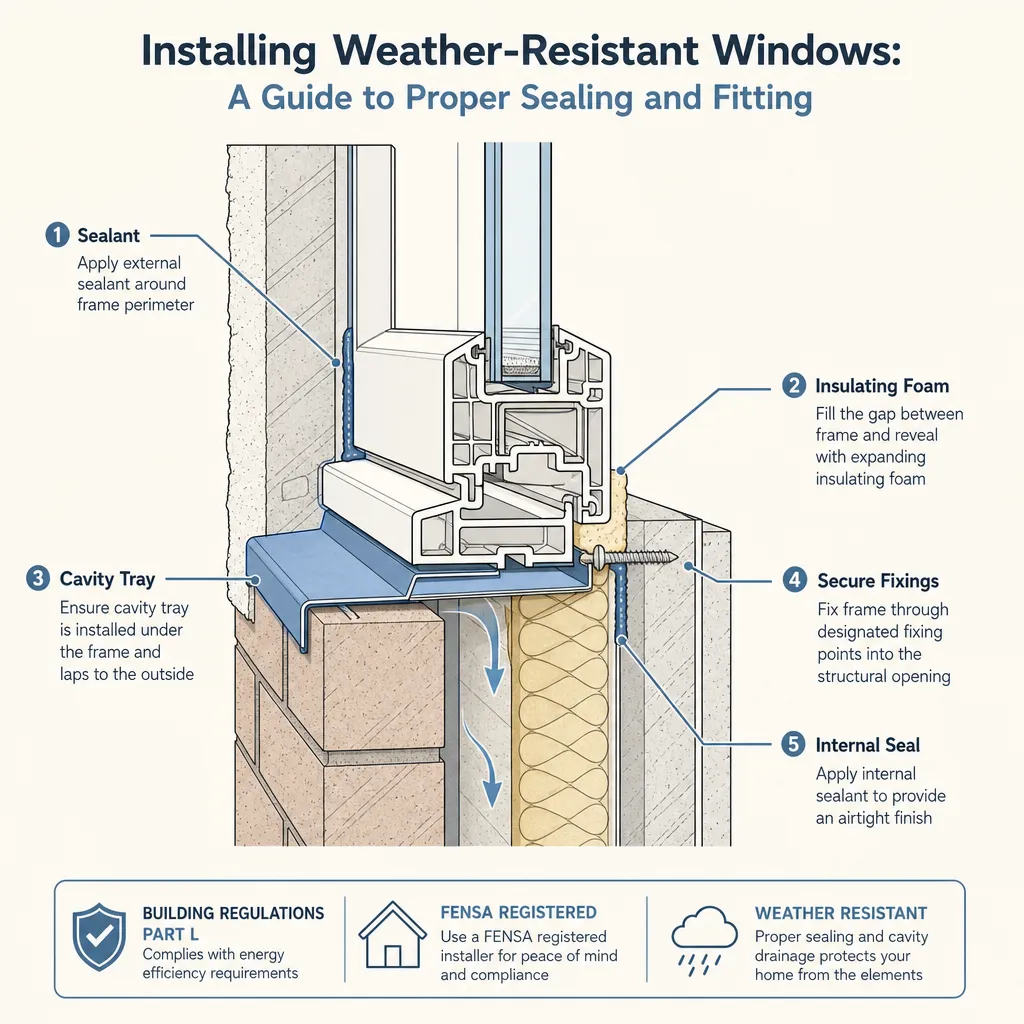
Installing Weather-Resistant Windows: A Guide to Proper Sealing and Fitting
Replacing windows in England requires Building Regulations compliance under Part L — either via a FENSA- or CERTASS-registered installer who self-certifies, or through local authority building control notification.
 Improvement & Build
Basement Waterproofing Solutions and Protection Methods
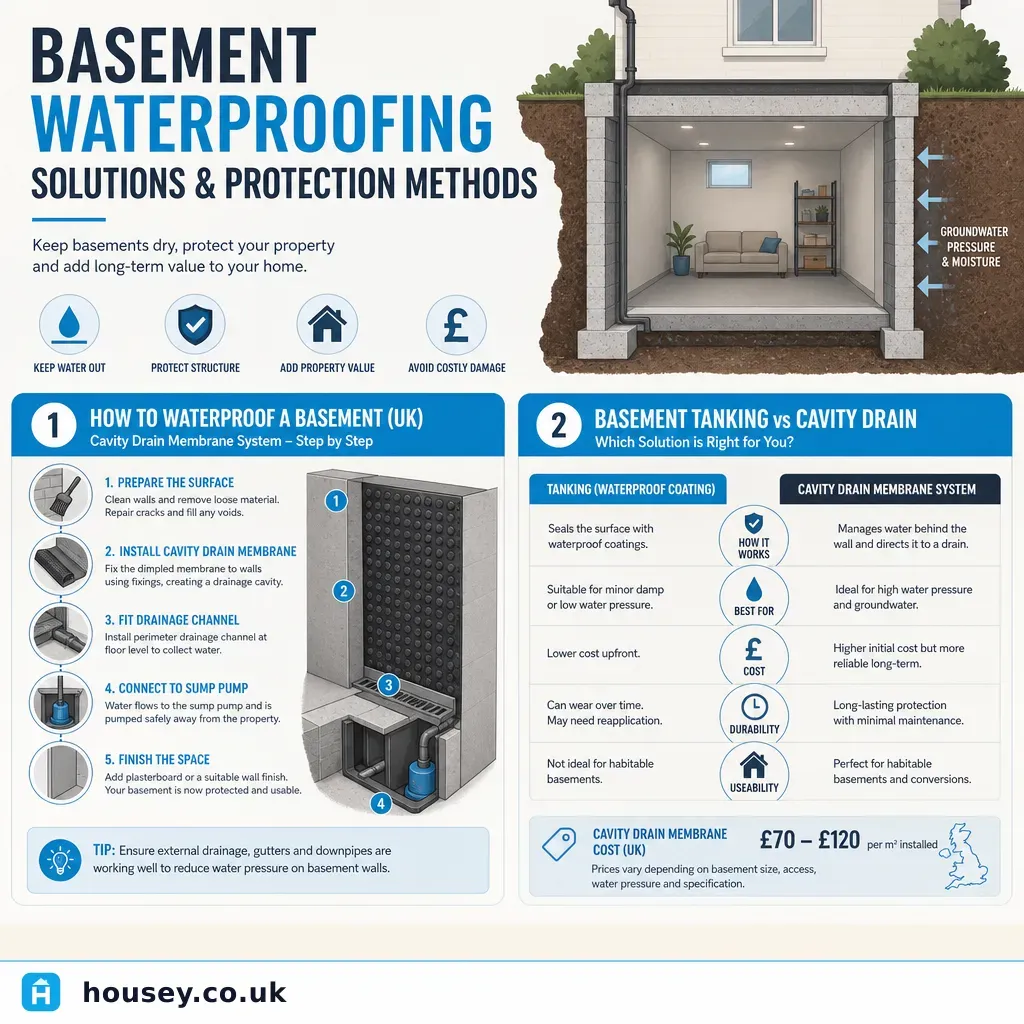
Basement waterproofing in the UK uses one of three system types defined in BS 8102:2022: Type A (barrier tanking), Type B (structurally integral concrete), or Type C (cavity drain with sump pump).
 Improvement & Build
Protecting Your Property from Damp and Water Ingress
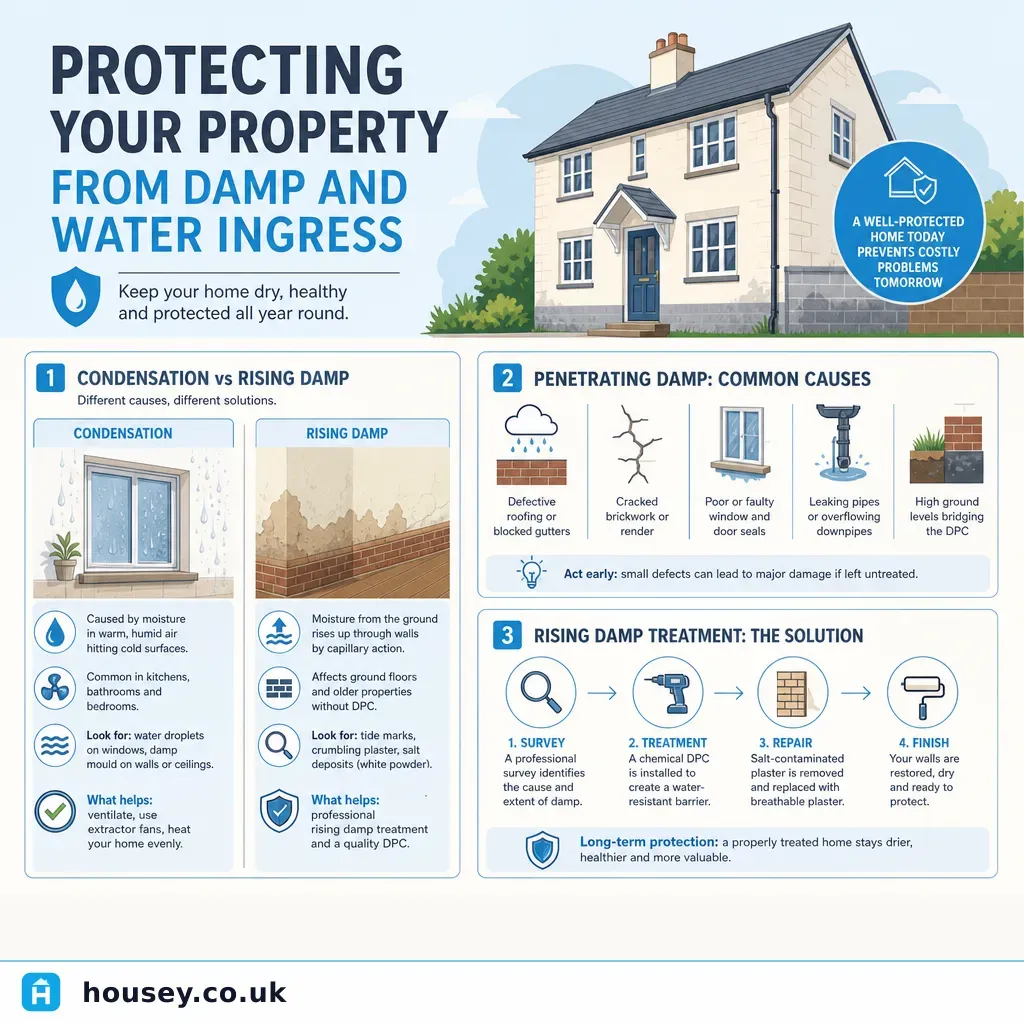
Damp in UK homes usually falls into three categories: rising damp (groundwater drawn up through walls), penetrating damp (rain or groundwater entering through the building envelope), and condensation (moisture from warm internal air meeting a cold surface).