Protecting Trees During Construction: Best Practice Guidelines for Arboricultural Protection
By Housey · Last reviewed 18th of May 2026
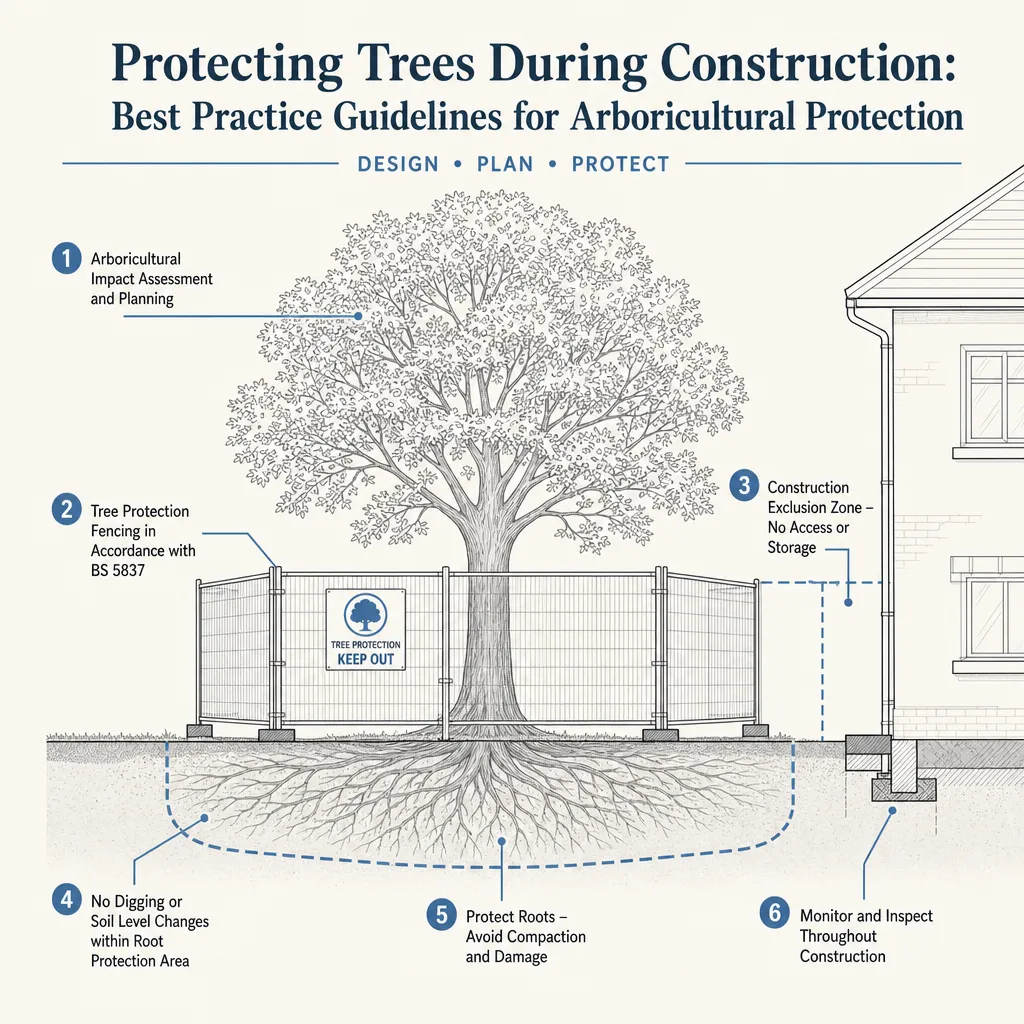
Protecting Trees During Construction: Best Practice Guidelines for Arboricultural Protection
Tree damage during construction is one of the most avoidable and yet most frequently encountered problems on UK building sites. Whether you are extending a Victorian terrace, adding an outbuilding to a 1930s semi, or undertaking a larger development, trees on and adjacent to the site can suffer serious harm from root compaction, soil contamination, ground level changes, and mechanical damage — often long before any visible symptoms appear. Local planning authorities routinely impose formal arboricultural protection measures as planning conditions, and damaging a tree subject to a Tree Preservation Order can result in criminal prosecution and an unlimited fine.
Key points
- BS 5837:2012 ('Trees in relation to design, demolition and construction') is the British Standard defining best practice for arboricultural protection on UK construction sites; it is routinely cited in planning conditions and underpins Arboricultural Impact Assessments.
- Trees covered by Tree Preservation Orders (TPOs) have statutory protection under the Town and Country Planning (Tree Preservation) (England) Regulations 2012 — damaging or destroying a protected tree without consent is a criminal offence carrying an unlimited fine.
- The Root Protection Area (RPA) defined in BS 5837:2012 is commonly far larger than homeowners and developers expect; for a tree with a 400mm trunk diameter, the RPA circle has a radius of approximately 4.5 metres.
- Trees in Conservation Areas also carry automatic protection: any works to a qualifying tree (stem diameter over 75mm at 1.5m height) require six weeks' prior notice to the local planning authority under section 211 of the Town and Country Planning Act 1990.
- Root damage from construction typically manifests as canopy dieback, structural instability, or tree death two to three growing seasons after the harm occurs — making prevention far more important than remediation.
Tree Preservation Orders and Conservation Area protections
A Tree Preservation Order is a legal instrument made by a local planning authority (LPA) to protect a specific tree or group of trees deemed to have significant amenity value. Written consent from the LPA is required before carrying out any works that could harm a TPO tree — including pruning, lopping, uprooting, or any construction activity likely to damage roots or canopy. This applies on construction sites exactly as it does at any other time.
In Conservation Areas, the protection applies automatically to trees with a stem diameter of 75mm or more at 1.5m height. Works require a section 211 notice submitted to the LPA at least six weeks in advance, giving the authority time to consider whether to make a TPO. Carrying out works without notice is a criminal offence, even if the LPA would ultimately have approved them.
Before commencing any construction project, check your local planning authority's TPO register — most councils publish this online — and review any existing planning consent for the site to identify arboricultural conditions attached to a prior permission. The Planning Portal provides guidance on how to search and what to submit.
What BS 5837:2012 requires in practice
BS 5837:2012 is the technical framework underpinning most planning authority requirements for tree protection on UK construction sites. Its key steps are:
Tree survey and categorisation: a qualified arboricultural consultant surveys all trees on and immediately adjacent to the site and assigns each a retention category — Category A (high value, 40+ year expectancy), Category B (moderate value, 20+ years), Category C (low value, less than 20 years), or Category U (recommended for removal). The survey forms the basis of the Arboricultural Impact Assessment (AIA).
Root Protection Area calculation: the RPA is calculated as a circle with an area (in m²) equal to the stem diameter in mm multiplied by π. For a 400mm trunk, this gives an RPA of approximately 1,257 m², represented as a circle with a radius of about 4.5m. The RPA defines the ground zone that must not be disturbed without an approved method being in place.
Tree Protection Zones: physical barriers — typically Heras fencing or chestnut paling attached to vertical stakes — are erected around each tree's RPA before any works begin, including demolition. Barriers must remain in place until all construction is completed and the site is reinstated.
Arboricultural Method Statement: for works that must take place near or within an RPA — including service trenching, drainage, and foundations — the AMS sets out exactly how each activity will be carried out to avoid or minimise root damage. Approved no-dig techniques, such as directional drilling or air-spade hand excavation, are specified where service routes must cross root zones.
Arboricultural protection checklist for homeowners and developers
Before breaking ground on any project near trees, work through this checklist:
Tree protection obligations by designation status
Tree status | Legal basis | Works requiring prior authorisation | Who to contact | Consequence of breach |
|---|---|---|---|---|
TPO tree | Town and Country Planning Act 1990 / TPO Regulations 2012 | Any pruning, felling, or activity likely to harm the tree | LPA: written application for consent | Criminal offence; unlimited fine |
Conservation Area tree (stem ≥75mm at 1.5m) | Town and Country Planning Act 1990, s211 | Any works to the tree | LPA: six weeks' prior written notice | Criminal offence |
Tree subject to planning condition (AIA/AMS required) | Planning condition on existing consent | Works within RPA or as specified in condition | LPA: discharge of condition application | Breach of planning condition; enforcement notice |
Undesignated tree, no planning condition | None | None — but good practice still applies | N/a | No criminal liability; potential civil liability if roots or branches adjoin neighbouring land |
Root damage: the invisible risk
Root damage is the most common form of tree harm on construction sites and frequently goes unnoticed until symptoms appear one to three growing seasons later. High-risk activities include:
- Trenching for services (drainage, electricity, gas, water, telecoms) within or crossing an RPA.
- Soil compaction from heavy plant, delivery vehicles, scaffolding bases, or stockpiled materials in the root zone.
- Level changes — cutting down or raising existing ground levels within the RPA alters rooting depth and soil moisture balance.
- Chemical contamination from cement mixing, concrete wash-out, fuel spillage, or aggregate run-off within the root zone.
- Severing structural roots during foundation excavation close to the tree base.
Where services must cross an RPA, directional drilling or very narrow hand-dug trenches using pneumatic air-spade tools are generally acceptable alternatives. An arboricultural consultant should specify the appropriate method for inclusion in the Arboricultural Method Statement.
Important limitations
This article provides general guidance based on BS 5837:2012, the Town and Country Planning Act 1990, and standard UK practice as of 2026-05-18. Tree protection requirements vary considerably depending on the specific trees, site conditions, local planning authority policies, planning history, and the nature of proposed works. This article does not constitute professional arboricultural or planning advice for any specific project. A qualified arboricultural consultant must assess your site and trees before any works commence. If you are uncertain about TPO status or the arboricultural conditions attached to a planning consent, contact your LPA before proceeding.
When this becomes urgent
Seek professional advice immediately if:
- You discover a TPO on a tree on or adjacent to your site after construction has started.
- Tree protection fencing has been moved, damaged, or breached during works.
- A tree shows signs of distress during or after works — wilting, sudden dieback, bark damage, or visible root severance.
- A tree has been removed or significantly damaged without the required TPO consent or section 211 notice being in place.
- Your LPA has contacted you regarding a potential TPO breach or has issued an enforcement notice.
What to ask a qualified professional
Before appointing an arboricultural consultant for a construction project, ask:
- Are you a member of the Arboricultural Association (AA) or an ISA Certified Arborist, and can you provide your membership or registration number?
- Will you produce an Arboricultural Impact Assessment and Arboricultural Method Statement to BS 5837:2012 suitable for submission as a pre-commencement planning condition?
- Will you check the LPA's TPO register and the site's planning history as part of your survey scope?
- Will your report include Tree Protection Zone layout drawings for the structural engineer, architect, and site manager?
- Can you provide monitoring visits during the construction programme to verify that protection measures are being maintained?
- Are you experienced with projects of this type — extension, new build, or infrastructure — and with properties of this era and condition?
When to get professional help
Any project near trees of significant size, age, or protected status should involve a qualified arboricultural consultant from the earliest design stage. Bringing in a consultant only after planning permission has been granted — or, worse, after groundworks have started — commonly results in redesign, programme delays, and cost overruns. A good arboricultural consultant works alongside the architect and structural engineer from the outset, ensuring that tree constraints inform the layout rather than create late-stage problems.
How Housey can help
Getting arboricultural protection right starts with a proper survey before design is finalised. Housey connects you with qualified professionals for arboricultural surveys — covering BS 5837:2012 tree surveys, TPO checking, and the production of Arboricultural Impact Assessments and Method Statements required as planning conditions. For any pruning, formative works, or removal approved as part of your project, experienced tree surgeons can carry out works within the terms of consent conditions.
Frequently asked questions
What is a Root Protection Area and how is it calculated?
A Root Protection Area (RPA) is the ground zone around a tree that must be protected from compaction, excavation, or contamination during construction. Under BS 5837:2012, it is calculated as: RPA (m²) = stem diameter in mm × π. For a tree with a 400mm trunk the RPA is approximately 1,257 m², typically a circle with a radius of around 4.5m — far larger than most people expect when they first encounter the standard.
Do I need planning permission to carry out construction works near a tree?
Construction works near a tree do not automatically require planning permission. However, if the tree has a TPO, written consent from the LPA is required before any works that could harm it. If your project has an existing planning consent, check all conditions for arboricultural requirements before starting. Trees in Conservation Areas require six weeks' prior notice for qualifying works. When uncertain, contact your LPA before proceeding.
What does an Arboricultural Method Statement include?
An Arboricultural Method Statement (AMS) specifies how construction activities near trees will be managed to prevent damage. It typically covers tree protection zone layouts, approved and prohibited access routes, no-dig techniques for services crossing root zones, ground protection measures, any pre-construction tree surgery required, and a schedule of site monitoring visits. LPAs often require an approved AMS as a pre-commencement planning condition.
Can I remove a tree on my own land without permission?
You can generally remove a tree on your own land without permission if it does not have a TPO and is not in a Conservation Area, and provided no planning condition protects it. Always check the TPO register with your LPA before felling any significant tree. In Conservation Areas, trees with a stem diameter of 75mm or more at 1.5m height require six weeks' prior notice to the LPA.
Sources and further reading
- Tree Preservation Orders and trees in conservation areas — GOV.UK
- Town and Country Planning (Tree Preservation) (England) Regulations 2012 — legislation.gov.uk
- BS 5837:2012 — building near trees guidance — Arboricultural Association
- Find an Arboricultural Association Approved Consultant — Arboricultural Association
- Planning and trees — Planning Portal
Useful next reads
 Planning & Pre-Build
Effective Site Management: Best Practices for Building Project Success
Effective site management on a UK building project requires a clear programme, written contracts, CDM Regulations compliance, and proactive coordination between the principal contractor and all trades.
 Planning & Pre-Build
Considerations for Construction Projects Near Trees
Construction near trees in the UK is governed by BS 5837:2012, Tree Preservation Order legislation, and local planning policy.
 Planning & Pre-Build
Changes to Loft Conversion Rules: Permitted Development and Planning Updates
In England, most loft conversions on standard houses qualify as Permitted Development under Class B of the GPDO 2015, allowing up to 40 cubic metres (terraced) or 50 cubic metres (detached or semi-detached) without a planning application — if conditions are met.
 Planning & Pre-Build
Residential Properties Built with Concrete Construction Methods
UK homes are built using several concrete methods: in-situ cast concrete, precast panel systems, insulating concrete formwork (ICF), and older non-traditional types such as Wimpey No-Fines and Laing Easiform.
 Planning & Pre-Build
Wall Cavities: Design Principles vs. Construction Reality
A UK cavity wall is designed to resist weather, control heat loss, and structurally link two masonry leaves.