Protecting Trees from Deer Damage: Fencing and Management Strategies
By Housey · Last reviewed 18th of May 2026
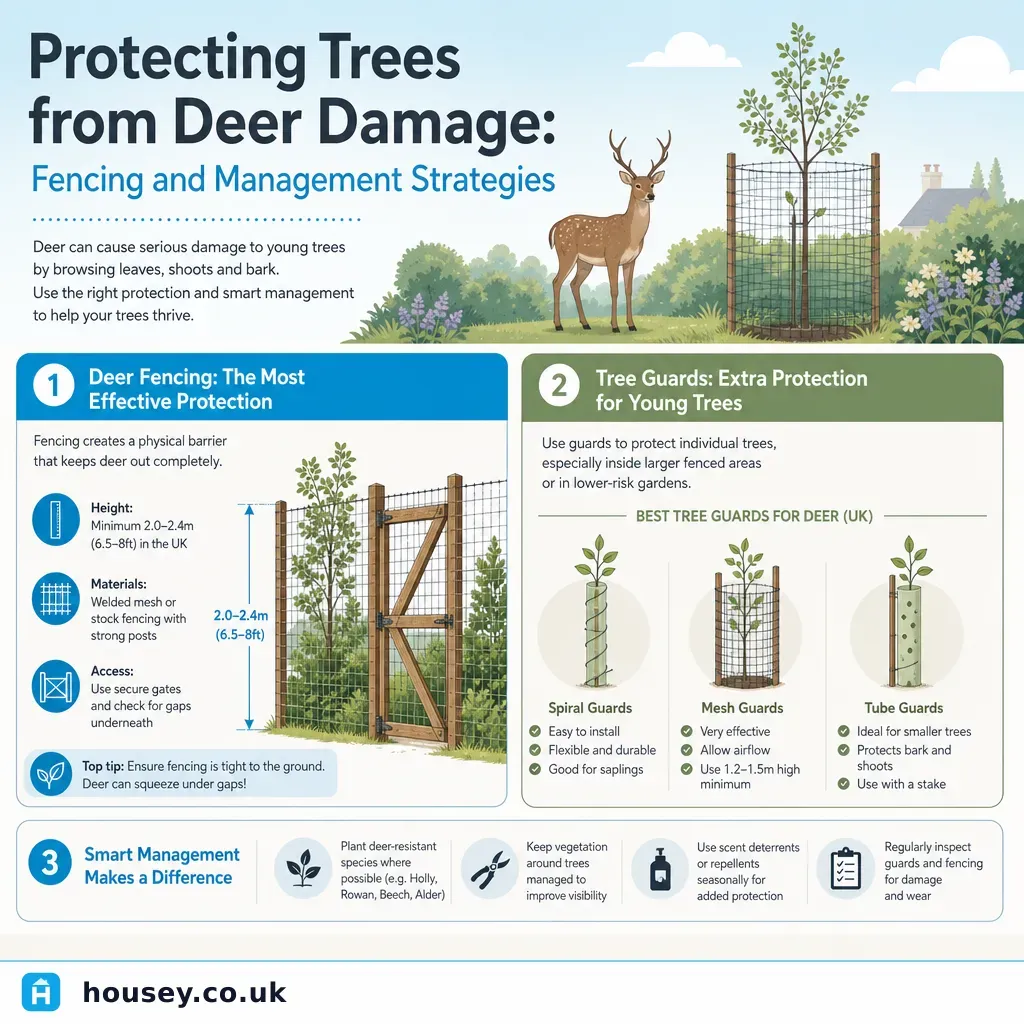
Protecting Trees from Deer Damage: Fencing and Management Strategies
Deer browsing affects gardens and smallholdings across much of rural and semi-rural England, Wales, and Scotland, with populations of roe, muntjac, fallow, and red deer now established across a wider range than at any point in modern history. For homeowners who have recently planted trees or are managing an established garden bordering woodland or farmland, unprotected trees can suffer severe damage within a single season. Getting the right protection in place before deer pressure becomes apparent is considerably cheaper and less stressful than replacing established specimens after the fact.
Key points
- Muntjac deer (Muntiacus reevesi), now widespread across much of England and Wales, have no defined breeding season and cause year-round browsing damage at heights up to approximately 75 cm.
- Roe deer can clear fences up to around 1.5 m; effective perimeter exclusion generally requires a minimum of 1.8 m, rising to 2.1 m where fallow or red deer are also present.
- The Forestry Commission recommends tree shelters and mesh guards fixed to treated timber stakes for new planting; spiral plastic guards alone are insufficient to deter deer at heights below 60 cm.
- Bark stripping (fraying), where male deer rub velvet from antlers, typically peaks between August and November; trees with thin bark — birch, cherry, rowan — are particularly vulnerable.
- Deer damage to garden trees is not covered by standard home insurance; costs of replacement and protection fall entirely to the homeowner.
How deer damage trees and when it occurs
Deer cause three main types of tree damage: browsing (eating shoots, buds, and leaves), bark stripping (fraying antlers against stems), and ground disturbance from hooves. Browsing affects the leading shoot and side branches most severely in newly planted trees, while bark stripping can ring-bark an established tree, cutting off the flow of water and nutrients and often killing it within a single growing season.
Muntjac are active throughout the year and tend to browse low, typically below 75 cm. Roe deer feed at heights up to approximately 1 m. Fallow and red deer, present in parts of the south, Midlands, and Scotland, can reach 1.2 m and are stronger jumpers. Understanding which species are active in your area helps you size both individual guards and any perimeter fencing correctly. The British Deer Society publishes regional distribution maps that can help identify likely species.
Tree guards and shelters: which type to choose
Individual tree protection is usually the most practical solution for gardens with up to 20–30 trees, or where only key specimens need safeguarding.
Guard type | Best for | Not ideal for | Effective height | Key consideration |
|---|---|---|---|---|
Spiral plastic guard | Young saplings; combined rabbit and light deer pressure | Areas with regular deer activity; transplants above 60 cm | 45–60 cm | Insufficient alone for roe or muntjac; combine with a taller outer cage where deer pressure is more than occasional |
Mesh tube (1.2 m) | Most garden saplings; moderate deer pressure | Windy exposed sites without robust staking | 1.2 m | Stake must be driven firmly; check annually for uplift or displacement |
Rigid plastic tree shelter | Woodland and hedgerow planting; provides a microclimate benefit | Ornamental gardens where appearance matters | 60–120 cm | Remove once tree is established (typically 5–7 years) to prevent bark damage from a tight fit |
Weld mesh cage | High-value specimen trees; severe or persistent deer pressure | Large-scale planting where unit cost is prohibitive | 1.2–1.8 m | Fix to two or three treated timber stakes; leave clearance for trunk expansion |
Perimeter deer fence | Whole-garden or paddock protection; multiple trees to safeguard | Small urban plots; conservation area settings where visual impact is restricted | 1.8–2.1 m | Inspect regularly for gaps at ground level, where deer will push underneath if given the opportunity |
Indicative UK costs, last reviewed 2026-05-18. Individual guards typically cost £1–£6 each; weld mesh cages £15–£50 depending on size; perimeter fencing £8–£20 per linear metre installed. Costs vary significantly by supplier, quantity, and site conditions.
Perimeter fencing: heights, types, and practical considerations
Where the whole garden, orchard, or a significant planting area needs protection, a perimeter deer fence is the most reliable long-term solution. Timber post-and-wire fences using high-tensile hexagonal wire mesh are the most widely used approach; the mesh should extend to ground level and be pinned or buried slightly to prevent deer pushing underneath.
Heights by likely species:
- 1.5 m: may deter muntjac and roe in low-pressure areas, but is not reliably effective where deer are bold or food-scarce.
- 1.8 m: the practical minimum for roe deer exclusion; suitable for most English gardens where roe or muntjac are the primary concern.
- 2.1 m: recommended where fallow or red deer are present, or where the planting warrants greater investment.
- Electric fencing: a temporary or lower-cost alternative for paddocks and orchards; requires regular maintenance and vegetation management along the fence line to remain effective.
Planning permission is not usually required for fences below 2 m in height, provided they do not adjoin a highway and there are no Article 4 directions or other local restrictions. If the property is listed or within a conservation area, check with your local planning authority before installing any fence above 1 m.
Which protection method should you choose?
- Choose individual mesh tubes (1.2 m) fixed to robust stakes if you have fewer than 15 newly planted trees and are primarily concerned with roe deer or muntjac.
- Choose weld mesh cages if you have high-value ornamental trees or semi-mature transplants where long-term retention and appearance both matter.
- Choose a perimeter deer fence of 1.8–2.1 m if the whole garden is at risk, you have multiple tree species to protect, or existing individual guards have been breached repeatedly.
- Choose electric fencing if you need a temporary or cost-effective paddock or orchard solution and are prepared to maintain the fence through the season.
- Ask a professional landscaper or fencing contractor if the site has boundary complications, difficult terrain, or you need guidance on planting strategy alongside protection measures.
- Check with your local planning authority before installing any fence above 2 m, in a conservation area, or affecting a right of way.
Red flags: signs that deer pressure is becoming severe
Seek professional advice or act promptly if you notice:
- Ring-barking (bark stripped all the way around the trunk) on any tree — the tree may not recover without urgent intervention.
- Repeated breakthrough of existing guards, suggesting a larger or more persistent deer population than the current protection was designed to handle.
- Fraying damage at heights above 1.2 m, which may indicate fallow or red deer rather than the smaller species you had anticipated.
- Multiple young trees with leading shoots browsed off despite guards being in place — guards may be too short, poorly staked, or have shifted over winter.
- Regular deer tracks through or under perimeter fencing, indicating a breach that needs locating and repairing before further damage occurs.
When to get professional help
A landscape professional or specialist fencing contractor can assess the scale of deer pressure, advise on the correct fence specification for your site, and carry out installation on difficult or extensive plots. If your planting includes commercially significant trees or you are managing woodland, Forest Research and the Forestry Commission publish detailed technical guidance and can advise on grant-eligible protection under the England Woodland Creation Offer (EWCO).
For large-scale deer management — particularly where deer are causing damage across a wider area — a professional deer manager with relevant Deer Management Qualifications (DMQs) may be worth consulting alongside a fencing or landscape specialist.
How Housey can help
If you need professional help designing, installing, or reviewing tree protection and deer-management fencing, Housey can connect you with experienced landscapers and garden designers who can assess your site, identify the species involved, and recommend the right combination of individual guards and perimeter solutions for your plot.
Frequently asked questions
Do I need planning permission for deer fencing in my garden?
Fences below 2 m in height do not usually require planning permission under permitted development rights, provided they do not adjoin a highway and there are no restrictive conditions on your property. In a conservation area or on a listed property, different rules may apply. Always check with your local planning authority before installing a fence that could materially change the external appearance of the property.
Can I remove deer from my garden myself?
Deer are protected under the Deer Act 1991 in England and Wales. It is illegal to take or kill deer outside permitted seasons, at night, or using prohibited methods. Any control must be carried out by a qualified person using appropriate methods. Contact the British Deer Society for regional advice, or engage a professional wildlife manager with relevant Deer Management Qualifications for licensed control in your area.
How long do plastic tree guards typically last?
Most UV-stabilised plastic spiral guards and mesh tubes last three to seven years before degrading. They should be removed once the tree stem is large enough to no longer need protection, as a tight guard left in place can cause girdling damage to the bark. Weld mesh cages are more durable and can be removed and reused carefully as the tree establishes.
Are muntjac deer harder to protect against than roe deer?
Muntjac are smaller than roe deer, browse low — typically below 75 cm — and are active all year with no defined breeding season. They cannot jump as high as roe, so a solid 1.5 m perimeter fence is usually sufficient in muntjac-only areas. However, their year-round persistence means individual tree guards must be properly sized and well-secured from the moment of planting.
Sources and further reading
- Deer management: protecting trees and woodland — Forest Research
- Protecting trees from deer — Woodland Trust
- UK deer species and distribution — British Deer Society
- Deer Act 1991 — legislation.gov.uk
- England Woodland Creation Offer (EWCO) — GOV.UK
Useful next reads
 Improvement & Build
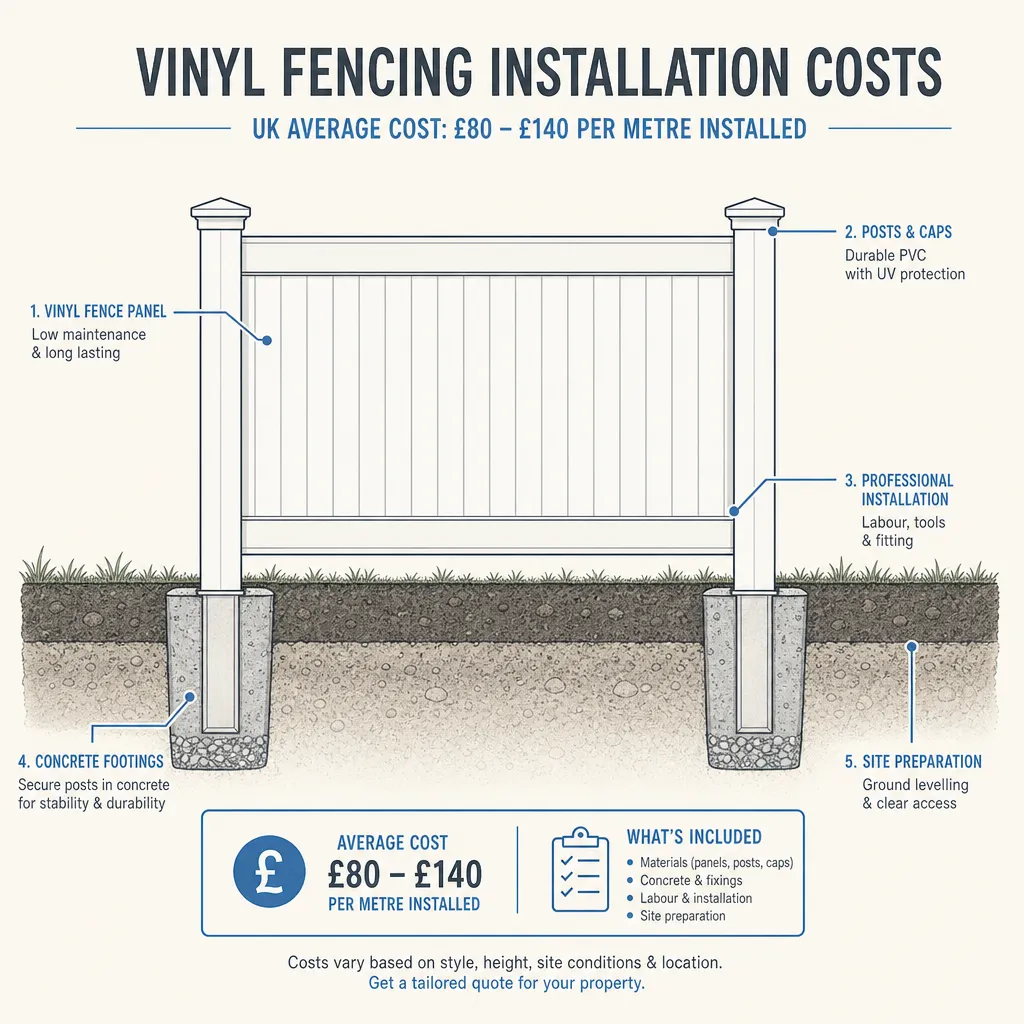
Vinyl Fencing Installation Costs
Vinyl fencing in the UK costs roughly £60–£200 per metre for supply and installation, depending on fence style, height, and ground conditions.
 Improvement & Build
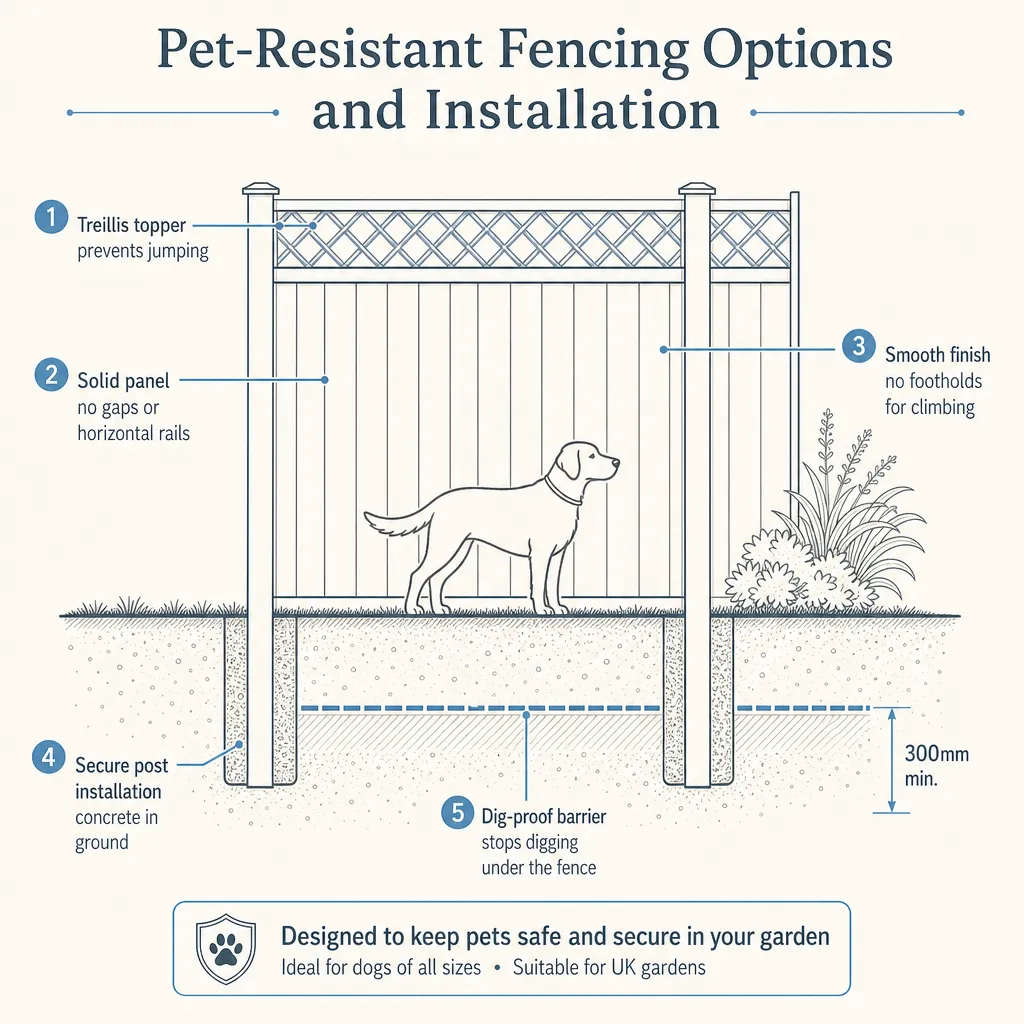
Pet-Resistant Fencing Options and Installation
Pet-resistant fencing in the UK typically needs to be at least 1.
 Improvement & Build
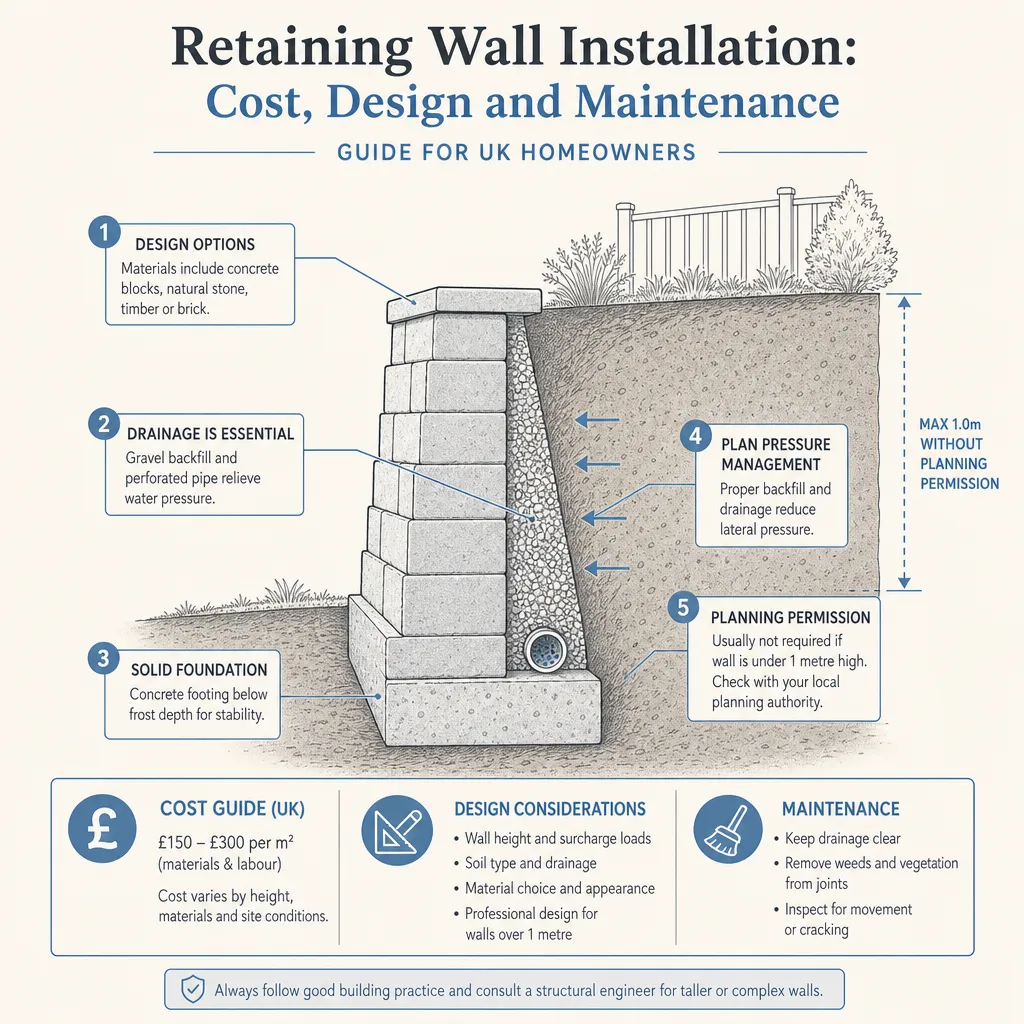
Retaining Wall Installation: Cost, Design and Maintenance
A retaining wall holds back soil on a sloped or banked site.
 Improvement & Build
Seasonal Garden Transformations and Outdoor Design Ideas
A successful garden transformation in the UK works with the seasons rather than against them — establishing structure and hard landscaping in autumn or winter, planting in spring, and enjoying the results through summer.
 Improvement & Build
Designing Garden Irrigation Around Trees and Landscaping Elements
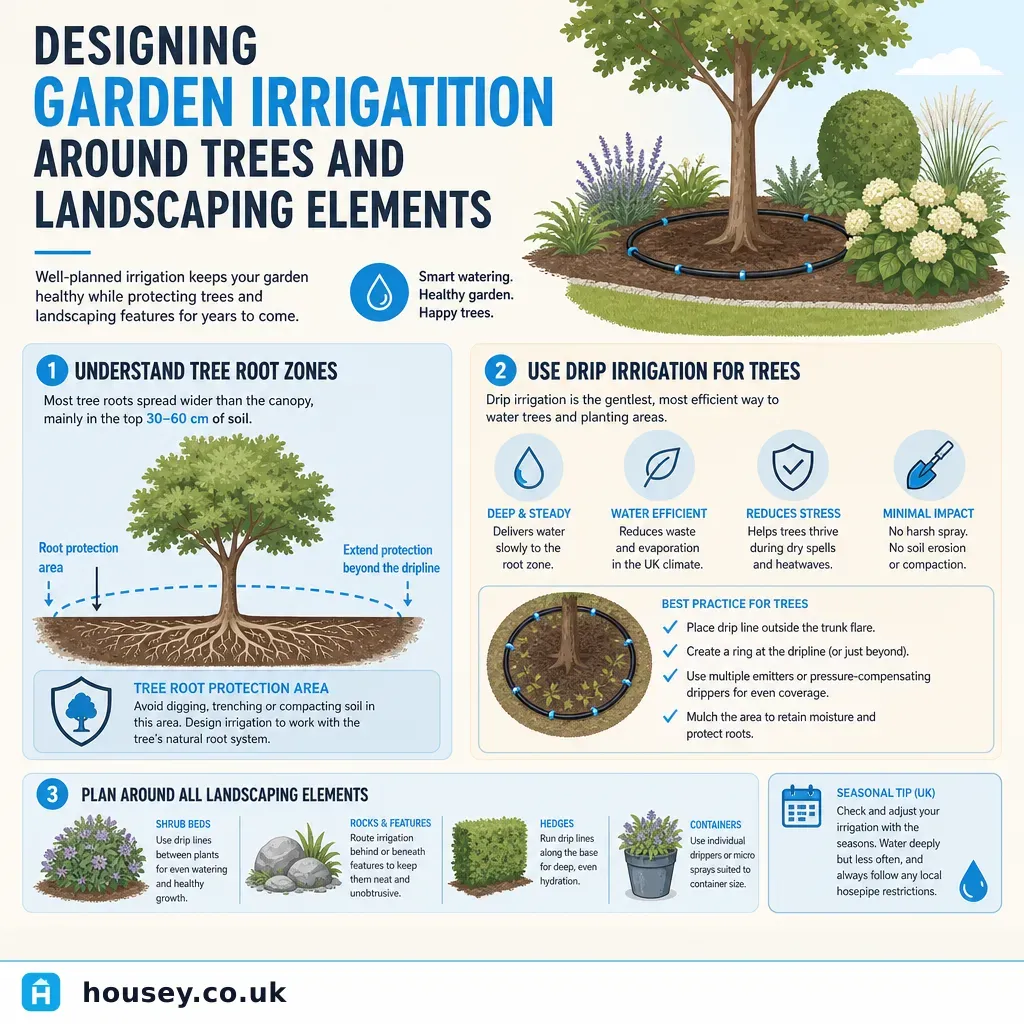
Design irrigation around trees by respecting the root protection area defined under BS 5837:2012, using drip or leaky pipe delivery rather than spray heads, and putting the tree zone on its own circuit.