Understanding Service Guarantees: Protection for Your Home Improvement Project
By Housey · Last reviewed 24th of May 2026

Understanding Service Guarantees: Protection for Your Home Improvement Project
When a building project finishes and the contractor hands back your keys, the relationship does not end there. Defects can emerge weeks, months, or even years after completion, and the value of the guarantee or warranty you received is tested precisely at that point. Many homeowners accept guarantees without fully understanding their scope, their limitations, or whether they would provide meaningful redress if the contractor ceased trading before a problem was discovered.
Key points
- Under the Consumer Rights Act 2015, all home improvement services must be performed with reasonable care and skill; if they are not, you are entitled to a repeat performance or a price reduction regardless of any written guarantee.
- A contractor's own workmanship guarantee is only as useful as the business behind it; if the company folds, the guarantee becomes unenforceable unless it is backed by a regulated insurer.
- Insurance-backed guarantees (IBGs) are underwritten by a third-party insurer and remain valid even if the contractor ceases trading; they typically transfer automatically to a new owner when the property is sold.
- Manufacturer warranties on installed products — roof tiles, windows, boilers, composite decking — are separate from workmanship guarantees and run with the product, not the installer.
- TrustMark-registered contractors and Federation of Master Builders (FMB) members agree to codes of conduct and dispute-resolution processes, but membership alone does not automatically provide an IBG.
The three types of guarantee explained
1. Workmanship guarantees
Issued directly by the contractor, a workmanship guarantee covers defects in the way the work was carried out — not faults in the materials themselves. These typically last between one and ten years depending on the trade and the contract.
The critical limitation: if the contractor dissolves, is wound up, or simply stops trading, the guarantee is worthless because there is no solvent entity to honour it. For small sole traders, this risk is material. For loft conversions, extensions, and major roofing works — projects where latent defects can take years to appear — a workmanship-only guarantee carries real risk.
2. Insurance-backed guarantees (IBGs)
An IBG is underwritten by a regulated insurer. The contractor purchases the policy as part of the project cost, and the policy names the homeowner as the insured party.
Key features:
- Remains valid if the contractor ceases trading or becomes insolvent.
- Typically transfers to the new owner when the property is sold, which can be a positive selling point.
- Comes with a policy document naming the insurer, the reference number, and the specific works covered.
- Schemes vary — some are provided through industry bodies such as LABC Warranty, Premier Guarantee, PCA (for damp and timber), and CIGA (for cavity wall insulation); others are available directly through contractors.
Always ask for the policy document directly; do not accept a verbal assurance that the work is covered.
3. Manufacturer warranties
When a contractor installs a product — a roof tile system, a boiler, uPVC windows, or insulation — the product carries the manufacturer's warranty. This covers material failure, not installation error. Windows replaced under the FENSA or CERTASS scheme generate a certificate confirming the installation complied with Building Regulations Part L; the manufacturer's warranty on the sealed unit runs separately.
Boiler manufacturers typically offer two to ten years' warranty registered at the point of installation, separate from any guarantee on the plumber's installation work. Always register products at installation and retain the warranty documentation.
Comparison: types of guarantee
Type | Who issues it | Survives contractor failure? | Transfers on sale? | What it covers |
|---|---|---|---|---|
Workmanship guarantee | Contractor | No | Usually no | Installation method, defects in workmanship |
Insurance-backed guarantee (IBG) | Insurer, via contractor | Yes | Usually yes | Workmanship defects; often structural defects |
Manufacturer warranty | Product manufacturer | Yes | Usually yes, if registered | Product failure, material defects |
Statutory rights (Consumer Rights Act 2015) | The law | Not applicable | Not applicable | Right to repeat performance or price reduction |
What to ask before accepting a guarantee
Before signing a contract or accepting a completion sign-off, ask the following:
- Who is the guarantor? Is this the contractor alone, or is there an underwriting insurer? Ask for the policy document.
- What does it cover? Workmanship only, or materials too? Are structural defects included?
- How long does it run? One year is common for minor works; five to ten years is more appropriate for extensions, roofing, damp-proofing, and cavity wall insulation.
- Does it transfer to a new owner? Particularly important if you are planning to sell within the guarantee period.
- What is the claims process? Who do you contact first — the contractor or the insurer?
- What is excluded? Maintenance items, wear and tear, accidental damage, and structural movement caused by ground conditions are commonly excluded.
- Is there a registration number or policy reference? Without this, an IBG claim may be unverifiable.
Red flags: when a guarantee is not what it seems
Be cautious if:
- The contractor cannot name the insurer underwriting an IBG when you ask directly.
- The guarantee is issued on a generic template with no reference to the specific works or property address.
- You are told the "guarantee" is equivalent to your statutory rights under the Consumer Rights Act 2015 — your statutory rights are a legal floor, not a substitute for a proper guarantee.
- The contractor requests full payment before providing the guarantee documentation.
- The guarantee period is shorter than the typical lifespan of the defects it covers — for example, a one-year guarantee on flat roof waterproofing, where membrane failures often become apparent at two to five years.
- There is no dispute-resolution process specified; a professional guarantee should name an independent adjudicator or recognised ombudsman.
Your statutory rights under the Consumer Rights Act 2015
Even without a written guarantee, you have legal rights when contracting for home improvement services in the UK:
- Services must be performed with reasonable care and skill.
- If the service falls short of this standard, you are entitled to ask the contractor to repeat the work at no additional cost.
- If a repeat is not possible or the contractor refuses, you are entitled to a price reduction — potentially down to zero for seriously defective work.
- These rights apply for up to six years in England, Wales, and Northern Ireland (five years in Scotland) under the Limitation Act 1980 and the Prescription and Limitation (Scotland) Act 1973.
Citizens Advice provides practical guidance on exercising these rights, including template letters and small claims court guidance.
When to get professional help
If defects appear and a contractor is disputing liability:
- Document everything: photographs with timestamps, written communications, and the original contract or specification.
- Write formally to the contractor setting out the defect and requesting remediation — email provides a clear audit trail.
- If the contractor is a TrustMark registrant or FMB member, use the scheme's complaints process before escalating.
- For structural defects or safety-critical issues, commission an independent assessment from a RICS-chartered surveyor before any remediation starts.
- For IBG claims, contact the insurer directly with the policy reference; the insurer manages the claim, not the contractor.
How Housey can help
Housey works with vetted contractors across a range of trades. Whether you are planning a loft conversion through our loft conversion companies, commissioning an extension via our extension builders, or arranging a new roof through qualified roofers, Housey's quote comparison tools let you review provider credentials, scheme memberships, and guarantee terms before you commit.
Frequently asked questions
What is an insurance-backed guarantee (IBG)?
An insurance-backed guarantee is a policy underwritten by a regulated insurer that protects a homeowner if the contractor who carried out the work ceases trading before the guarantee period ends. Unlike a contractor's own workmanship guarantee, an IBG remains valid regardless of the contractor's solvency. It should come with a policy document, a reference number, and a clear claims process.
Does the Consumer Rights Act 2015 cover home improvements?
Yes. Under the Consumer Rights Act 2015, any home improvement service must be performed with reasonable care and skill. If it is not, you are entitled to ask the contractor to repeat the work free of charge, or to receive a price reduction. These rights apply regardless of any written guarantee and are enforceable for up to six years in England and Wales.
How long should a workmanship guarantee last?
It depends on the work. Minor repairs and redecoration: one to two years is common. Roofing and waterproofing: five to ten years is reasonable, given how long defects can take to appear. Extensions and structural work: ten years is a reasonable expectation, particularly for insurance-backed guarantees. Always check what the guarantee covers as well as its duration.
Does a guarantee transfer when I sell my property?
Contractor-issued workmanship guarantees often do not transfer automatically — check the terms carefully. Insurance-backed guarantees generally transfer to the new owner, which can be a positive factor in a sale. Manufacturer warranties on products typically transfer if they were registered at installation. Ask your contractor and solicitor to confirm the position before exchange.
Sources and further reading
- Consumer Rights Act 2015 — legislation.gov.uk
- Problems with building work, decorating and repairs — Citizens Advice
- TrustMark: government-endorsed quality scheme — TrustMark
- Federation of Master Builders: find a builder and understand guarantees — Federation of Master Builders
- FENSA: replacement windows and doors compliance certificates — FENSA
Useful next reads
 Improvement & Build
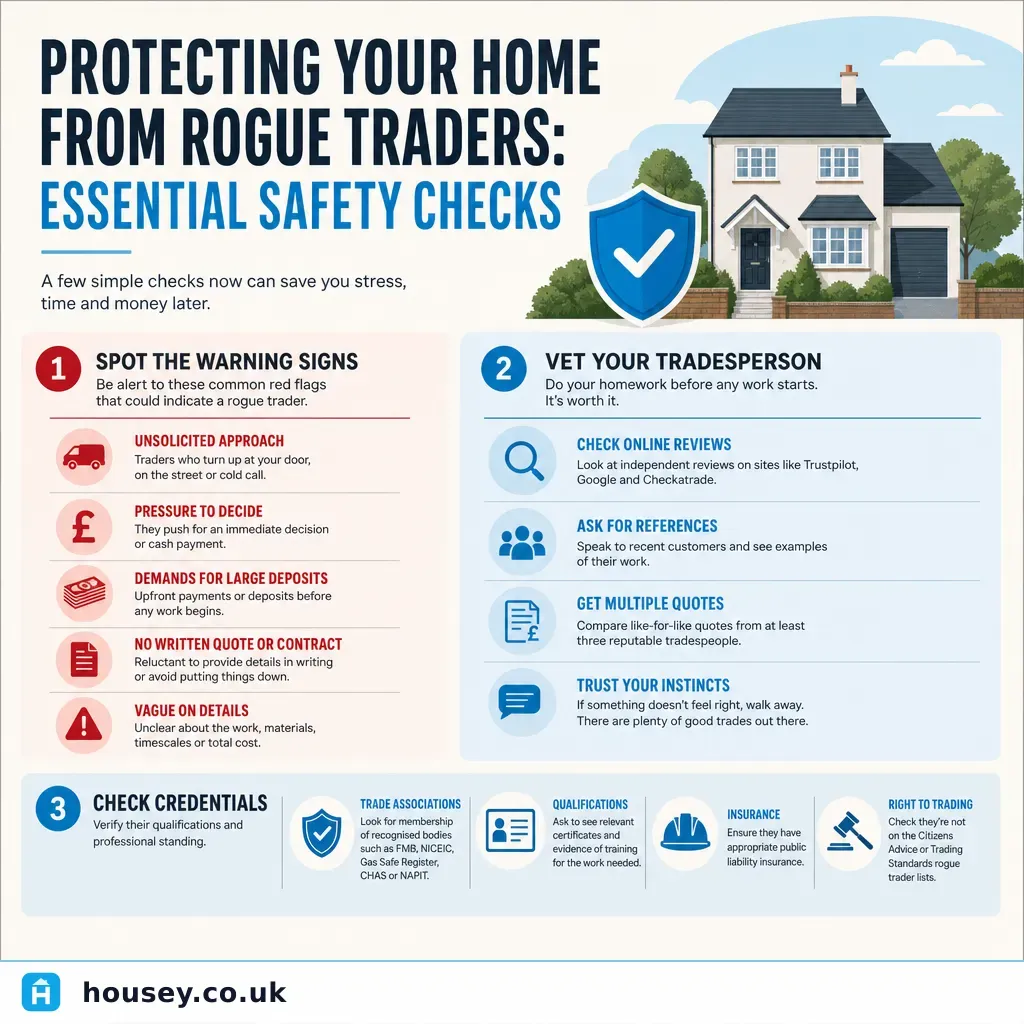
Protecting Your Home from Rogue Traders: Essential Safety Checks
Protect your home from rogue traders by verifying credentials before work starts: check for a trading address and company number, ask for references from recent local jobs, confirm any required scheme membership (Gas Safe, NICEIC, FENSA), and never pay cash in full upfront.
 Improvement & Build
Common Roofing Scams: How to Protect Yourself and Your Property
Roofing scams most often involve unsolicited doorstep approaches, pressure to pay large deposits upfront, claims of urgent storm or structural damage, and contractors who disappear without completing work.
 Improvement & Build
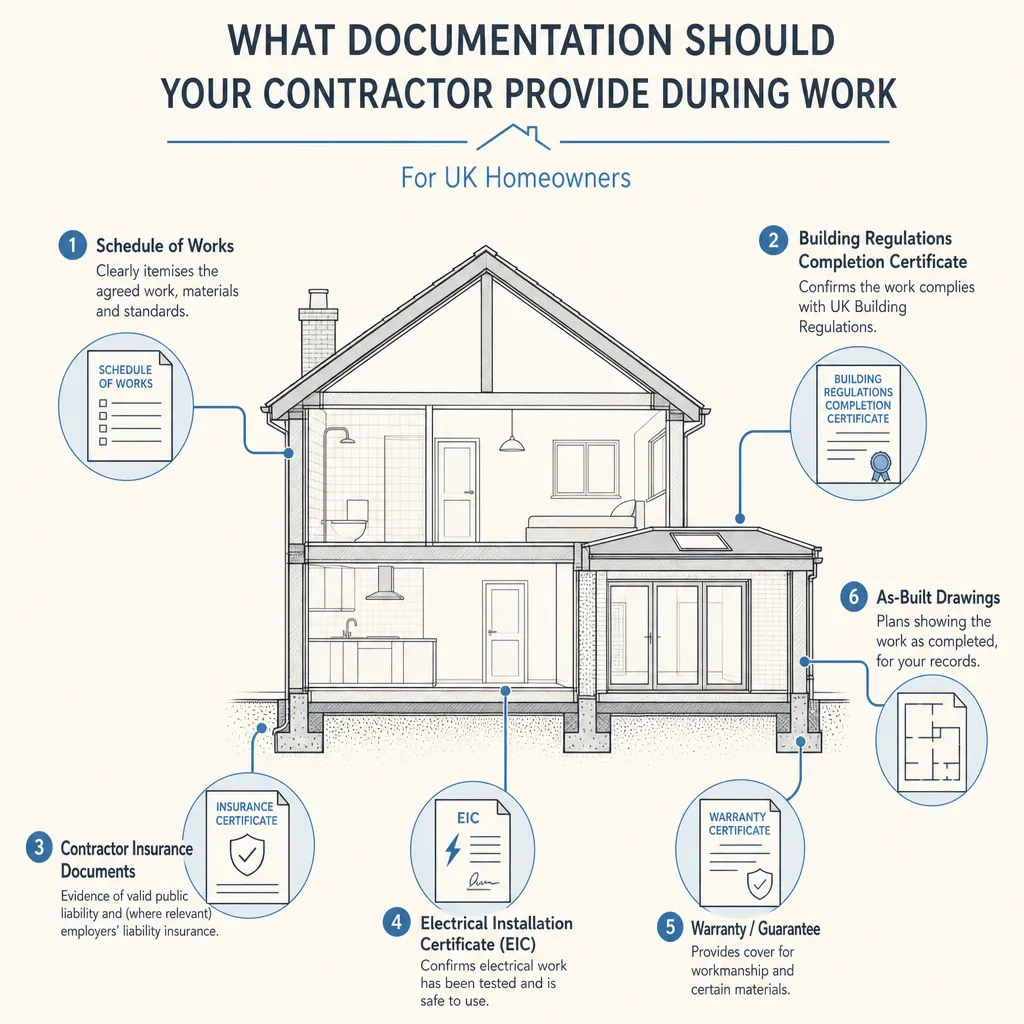
What Documentation Should Your Contractor Provide During Work
During building work, your contractor should provide a signed written contract, public liability insurance certificate, and copies of any building control application.
 Improvement & Build
Identifying Problem Areas: Rogue Traders and How to Protect Your Home
Rogue traders target homeowners with unsolicited visits, pressurised quotes, and substandard or incomplete work.
 Improvement & Build
Stopping Unqualified Traders: Standards That Protect Homeowners
Protect yourself from unqualified traders by knowing which trades are legally regulated: gas engineers must be Gas Safe registered, electricians must work under Part P or notify building control, and window installers must be FENSA or Certass registered.