Identifying Problem Areas: Rogue Traders and How to Protect Your Home
By Housey · Last reviewed 19th of May 2026
Identifying Problem Areas: Rogue Traders and How to Protect Your Home
Rogue traders cause significant financial and emotional harm to UK homeowners each year, with Citizens Advice handling tens of thousands of complaints annually about building and home improvement work. The problem is not confined to doorstep cold-callers — rogue operators also advertise online and on social media, often appearing superficially credible before problems emerge. Knowing the warning signs, how to verify credentials before any work starts, and what your rights are if things go wrong can protect you from costly, and sometimes dangerous, mistakes.
Key points
- TrustMark is a government-endorsed quality scheme for tradespeople covering all domestic repair, maintenance, and improvement work — registered firms are assessed for technical competence, customer service, and trading practices, and the scheme is backed by the Department for Energy Security and Net Zero (DESNZ).
- The Citizens Advice Consumer Service (0808 223 1133) and Trading Standards are the primary statutory bodies handling rogue trader complaints in the UK — always report concerns even if you are unsure whether a criminal offence has occurred.
- Under the Consumer Rights Act 2015, work carried out for a consumer must be performed with reasonable care and skill, at a reasonable price if not agreed in advance, and within a reasonable time — these rights apply regardless of whether you have a written contract.
- The Cancellation of Contracts made in a Consumer's Home or Place of Work etc. Regulations 2008 give you a 14-day cooling-off period for contracts agreed at your home worth over £42, provided the work has not already been completed at your specific request.
- Gas work carried out by anyone not on the Gas Safe Register is illegal under the Gas Safety (Installation and Use) Regulations 1998 — always verify the engineer's licence card number on the Gas Safe Register website before any gas work begins.
Who rogue traders target and how they operate
Rogue traders do not confine themselves to a single type of property or homeowner. Research by Citizens Advice and Trading Standards consistently highlights common operational patterns:
- Cold-call door-knockers who claim to have spotted a problem — loose roof tiles, cracked pointing, blocked gutters — while working in the area, offering a "competitive" same-day quote and requesting immediate cash payment.
- Online and social media advertisers who generate quote enquiries without verifiable credentials, insurance, or accreditation, often quoting very low prices to win work before problems surface.
- "Too cheap to be true" quotes that undercut legitimate contractors by 40% or more, only to demand additional money mid-project using claims about unexpected problems discovered once work is under way.
- Incomplete or substandard work, where a deposit is taken and the trader disappears, or the completed work fails to meet Building Regulations standards or basic professional quality expectations.
How to verify a tradesperson before agreeing to work
Verification takes under 15 minutes and should happen before any contract is agreed or deposit paid. Use this checklist:
Homeowner verification checklist
- Gas work: Gas Safe Register (gassaferegister.co.uk) — check the engineer's licence card number before any work.
- Electrical work: NICEIC or NAPIT registered electricians.
- Oil heating: OFTEC register.
- Window and door replacement: FENSA or Certass registered installers.
Red flags: warning signs before and during work
Even after initial verification, problems can surface. Pause and reassess if you notice any of the following:
Before work starts:
- Unsolicited approach with pressure to decide the same day.
- Quote provided only verbally, with refusal to confirm anything in writing.
- Request for full payment — or a very large proportion — in cash before any work begins.
- Inability or unwillingness to provide insurance documentation, qualifications, or scheme accreditation when asked.
- Business address that cannot be independently verified (PO box only, no registered address traceable on Companies House).
- Quote dramatically lower than all others received — sometimes 40–60% below — with no clear explanation for the saving.
During work:
- Claim of unexpected additional work required, with a demand for more money before continuing.
- Workers seen without appropriate personal protective equipment on projects where it is required.
- Materials brought to site that differ significantly from those specified in the written quote.
- Requests for additional cash payments not reflected in any written documentation.
- Reluctance to leave the premises, or deliberate creation of time pressure ("we need to order materials today or the price changes").
What to ask before agreeing to any work
Before signing a contract or paying a deposit, ask the following questions:
- Can I see your current public liability insurance certificate?
- What professional accreditations or scheme memberships do you hold — and can I verify them independently?
- Are you registered with Gas Safe / NICEIC / FENSA / TrustMark for this type of work?
- Will you provide a written quote with a full specification of materials, method, and timescale?
- What is the payment schedule, and do you accept bank transfer rather than cash?
- What guarantee or warranty do you offer on the completed work?
- Who will be on site — you personally, or subcontractors — and what are their qualifications?
- What happens if the project overruns, or if unexpected problems are discovered?
- Can you provide the names and contact details of two referees from similar recent local jobs?
- Is VAT included in the quote, and if so, what is your VAT registration number?
Your rights if things go wrong
If work is substandard, incomplete, or you believe you have been the victim of fraud:
- Contact the trader in writing first, setting out the problem and requesting resolution within a reasonable timeframe. Fourteen days is generally considered reasonable for an initial response.
- Contact your bank or credit card provider. If you paid by credit card, Section 75 of the Consumer Credit Act 1974 gives you a right of recourse against the card provider for work not delivered or delivered defectively, on contracts between £100 and £30,000.
- Contact Citizens Advice (citizensadvice.org.uk or 0808 223 1133) for guidance on your rights and referral to Trading Standards.
- Report to Trading Standards via the Citizens Advice Consumer Service, which passes complaints to the relevant local Trading Standards office.
- Report fraud to Action Fraud (actionfraud.police.uk or 0300 123 2040) — the national reporting centre for fraud and cybercrime in England, Wales, and Northern Ireland.
- Contact your local council's building control team if work may have been carried out in breach of Building Regulations without consent.
Recovery of money paid to a rogue trader through civil action can be slow and is not guaranteed. Prevention and thorough verification before any work starts are significantly more effective than pursuing remedies after the fact.
When to get professional help
If you suspect gas or electrical work has been carried out unsafely or without proper certification, stop using the affected systems and arrange an independent inspection immediately — a Gas Safe-registered engineer for gas work, and an NICEIC or NAPIT-registered electrician for electrical systems. Substandard gas work is a safety emergency: contact the National Gas Emergency Service on 0800 111 999 if you smell gas or suspect a leak. For structural work carried out without Building Regulations approval, contact your local building control authority, who can advise on regularisation options or enforcement.
How Housey can help
Housey makes it straightforward to request quotes from vetted service providers — tradespeople who have been checked for appropriate qualifications, insurance, and trading practices before appearing on the platform. Comparing multiple vetted quotes through a single, structured process is one of the most practical defences available to UK homeowners against rogue operators.
Frequently asked questions
How do I check if a trader is on the Gas Safe Register?
Visit gassaferegister.co.uk and enter the engineer's licence card number, which Gas Safe-registered engineers are required to carry and produce on request. You can also call the Gas Safe Register on 0800 408 5500. Always verify before any gas work begins — it is a legal requirement under the Gas Safety (Installation and Use) Regulations 1998 for all gas work to be carried out by a Gas Safe-registered engineer.
What should I do if a rogue trader has already done work on my house?
Document everything immediately: photograph the work, preserve all written or digital records, and note the dates and content of any verbal conversations. Contact Citizens Advice (0808 223 1133) for guidance on your options, which may include Trading Standards referral, a Section 75 credit card chargeback, or a claim through the small claims court. If you believe fraud has occurred, report it to Action Fraud.
Are online review platforms a reliable way to vet tradespeople?
Review platforms provide a useful signal, particularly where a tradesperson has many recent, detailed reviews mentioning specific project types. However, reviews can be manipulated and platforms vary in their verification rigour. Use review platforms as one input alongside TrustMark or scheme membership, directly verified insurance, and personal references for a more reliable overall picture.
Can I get my money back from a rogue trader?
Recovery depends on how you paid. Credit card payments allow a Section 75 claim against your card provider for work not delivered or delivered defectively, on contracts between £100 and £30,000. Bank transfers are harder to recover — the Authorised Push Payment fraud reimbursement framework may apply if you were deceived into paying. Contact your bank immediately; speed increases the chance of recovery.
Sources and further reading
- Citizens Advice: problems with building work — Citizens Advice
- TrustMark government-endorsed quality scheme — TrustMark
- Gas Safe Register consumer check — Gas Safe Register
- Report fraud to Action Fraud — City of London Police
- Consumer Rights Act 2015 guidance — GOV.UK
- NICEIC find a registered contractor — NICEIC
Useful next reads
 Improvement & Build
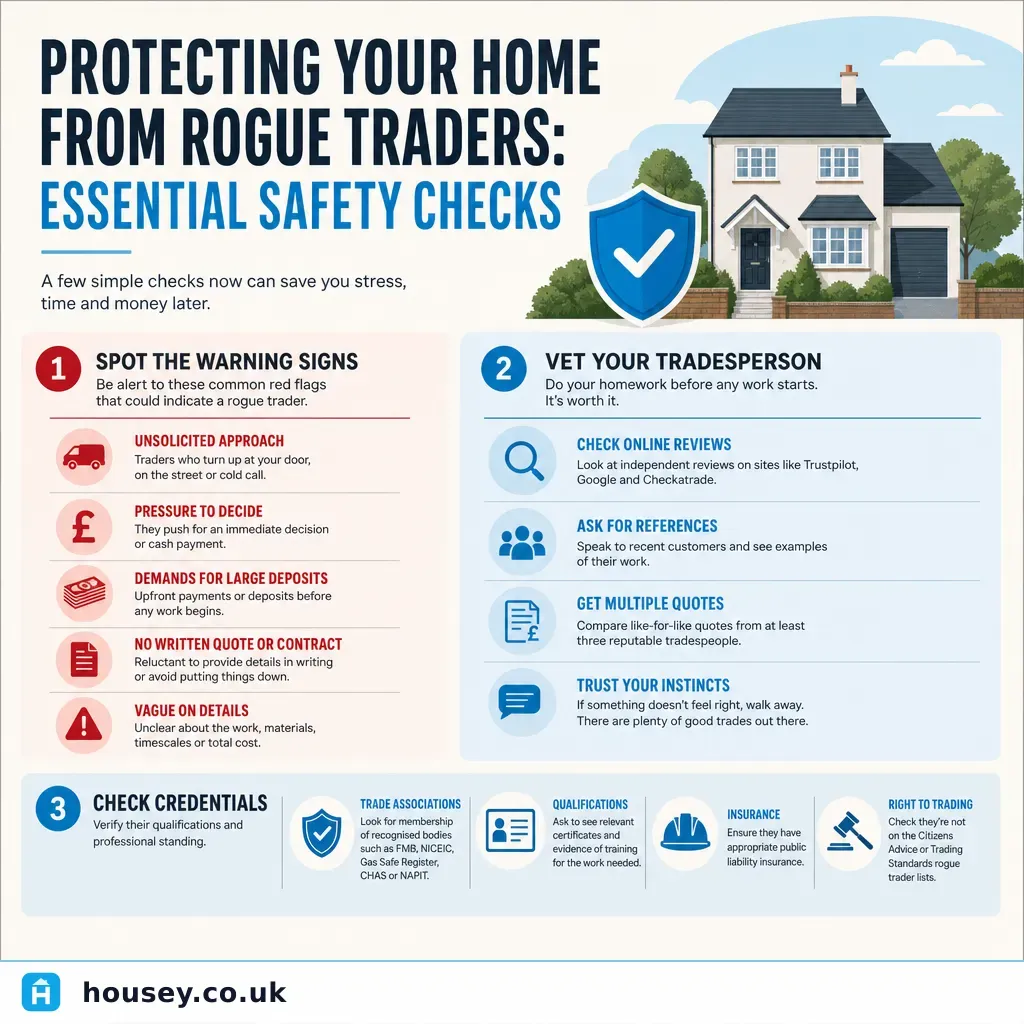
Protecting Your Home from Rogue Traders: Essential Safety Checks
Protect your home from rogue traders by verifying credentials before work starts: check for a trading address and company number, ask for references from recent local jobs, confirm any required scheme membership (Gas Safe, NICEIC, FENSA), and never pay cash in full upfront.
 Improvement & Build
Stopping Unqualified Traders: Standards That Protect Homeowners
Protect yourself from unqualified traders by knowing which trades are legally regulated: gas engineers must be Gas Safe registered, electricians must work under Part P or notify building control, and window installers must be FENSA or Certass registered.
 Improvement & Build
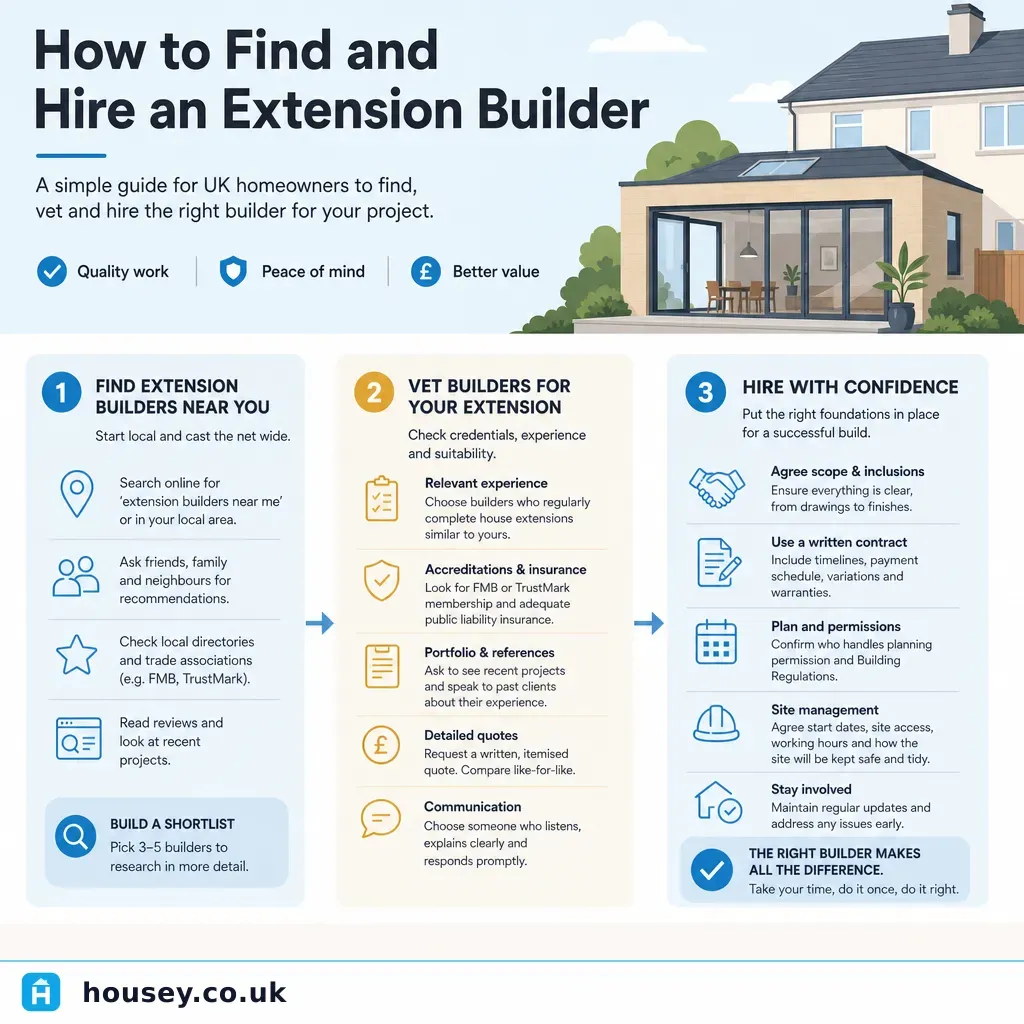
How to Find and Hire an Extension Builder
To hire a reliable extension builder, get at least three detailed written quotes from contractors with documented experience of similar projects.
 Improvement & Build
Understanding Service Guarantees: Protection for Your Home Improvement Project
Home improvement guarantees fall into three main forms: workmanship guarantees issued by the contractor, insurance-backed guarantees (IBGs) underwritten by a third party and valid even if the contractor closes, and manufacturer warranties on installed products.
 Improvement & Build
Selecting and Hiring a Remodelling Contractor
Hiring a remodelling contractor starts with a written scope of works and a shortlist of at least three companies registered with TrustMark or the Federation of Master Builders.