Purchasing Property in Conservation Areas: Special Considerations
By Housey · Last reviewed 25th of May 2026
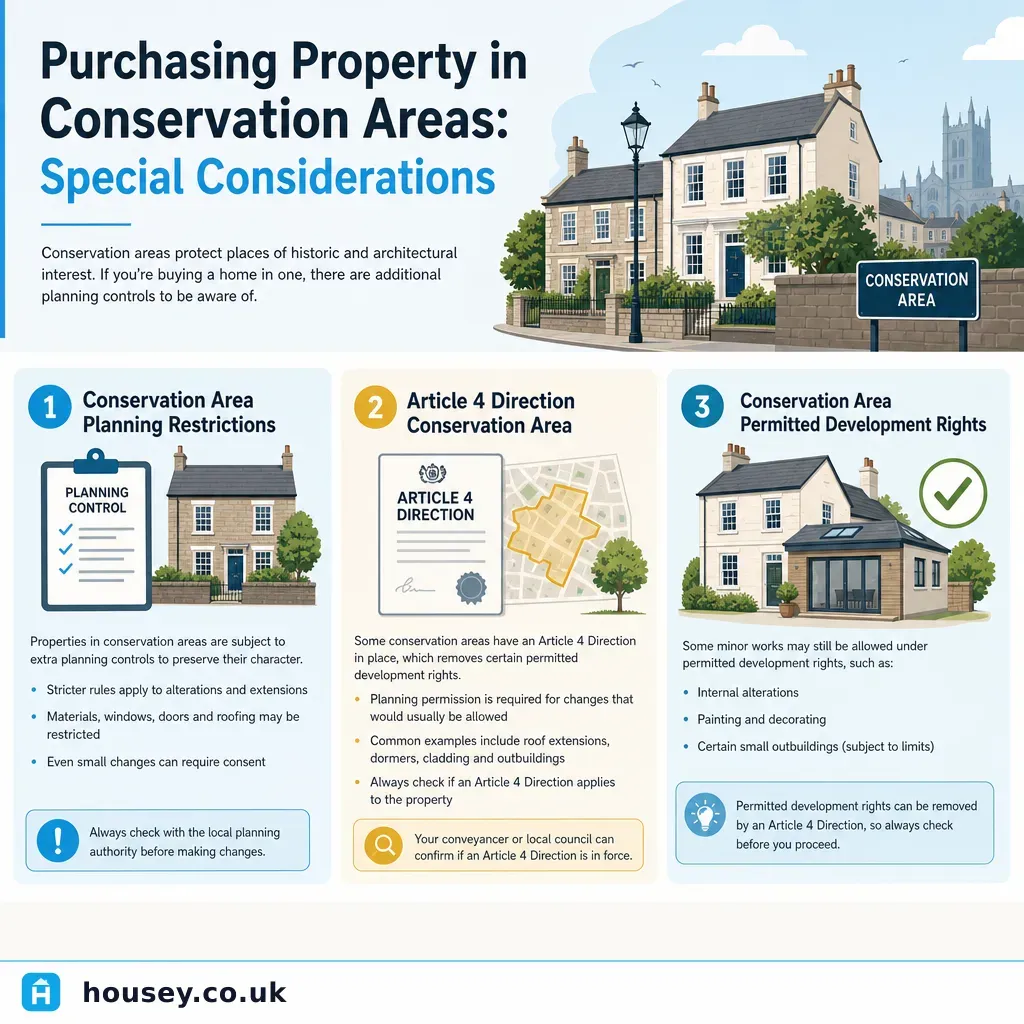
Purchasing Property in Conservation Areas: Special Considerations
Buying a home in a conservation area — whether a Victorian terrace, an Edwardian semi, or a period property in a historic market town — can mean acquiring a home in a carefully protected streetscape. It also brings planning restrictions and obligations that do not apply to most other residential properties, and these are often more extensive than buyers realise at the point of making an offer. Understanding the framework before exchange helps you assess both the property's potential and the limits on what you can change.
Key points
- Conservation areas are designated under the Planning (Listed Buildings and Conservation Areas) Act 1990 by local planning authorities, which also have a duty to review their designations periodically.
- Article 4 Directions allow local authorities to remove some or all permitted development rights in a conservation area — meaning alterations that elsewhere need no permission (replacing windows, adding a satellite dish) may require full planning consent.
- Trees in a conservation area with a trunk diameter of 75 mm or more at 1.5 m above ground are protected: you must give the local authority six weeks' written notice before carrying out any works, allowing time to impose a Tree Preservation Order.
- Unauthorised demolition of an unlisted building in a conservation area is a criminal offence under the 1990 Act.
- Conservation area consent was abolished in 2013; demolition of unlisted structures in a conservation area now requires standard planning permission under the Town and Country Planning Act 1990, s.196D.
What a conservation area designation means in practice
A conservation area is not a blanket ban on all change — it is a framework requiring that the character and appearance of the area be preserved or enhanced. In practice, this affects buyers in several ways:
- Permitted development rights may be curtailed or removed entirely, especially where an Article 4 Direction is in force.
- Planning applications are assessed against a Conservation Area Appraisal — a document the local authority uses to define what makes the area special. Proposals that conflict with the appraisal are at significant risk of refusal.
- There is a presumption against demolishing buildings that make a positive contribution to the character of the area.
- Replacement materials and design must be sympathetic: modern UPVC windows are regularly refused in conservation areas where timber sashes are the vernacular; render in a place of brick may also be refused.
Comparison: conservation area vs listed building restrictions
Factor | Conservation area (unlisted property) | Listed building (any grade) |
|---|---|---|
Consent type for external alterations | Planning permission (if PD rights removed) | Listed Building Consent, plus planning permission where required |
Internal alterations | Usually unrestricted unless Article 4 applies | Listed Building Consent needed for works affecting character |
Window replacement | May need permission; materials scrutinised | Consent almost always required; like-for-like only |
Extension | Permitted development may apply — check Article 4 | Listed Building Consent required; reversibility expected |
Demolition | Planning permission required | Listed Building Consent required; rarely granted for Grade I or II* |
Tree works | Six-week advance notice required | Six-week notice; TPO may follow |
Who enforces | Local planning authority (LPA) | LPA and Historic England |
Decision tree: how to assess a conservation area property before buying
- Is there an Article 4 Direction? Check the local authority's planning pages or ask the seller's solicitor. If yes, confirm exactly which permitted development rights are removed before you commit.
- Is the property also listed? Search the Historic England National Heritage List for England (or equivalent registers for Wales, Scotland, and Northern Ireland). Listed status adds a further consent layer that applies to internal as well as external works.
- What does the Conservation Area Appraisal say? Request it from the LPA. It identifies which elements contribute positively to the area — these are the features most likely to be protected and the hardest to alter.
- Are there trees on or near the property? Any tree works after purchase require advance notification; some may be refused and a TPO imposed.
- Has previous work been carried out without consent? Ask your conveyancer to check for planning enforcement notices and request copies of all planning consents and certificates of lawfulness for past alterations.
- Are you uncertain about the scope of restrictions? Instruct a heritage or planning consultant for a pre-purchase appraisal before exchange.
Red flags to investigate before exchange
The following warrant specific investigation — raise them with your conveyancer and, where relevant, request documentary evidence:
- Replacement windows, doors, or cladding that appear modern or non-original and where no planning consent or permitted development confirmation is on file.
- Outbuildings, rear extensions, or garage conversions added with no visible planning records.
- Trees on the plot that have been significantly reduced or removed — check whether works were notified to the LPA and whether a TPO exists.
- A purchase price notably below comparable properties in the same street — sometimes reflects undisclosed enforcement history or outstanding compliance issues.
- A vendor who cannot produce planning consents for any alterations made since the property was built.
What to ask before making an offer
- Is there an Article 4 Direction in force, and which permitted development rights does it remove?
- Has the property been altered since its original construction? Are planning consents or certificates of lawfulness available for those works?
- What are the local authority's design guidelines for extensions and alterations in this conservation area?
- Are any trees subject to a Tree Preservation Order, and have any tree works been carried out in the past five years?
- Does the local authority publish a Conservation Area Management Plan that supplements the Appraisal?
Important limitations
Conservation area rules vary significantly between local authorities and depend on the specific wording of any Article 4 Direction in force, the character of the individual property, and any enforcement history. The 2013 abolition of conservation area consent and subsequent amendments to permitted development rights mean the position is more nuanced than many general guides suggest. This article provides a general overview for England; rules differ in Wales (administered by Cadw and local planning authorities under Welsh planning policy), Scotland (Historic Environment Scotland), and Northern Ireland (Historic Environment Division). Always instruct a conveyancer and, where significant alterations are planned, a heritage or planning consultant familiar with the specific local authority.
When to get professional help
Seek specialist advice before exchange if:
- The property has been altered — extensions, window replacements, cladding — with no visible planning records
- You intend to extend, alter the facade, or carry out significant works after purchase
- The property sits on the boundary between a conservation area and non-designated land
- There is a Tree Preservation Order on trees you will need to manage
- You are unsure whether the property is also a listed building
- An enforcement notice or certificate of lawful development is missing from the property's history
What to ask a qualified professional
When instructing a conveyancer, planning consultant, or heritage consultant:
- Can you confirm all planning consents and enforcement history through a local authority search and any additional enquiries?
- Is the property subject to an Article 4 Direction, and can you obtain the exact text to confirm which rights are removed?
- If I want to carry out specific works after purchase, what consents will I need and how likely are they to be granted?
- Are there materials or design approaches that this local authority regularly approves or refuses for this type of property?
- Should I commission a heritage impact assessment before submitting a planning application for any proposed alterations?
How Housey can help
Housey connects buyers and owners with professionals experienced in conservation area properties. Our conveyancing service includes solicitors familiar with local authority searches and planning enforcement checks. Our heritage and conservation consultants can advise on what changes are likely to be approved and help you prepare a planning application that the LPA will support. For pre-purchase planning appraisals, our planning consultancy service can assess the restrictions before you commit to a purchase.
Frequently asked questions
Can I extend a property in a conservation area?
Often yes, but the extension must be designed to preserve or enhance the character and appearance of the area. Whether permitted development rights apply depends on whether an Article 4 Direction is in force. Even where planning permission is not required, materials and design should be sympathetic to the original building — councils can refuse retrospective applications and require removal of unsympathetic works.
Do I need planning permission to replace windows in a conservation area?
In many conservation areas where an Article 4 Direction is in force, yes. Replacing original timber sash windows with UPVC alternatives is regularly refused. Check with the local planning authority before ordering any replacement units — retrospective applications for refused materials may result in an enforcement notice requiring reinstatement at your cost.
What is an Article 4 Direction and how do I know if my property is affected?
An Article 4 Direction is an order made by a local authority that removes specified permitted development rights, meaning you need planning permission for works that would otherwise be allowed without consent. The local authority's planning pages should list all active Article 4 Directions; your conveyancer can also check this as part of the local authority search.
Does buying in a conservation area affect my home insurance?
It can. Reinstatement costs for period properties with original features — lime plaster, timber sash windows, traditional brickwork — are often higher than for modern equivalents. Tell your insurer the property is in a conservation area and provide an accurate rebuild cost; your surveyor or conveyancer can advise on how to establish this figure.
Sources and further reading
- Planning (Listed Buildings and Conservation Areas) Act 1990 — legislation.gov.uk
- Conservation areas: designation, appraisals and management — GOV.UK Planning Practice Guidance
- Conservation areas guidance — Historic England
- National Heritage List for England — Historic England
- Article 4 Directions guidance — GOV.UK Planning Practice Guidance
Useful next reads
 Planning & Pre-Build
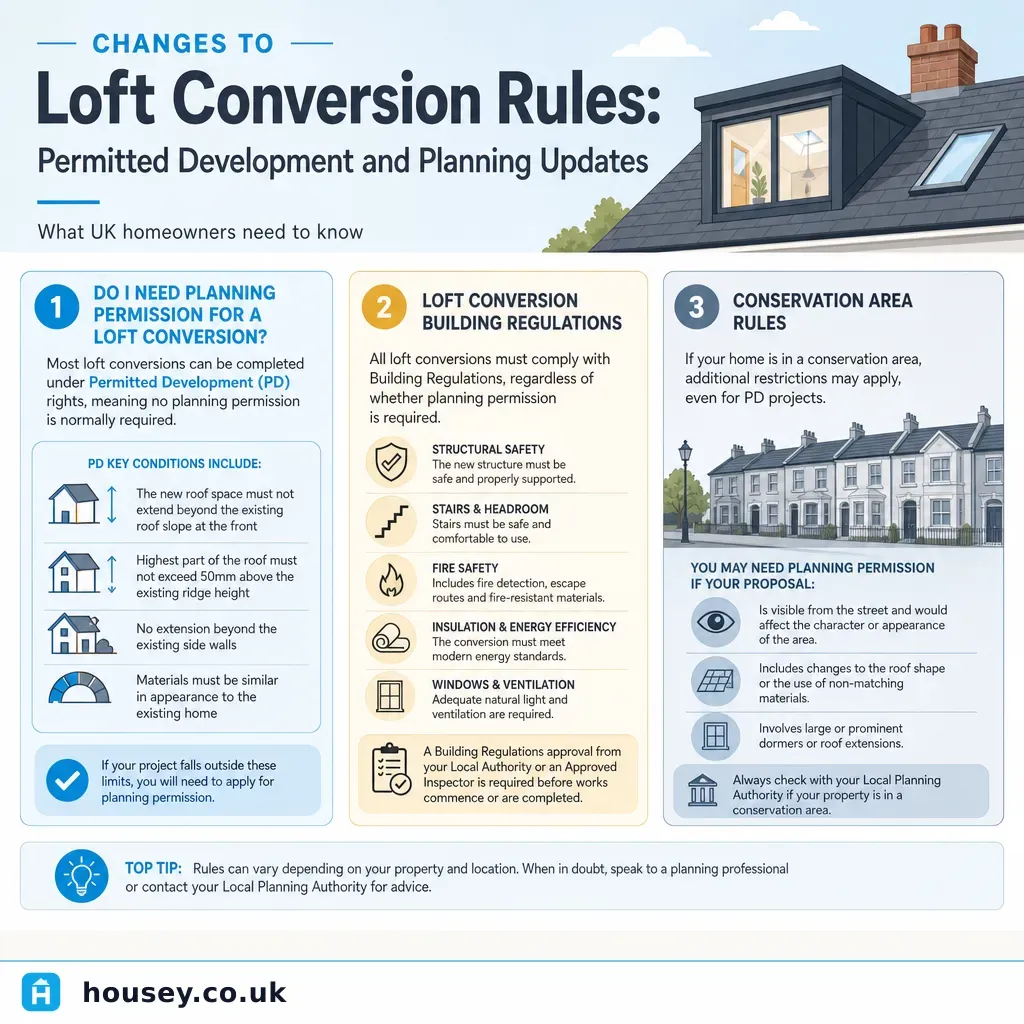
Changes to Loft Conversion Rules: Permitted Development and Planning Updates
In England, most loft conversions on standard houses qualify as Permitted Development under Class B of the GPDO 2015, allowing up to 40 cubic metres (terraced) or 50 cubic metres (detached or semi-detached) without a planning application — if conditions are met.
 Planning & Pre-Build
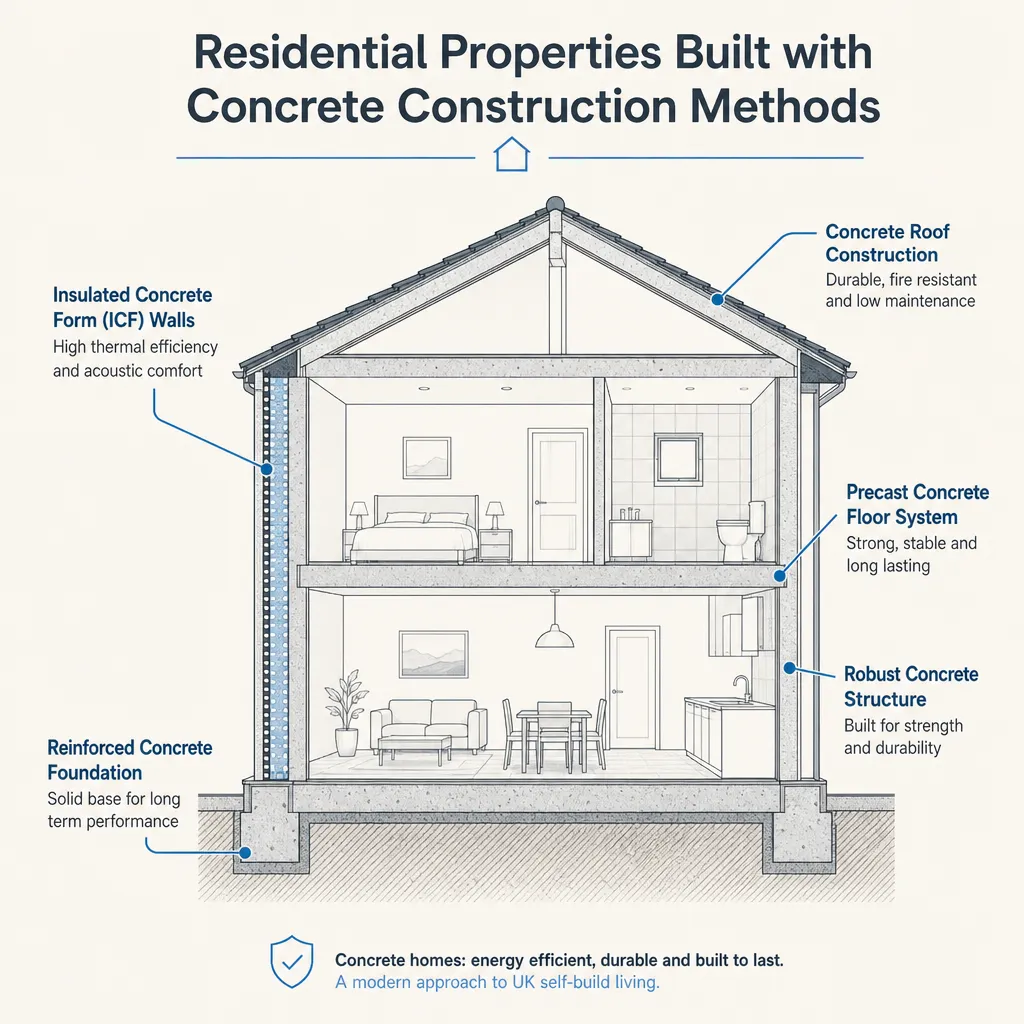
Residential Properties Built with Concrete Construction Methods
UK homes are built using several concrete methods: in-situ cast concrete, precast panel systems, insulating concrete formwork (ICF), and older non-traditional types such as Wimpey No-Fines and Laing Easiform.
 Planning & Pre-Build
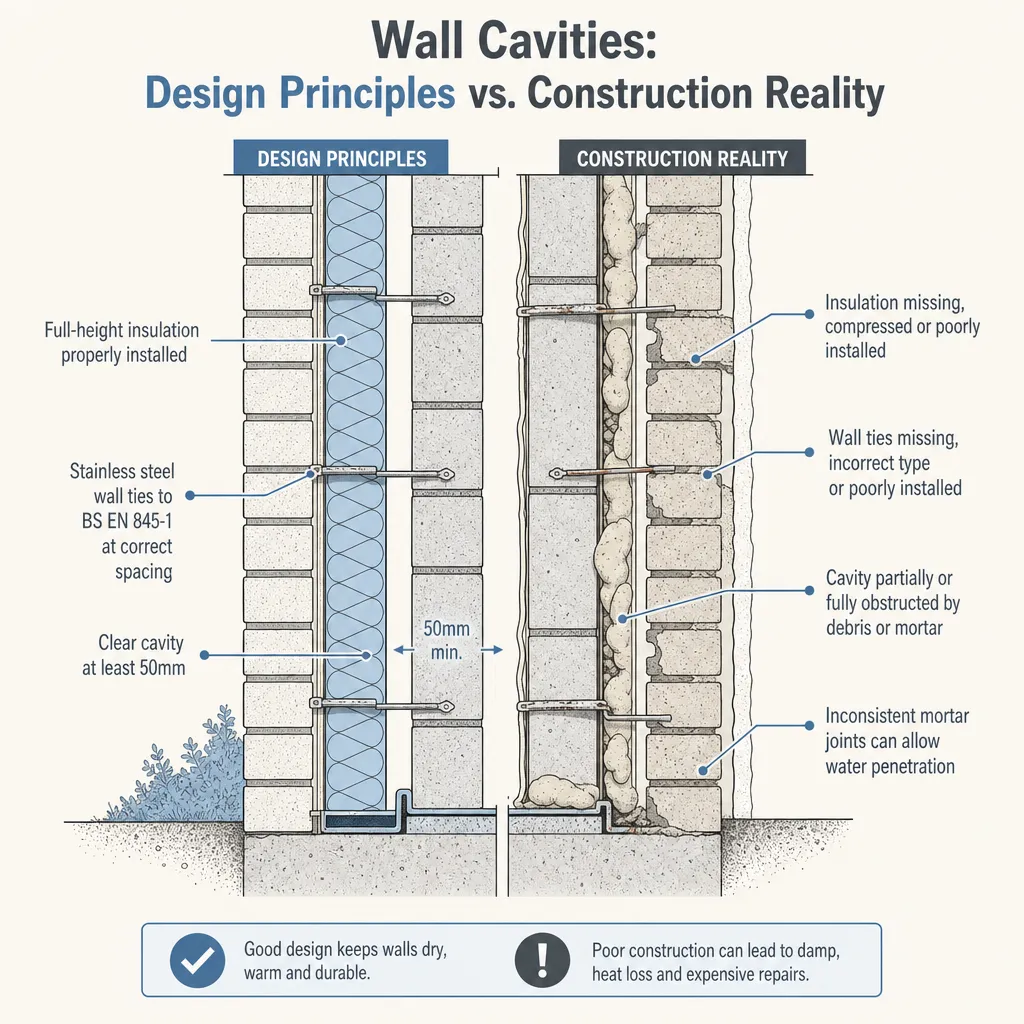
Wall Cavities: Design Principles vs. Construction Reality
A UK cavity wall is designed to resist weather, control heat loss, and structurally link two masonry leaves.
 Planning & Pre-Build
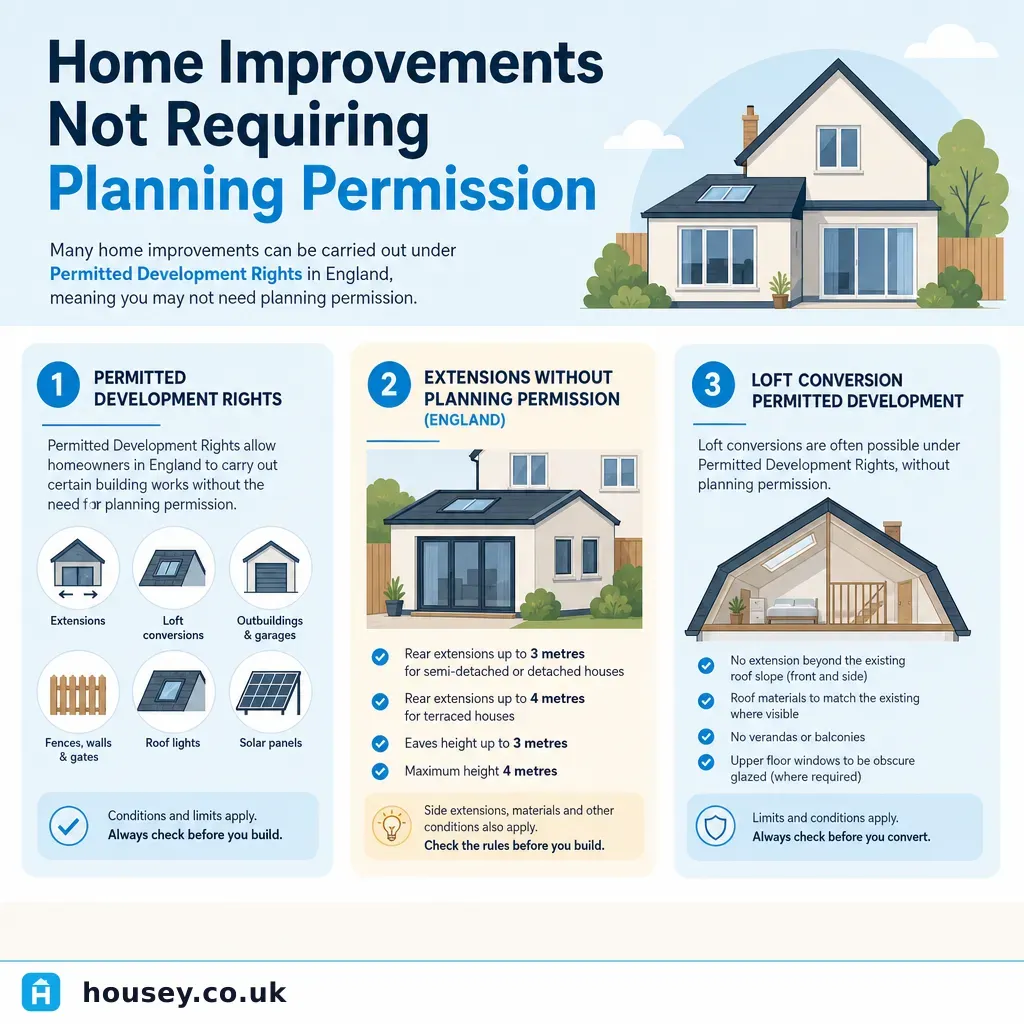
Home Improvements Not Requiring Planning Permission
Many common home improvements in England fall under Permitted Development Rights and do not require a planning application.
 Planning & Pre-Build
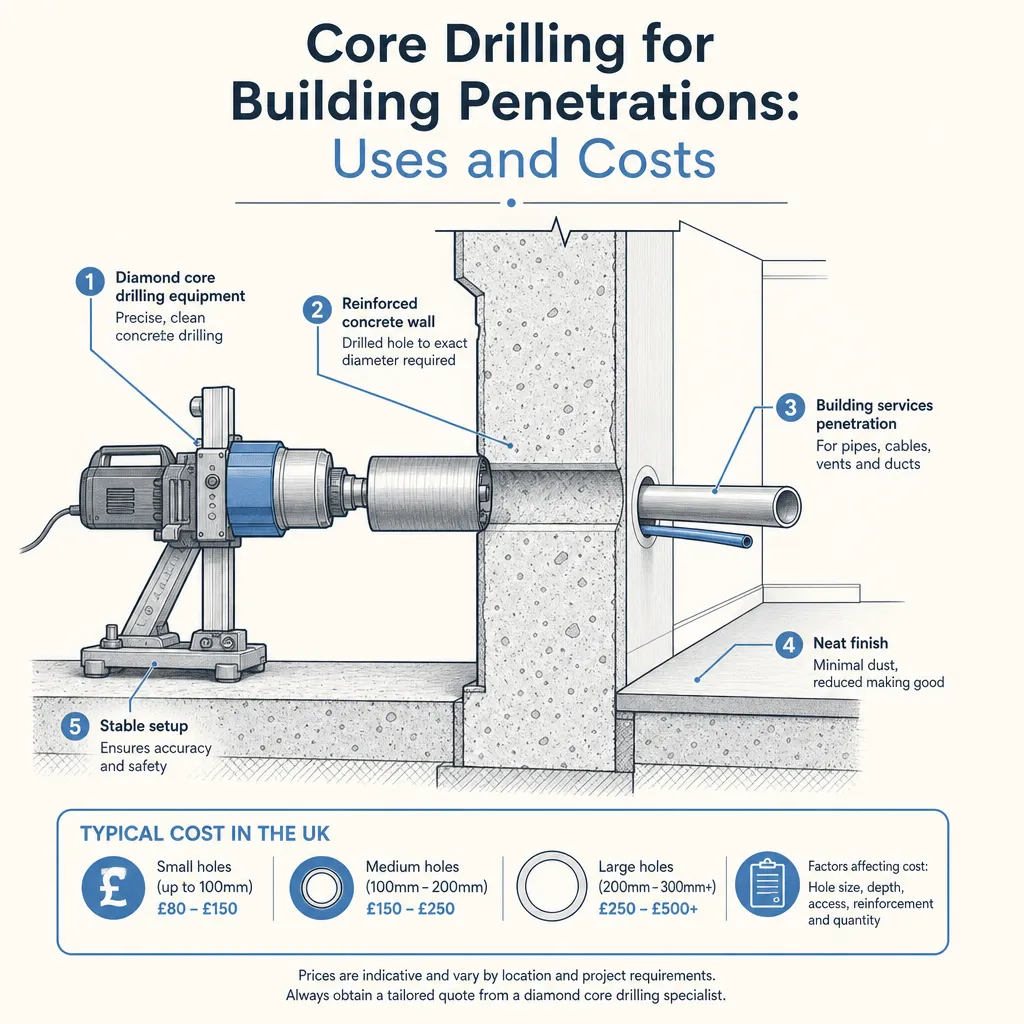
Core Drilling for Building Penetrations: Uses and Costs
Core drilling uses diamond-tipped equipment to cut clean holes through concrete, masonry, or block for pipes, ducts, cables, and building services.