PVC Roofing: Material Properties and Long-term Performance Evaluation
By Housey · Last reviewed 7th of May 2026
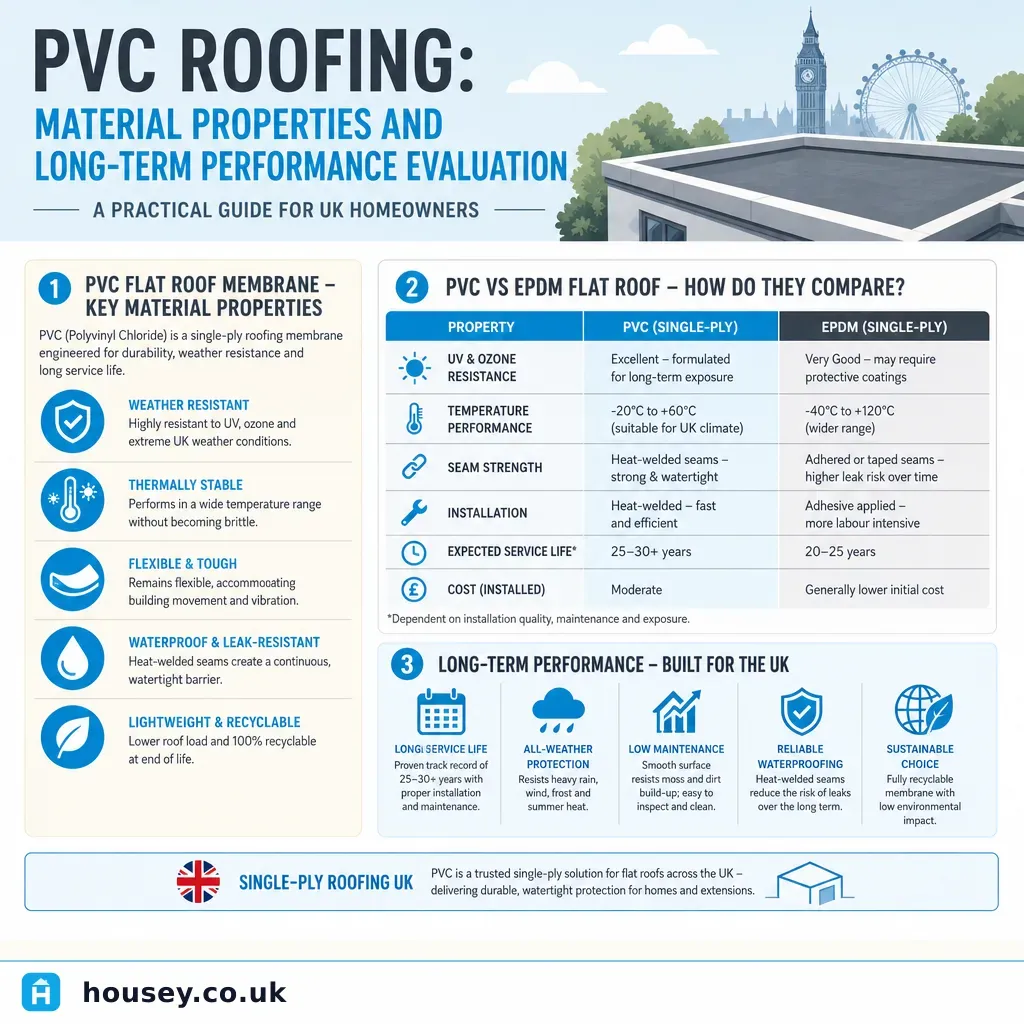
PVC Roofing: Material Properties and Long-term Performance Evaluation
Flat and low-pitch roofs are common on UK extensions, garages, and outbuildings, and the choice of membrane system has real implications for longevity, maintenance requirements, and lifecycle cost. PVC (polyvinyl chloride) single-ply membranes have been used on UK roofs for several decades and remain widely specified, but their long-term performance depends on factors that homeowners rarely encounter until a problem arises. Understanding how PVC roofing works, how it compares with alternatives, and what failure looks like helps you make better decisions whether you are commissioning new works or evaluating an existing installation.
Key points
- PVC single-ply membranes are installed using hot-air welded seams that fuse the thermoplastic material to create a continuous waterproof joint — seam quality is the most critical determinant of long-term waterproofing performance.
- Manufacturer warranties on PVC flat roof membranes commonly range from 15 to 25 years when installed by an approved contractor; the membrane itself may last considerably longer with correct detailing and maintenance.
- PVC membranes are not compatible with bitumen: direct contact with felt, torch-on, or asphalt materials causes plasticiser migration that accelerates membrane degradation.
- Building Regulations Approved Document C (resistance to moisture) and Approved Document L (conservation of fuel and power) are both relevant to flat roof specification and detailing.
- PVC membranes can become brittle over time through plasticiser migration; formulation quality varies significantly between manufacturers, affecting real-world service life.
What is PVC single-ply roofing?
PVC single-ply roofing is a thermoplastic membrane, typically 1.2mm to 2.0mm thick, manufactured from polyvinyl chloride combined with plasticisers, stabilisers, and UV-resistant additives. It is supplied in rolls and installed over an insulation layer — usually polyisocyanurate (PIR) or expanded polystyrene (EPS) board — that is mechanically fixed or fully adhered to the roof deck.
The membrane is fixed at its perimeter and at laps using hot-air welding, which fuses the thermoplastic material to create a continuous waterproof layer. This differentiates PVC from EPDM (ethylene propylene diene monomer) systems, where seams are typically formed using adhesive tape — a method more dependent on installation quality and more prone to long-term adhesive failure.
PVC membranes are available in a range of colours and can be reinforced with polyester or glass-fibre scrim to improve dimensional stability and puncture resistance.
PVC vs EPDM vs TPO: a comparison
Feature | PVC | EPDM | TPO |
|---|---|---|---|
Seam method | Hot-air welded | Adhesive tape or liquid | Hot-air welded |
Typical warranty | 15–25 years | 10–20 years | 15–25 years |
Bitumen compatibility | Not compatible | Generally compatible | Generally compatible |
Plasticiser migration risk | Yes — quality-dependent | Not applicable (thermoset) | Lower risk than PVC |
UV resistance | Good; stabilisers incorporated | Good; inherently UV-stable | Good |
Colour options | Wide range | Usually black or white | Usually white or grey |
Indicative installed cost | £70–£120/m² | £60–£110/m² | £70–£120/m² |
Indicative UK costs, last reviewed 2026-05-07. Figures cover supply and installation of the membrane system on a straightforward flat roof; they exclude structural repairs, insulation upgrades, or complex detailing. Always obtain multiple quotes.
TPO (thermoplastic polyolefin) shares PVC's hot-air welded seam method but uses a different polymer base that avoids plasticiser migration concerns. It is increasingly common on UK domestic and commercial flat roofs.
Long-term performance factors
Plasticiser migration
Plasticisers make PVC flexible during manufacture. Over time — particularly under high UV exposure or elevated temperatures — these plasticisers can migrate out of the membrane, leaving it progressively stiffer and more brittle. The result is a membrane prone to cracking, particularly around details, penetrations, and edges. Premium PVC formulations with higher levels of UV stabilisers perform significantly better than budget equivalents. A membrane that has become visibly stiff or shows surface cracking around flashings is approaching the end of its serviceable life.
Seam integrity
The quality of hot-air welded seams is the single most important variable in a PVC roof's long-term performance. An improperly welded seam — from incorrect temperature, speed, or pressure during installation — creates a potential failure point that may not become apparent until the membrane is under thermal stress. On older roofs, delaminating or lifting seams are a primary cause of water ingress.
Detailing at penetrations
Pipes, rooflights, mechanical equipment, and parapet walls all require careful detailing where the membrane meets a vertical surface. These junctions are statistically the most common failure points on any flat roof system. Poorly executed flashings are a leading cause of failure within the first five years of installation.
Thermal movement
All flat roof membranes are subject to thermal expansion and contraction. On a large flat roof, a PVC membrane may move significantly over the course of a year. Correct fastening, adequate membrane relaxation during installation, and appropriate detailing at fixed points manage this movement. A membrane that has been over-tensioned during installation may split under thermal contraction in a cold winter.
Does PVC roofing require planning permission?
For most residential flat roofs on extensions, garages, or outbuildings, replacement or re-roofing with a PVC membrane does not require planning permission, provided:
- The work is like-for-like replacement without raising the roof height
- The building is not listed or in a conservation area where additional restrictions may apply
- The works comply with Building Regulations, particularly Approved Document C and Approved Document L where insulation is being altered or added
Where works increase the extent of the flat roof or change the roof structure, building regulations approval is more likely to be required. Always check with your local planning authority or building control body if in doubt.
Checklist: evaluating an existing PVC flat roof
Use this checklist when assessing a PVC roof you own or are considering buying:
Any of these issues identified during a property purchase or pre-works survey warrants a professional inspection before proceeding.
Red flags: when a PVC flat roof needs immediate attention
- Active water ingress: staining, mould growth, or dripping inside the building below the flat roof
- Large areas of membrane blistering or delamination from the insulation layer
- Seams that can be probed apart or that show visible gaps
- Membrane brittleness or cracking at flashings, penetrations, or changes of direction
- Sagging or visible deflection in the roof deck
- Gutters or outlets blocked with water damming against the upstand
A flat roof showing any of these conditions should be inspected by a qualified roofer before winter.
When to get professional help
Flat roof inspection and repair should involve a qualified roofer familiar with single-ply membrane systems. PVC membrane work — welding, detailing, and repair — requires specific training and equipment. Attempting DIY repairs with incompatible materials, particularly bitumen-based products, can accelerate membrane failure.
Consider a professional assessment when:
- You are buying a property with an existing flat roof and the age or condition is unknown
- You notice any of the red flags listed above
- The roof is more than 15 years old and has not been professionally inspected
- You are planning a re-roof and want to understand whether the existing system can be overlaid or must be stripped
A roof survey will provide an independent condition assessment and help you understand whether repair, overlay, or full replacement is the appropriate course of action.
How Housey can help
If you need a flat roof assessed or replaced, Housey can help you request quotes from qualified roofers with single-ply membrane experience. For an independent condition report before committing to works, you can also request a roof survey through Housey.
Frequently asked questions
How long does a PVC flat roof last in the UK?
A well-installed PVC single-ply membrane typically carries a manufacturer warranty of 15 to 25 years. In practice, quality PVC systems can last 30 years or more when detailing is maintained and minor defects are addressed promptly. Plasticiser quality, UV exposure, installation standards, and maintenance history are the main variables. Ageing PVC that has become brittle or shows cracking at details is approaching the end of its serviceable life.
Is PVC roofing better than EPDM for a house extension?
Both systems are well-established in the UK. PVC membranes use hot-air welded seams, generally considered more reliable over time than the adhesive-tape seams typical of EPDM systems. However, EPDM is a thermoset material not susceptible to plasticiser migration and is inherently UV-stable. TPO offers hot-air welded seams without plasticiser migration risk. A qualified roofer should advise on the best system for your specific project and budget.
Does a PVC flat roof replacement need building regulations approval?
Like-for-like membrane replacement typically requires building control notification. Where works involve changes to insulation — particularly upgrading to meet Approved Document L requirements — building regulations approval is more likely required. In England, you can use a building notice or full plans application, or engage an approved inspector. Check with your local building control body before starting. Listed buildings and conservation area properties may have additional requirements.
Can PVC roofing be laid over an existing felt roof?
PVC must not be in direct contact with bitumen-based materials because bitumen attacks the plasticiser in PVC, accelerating membrane degradation. If overlay is proposed, a separation layer such as a polythene sheet or fleece must be used. In many cases, complete strip-back and replacement is more appropriate and will be specified by a reputable installer following NFRC best practice guidance. Always confirm the proposed approach with your roofer before works begin.
Sources and further reading
Useful next reads
 Improvement & Build
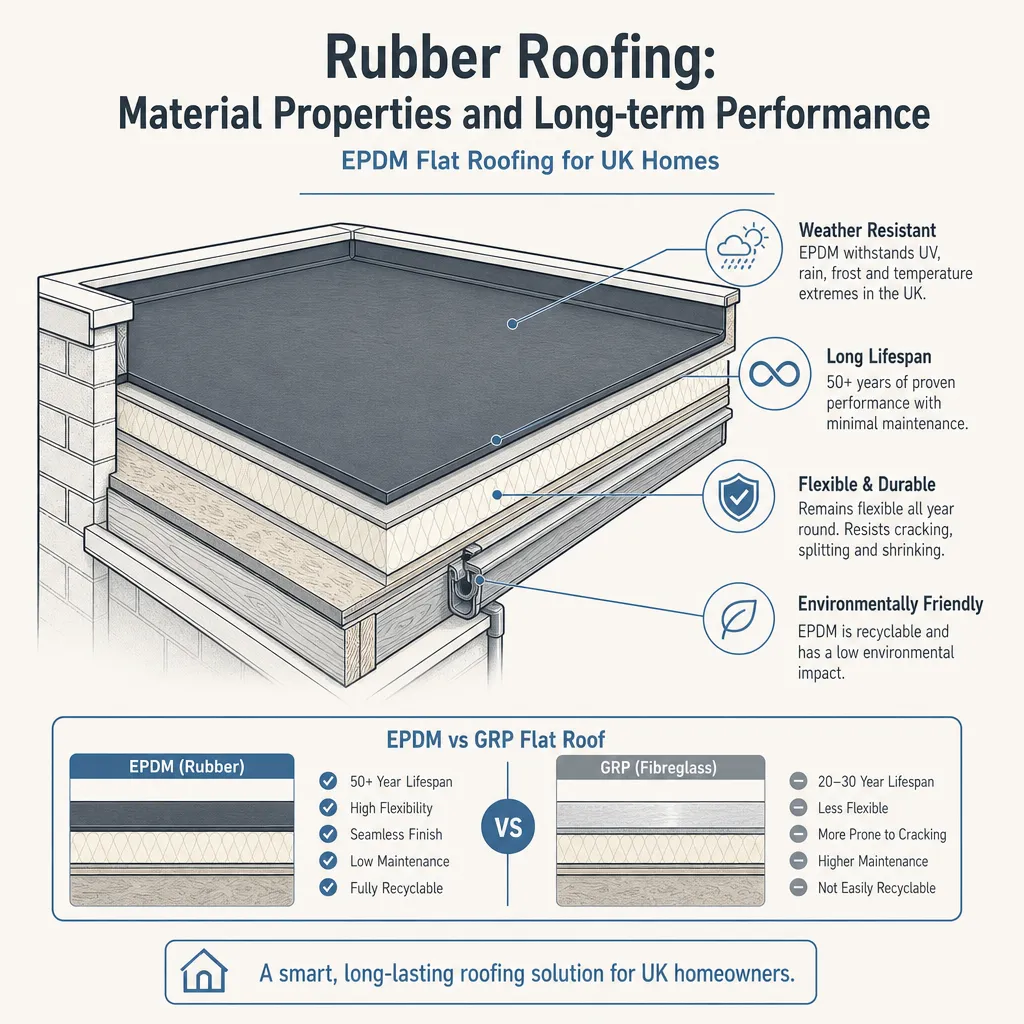
Rubber Roofing: Material Properties and Long-term Performance
EPDM rubber roofing is a synthetic rubber membrane used on UK flat roofs, available in large sheets that minimise seams.
 Improvement & Build
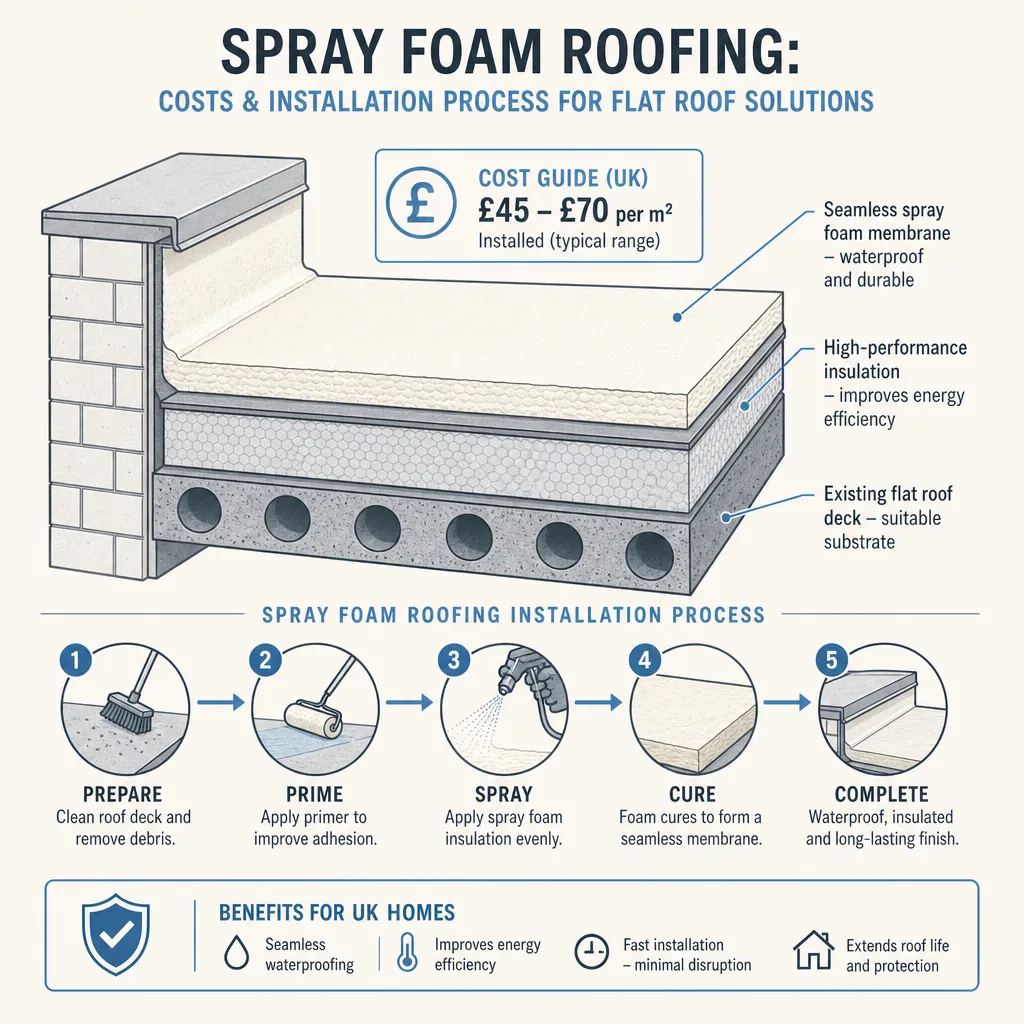
Spray foam roofing: costs and installation process for flat roof solutions
Spray foam roofing for a domestic flat roof in the UK typically costs between £70 and £120 per square metre including preparation, foam application, and UV-protective topcoat, though prices vary with roof size, access, existing substrate condition, and region.
 Improvement & Build
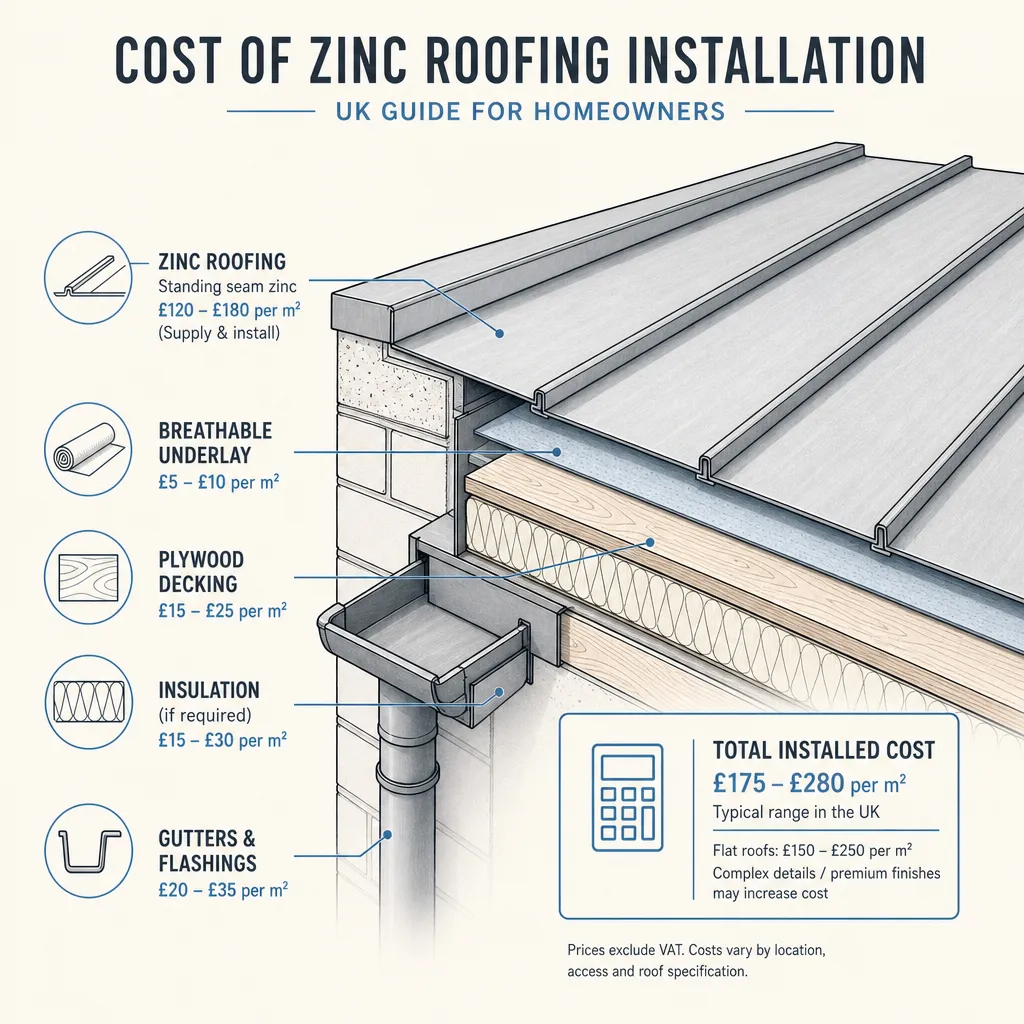
Cost of Zinc Roofing Installation
Zinc roofing typically costs £100–£200 per m² installed in the UK for standing seam systems, with flat roof applications ranging from £80–£160 per m².
 Improvement & Build
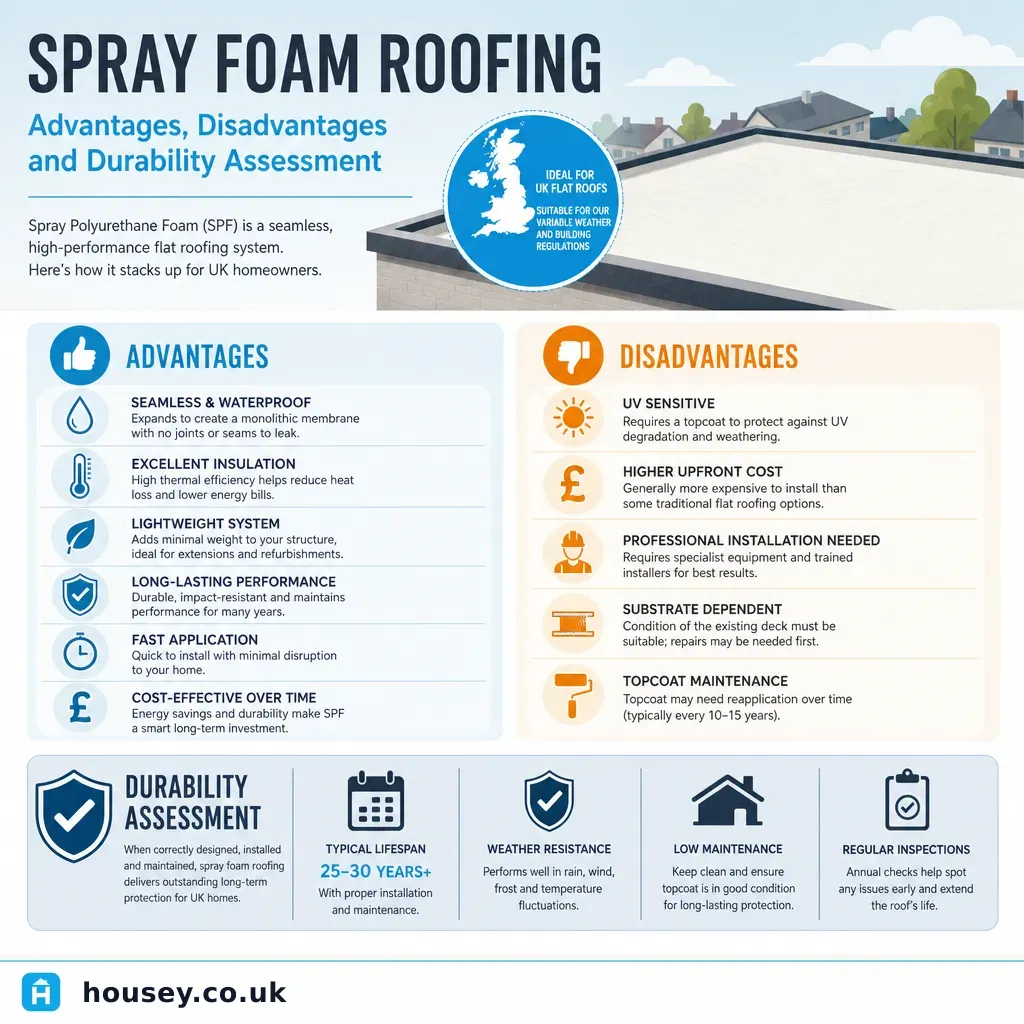
Spray foam roofing: advantages, disadvantages and durability assessment
Spray foam roofing creates a seamless, fully adhered waterproof membrane with built-in insulation that can extend the life of a flat roof by 20 to 30 years when correctly topcoated and maintained.
 Improvement & Build
Understanding Roof Shingles: Materials, Lifespan, and Selection
Roof shingles are individual overlapping tiles made from timber (such as Western Red Cedar or oak), bitumen, or composite materials.