Q1 2025 Home Improvement Trends: Market Data and Consumer Priorities
By Housey · Last reviewed 24th of May 2026
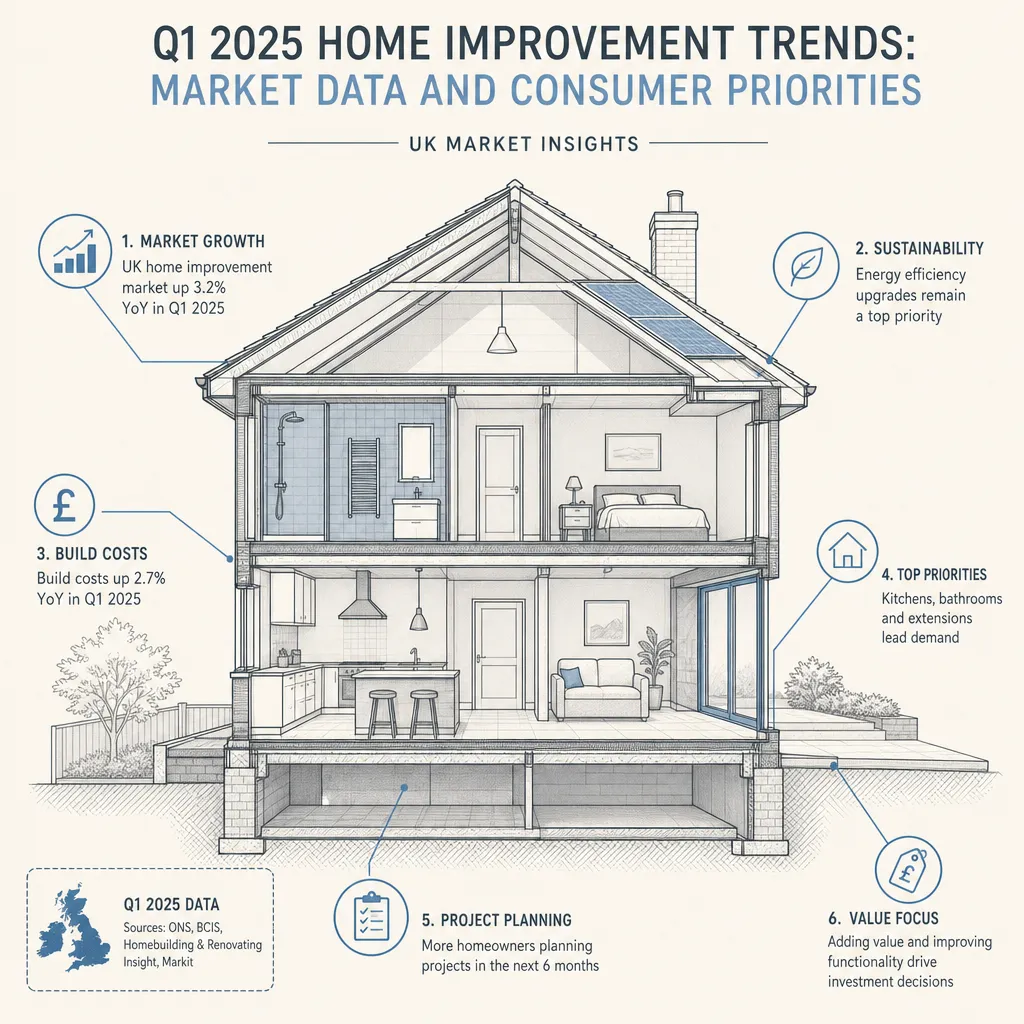
Q1 2025 Home Improvement Trends: Market Data and Consumer Priorities
The first quarter of any year is a reliable early indicator for the home improvement sector — decisions made over the Christmas period and in January typically feed through into quotation activity and project starts from February onwards. Q1 2025 arrived against a backdrop of stabilising but still elevated build costs, the first sustained period of falling mortgage rates since 2021, and continued policy focus on energy efficiency — all of which shaped what UK homeowners chose to prioritise and commission.
Key points
- The Federation of Master Builders (FMB) State of Trade Survey reported improved workloads for small and medium-sized builders in early 2025, with refurbishment and extension work the most commonly cited activity type.
- ONS construction output data for Q1 2025 showed repair and maintenance activity — including private housing — remaining resilient compared with new-build starts, which remained subdued.
- Energy-related improvements (insulation, ventilation, and heat pump installations) continued to grow as a share of home improvement spend, driven partly by EPC-related compliance concerns among private landlords.
- MCS-certified heat pump installations grew year-on-year in early 2025, though the UK's rate of uptake remained below the government's 600,000-per-year pathway target for 2028.
- Consumer confidence in home improvement improved modestly as the Bank of England Base Rate fell from the August 2023 peak of 5.25%, easing conditions for home improvement finance.
What the Q1 2025 market data tells us
Build cost stabilisation
After sharp material and labour cost increases in 2022–2023, Q1 2025 data showed build costs broadly stabilising. BCIS (Building Cost Information Service) indices indicated that cost inflation for domestic repair, maintenance, and improvement work had moderated compared with the preceding two years, though costs remained materially higher than pre-2021 levels. Subcontractor availability improved in some trades — including groundworks, plastering, and internal fit-out — while electrical and plumbing capacity remained tighter in many regions.
For homeowners, this meant that projects shelved during the cost spike became viable again — particularly loft conversions, kitchen extensions, and bathroom refurbishments deferred on cost grounds since 2022.
What homeowners prioritised in Q1 2025
The following table reflects reported consumer priorities across key home improvement categories, based on available sector surveys from Q1 2025:
Category | Direction vs Q4 2024 | Key driver | Typical professional |
|---|---|---|---|
Energy efficiency (insulation, glazing) | Increasing | EPC compliance, bill reduction | Insulation installer, retrofit coordinator |
Kitchen and bathroom renovation | Stable–increasing | Deferred spending, stable house prices | Builder, joiner, plumber |
Loft and garage conversions | Increasing | Space creation vs moving costs | Architect, structural engineer, builder |
Extensions (single or double storey) | Stable | Space needs, planning confidence | Architect, planning consultant, builder |
Heat pump installation | Increasing from low base | Boiler Upgrade Scheme, boiler replacement | MCS-certified heat pump installer |
Roofing and structural repairs | Stable | Ongoing maintenance cycle | Roofing contractor, structural engineer |
Decorating and landscaping | Stable | Lower-cost discretionary spend | Decorator, landscaper |
Based on FMB State of Trade Q1 2025, MCS installation data, and sector commentary available at time of publication. Reflects reported trends, not nationally representative survey data.
What not to assume
Interpreting home improvement market data requires caution. Several common misreadings can lead to poorly timed or poorly budgeted decisions:
Do not assume all UK regions experienced the same trends. London and the South East typically see different cost and demand dynamics than the North West, Scotland, or Wales. Build costs, planning timescales, and subcontractor availability vary significantly by location.
Do not assume published indices reflect your specific project. BCIS cost indices are national averages — your actual quote depends on your property's condition, location, access constraints, and specification choices.
Do not assume that falling mortgage rates immediately translated into higher project volumes. The lag between improved borrowing conditions and project completions is typically 6–12 months — Q1 2025 optimism was feeding a pipeline rather than a surge of finished projects.
Do not assume government grant schemes will remain at current parameters. The Boiler Upgrade Scheme grant amount and eligibility rules have been revised before. Always verify current figures on GOV.UK before factoring grant income into a project budget.
Loft conversions and extensions: the dominant project type
For the third consecutive year, loft conversions and single-storey extensions dominated planning application data and builder order books heading into 2025. The rationale is consistent across UK regions: with house price rises in 2020–2022 and transaction costs — stamp duty, legal fees, removal costs — making moving expensive, many homeowners find that improving an existing property delivers better value than trading up.
A worked UK property scenario
A homeowner in a 1970s three-bedroom semi-detached in the East Midlands had deferred a dormer loft conversion project since late 2022 due to cost uncertainty. Revisiting the plan in early 2025, they found quotes from local builders averaging £45,000–£60,000 for a dormer conversion with staircase, skylight, and en-suite bathroom — compared to £55,000–£75,000+ in 2023. With a home improvement loan available at under 4.5%, the project moved from provisional to live in February 2025. Planning consent was obtained in nine weeks via permitted development rights confirmed by a lawful development certificate.
Indicative UK costs, last reviewed 2026-05-24. Actual costs vary by specification, location, access, and market conditions.
This pattern repeated widely — cost moderation combined with improved access to finance and persistent space pressure created a pipeline of projects that had been paused rather than cancelled.
Energy efficiency: from optional upgrade to compliance-driven spend
Energy-related improvements shifted character between 2023 and 2025. Earlier years saw energy upgrades motivated mainly by bill reduction; Q1 2025 data showed a growing compliance motive — particularly among private landlords facing proposed EPC Band C requirements for new tenancies in England.
The ECO4 scheme continued to fund insulation for eligible households, and the Boiler Upgrade Scheme sustained heat pump installation activity. MCS data showed continued year-on-year growth in heat pump completions, though the annual pathway target of 600,000 installations by 2028 remained a significant stretch based on Q1 2025 run rates.
Retrofit coordinators accredited under PAS 2035 were increasingly in demand as homeowners undertaking whole-house efficiency programmes recognised that piecemeal insulation can create moisture or ventilation problems without holistic assessment.
Consumer confidence and market outlook
Consumer sentiment and sector indices showed a modest improvement in Q1 2025 following sustained negative readings through 2023–2024. Key confidence drivers included reductions in the Bank of England Base Rate from the August 2023 peak of 5.25%, broadly stable house prices across most UK regions, and continued labour market resilience.
The RICS Residential Market Survey for Q1 2025 noted improving buyer enquiries and increased agreed sales activity compared with Q1 2024, which historically correlates with increased home improvement activity as new purchasers invest in recently acquired properties.
When to get professional help
If you are planning a project informed by Q1 2025 market conditions, early professional engagement is advisable given subcontractor demand in many areas:
- For extensions and loft conversions, appoint an architect or architectural technologist before finalising budget — they can identify planning risks and specification choices before quotes are invited.
- For energy improvements, a retrofit assessment under PAS 2035 is the appropriate starting point for whole-house upgrades and reduces the risk of insulation-related moisture problems.
- For structural works, always commission a structural engineer's assessment before proceeding.
- For projects requiring planning permission, allow for local authority processing times — many councils are operating beyond the eight-week statutory target.
How Housey can help
Housey connects UK homeowners with vetted local professionals across the full home improvement lifecycle — from architects and planning consultants for extensions and loft conversions, to retrofit assessors and insulation installers for energy upgrades. Whether your 2025 project is at the planning stage or ready to go out to tender, Housey can help you find the right specialists for your property type, location, and budget.
Frequently asked questions
Did build costs fall in Q1 2025?
Build costs broadly stabilised in Q1 2025 rather than falling significantly. BCIS data indicated that cost inflation for repair, maintenance, and improvement work had moderated from the 2022–2023 peak, but costs remained materially above pre-pandemic levels. Homeowners should obtain fresh quotes rather than relying on estimates from 2022 or 2023, as the cost structure has changed.
Was planning permission easier to obtain in Q1 2025?
Planning application processing times varied considerably by local authority in Q1 2025. Updates to the National Planning Policy Framework in late 2024 signalled a more permissive approach to residential development, but resource constraints at local authorities meant this did not translate uniformly into faster decisions. Check your local planning authority's performance data before committing to a planning-dependent project timeline.
Which home improvements added the most value in Q1 2025?
Data from estate agents and valuers consistently pointed to loft conversions, kitchen extensions, and EPC improvements as having the strongest value impact relative to cost. Value-add depends heavily on local property values, the base condition of the property, and quality of finish. A RICS-registered valuer is the only reliable source of a value estimate for a specific property.
Is there government support for home improvements in 2025?
Several schemes were available in 2025: the Boiler Upgrade Scheme for heat pumps, ECO4 for insulation for eligible households, and the Great British Insulation Scheme. Tax relief is not generally available for residential home improvements. Always check GOV.UK for current schemes, eligibility thresholds, and application routes, as parameters change regularly.
Sources and further reading
- State of Trade Survey — Federation of Master Builders
- Construction output in Great Britain — Office for National Statistics
- UK Residential Market Survey — Royal Institution of Chartered Surveyors
- MCS: Heat pump installation data — Microgeneration Certification Scheme
- Boiler Upgrade Scheme — GOV.UK
Useful next reads
 Improvement & Build
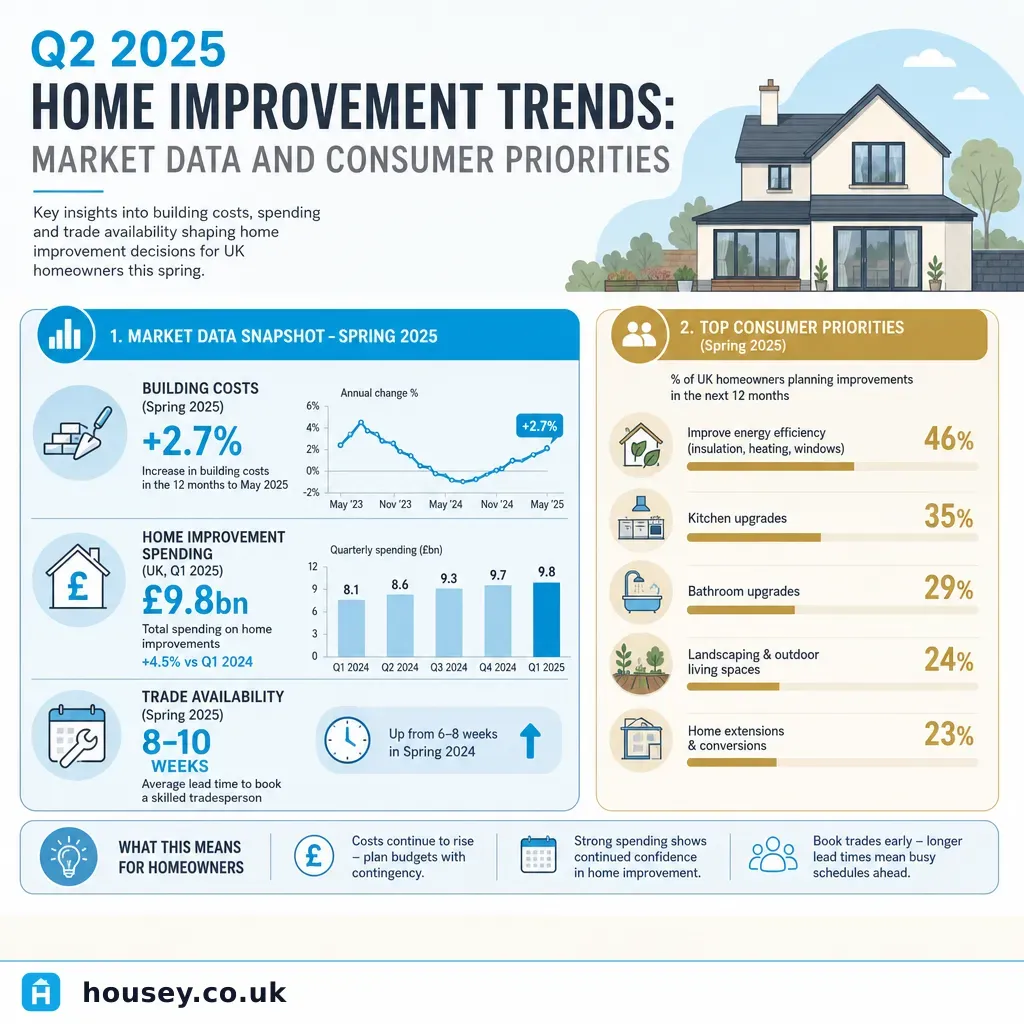
Q2 2025 Home Improvement Trends: Market Data and Consumer Priorities
In Q2 2025, kitchen refurbishments and bathroom renovations led UK consumer home improvement demand, followed by single-storey extensions and garden offices.
 Improvement & Build
Q4 2025 Home Improvement Trends: Market Data and Consumer Priorities
In Q4 2025, UK homeowners prioritised heating upgrades, insulation, and kitchen refurbishments as temperatures fell.
 Improvement & Build
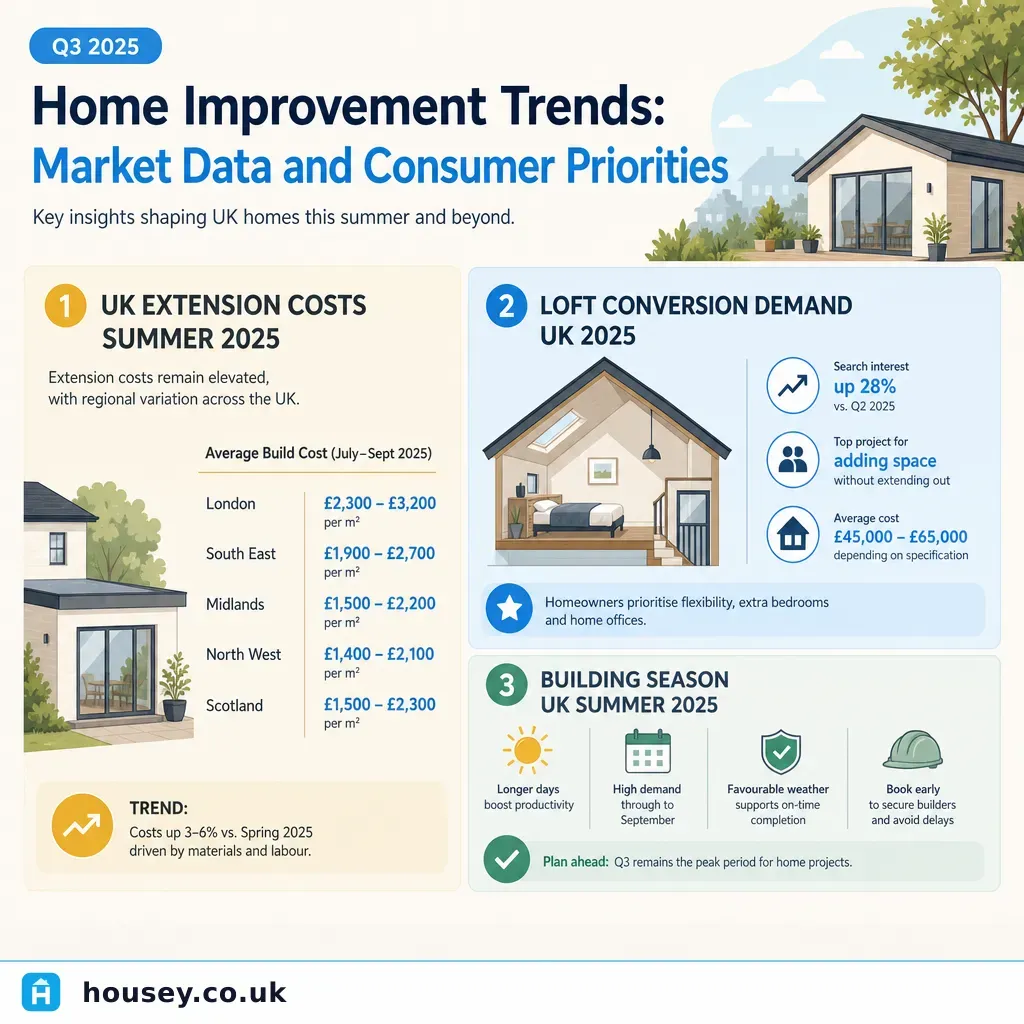
Q3 2025 Home Improvement Trends: Market Data and Consumer Priorities
Q3 2025 was the UK's peak building season, with single-storey extensions, loft conversions, and outdoor living projects at their highest quarterly demand.
 Improvement & Build
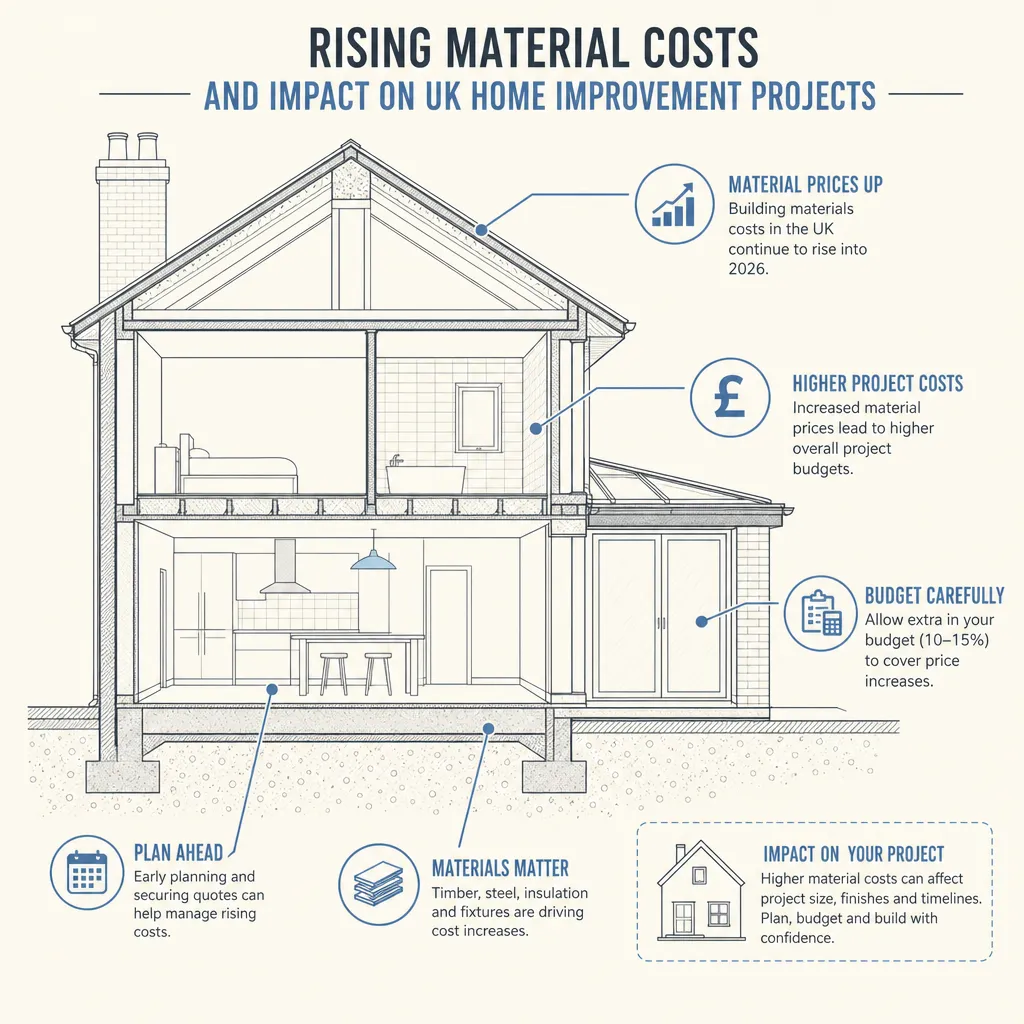
Rising Material Costs and Impact on UK Home Improvement Projects
UK construction material prices remain above pre-2020 levels despite some easing from peak inflation.
 Improvement & Build
Garden Design Trends and Contemporary Landscaping Ideas
Contemporary UK garden design centres on low-maintenance naturalistic planting, multi-functional outdoor spaces, sustainable hard landscaping materials, and wildlife-friendly rewilded areas.