Q4 2025 Home Improvement Trends: Market Data and Consumer Priorities
By Housey · Last reviewed 19th of May 2026

Q4 2025 Home Improvement Trends: Market Data and Consumer Priorities
The fourth quarter — October through December — marks a seasonal shift in the UK home improvement market from external build projects to interior works, heating upgrades, and forward planning for spring. Shorter days and colder weather reduce the viability of major structural works, but demand for heating system replacements, insulation, kitchen refurbishments, and planning applications for spring starts typically peaks in Q4. In 2025, this seasonal pattern was reinforced by continued energy retrofit scheme activity, pre-Christmas interior project demand, and a natural calendar year-end review of capital improvement budgets among both owner-occupiers and private landlords.
Key points
- All gas work — including boiler replacement — must be carried out by a Gas Safe registered engineer; Building Regulations Approved Document J governs the installation of combustion appliances and fuel storage in dwellings.
- The Boiler Upgrade Scheme (BUS) provided £7,500 grants for air source heat pump installations throughout Q4 2025, administered by Ofgem; ground source heat pump grants were available at the same level.
- PAS 2035 is the UK standard governing the assessment and coordination of domestic energy retrofit and is mandatory for projects accessing government funding (ECO4, GBIS), requiring a TrustMark-registered Retrofit Coordinator for multi-measure works.
- A reduced VAT rate of 5% applies to certain energy-saving materials — including insulation, heat pumps, solar panels, and draught stripping — when supplied and installed by a VAT-registered contractor, a meaningful saving on larger retrofit projects.
- Householder planning applications submitted in Q4 for spring 2026 project starts allow the statutory 8-week LPA determination period to run over winter, enabling contractor mobilisation by March or April.
What drove Q4 2025 demand
Project priority comparison: Q4 2025
Project type | Q4 demand level | Why Q4 peaks | Key requirement |
|---|---|---|---|
Boiler replacement | Very high | Heating failures increase in cold weather | Gas Safe registered engineer |
Loft insulation | High | Pre-winter energy cost concern | ECO4 or GBIS may fund eligible households |
Cavity wall insulation | High | Pre-winter energy cost concern | ECO4 or GBIS eligibility check recommended |
Kitchen refurbishment | High | Pre-Christmas refresh; indoor project | Book 8–14 weeks ahead |
Air source heat pump | Moderate | BUS grant uptake; pre-winter installation | MCS-accredited installer for BUS grant |
Planning application preparation | Moderate | Lead time for spring 2026 builds | Allow 8–12 weeks for LPA determination |
Bathroom renovation | Moderate | Indoor project; no weather dependency | 4–10 weeks typical lead time |
Indicative demand levels based on industry pattern data, last reviewed 2026-05-19.
Heating system decisions in Q4 2025
Q4 concentrates heating upgrade decisions more than any other quarter: rising energy bills, falling temperatures, and the increased likelihood of boiler failure in cold weather all create urgency. The options available to UK homeowners in Q4 2025 were:
Gas boiler replacement: A like-for-like replacement remains the most common outcome for most UK homes. All gas work must be carried out by a Gas Safe registered engineer. Under Building Regulations Part L, replacement boilers must meet minimum efficiency standards — modern A-rated condensing boilers are the baseline. Indicative installed cost: £2,000–£4,500 depending on boiler brand, system type, and complexity (indicative, last reviewed 2026-05-19).
Air source heat pump (ASHP): The £7,500 BUS grant made ASHP installation more financially accessible. ASHPs work most efficiently in well-insulated homes; a heat loss calculation to BS EN 12831 is required before specifying pump size, and MCS accreditation is required for installers claiming the BUS grant. Wait times of 8–20 weeks from initial enquiry to commissioning were common in high-demand regions through Q4.
Hybrid heat pump systems: An ASHP combined with a retained gas boiler offers flexibility for homes not yet fully suitable for heat-pump-only operation, though the installed cost is higher than a standard boiler replacement.
Decision tree: which heating upgrade route?
- Straightforward like-for-like boiler replacement? Standard route for most UK homes. Requires a Gas Safe registered engineer. New boiler must meet Part L minimum efficiency standards. Shortest lead time of the available options in most regions.
- Considering a switch to an air source heat pump? Most viable in properties rated EPC C or above, or recently upgraded with insulation. Apply for the Boiler Upgrade Scheme grant through an MCS-accredited installer before any work commences — the grant cannot be claimed retrospectively.
- Not sure whether a heat pump suits your home? Commission a retrofit assessment from a TrustMark-registered Retrofit Assessor — required for PAS 2035 compliance when using government funding, and recommended for self-funded projects to avoid costly undersizing or performance failures.
- Solid-wall or hard-to-treat property? External or internal wall insulation may be needed before an ASHP operates efficiently. This is a larger, sequenced project that benefits from whole-house retrofit planning rather than a piecemeal approach.
Insulation in Q4 2025
Insulation demand peaked in Q4 as homeowners confronted falling temperatures and energy bills. The two most cost-effective measures for typical UK homes — loft insulation and cavity wall insulation — remained eligible for funded support under active government schemes through Q4 2025.
Scheme | What it covers | Who qualifies | How to access |
|---|---|---|---|
ECO4 | Full insulation and heating measures | Benefits recipients; EPC D or below | Via energy supplier |
Great British Insulation Scheme (GBIS) | Cavity wall and loft insulation | Broader eligibility (council tax bands A–D) | Via energy supplier or local authority |
Boiler Upgrade Scheme (BUS) | Air and ground source heat pumps | Most homeowners (no income test) | Via MCS-accredited installer |
Scheme eligibility and funding levels can change. Always check GOV.UK for current scheme status before applying.
Kitchen and bathroom projects in Q4 2025
Q4 brings a consistent spike in kitchen refurbishment enquiries, driven by the pre-Christmas refresh cycle — homeowners wanting updated kitchens operational before December gatherings. This creates a booking crunch for established kitchen fitters from September through November across most UK regions.
Practical Q4 kitchen planning checklist:
Planning for spring 2026 starts
Q4 is the optimal window for commissioning design work and submitting planning applications for projects homeowners intend to build in spring and summer 2026. A householder planning application submitted in October or November 2025 would typically receive determination by January or February 2026, leaving time to appoint a contractor and mobilise on site in April or May.
Document preparation list for a Q4 2025 planning application:
When to get professional help
Q4 creates specific urgency conditions where professional help should not be deferred:
- A boiler has failed or is showing signs of unsafe operation — contact a Gas Safe registered engineer immediately; never attempt DIY gas repairs
- A roof leak is identified heading into winter — obtain a roofing contractor's assessment urgently; delayed repairs can result in significant structural and decorative damage over wet winter months
- A complex planning application is needed — listed building consent, conservation area, or Article 4 — where a planning consultant can avoid a costly refusal and potential appeals process
- A whole-house retrofit is being planned — PAS 2035 requires a TrustMark-registered Retrofit Coordinator for government-funded multi-measure projects, and the standard is advisable for self-funded projects too
How Housey can help
Housey connects UK homeowners with vetted professionals across heating, insulation, planning, kitchen design, and build services — so you can move from Q4 planning decisions to a confident spring 2026 project start with the right accreditations and credentials verified before work begins.
Frequently asked questions
Can I get a government grant for a new gas boiler in Q4 2025?
In Q4 2025, there was no government grant specifically for gas boiler replacements. Government policy was actively encouraging a transition away from new gas boiler installations. The Boiler Upgrade Scheme offered £7,500 for air source and ground source heat pumps instead. Some energy suppliers offered boiler finance or cashback — these are commercial arrangements, not government grants. Always check GOV.UK for the latest scheme status before making a decision.
Is VAT charged on home improvement work in the UK?
Most home improvement work on a completed dwelling is subject to 20% VAT. A reduced rate of 5% applies to certain energy-saving materials — including insulation, solar panels, heat pumps, and draught stripping — when supplied and installed by a VAT-registered contractor. Zero rating may apply in specific circumstances such as some listed building conversions. Confirm the VAT treatment with your contractor and check current HMRC guidance, as rules can change.
What is PAS 2035 and why does it matter for retrofit projects?
PAS 2035 is the UK standard for whole-house energy retrofit. It requires a qualified Retrofit Assessor to survey the property and a TrustMark-registered Retrofit Coordinator to design and oversee improvement works. It is mandatory for projects using government funding such as ECO4 and GBIS, and is designed to prevent moisture, ventilation, and performance problems from poorly sequenced retrofit measures. Following PAS 2035 principles is considered best practice even for self-funded multi-measure projects.
When should I submit a planning application to start building in spring 2026?
Submit in October or November 2025 to maximise the chance of determination before the new year. The target period for a householder application is 8 weeks from receipt of a valid submission; some LPAs reported longer times in 2025. Factor in time to appoint a contractor after receiving approval, and allow for any pre-application advice process or party wall notice periods running in parallel.
Sources and further reading
- Gas Safe Register: Find a registered engineer — Gas Safe Register
- Boiler Upgrade Scheme — GOV.UK
- Great British Insulation Scheme — GOV.UK
- TrustMark: PAS 2035 and retrofit standards — TrustMark
- Energy Saving Trust: Cavity wall insulation — Energy Saving Trust
- HMRC: VAT energy saving materials — HMRC
- Building Regulations Approved Document J — GOV.UK
- Planning Portal: Householder applications — Planning Portal
Useful next reads
 Improvement & Build
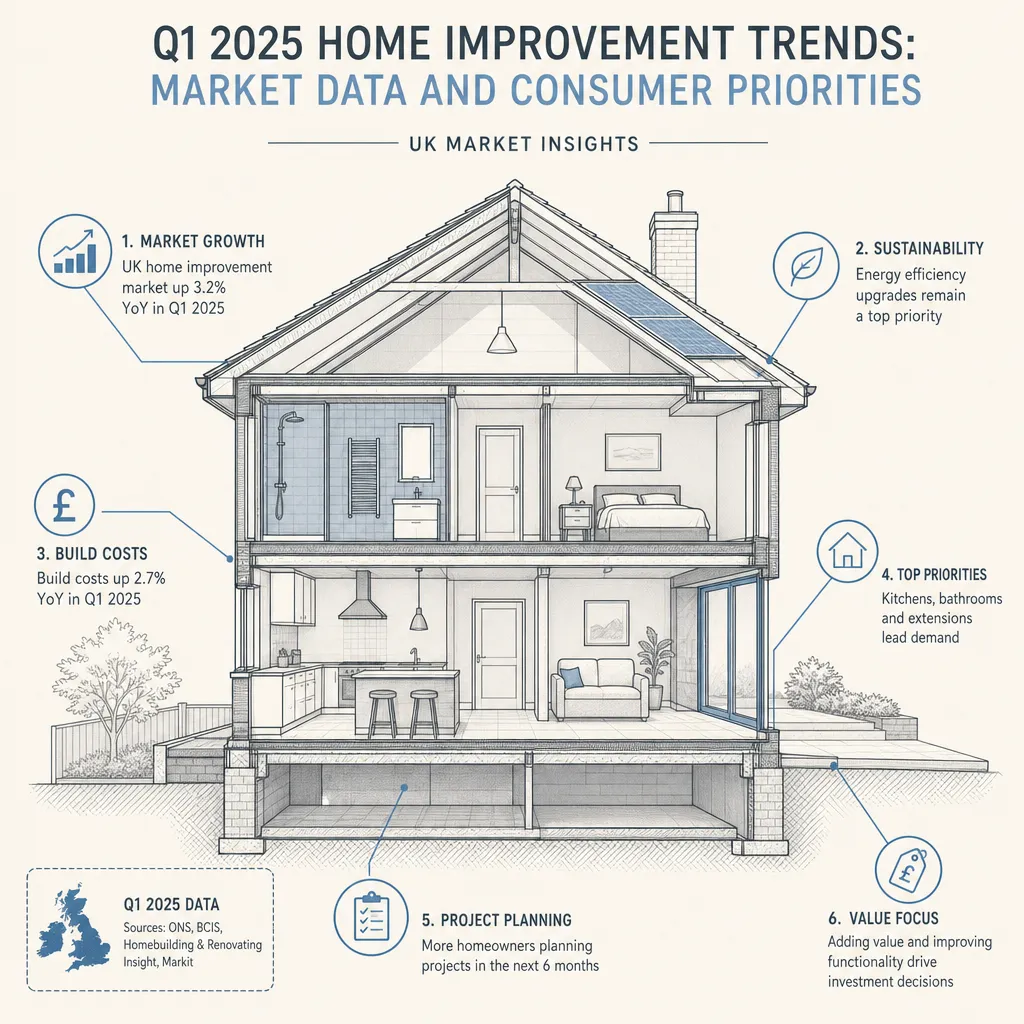
Q1 2025 Home Improvement Trends: Market Data and Consumer Priorities
Q1 2025 saw UK homeowners prioritise loft conversions, energy efficiency upgrades, and kitchen extensions as build costs stabilised following the 2022–2023 peak and mortgage rates began to ease.
 Improvement & Build
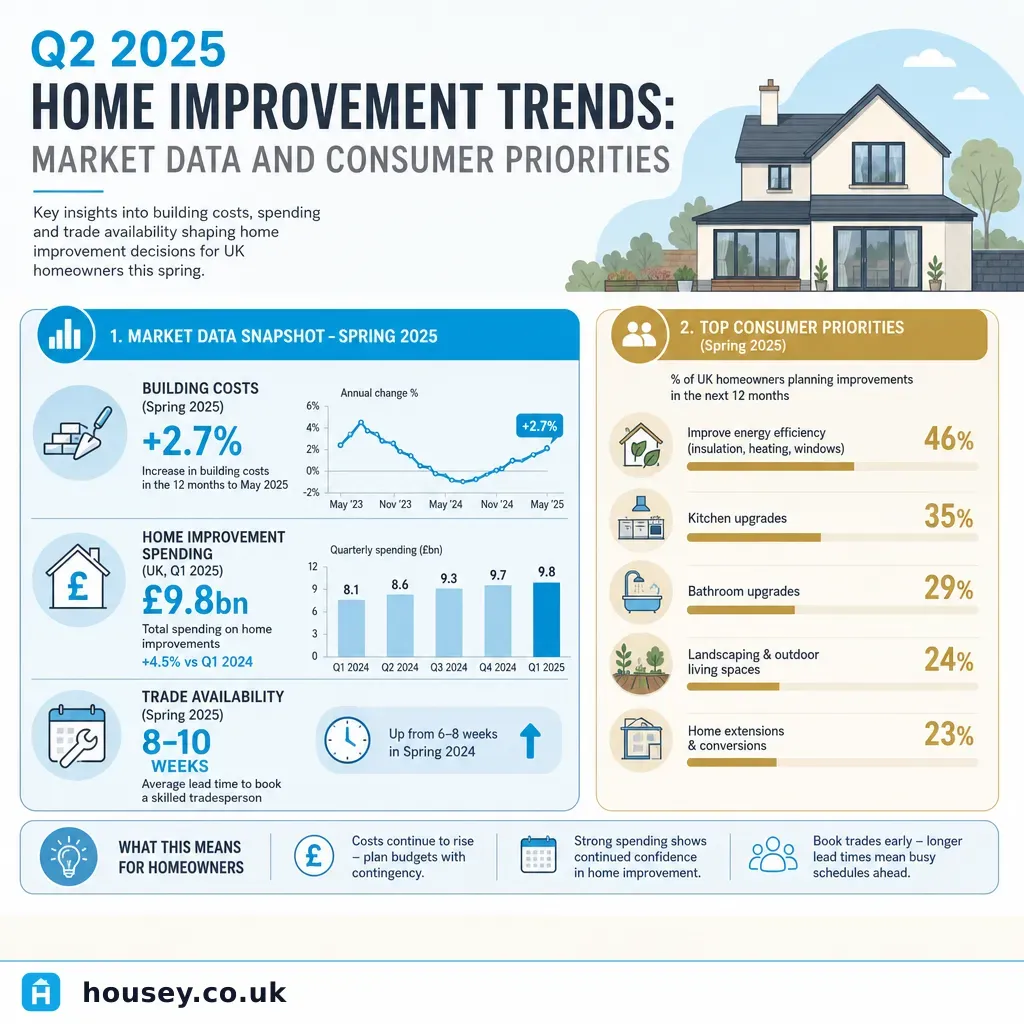
Q2 2025 Home Improvement Trends: Market Data and Consumer Priorities
In Q2 2025, kitchen refurbishments and bathroom renovations led UK consumer home improvement demand, followed by single-storey extensions and garden offices.
 Improvement & Build
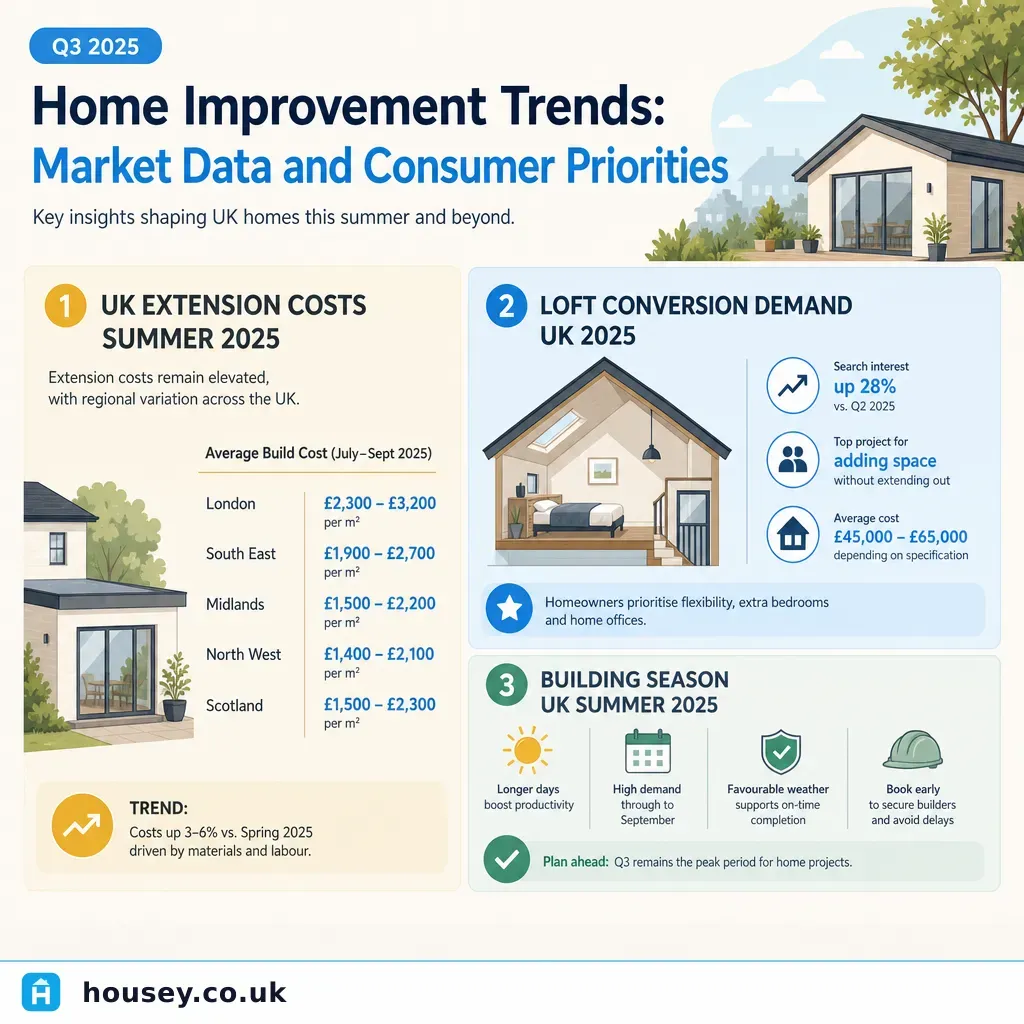
Q3 2025 Home Improvement Trends: Market Data and Consumer Priorities
Q3 2025 was the UK's peak building season, with single-storey extensions, loft conversions, and outdoor living projects at their highest quarterly demand.
 Improvement & Build
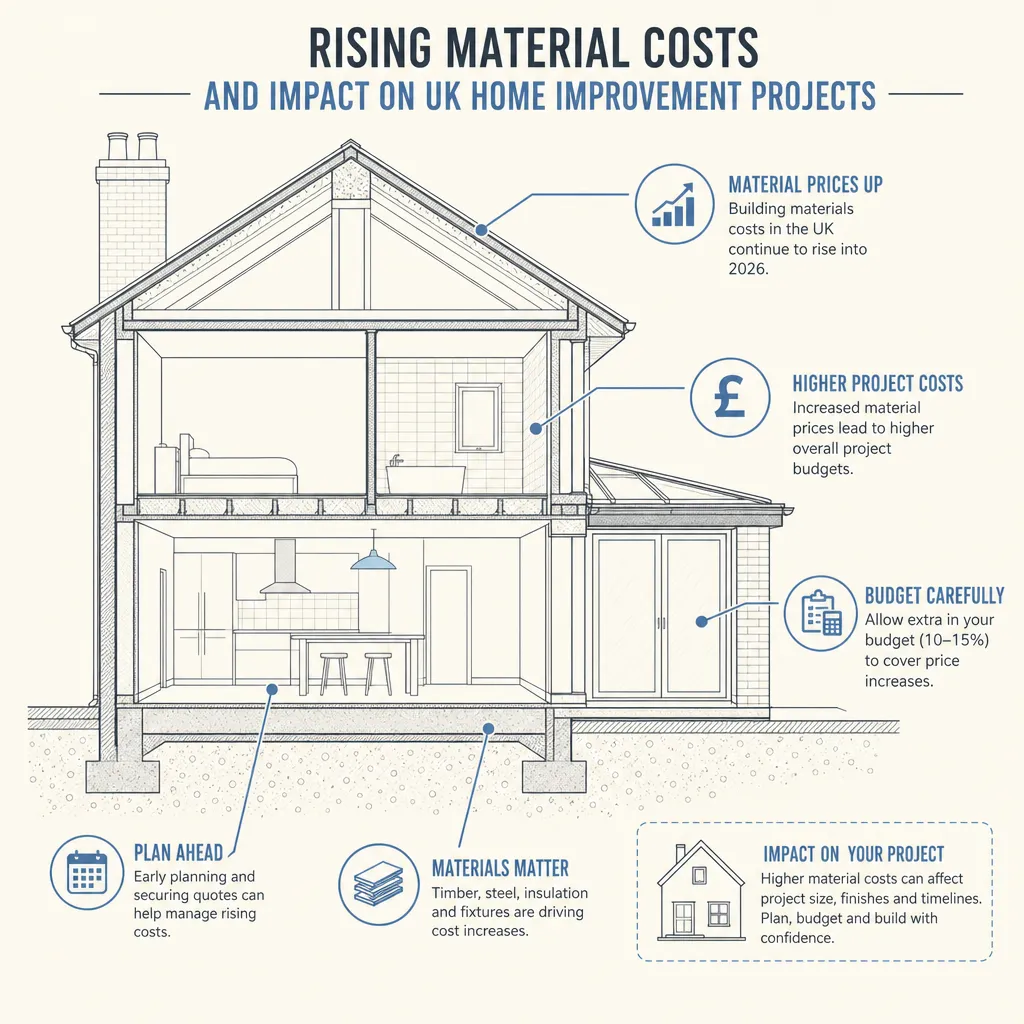
Rising Material Costs and Impact on UK Home Improvement Projects
UK construction material prices remain above pre-2020 levels despite some easing from peak inflation.
 Improvement & Build
Garden Design Trends and Contemporary Landscaping Ideas
Contemporary UK garden design centres on low-maintenance naturalistic planting, multi-functional outdoor spaces, sustainable hard landscaping materials, and wildlife-friendly rewilded areas.