Q3 2025 Home Improvement Trends: Market Data and Consumer Priorities
By Housey · Last reviewed 19th of May 2026
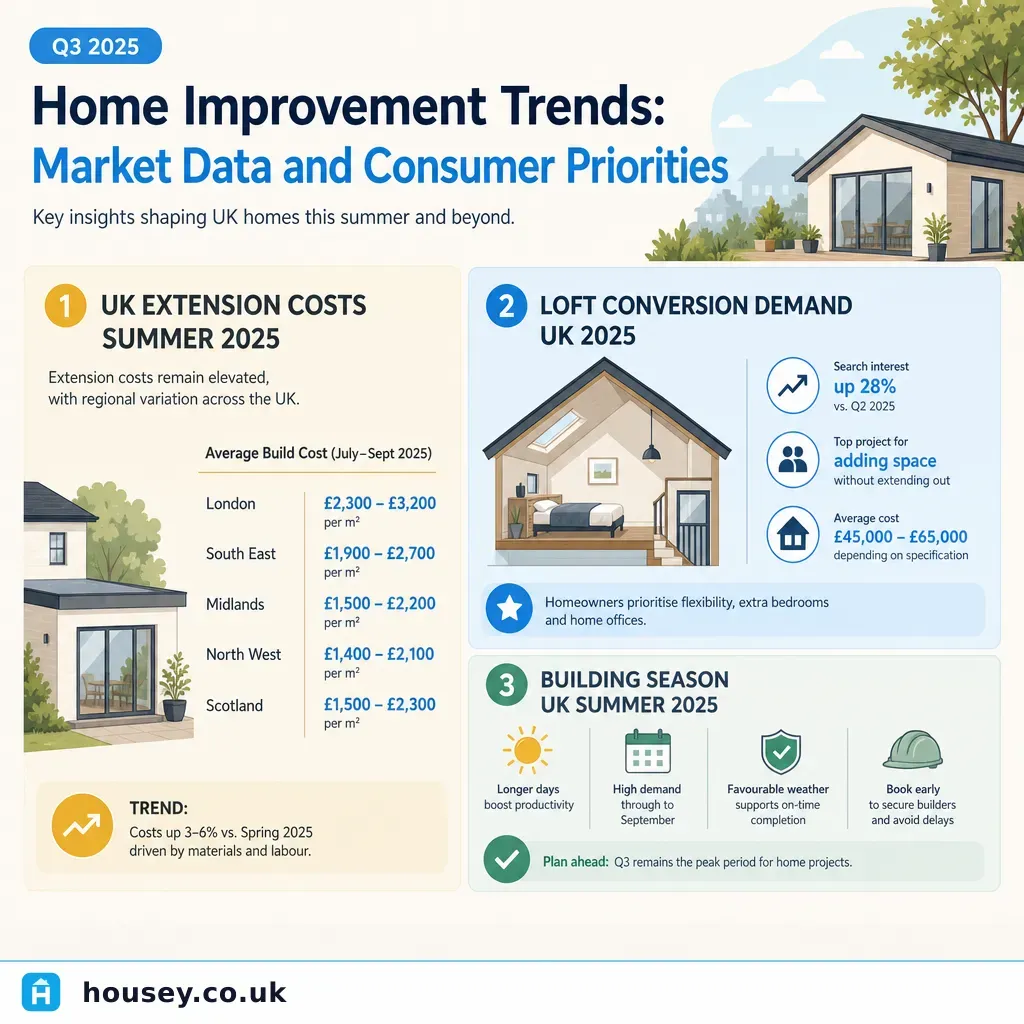
Q3 2025 Home Improvement Trends: Market Data and Consumer Priorities
The third quarter — July through September — represents the peak of the UK building season. Longer days, typically settled weather, and school summer holidays create the optimal conditions for external works, loft conversions, and structural projects requiring scaffolding or open roof structures. For homeowners whose projects were underway through Q3 2025, conditions were shaped by tight trade availability, stabilising but not cheap materials costs, and growing pre-winter interest in energy retrofit. For those beginning the contractor search in July, the reality across most UK regions was that the most sought-after local builders were already fully committed through summer and into early autumn.
Key points
- The CITB's Construction Skills Network has consistently projected a UK construction workforce shortfall running into the tens of thousands; Q3 represents the period of tightest trade availability each year, when peak seasonal demand meets a structurally constrained supply.
- Permitted development rights for loft conversions allow up to 40 m³ of additional roof space for semi-detached and terraced houses, and up to 50 m³ for detached houses, subject to materials and facing conditions under the Town and Country Planning (General Permitted Development) (England) Order 2015.
- Building Regulations Approved Document L (conservation of fuel and power) sets minimum thermal performance standards for any new extension and for replacement windows and doors installed during a refurbishment.
- The prior approval (neighbour consultation scheme) route allows single-storey rear extensions up to 8 m depth for detached houses and 6 m for semi-detached and terraced properties, subject to a 42-day consultation rather than a full planning application.
- Late Q3 — August and September — typically marks the start of pre-winter retrofit planning, as homeowners begin assessing their heating systems and insulation levels ahead of the colder months.
What drove Q3 2025 demand
Q3 is consistently the quarter with the highest volume of active building projects in the UK. Homeowners who planned in Q1 and secured contractors in Q2 had their projects underway through summer. This creates a dual character for Q3: a peak delivery window for those who planned ahead, and a frustrating bottleneck for those who began the contractor search in July.
Project demand by type: Q3 2025
Project type | Q3 demand level | Why Q3 peaks | Typical build duration |
|---|---|---|---|
Two-storey extension | Very high | Dry weather for foundation-to-roof work | 20–30 weeks |
Single-storey rear extension | Very high | External works and roof fitting | 12–20 weeks |
Loft conversion (dormer) | High | Roof works and structural alteration | 10–18 weeks |
Outdoor living (decking, landscaping) | High (early Q3) | Garden season peak | 2–6 weeks |
Roofing repairs and replacement | High | Dry-weather scaffolding window | 1–4 weeks |
Pre-winter energy retrofit | Moderate, rising late Q3 | Preparation for heating season | 1–3 weeks (insulation); 8–20 weeks (heat pump) |
Indicative demand levels based on FMB and trade-platform data patterns, last reviewed 2026-05-19.
Building costs in Q3 2025
Materials price stabilisation that began in late 2024 continued through Q3 2025. The ONS Producer Price Index showed construction product inflation running below 3% year-on-year across most categories — a significant moderation from 2022 peaks. Several subcategories remained subject to volatility:
- Structural steel: Tracked international commodity markets, with some price movement through mid-2025.
- Insulation products: Demand from ECO4 and the Great British Insulation Scheme kept rigid insulation board and mineral wool prices firm.
- Copper and wiring: Sustained demand from electrical upgrades and EV charger installations maintained elevated prices for electrician-supplied materials.
Labour remained the dominant cost driver. FMB member surveys indicated that a significant majority of small and medium building firms reported difficulty recruiting skilled tradespeople through Q3 — consistent with the CITB's long-running structural shortage data.
Indicative UK project cost ranges, Q3 2025 (last reviewed 2026-05-19):
Project | Indicative range | Key variables |
|---|---|---|
Single-storey rear extension | £25,000–£55,000+ | Size, specification, region |
Loft conversion (dormer) | £35,000–£65,000+ | Dormer size, en-suite, structural complexity |
Two-storey extension | £55,000–£120,000+ | Footprint, specification, region |
Full kitchen refurbishment | £8,000–£35,000+ | Units, worktops, appliances, structural changes |
Always obtain at least three written quotes before committing to a contractor. Figures drawn from FMB and trade-platform data; actual quotes will vary by region and specification.
Trade availability in Q3 2025
Q3 is consistently the most competitive quarter for homeowners seeking established contractors. The most common planning mistake the FMB identifies is homeowners beginning the contractor search in July for a July start — by which point well-regarded local firms across most UK regions are fully booked through summer and into early autumn.
Red flags when sourcing a contractor under time pressure
When availability is tight, some homeowners accept quotes from less-established firms out of urgency. Watch for these warning signs before committing:
- An offer to start immediately with no waiting list or prior booking
- A request for a large upfront cash payment before any work has commenced
- No trade body membership (FMB, TrustMark, NICEIC, Gas Safe) or inability to show recent building control sign-off records
- No written specification or formal contract offered before work begins
- Unwillingness to provide references from comparable recent projects in your local area
- Vague or verbal-only descriptions of the scope of works and materials to be used
Decision tree: Q3 project planning
- Want a major project (extension or loft conversion) underway in Q3? If you have not secured a contractor by May, plan for a Q4 or Q1 2026 start — and use Q3 to finalise design, obtain quotes, and submit any required planning applications.
- Considering a kitchen or bathroom refurbishment? A Q3 start remains achievable with 8–12 weeks' notice if you began outreach in April or May.
- Planning energy retrofit before winter? Start the process in July or August — heat pump installations require site survey, heat loss calculation, MCS paperwork, and installation scheduling, with combined lead times of 8–20 weeks in high-demand regions.
- Outdoor living projects (decking, landscaping, fencing)? Book in Q1 or Q2 for Q3 delivery; landscape contractors' books fill quickly from March onwards across most of England.
- Roofing or guttering repair? These projects carry shorter lead times than structural works; approach local roofing contractors from June for summer availability.
Planning activity in Q3 2025
The Planning Portal's householder application data consistently shows Q2 and Q3 as the highest-volume quarters for domestic planning submissions. Most applications are for extensions, loft conversions, and outbuildings — projects planned over winter and spring, then submitted for same-season or autumn build starts.
Key planning points relevant to Q3 2025 included:
- The 42-day prior approval consultation period for larger extensions under the neighbour consultation scheme remained a faster alternative to a full application for eligible projects.
- LPA determination delays were reported in some areas, with determination times of 10–14 weeks rather than the target 8 weeks.
- Continued restrictions on permitted development in conservation areas — particularly for roof alterations and external cladding materials — meant that homeowners in these designations generally faced longer planning timelines.
Pre-winter energy retrofit: Q3 momentum
Late Q3 typically sees the beginning of pre-winter retrofit demand. In Q3 2025, the government schemes active to support this included:
Boiler Upgrade Scheme: £7,500 for air source heat pumps; £7,500 for ground source heat pumps. Applications processed via MCS-accredited installers. Demand continued to outstrip installer capacity in much of southern England and the South East.
Great British Insulation Scheme (GBIS): Means-tested cavity wall and loft insulation support with broader eligibility than ECO4 — covering some owner-occupiers in council tax bands A–D.
ECO4: Supplier-obligation scheme targeting the most vulnerable and lowest-income households with a full range of insulation and heating measures.
The Energy Saving Trust estimated typical savings of £150–£200 per year for a semi-detached home with an uninsulated loft, making loft insulation one of the most cost-effective single measures available to eligible homeowners.
When to get professional help
Engage a structural engineer before removing or modifying any load-bearing element — walls, chimney breasts, steel supports — in an extension or loft conversion project. If cracks in external walls are widening, stepped through brickwork, or accompanied by sticking doors or windows, ask a chartered structural engineer to inspect before undertaking any works in or near that area. For energy retrofit projects using government funding, a TrustMark-registered Retrofit Assessor and Retrofit Coordinator (as required by PAS 2035) should design and oversee any multi-measure works to prevent moisture, ventilation, and performance risks.
How Housey can help
Housey helps UK homeowners find vetted local professionals for every stage of the home improvement journey — from initial structural assessments through to full extension builds and pre-winter energy retrofits. Compare quotes from accredited contractors in your area and move forward with confidence that the right credentials are in place.
Frequently asked questions
Why is Q3 the hardest time to find a contractor in the UK?
Q3 is the peak of the UK building season — longer days and typically settled weather allow external works, loft conversions, and structural projects to proceed most efficiently. Demand for established builders, roofers, and extension specialists peaks when their books are fullest. By July, most well-regarded contractors in high-demand areas are already booked months ahead; the effective planning window for Q3 starts closes in April or May.
Can I use permitted development rights for a loft conversion in a conservation area?
Standard loft conversion permitted development rights — including rear dormers — are generally removed for properties in designated conservation areas. A full planning application is normally required. Some flush-fitting rooflights may still be permitted, but check with your local planning authority before assuming any PD rights apply. Rules can also vary if your property has a history of prior PD use or falls within an Article 4 direction area.
What is the difference between ECO4 and the Great British Insulation Scheme?
ECO4 is a supplier-obligation scheme primarily targeting the most vulnerable households — typically benefits recipients in properties rated EPC D or below. The Great British Insulation Scheme (GBIS) has broader eligibility, including some owner-occupiers in council tax bands A–D who do not receive benefits. Both can fund insulation at no or low cost; eligibility is assessed by an energy supplier or a government-registered assessor.
How long does a householder planning application take in the UK?
The target determination period for a householder planning application is 8 weeks from the date a valid application is received. In practice, some local planning authorities reported determination times of 10–14 weeks in 2025 due to resourcing pressures. The prior approval route for larger single-storey rear extensions has a statutory 42-day consultation period, which often makes it faster than a full planning application for eligible extensions.
Sources and further reading
- FMB Housing Survey — Federation of Master Builders
- Construction Skills Network Forecasts — CITB
- Boiler Upgrade Scheme — GOV.UK
- Great British Insulation Scheme — GOV.UK
- Energy Saving Trust: Loft insulation — Energy Saving Trust
- Planning Portal: Extensions guidance — Planning Portal
- Building Regulations Approved Document L — GOV.UK
Useful next reads
 Improvement & Build
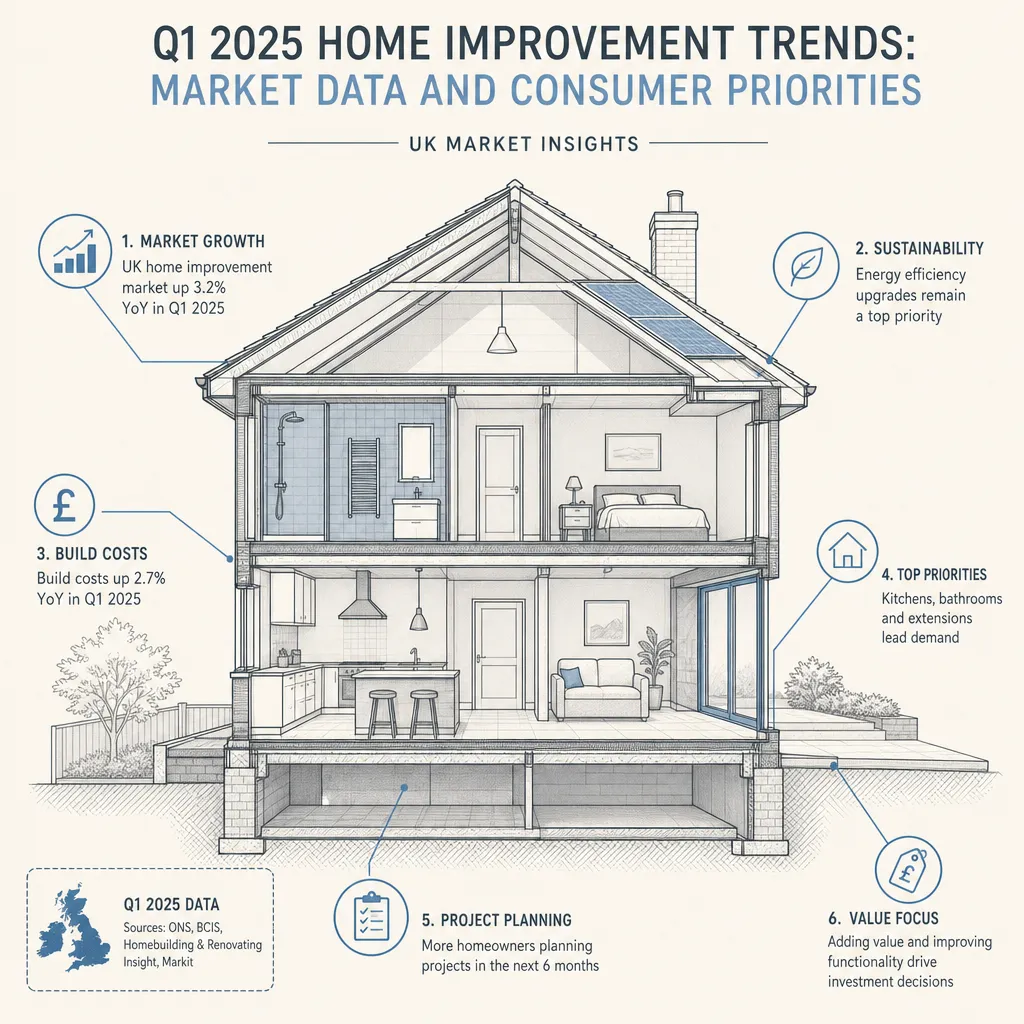
Q1 2025 Home Improvement Trends: Market Data and Consumer Priorities
Q1 2025 saw UK homeowners prioritise loft conversions, energy efficiency upgrades, and kitchen extensions as build costs stabilised following the 2022–2023 peak and mortgage rates began to ease.
 Improvement & Build
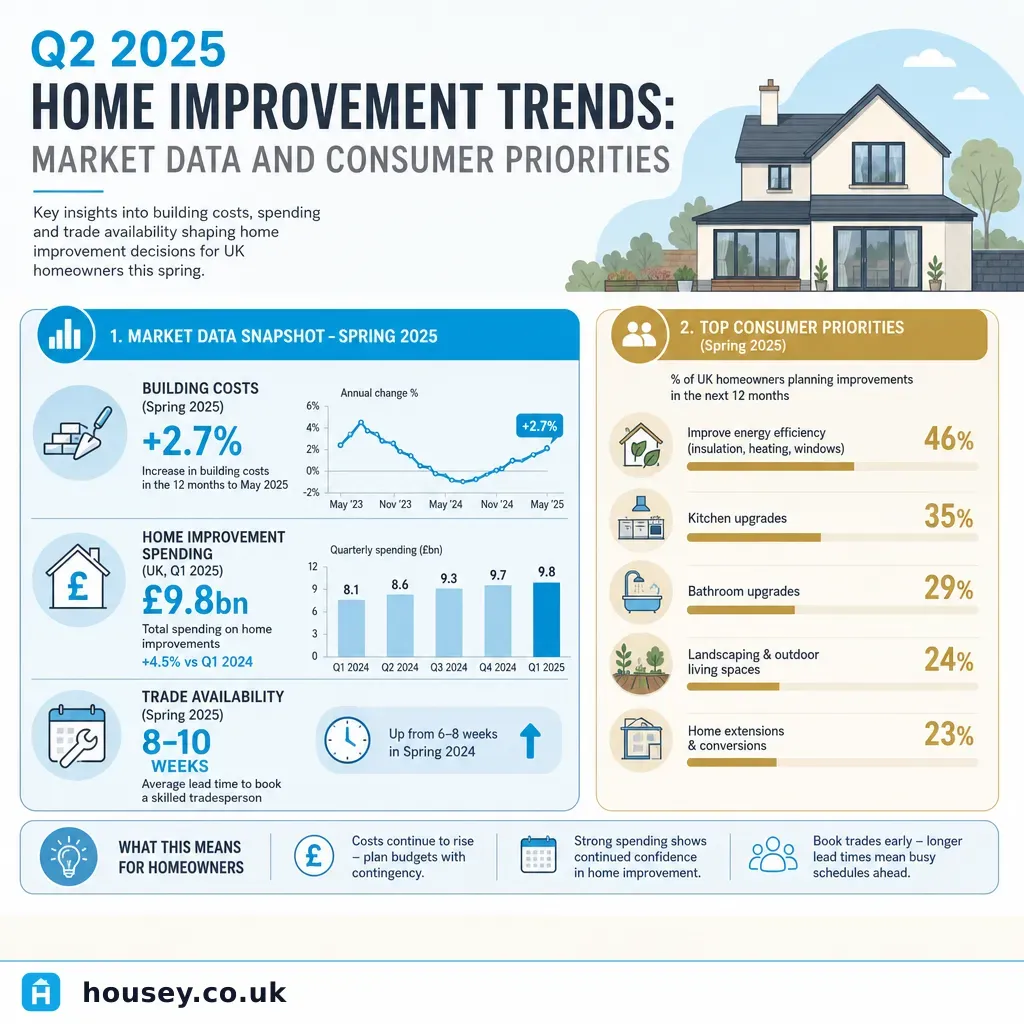
Q2 2025 Home Improvement Trends: Market Data and Consumer Priorities
In Q2 2025, kitchen refurbishments and bathroom renovations led UK consumer home improvement demand, followed by single-storey extensions and garden offices.
 Improvement & Build
Q4 2025 Home Improvement Trends: Market Data and Consumer Priorities
In Q4 2025, UK homeowners prioritised heating upgrades, insulation, and kitchen refurbishments as temperatures fell.
 Improvement & Build
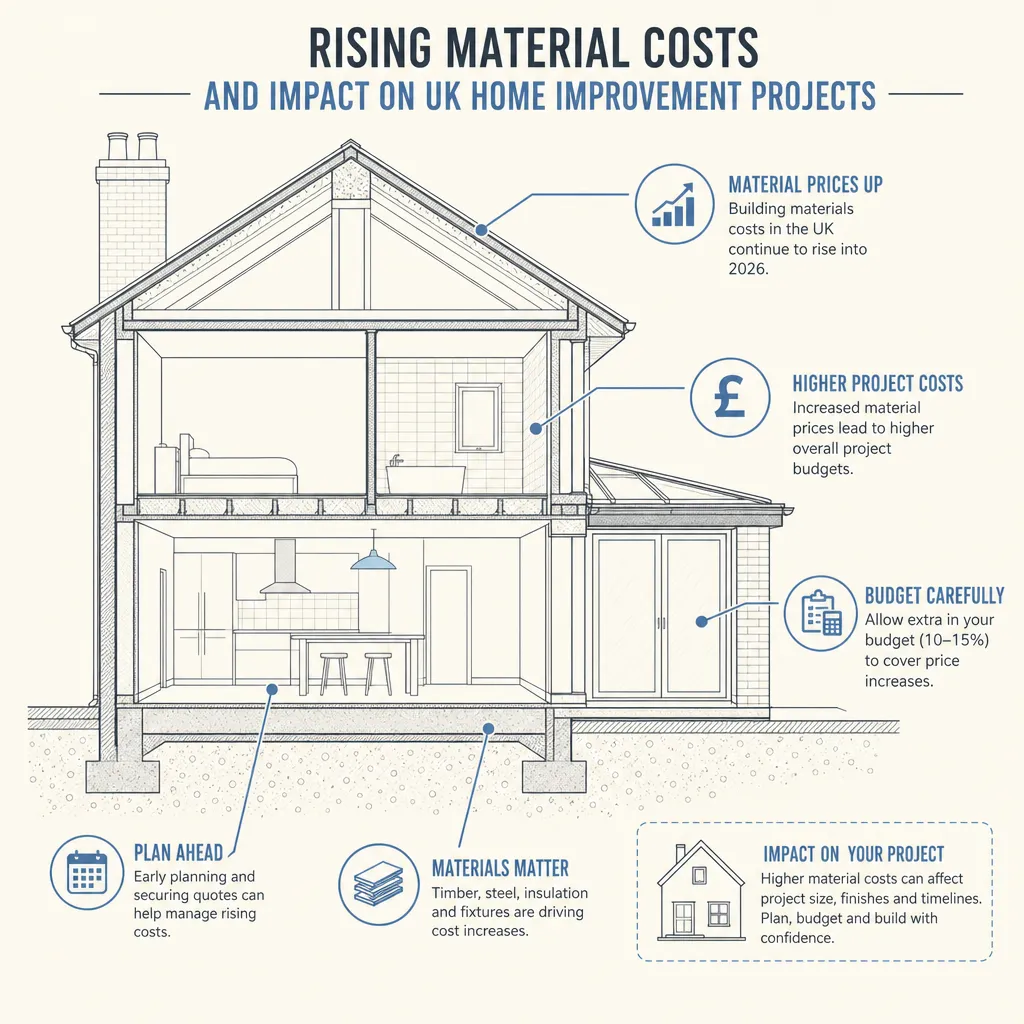
Rising Material Costs and Impact on UK Home Improvement Projects
UK construction material prices remain above pre-2020 levels despite some easing from peak inflation.
 Improvement & Build
Garden Design Trends and Contemporary Landscaping Ideas
Contemporary UK garden design centres on low-maintenance naturalistic planting, multi-functional outdoor spaces, sustainable hard landscaping materials, and wildlife-friendly rewilded areas.