Q2 2025 Home Improvement Trends: Market Data and Consumer Priorities
By Housey · Last reviewed 19th of May 2026
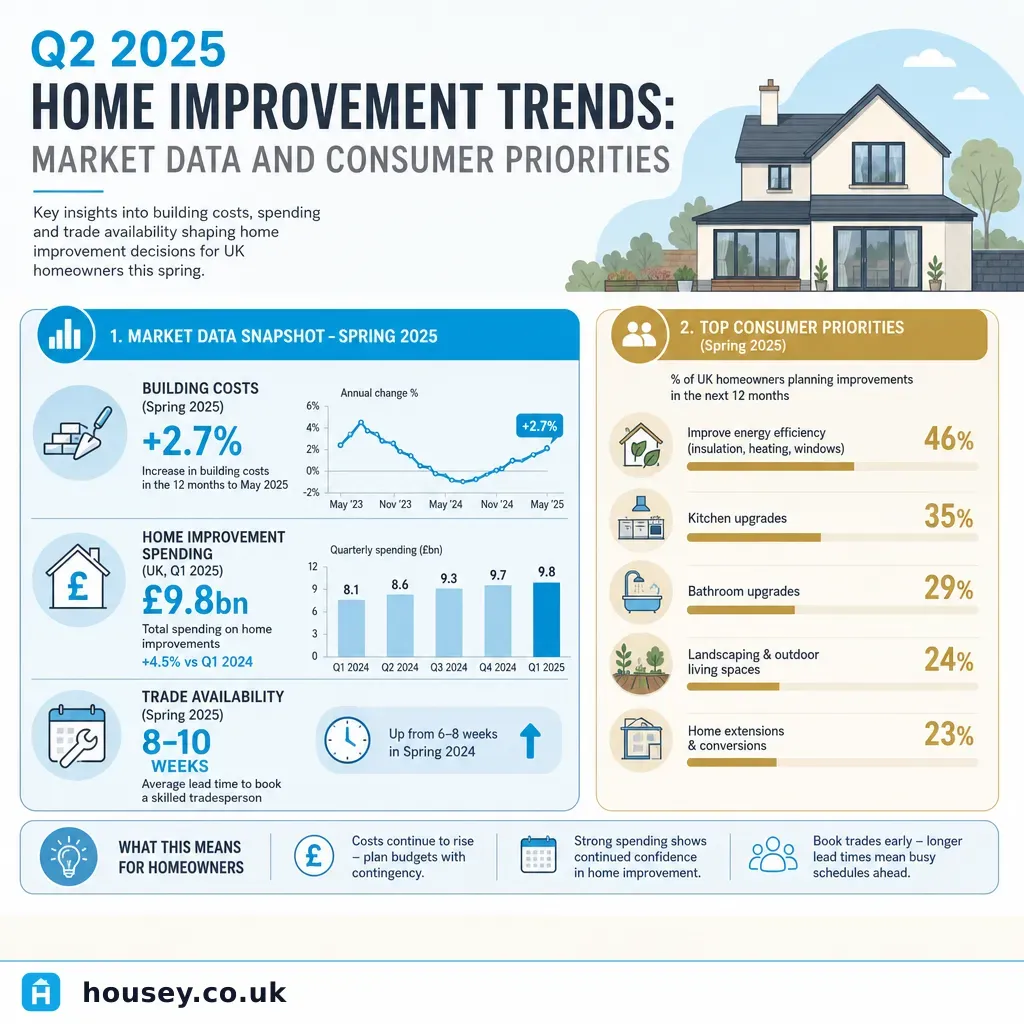
Q2 2025 Home Improvement Trends: Market Data and Consumer Priorities
The second quarter of 2025 — April through June — marks the traditional start of the main building season in England and Wales, when longer daylight hours and warmer weather allow external works to begin in earnest. For UK homeowners weighing up renovation decisions, understanding what drove demand across the sector during this period helps set realistic expectations around trade availability, lead times, and material costs. Q2 2025 sat at a juncture shaped by a gradually shifting interest rate environment, evolving energy efficiency obligations for private landlords, and a structural shortage of skilled tradespeople that has characterised the UK construction market for most of the 2020s.
Key points
- The Federation of Master Builders (FMB) consistently reports bricklayers, plasterers, and plumbers among the most difficult trades to source in spring quarters; Q2 is typically the point at which summer project slots become fully booked with established firms.
- Building materials price inflation — tracked via the ONS Producer Price Index for construction products — eased from its 2022–2023 peaks but remained above long-run averages during H1 2025.
- Permitted development rights allow single-storey rear extensions up to 4 m depth for detached houses and 3 m for semi-detached and terraced properties without a full planning application, subject to conditions and local restrictions.
- The Boiler Upgrade Scheme (BUS) provided £7,500 grants for air source and ground source heat pump installations throughout Q2 2025, administered by Ofgem.
- Kitchen and bathroom refurbishments typically account for the largest share of consumer home improvement projects by count in Q2, driven by pre-summer refresh cycles and the desire to improve saleable value before the spring property market.
What homeowners prioritised in Q2 2025
Spring traditionally triggers the highest volume of new home improvement enquiries in the UK. Trade-matching platform data and FMB member surveys point to a consistent pattern: kitchen refurbishments and bathroom renovations dominate by project count, while extensions and loft conversions dominate by total project value.
Project priority comparison: Q2 2025
Project type | Consumer demand rank | Typical lead time (Q2) | Main driver |
|---|---|---|---|
Kitchen refurbishment | 1 | 6–14 weeks | Pre-summer refresh, property value uplift |
Bathroom renovation | 2 | 4–10 weeks | General upkeep, EPC-linked landlord upgrades |
Single-storey rear extension | 3 | 12–20 weeks (inc. build) | Space needs, house price environment |
Garden office or outbuilding | 4 | 6–12 weeks | Hybrid working, PD rights usage |
Loft conversion | 5 | 16–26 weeks | Adding bedrooms without moving |
External decoration or rendering | 6 | 3–8 weeks | Post-winter maintenance |
Indicative UK lead times based on FMB and trade-platform data patterns, last reviewed 2026-05-19. Actual timelines will vary by region and contractor availability.
Building materials and costs in Q2 2025
Following the sharp price increases of 2021–2023 — driven by pandemic supply chain disruption, energy cost spikes, and post-Brexit logistics friction — building materials inflation moderated through 2024 and into 2025. The ONS Producer Price Index for construction products showed year-on-year increases below 3% across most categories by early 2025, a significant improvement on the double-digit peaks seen in 2022.
Timber, insulation board, and aggregate-based products (blocks, bricks, concrete) saw the most meaningful stabilisation. Copper-based products — pipework and wiring — remained more volatile, tracking global commodity markets and sustained demand from electrical upgrade and EV charger installation work.
Cost drivers that remained elevated in Q2 2025:
- Labour rates, particularly for skilled trades (plumbers, electricians, plasterers)
- Energy surcharges embedded in scaffolding and plant hire costs
- Specialist installer premiums for MCS-accredited heat pump and solar PV contractors
Homeowners obtaining quotes in this period were generally advised to compare at least three written quotes and to ask specifically whether prices were fixed or subject to materials-price variation clauses before signing anything.
Trade availability and booking lead times
The FMB's Housing Survey for this period continued to highlight a structural shortage of skilled tradespeople across the UK. The Construction Industry Training Board (CITB) has identified persistent gaps in bricklaying, plastering, and plumbing for most of the 2020s, with demand consistently outpacing the available qualified workforce. In Q2 2025, the practical implication for homeowners was clear: well-regarded local contractors were typically booked 8–16 weeks ahead, and those who began searching in April for an April start frequently found that the most established local firms were already committed through summer.
Decision tree: when to start planning your Q2 project
- Planning an extension or loft conversion? Allow 4–8 weeks for quotes and design, 8–12 weeks for any planning or building control approval, and 16–26 weeks for the build. Start conversations with contractors in January or February for a summer project start.
- Kitchen or bathroom refurbishment? Most established fit-out contractors book 6–12 weeks ahead in spring. Approach them in February or March for an April or May start date.
- External works (rendering, roofing, external decoration)? Weather-dependent; aim to book in March for April availability. Decorators and renderers typically carry shorter lead times than general builders.
- Garden office under permitted development? Check Class E PD thresholds with your local planning authority if your property is in a conservation area or covered by an Article 4 direction — these can restrict or remove standard PD rights entirely.
- Unsure of budget or scope? Obtain two or three preliminary quotes before committing to detailed design work; initial feasibility visits are usually free with established contractors.
Planning and permitted development in Q2 2025
The Planning Portal reported continued high volumes of householder planning applications through Q2 2025, consistent with the broader trend of homeowners investing in their existing properties rather than moving — driven partly by stamp duty costs, constrained housing supply, and rising moving costs. Permitted development rights remained widely used for single-storey rear extensions, outbuildings, and roof lights. Homeowners in conservation areas, National Landscapes (formerly Areas of Outstanding Natural Beauty), or properties subject to an Article 4 direction should check with their local planning authority before assuming PD rights apply. The prior approval (neighbour consultation) route continued to allow larger single-storey rear extensions — up to 8 m depth for detached houses and 6 m for semi-detached and terraced properties — subject to a 42-day consultation period.
Energy improvements: Q2 2025 activity
Energy retrofit — insulation, heat pump installation, solar PV — showed steady demand growth in Q2 2025, supported by the Boiler Upgrade Scheme, the Great British Insulation Scheme (GBIS), and ECO4. Demand for MCS-accredited heat pump installers exceeded capacity in many UK regions, contributing to wait times of 8–20 weeks from initial enquiry to installation completion. Insulation enquiries were concentrated in northern England, Scotland, and the Midlands, where older housing stock and higher heating costs created the strongest uptake incentive.
What to ask before accepting a quote
A consistent finding from FMB member surveys is that homeowners who obtained multiple written quotes and asked structured questions had fewer disputes and better outcomes. Before accepting any quote for a Q2 2025 project:
- Is the price fixed, or subject to materials-price variation during the project?
- What are the payment milestones — and is a large upfront cash payment being requested before work starts?
- Who holds the relevant trade accreditations (Gas Safe, NICEIC, NAPIT, FMB, TrustMark)?
- How long is the quote valid, and what is the earliest confirmed start date?
- What is the variation policy if unforeseen defects or access issues are discovered during work?
- Will building regulations approval be required, and who is responsible for obtaining and signing off?
- Is VAT included in the quoted price?
When to get professional help
Most home improvement projects proceed without specialist professional input beyond the contractor. However, engage a qualified professional when:
- An extension or loft conversion involves removing or altering a load-bearing wall or chimney breast — a structural engineer's calculations are required before building control can approve the design
- Suspected asbestos-containing materials are present in a pre-2000 property — a licensed asbestos surveyor should assess before any disturbance
- Works are within 3 m of a neighbour's building or on or near a shared boundary and may trigger obligations under the Party Wall etc. Act 1996
- A proposal is within a conservation area or affects a listed building — a planning consultant or heritage specialist can help avoid a costly refusal
How Housey can help
Housey connects UK homeowners with vetted local professionals across the full spectrum of home improvement and build services. Whether you are planning a kitchen refurbishment, a rear extension, or an energy retrofit, Housey's matching engine helps you find qualified contractors with the right accreditations in your area, compare quotes side by side, and move forward with confidence.
Frequently asked questions
Why were building costs still elevated in Q2 2025?
Labour rates remained the primary driver. While materials price inflation eased significantly from its 2022–2023 peak, the shortage of skilled tradespeople — bricklayers, plasterers, plumbers — kept labour costs elevated. CITB projections for 2025 continued to show demand outpacing available workforce in key trade categories, with no near-term resolution in sight.
Do I need planning permission for a rear extension in spring 2025?
Many single-storey rear extensions fall under permitted development rights and do not require a full planning application. For detached houses the PD limit is typically 4 m; for semi-detached and terraced properties, 3 m. Conservation area properties, listed buildings, and homes under Article 4 directions may not benefit — always check with your local planning authority before starting work.
How far ahead should I book a contractor for a spring or summer project start?
In Q2 2025, established contractors were typically booked 8–16 weeks ahead. For April or May project starts, begin obtaining quotes and booking in January or February. Extensions and loft conversions benefit from even earlier planning — aim to have a contractor agreed by late autumn or winter the year before to secure a spring start.
What energy grants were available to UK homeowners in Q2 2025?
The Boiler Upgrade Scheme offered £7,500 for air and ground source heat pumps, administered by Ofgem. The Great British Insulation Scheme provided means-tested cavity wall and loft insulation support, while ECO4 targeted lower-income households with EPC D or below ratings. Eligibility and funding availability change — always check GOV.UK for current scheme status before applying.
Sources and further reading
- FMB Housing Survey — Federation of Master Builders
- Producer Price Index: Construction Materials — Office for National Statistics
- Boiler Upgrade Scheme — GOV.UK
- Great British Insulation Scheme — GOV.UK
- Construction Skills Network Labour Forecasts — CITB
- Planning Portal: Extensions guidance — Planning Portal
Useful next reads
 Improvement & Build
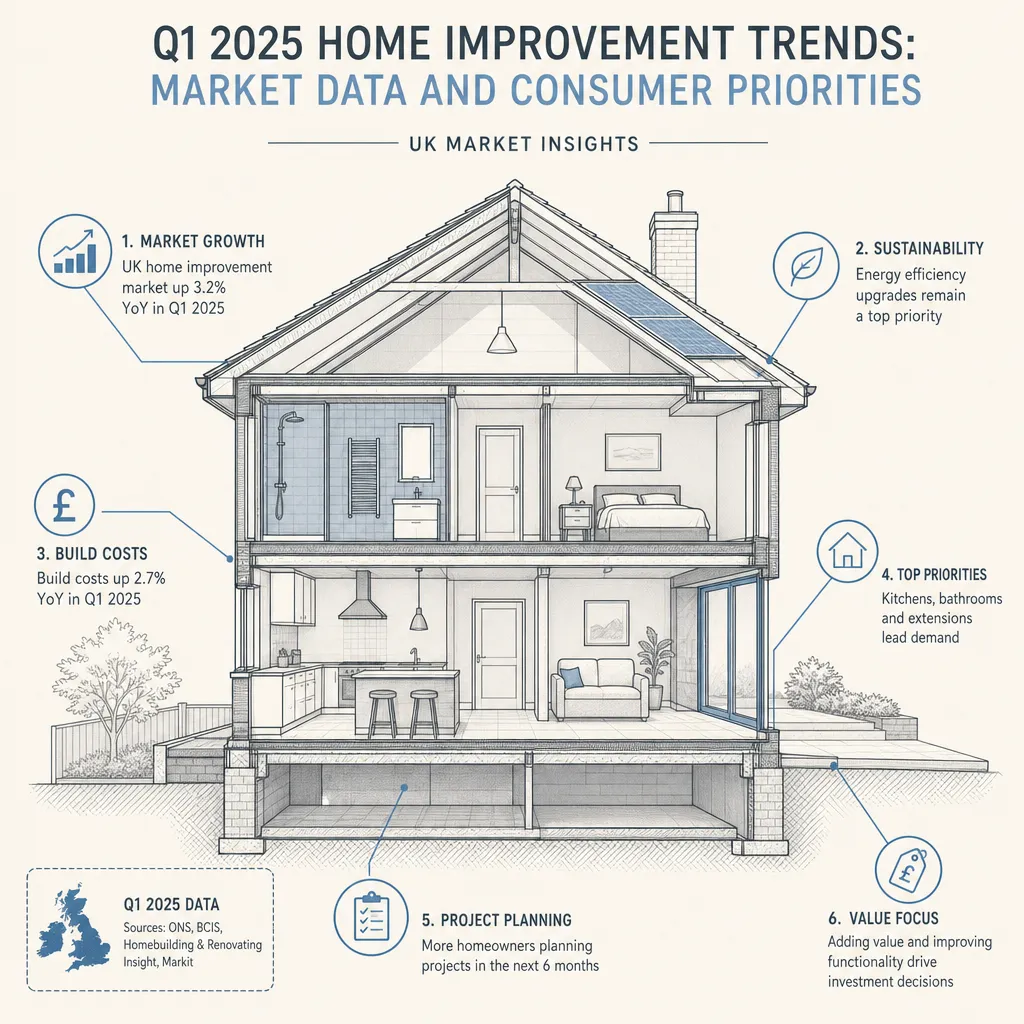
Q1 2025 Home Improvement Trends: Market Data and Consumer Priorities
Q1 2025 saw UK homeowners prioritise loft conversions, energy efficiency upgrades, and kitchen extensions as build costs stabilised following the 2022–2023 peak and mortgage rates began to ease.
 Improvement & Build
Q4 2025 Home Improvement Trends: Market Data and Consumer Priorities
In Q4 2025, UK homeowners prioritised heating upgrades, insulation, and kitchen refurbishments as temperatures fell.
 Improvement & Build
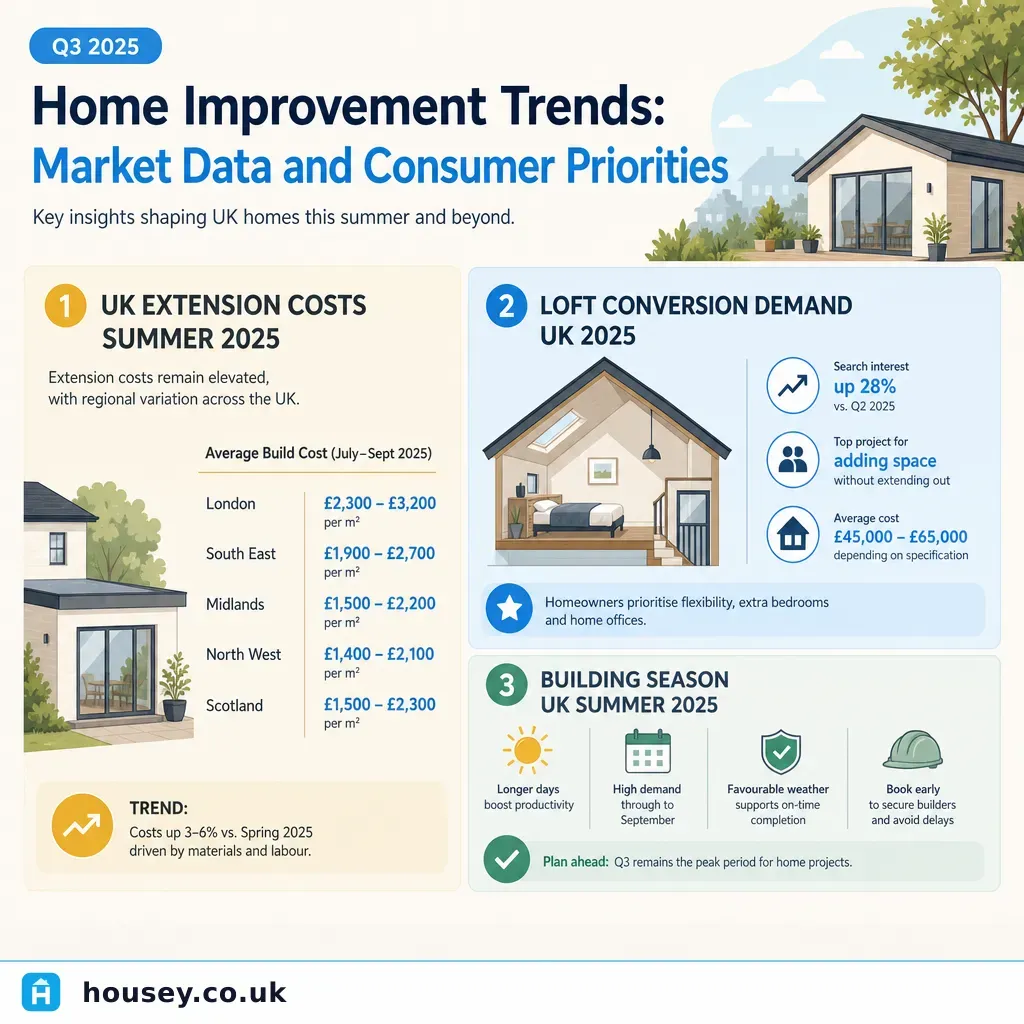
Q3 2025 Home Improvement Trends: Market Data and Consumer Priorities
Q3 2025 was the UK's peak building season, with single-storey extensions, loft conversions, and outdoor living projects at their highest quarterly demand.
 Improvement & Build
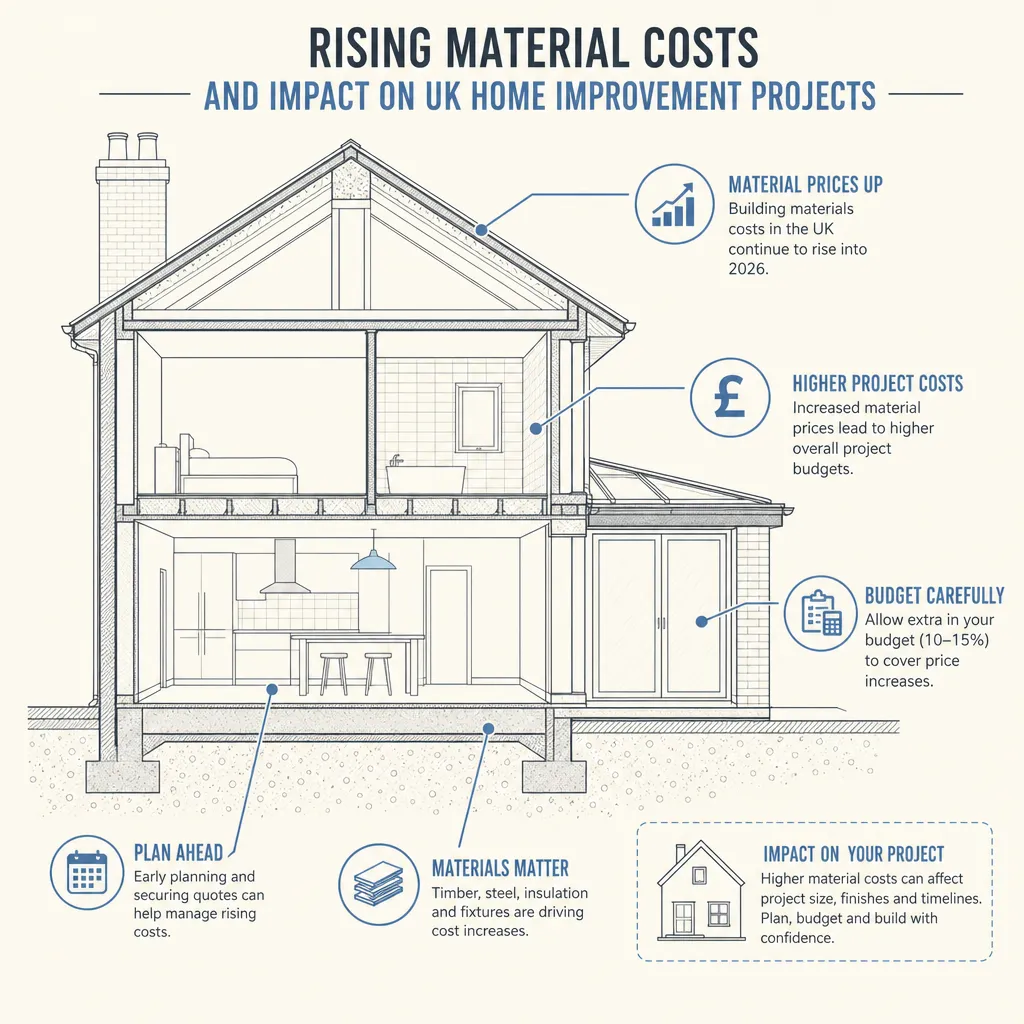
Rising Material Costs and Impact on UK Home Improvement Projects
UK construction material prices remain above pre-2020 levels despite some easing from peak inflation.
 Improvement & Build
Garden Design Trends and Contemporary Landscaping Ideas
Contemporary UK garden design centres on low-maintenance naturalistic planting, multi-functional outdoor spaces, sustainable hard landscaping materials, and wildlife-friendly rewilded areas.