Q1 2026 Job Price Index: UK Service Pricing Trends and Market Analysis
By Housey · Last reviewed 19th of May 2026
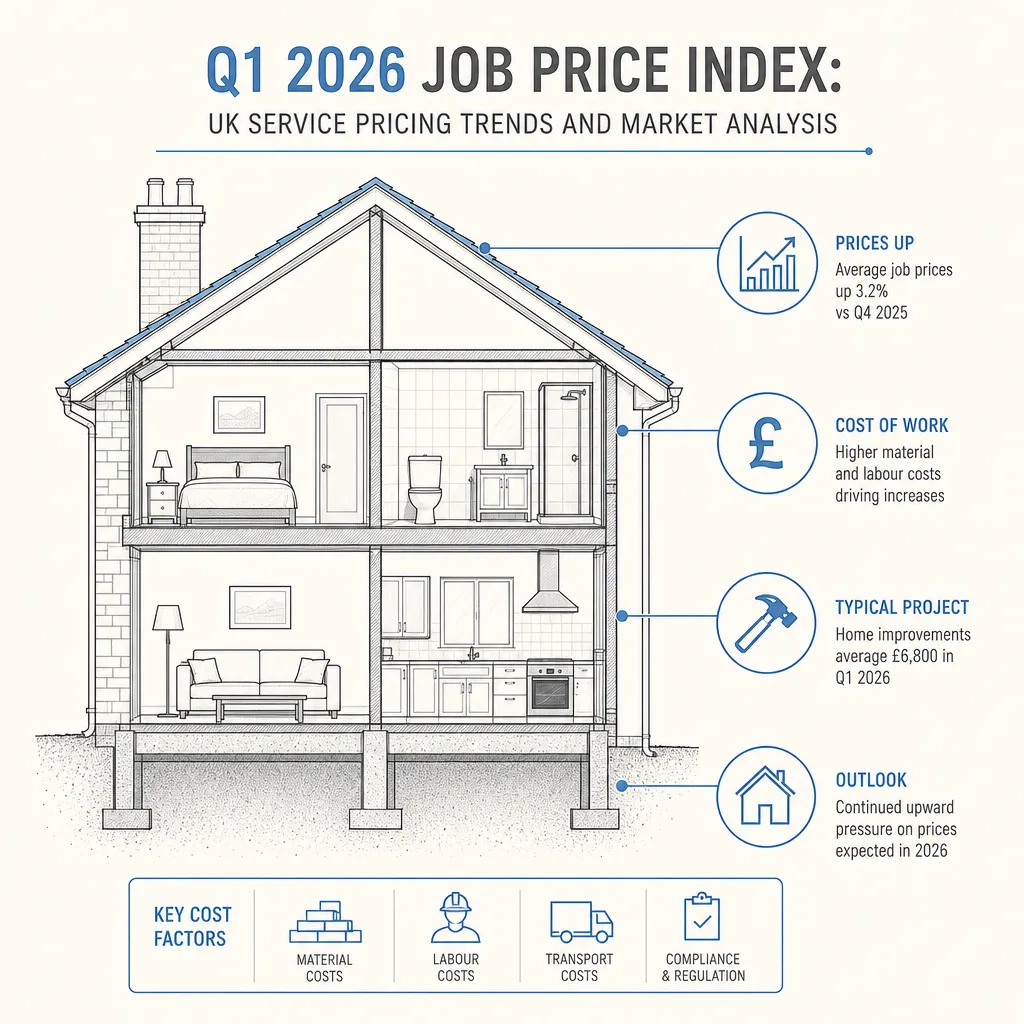
Q1 2026 Job Price Index: UK Service Pricing Trends and Market Analysis
For homeowners planning renovation, extension, or energy upgrade projects in 2026, understanding what happened to trade and construction prices in the first quarter — and why — informs better decisions on timing, budgeting, and contract terms. Q1 tends to set the baseline for the year ahead: materials suppliers renegotiate contracts, tradespeople review day rates, and contractor order books begin to fill. Q1 2026 was shaped by a specific combination of sustained labour shortages, elevated materials costs, and the looming effect of April's employer National Insurance changes.
Key points
- The ONS Construction Output Price Indices and the RICS Building Cost Information Service (BCIS) are the most reliable public benchmarks for tracking UK construction and trade cost trends over time.
- Employer National Insurance contribution increases effective April 2026 (announced in the October 2025 Autumn Budget) were expected to flow through to consumer quotes during Q2 and Q3 2026 as existing contracts rolled over.
- Materials costs for timber, rigid insulation board (PIR), and electrical components remained elevated above pre-2021 baselines in Q1 2026, though the acute inflationary spike of 2022–2023 had broadly moderated.
- Skilled trade labour — particularly electricians, plumbers, heat pump installers, and PAS 2035 retrofit specialists — continued to attract a premium, reflecting a structural skills gap consistently flagged by the CITB.
- Qualifying energy-saving materials (insulation, heat pumps, solar panels) attract 0% VAT under current HMRC rules — a meaningful saving for retrofit project budgets.
Why Q1 pricing matters for homeowners
Most tradespeople and small contractors review their day rates at the start of the calendar year. Q1 is when annual materials contracts with suppliers are renegotiated, when changes to employment costs — National Insurance, National Living Wage — are absorbed into forward pricing, and when post-Christmas order books begin to refill. The decisions made in Q1 feed through to the quotes homeowners receive from Q2 onwards.
Q1 2026 was notable for two reasons. First, the construction sector was pricing in the April 2026 employer National Insurance increase — a real additional cost for contractors with employed staff. Second, demand for energy retrofit services continued to outpace the pool of accredited installers, keeping specialist day rates firm and lead times extended in most UK regions.
Key cost indices to follow
These sources give homeowners the most reliable public picture of UK trade and construction price movements:
Index | Published by | Frequency | What it measures |
|---|---|---|---|
Construction Output Price Indices (OPI) | ONS | Quarterly | Prices received by contractors for construction output, by sector |
Producer Price Indices (PPI) — construction materials | ONS | Monthly | Input material price changes: timber, concrete, steel, insulation |
State of Trade Survey | Federation of Master Builders | Quarterly | Workload, price expectations, and confidence among SME builders |
BCIS Building Cost and Tender Price Indices | RICS (subscription) | Quarterly | Tender prices and building costs for new build and repair/maintenance work |
Construction Skills Network forecast | CITB | Annual | Workforce demand, output projections, and skills gap analysis by trade |
The ONS Construction OPI and PPI data are freely accessible on the ONS website. BCIS headline findings are routinely reported in the construction trade press, including Building magazine and Construction News.
What drove Q1 2026 trade prices
Labour: the principal cost pressure
Skilled trade labour remained the dominant cost driver in Q1 2026. Electricians, plumbers, gas engineers, and accredited heat pump and retrofit installers continued to command day rates reflecting strong demand against constrained supply. The CITB's Construction Skills Network has consistently projected a shortfall in the specialist trades most closely aligned with the UK's decarbonisation agenda — a structural issue rather than a temporary market peak.
For homeowners, this typically means:
- Longer lead times to secure a qualified tradesperson in high-demand areas — particularly London, the South East, and the South West.
- Day rates for experienced, accredited tradespeople that are meaningfully higher than equivalents from five years ago.
- Premium pricing for Gas Safe, NICEIC, MCS-accredited, and PAS 2035 retrofit-qualified contractors relative to unaccredited alternatives.
Materials: stable but elevated
Timber prices, which spiked sharply through 2021–2022, had moderated but remained above their 2019 baselines by early 2026. Rigid insulation board and mineral wool similarly reflected sustained retrofit demand. Electrical materials — cables, consumer units, and smart controls — were subject to ongoing copper price volatility and semiconductor supply constraints affecting component availability.
Homeowners commissioning work with a significant materials content should request quotes confirming whether materials are priced at a fixed rate for a defined period, or are subject to a market-rate variation clause.
Indicative UK cost context, last reviewed 2026-05-19. Specific prices vary by specification, supplier, and region.
Regional variation
Price variation by region is significant and persistent. BCIS regional location factors show London and the South East consistently attracting premiums of 15–30% above the national average for equivalent trade work. Scotland, Wales, and parts of Northern England typically sit at or below the national mean, though rural areas in any region may carry access and logistics surcharges.
Quote-comparison template: key questions for a 2026 quote
Question | Why it matters right now |
|---|---|
Is the materials price fixed for the duration, or subject to market adjustment? | Materials prices remain elevated and can move; a fixed-price quote protects against uplift |
How long is the quote valid? | Some Q1 quotes expired in 4–6 weeks as contractors anticipated mid-year price reviews |
Does the quote include provisional sums, and how are they managed? | Provisional sums are estimates, not fixed prices — agree limits and a variation process in writing |
Is VAT included, and does any element qualify for 0% VAT relief? | Qualifying retrofit measures attract 0% VAT; confirm which line items apply before signing |
Does the quote reflect the April 2026 NI changes? | Quotes prepared before April 2026 may be revised; clarify the contractor's position explicitly |
Is there a price escalation clause for longer projects? | Common on projects over 8–12 weeks; agree the reference index, trigger point, and cap upfront |
Decision tree: is now the right time to commission your project?
- Proceed now if you have a fixed-price quote with a validity period covering your intended start date, materials are specified in writing, and the contractor can mobilise within four to six weeks.
- Wait and re-quote if your quote contains significant unresolved provisional sums, a short validity period, or an open-ended materials variation clause — particularly for projects above £15,000.
- Lock in a preferred contractor with a signed letter of intent if you are planning a Q3 or Q4 2026 project; well-regarded tradespeople fill their order books early in the year and diary slots become scarce by late spring.
- Check VAT relief eligibility before commissioning insulation, heat pump, or solar panel work — qualifying energy-saving materials have attracted 0% VAT since April 2022 under current HMRC rules.
- Commission an independent cost plan from a quantity surveyor if the project exceeds £40,000–£50,000 — the fee (typically 1.5–3% of project value) is frequently recovered through better-informed contractor negotiations and avoided mid-project variations.
Red flags in a Q1 2026 quote
- No clear distinction between fixed-cost items and provisional sums — an open-ended estimate presented as a firm quote.
- A quote with no stated validity period that you are expected to accept weeks or months later at the original price.
- A suspiciously low figure relative to all other quotes, with no explanation of materials grade or specification — this sometimes reflects lower-grade materials or unaccredited subcontractors.
- Pressure to sign immediately — responsible contractors give homeowners reasonable time to compare quotes and consider.
- No mention of how mid-project cost changes are managed for a project lasting more than four to six weeks.
When to get professional help
For projects above approximately £20,000–£30,000, an independent quantity surveyor can prepare a cost plan, benchmark contractor quotes against current market indices, and administer variations during the build. Their fee (typically 1.5–3% of project value) is frequently recovered through cost certainty and better-managed change. For energy retrofit projects seeking grant funding — Boiler Upgrade Scheme, Great British Insulation Scheme, or ECO4 — a PAS 2035-accredited retrofit coordinator is a mandatory part of the funded works process and can advise on funding eligibility alongside technical specification.
How Housey can help
Housey gives homeowners a structured way to obtain, compare, and evaluate quotes from vetted local tradespeople across a wide range of improvement and build services. Rather than navigating a fragmented market manually, submit your project details once and receive competitive quotes from qualified, reviewed professionals — giving you the benchmark information needed to assess any individual quote against current market conditions.
Frequently asked questions
Where can I find free UK construction cost data?
The ONS publishes quarterly Construction Output Price Indices and monthly Producer Price Indices for construction materials free of charge on its website. The Federation of Master Builders publishes a quarterly State of Trade Survey with headline findings available without subscription. BCIS (RICS Building Cost Information Service) provides the most granular benchmark data but requires a professional or institutional subscription.
Do trade prices usually increase in Q1?
Day rates and materials mark-ups are often reviewed at the start of the calendar year, so Q1 is when increases commonly take effect. However, workload for many outdoor trades is lower in January and February, which sometimes creates scope for timing-based negotiation. Q2 and Q3 are the peak demand periods for most building trades, when contractor leverage tends to be higher.
How has the April 2026 National Insurance change affected trade pricing?
The increase in employer National Insurance contributions effective April 2026 raised employment costs for contractors with direct staff. Sole traders were not directly affected as employers, but those with employees absorbed additional costs. The full effect on consumer quotes was expected to emerge gradually through Q2 and Q3 2026 as existing contracts rolled over and new projects were priced.
Should I ask for a fixed-price materials schedule in my contract?
Yes, if materials represent a significant proportion of the contract value — broadly where they account for more than 30–40% of the total. Ask the contractor to confirm specific products, quantities, and agreed prices at the time of quoting, and agree in writing what happens if a product is unavailable. A clear variation clause protects both parties and avoids disputes mid-project over substitutions or cost increases.
Sources and further reading
- Construction Output Price Indices — ONS
- State of Trade Survey — Federation of Master Builders
- BCIS Building Cost Information Service — RICS
- Construction Skills Network: workforce forecasts — CITB
- VAT on energy-saving materials — GOV.UK
- TrustMark: government-endorsed quality scheme — TrustMark
Useful next reads
 Improvement & Build
Q4 Job Price Index: UK Service Pricing Trends and Market Analysis
UK home improvement service prices are influenced by material costs, labour availability, and seasonal demand.
 Improvement & Build
Rising Material Costs and Impact on UK Home Improvement Projects
UK construction material prices remain above pre-2020 levels despite some easing from peak inflation.
 Improvement & Build
Q1 2025 Home Improvement Trends: Market Data and Consumer Priorities
Q1 2025 saw UK homeowners prioritise loft conversions, energy efficiency upgrades, and kitchen extensions as build costs stabilised following the 2022–2023 peak and mortgage rates began to ease.
 Improvement & Build
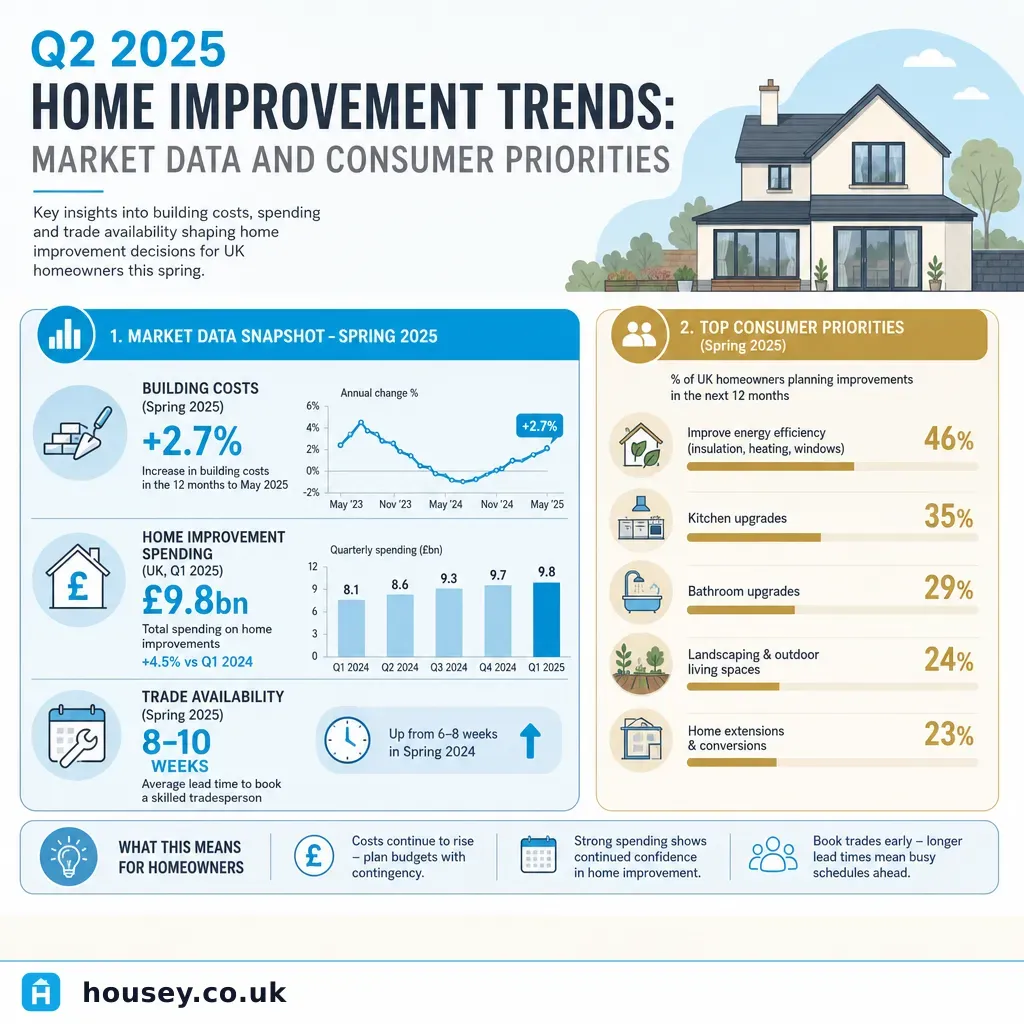
Q2 2025 Home Improvement Trends: Market Data and Consumer Priorities
In Q2 2025, kitchen refurbishments and bathroom renovations led UK consumer home improvement demand, followed by single-storey extensions and garden offices.
 Improvement & Build
Q4 2025 Home Improvement Trends: Market Data and Consumer Priorities
In Q4 2025, UK homeowners prioritised heating upgrades, insulation, and kitchen refurbishments as temperatures fell.