What is a pre-listing home inspection and why it matters
By Housey · Last reviewed 31st of May 2026
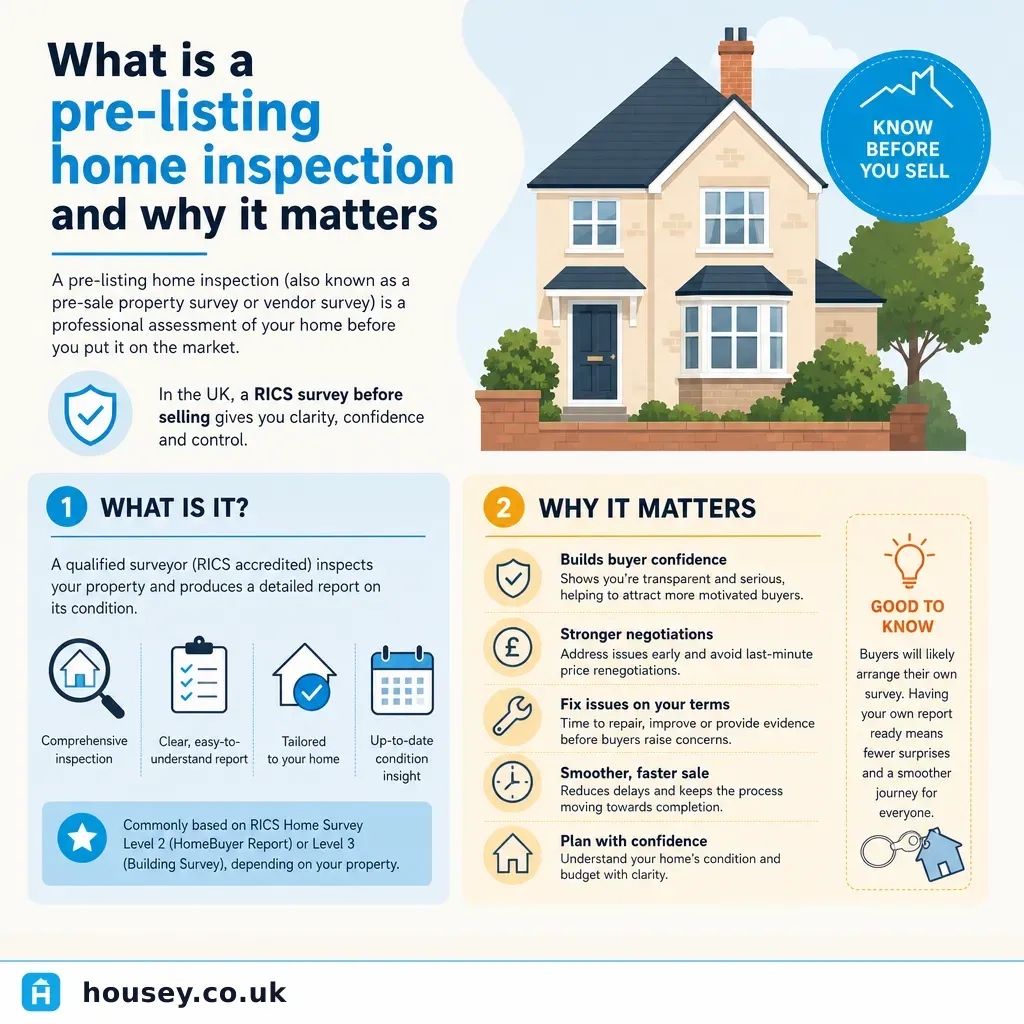
What is a pre-listing home inspection and why it matters
When a property reaches the open market, most buyers commission their own survey — but an increasing number of UK sellers are choosing to get there first. A pre-listing inspection, sometimes called a vendor survey or pre-sale survey, is commissioned by the seller before marketing begins, typically to reduce the risk of late-stage renegotiations or collapsed chains. It is most commonly considered by sellers of older properties, homes with visible defects, or anyone who has had a previous sale fall through.
Key points
- In Scotland, the Home Report — comprising a Single Survey, Energy Report, and Property Questionnaire — is a legal requirement for most residential sales and acts as the statutory pre-listing survey north of the border.
- Under the Consumer Protection from Unfair Trading Regulations 2008, sellers and estate agents must not make misleading omissions about a property's material characteristics — commissioning a pre-listing survey documents what you knew at the time of marketing.
- RICS Level 2 Home Surveys provide traffic-light condition ratings (1–3) and identify visible defects; RICS Level 3 surveys provide a full structural narrative with repair options — the right choice depends on the property's age, condition, and construction type.
- Pre-listing inspections are non-invasive: surveyors inspect accessible areas only and cannot lift floorboards or open walls, so some defects will only emerge during a buyer's more detailed investigation.
- New-build homes purchased from a developer typically carry an NHBC Buildmark 10-year structural warranty, which serves a different function from a pre-listing condition survey.
What a pre-listing inspection involves
A pre-listing survey is carried out by a RICS-registered surveyor before the property is listed with an estate agent. The surveyor inspects accessible parts of the structure: roof coverings (from ground or eaves level), walls, floors, windows, drainage, and installed services. The depth of inspection depends on the survey level chosen.
RICS Level 2 Home Survey: covers condition ratings (1–3), visible defects, and recommendations for specialist reports. It suits post-1930s homes in reasonable condition without obvious signs of significant problems.
RICS Level 3 Home Survey (formerly the Building Survey): provides a detailed narrative report covering construction methods, defects, probable causes, and repair options. It suits older, larger, altered, or non-standard properties — Victorian terraces, solid-wall homes, and properties with visible movement or damp.
Neither level is a structural engineer's report. If a surveyor identifies suspected structural movement or a drainage issue, they will usually recommend a further specialist investigation before exchange.
Why sellers commission a pre-listing survey
The most common reason is to avoid a late renegotiation. In a typical conveyancing chain, a buyer's surveyor submits a report several weeks after offer acceptance. If that report flags damp, a failing flat roof, or outdated wiring, the buyer's solicitor may request a price reduction — sometimes on the day of exchange.
A pre-listing survey gives the seller:
- Advance knowledge of defects before pricing and marketing.
- The opportunity to remedy issues before a buyer's surveyor visits, which can protect the asking price.
- Documented evidence that known issues were either remediated or disclosed transparently.
- A faster conveyancing process, because the buyer may partly rely on the vendor's report and reduce duplication.
A pre-listing survey is particularly valuable for sellers of Victorian or Edwardian terraces, period cottages, ex-local-authority stock, and properties that have been extended or altered.
Comparison: pre-listing survey vs buyer's survey
Factor | Pre-listing (vendor) survey | Buyer's survey |
|---|---|---|
Commissioned by | Seller | Buyer |
Timing | Before marketing | After offer accepted |
Primary purpose | Identify defects early; inform pricing | Protect buyer; inform mortgage valuation |
Who pays | Seller | Buyer |
Can it replace buyer's survey? | Rarely — lenders require independent valuation | N/A |
Most common UK level | RICS Level 2 or Level 3 | RICS Level 2 or Level 3 |
Scotland | Home Report (mandatory) | Some buyers still commission separately |
Disclosure obligations and the legal position
Under the Consumer Protection from Unfair Trading Regulations 2008, sellers and estate agents must not make misleading omissions about a property's material characteristics. Commissioning a pre-listing survey creates a documented record of what the seller knew at the time of marketing. This can be protective — but it also means the seller cannot later claim ignorance of defects the report identified.
Sellers are not legally obliged to share a vendor survey with buyers, but estate agents have their own disclosure obligations and will usually recommend that material findings are declared. In practice, sharing a survey — with a caveat that buyers should commission their own — builds buyer confidence and can reduce speculative low offers.
In Scotland, the single survey within the Home Report must be made available to all serious prospective purchasers under the Housing (Scotland) Act 2006.
Pre-listing inspection checklist for sellers
Before commissioning a pre-listing survey, gather the following documents:
Having these documents available allows the surveyor to cross-reference current conditions against approved works, reducing the risk of findings being flagged as potentially unauthorised.
When to get professional help
Most sellers will benefit from a pre-listing survey on properties over 30 years old, homes with visible defects, or homes that have been significantly altered. Seek professional advice if:
- You are aware of a past structural problem, subsidence, or underpinning and are uncertain about your disclosure obligations.
- The property has been extended or converted and you do not hold all the building regulations approvals.
- The property is leasehold and you are uncertain about the condition of the shared structure or common parts.
- You want to price confidently in a competitive market where buyers are using survey reports to negotiate hard.
How Housey can help
Housey connects sellers with RICS-qualified surveyors who can carry out a RICS Home Survey or a detailed RICS Level 3 survey before you go to market. If you also want an independent assessment of market value alongside the condition report, Housey can help you find a provider for a valuation survey.
Frequently asked questions
Do I have to share the pre-listing survey with buyers?
In England and Wales, there is no legal obligation to share a vendor survey with prospective buyers. However, material defects identified in the report should be declared to avoid claims under the Consumer Protection from Unfair Trading Regulations 2008. In Scotland, the single survey within the Home Report must be made available to all serious prospective purchasers.
Which RICS survey level is most suitable for a pre-listing inspection?
A RICS Level 2 Home Survey suits conventional post-1930s homes in reasonable condition, providing traffic-light condition ratings and identifying visible defects. A RICS Level 3 survey is more appropriate for older, larger, or altered properties — Victorian terraces, solid-wall homes, or any property with signs of damp, movement, or non-standard construction.
Will a pre-listing survey reduce my asking price?
Not automatically. A survey identifying minor, low-cost defects alongside evidence of remediation can protect an asking price by pre-empting buyer renegotiations. Issues most likely to drive down offers include significant structural movement, major damp penetration, or notifiable works carried out without building regulations approval.
How much does a pre-listing survey cost in the UK?
Indicative UK costs, last reviewed 2026-05-31. A RICS Level 2 Home Survey typically costs £400–£900 for an average property; a RICS Level 3 survey ranges from £600–£1,500 or more, depending on property size, location, and access requirements. Costs vary by region and property type — always obtain at least two quotes.
Sources and further reading
- Consumer Protection from Unfair Trading Regulations 2008 — legislation.gov.uk
- RICS Home Survey Standard — RICS
- Home Report guidance for Scotland — Scottish Government
- Buying and owning a home — Citizens Advice
Useful next reads
 Surveys & Inspections
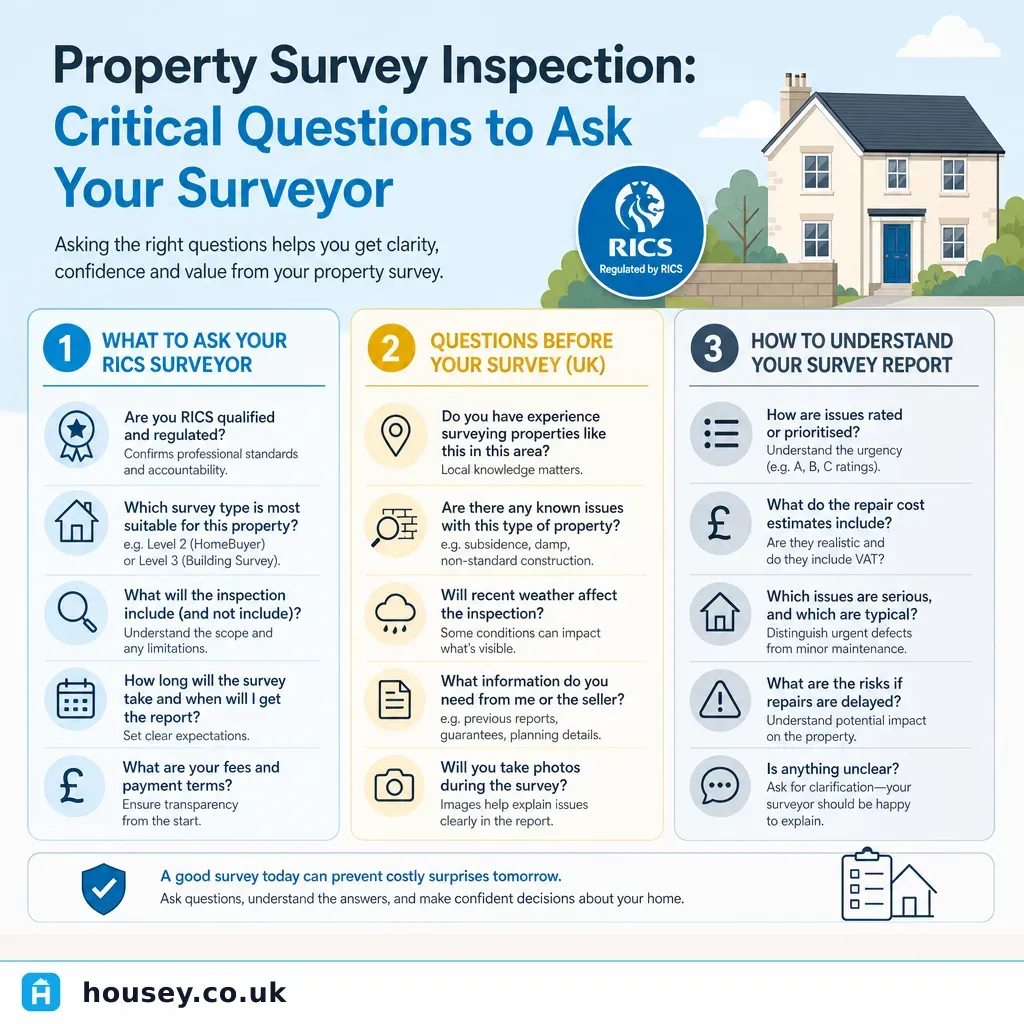
Property Survey Inspection: Critical Questions to Ask Your Surveyor
Before instructing a surveyor, ask which RICS level suits your property and what the report will and will not cover.
 Surveys & Inspections
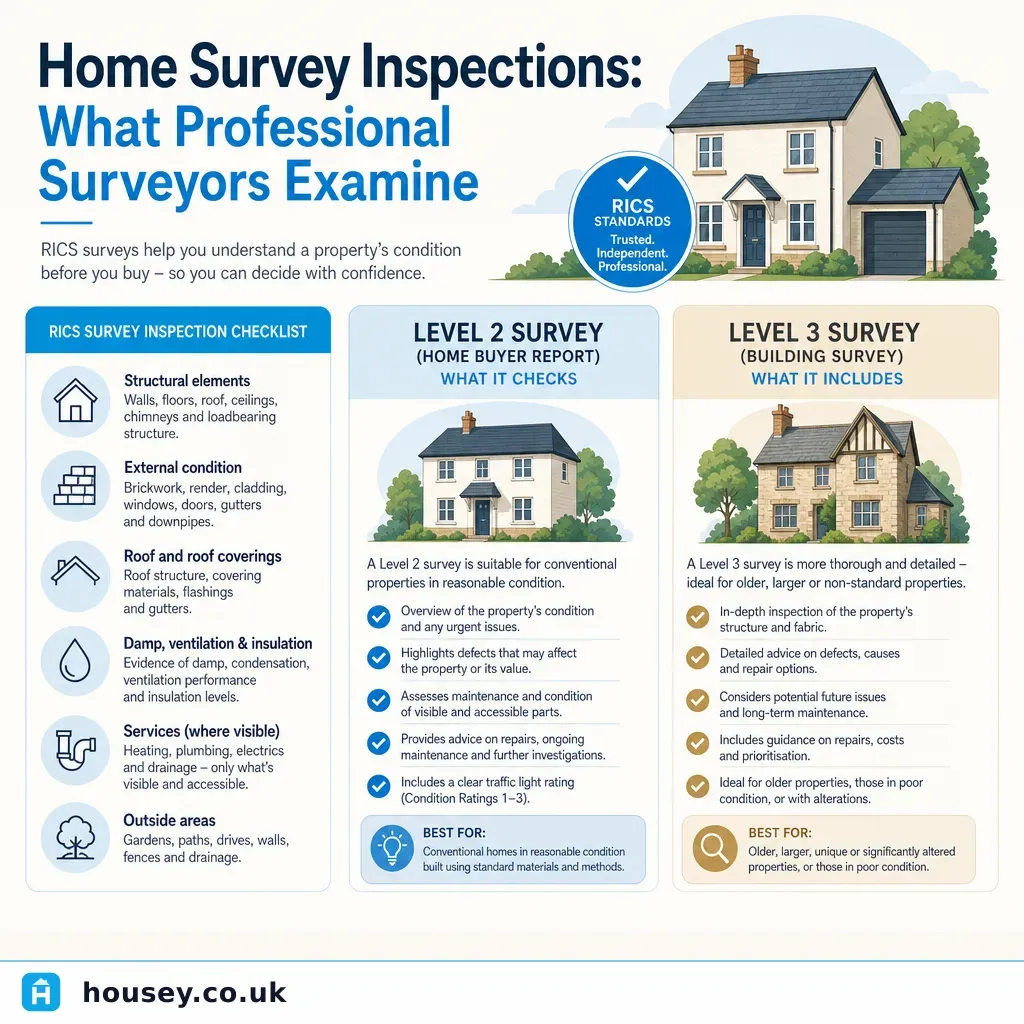
Home Survey Inspections: What Professional Surveyors Examine
A RICS home survey involves a visual inspection of a property's structure, roof, walls, floors, and services.
 Surveys & Inspections
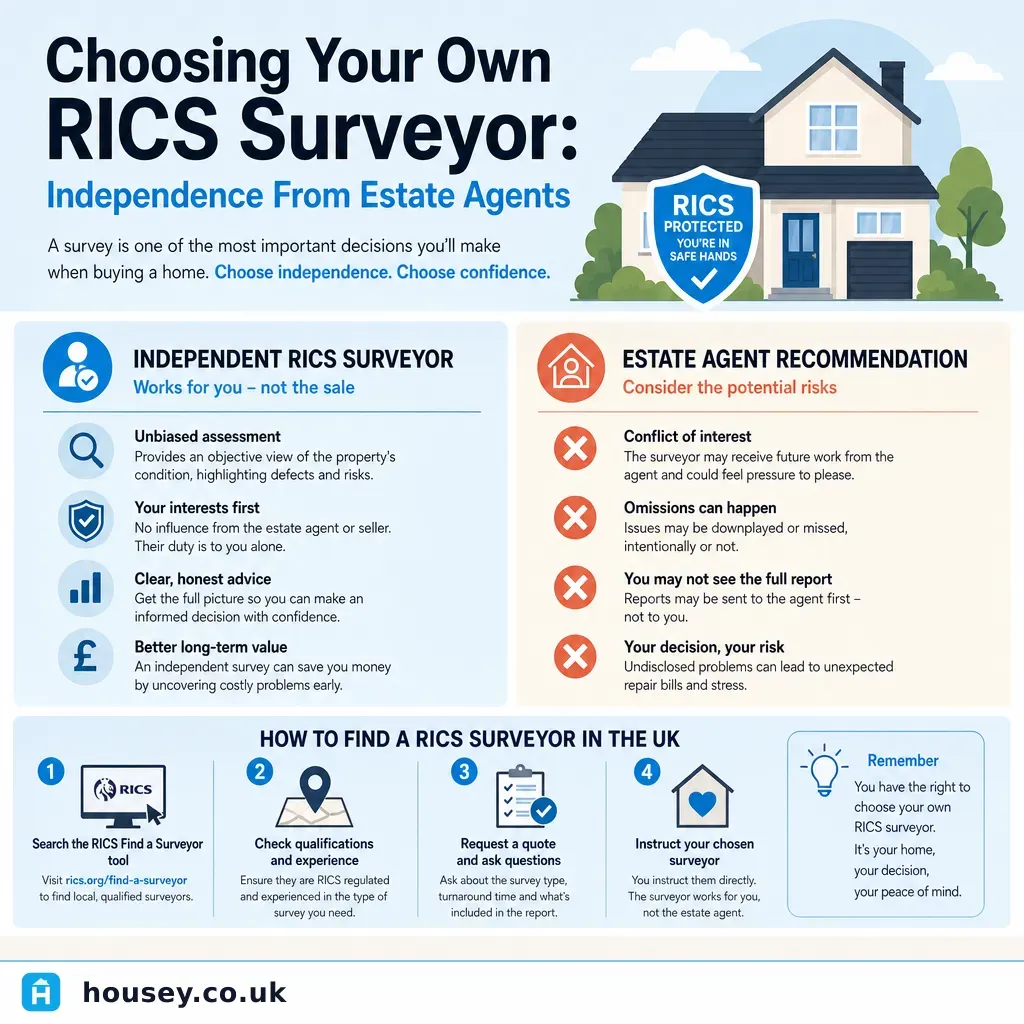
Choosing Your Own RICS Surveyor: Independence From Estate Agents
You have every right to choose your own RICS surveyor independently of your estate agent's recommendation.
 Surveys & Inspections
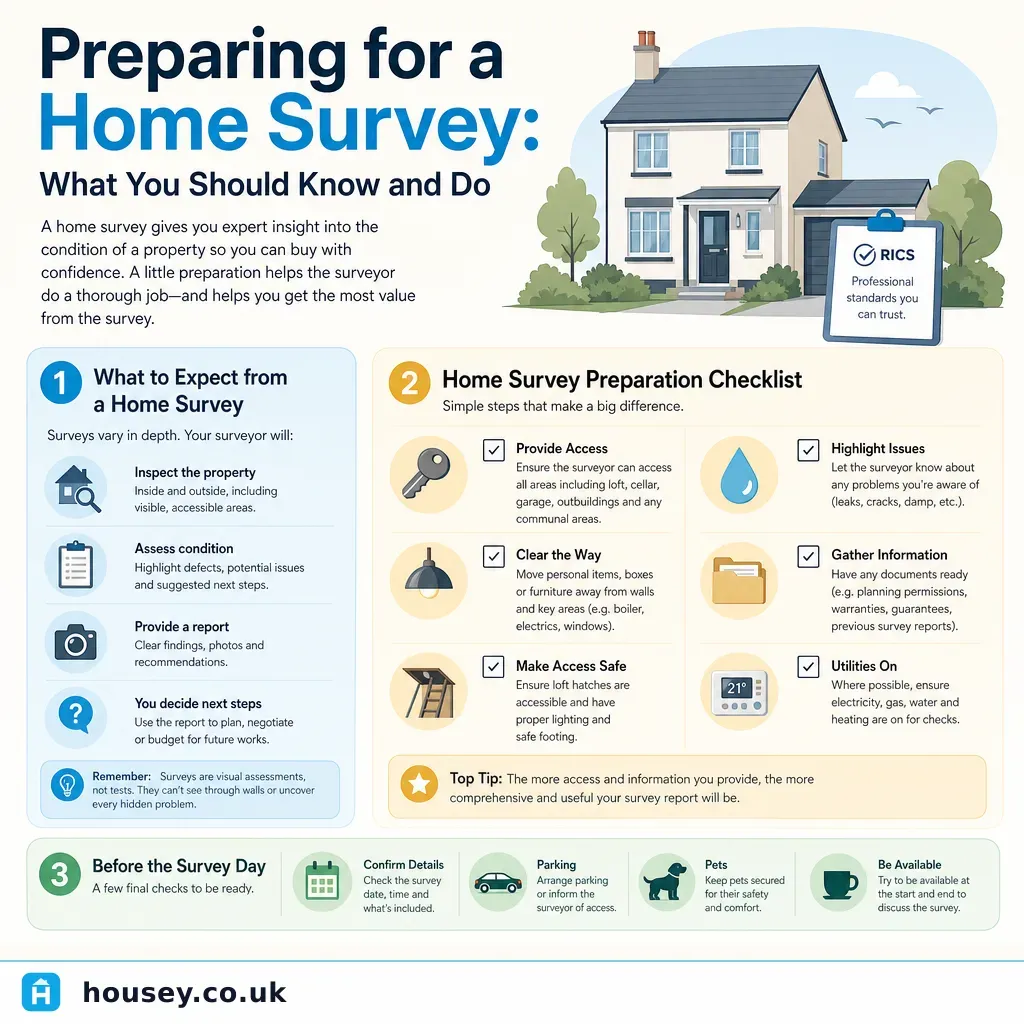
Preparing for a Home Survey: What You Should Know and Do
Preparing for a home survey means giving the surveyor clear access to all parts of the property, gathering relevant documents such as planning permissions and Building Regulations certificates, and knowing in advance which survey level has been instructed.
 Surveys & Inspections
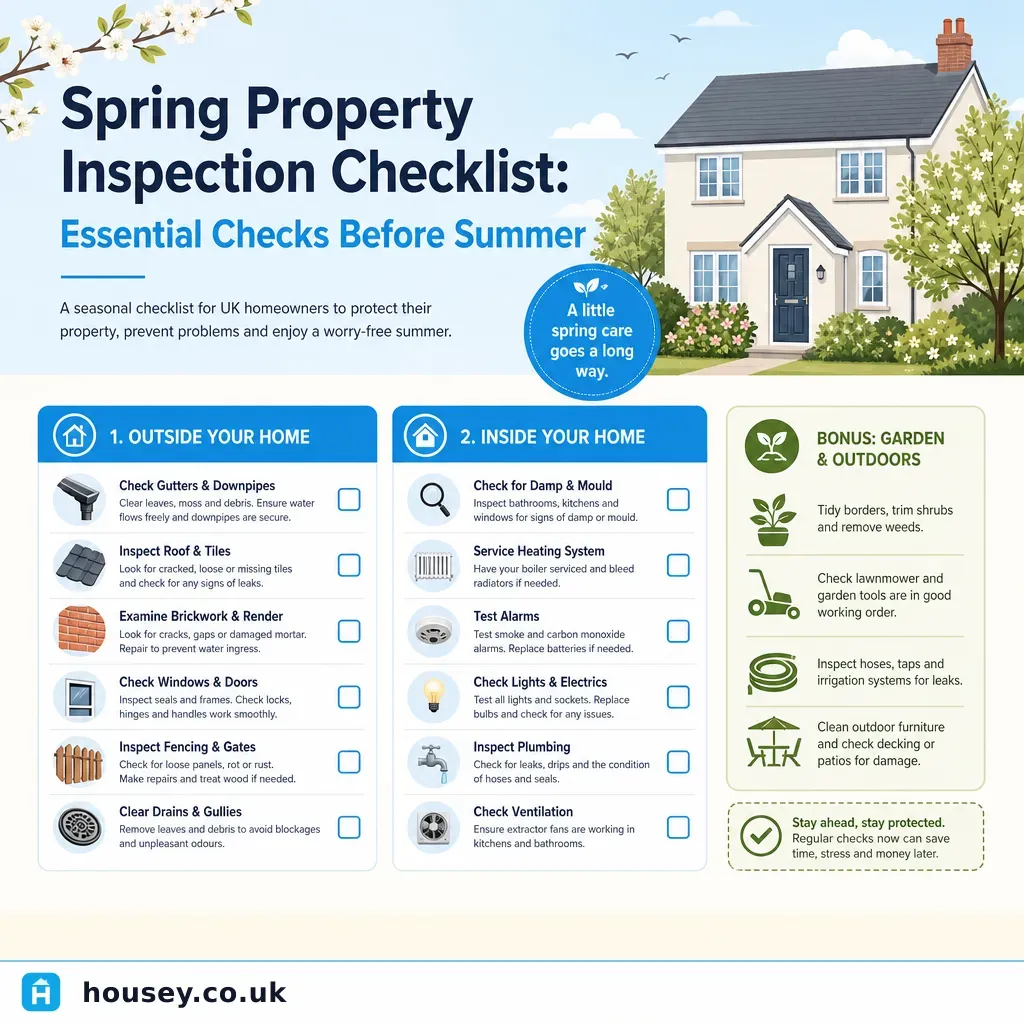
Spring Property Inspection Checklist: Essential Checks Before Summer
Each spring, UK homeowners should check the roof covering, gutters, flashings, drainage, external walls, and window seals for signs of winter damage.