Reality TV and Construction: Examining Authenticity in Building Entertainment
By Housey · Last reviewed 24th of May 2026
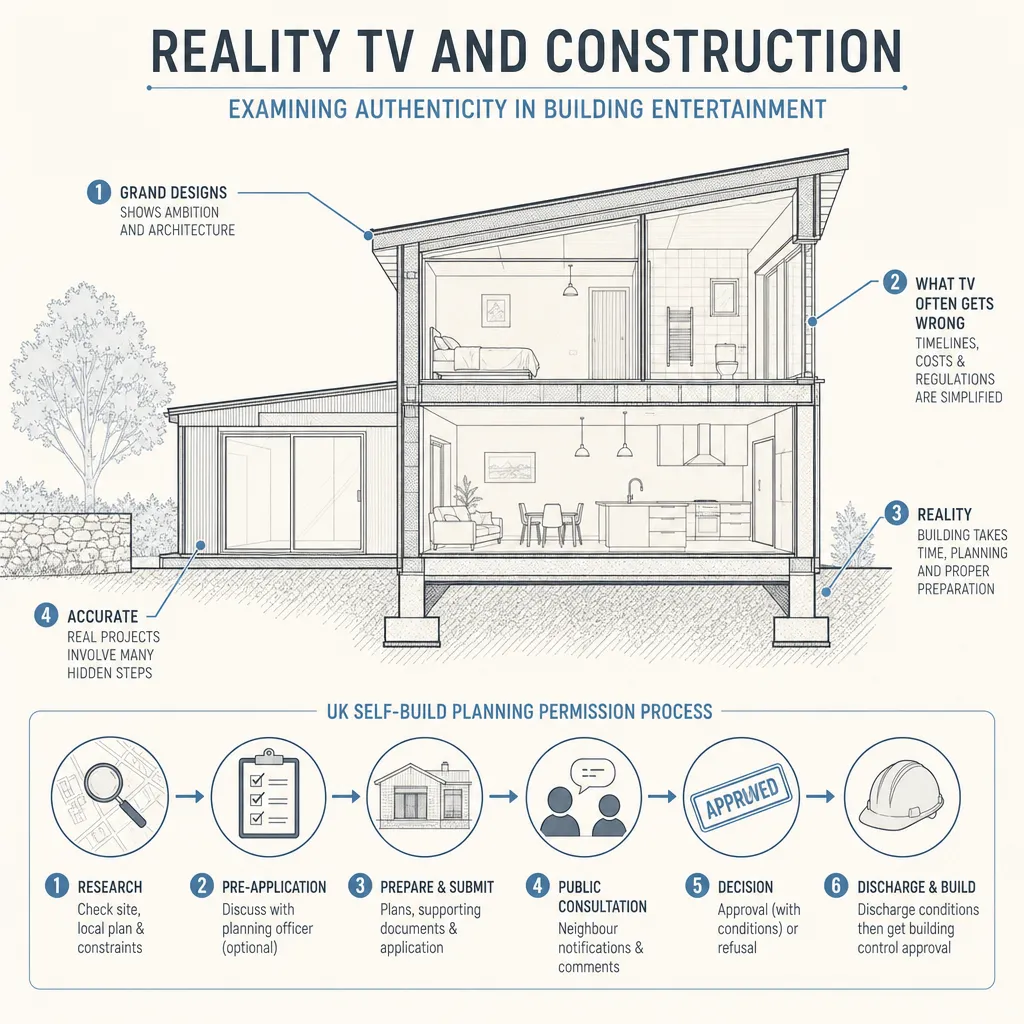
Reality TV and Construction: Examining Authenticity in Building Entertainment
UK television has produced a steady stream of construction and renovation programming — from Grand Designs to DIY SOS and a range of property transformation formats. These programmes attract large audiences and regularly inspire homeowners to consider ambitious self-build, extension, or renovation projects. The gap between what appears on screen and what a real UK building project involves is, however, considerable — and understanding that gap can save homeowners from costly surprises and regulatory difficulties.
Key points
- Grand Designs, first broadcast on Channel 4 in 1999, is the UK's most prominent self-build documentary format; the projects it features typically take 2–5 years from concept to occupation, compressed into 60-minute episodes.
- The Self Build and Custom Housebuilding Act 2015 gives individuals the right to register interest in serviced self-build plots with their local authority — a legal mechanism that construction TV rarely explains.
- Building Regulations approval under Schedule 1 to the Building Regulations 2010 (Parts A–P) is legally required for most structural, drainage, thermal, and fire-related work shown in building programmes.
- Planning permission decisions by local planning authorities under the Town and Country Planning Act 1990 typically take 8 weeks for householder applications and 13 weeks for major applications — statutory processes almost never shown in full on construction TV.
- Regulated work shown on renovation programmes — including gas installation, notifiable electrical work, and structural alterations — must be carried out by qualified professionals in the UK, regardless of what TV appears to suggest.
What does construction reality TV typically show?
Construction reality programmes serve an entertainment function: they compress timelines, dramatise setbacks, and end with a reveal. The format creates a narrative arc that does not reflect the regulatory, contractual, and logistical reality of building in the UK.
The following table compares what television typically portrays against what usually happens on a real UK project:
Aspect | Typical TV portrayal | Typical UK reality |
|---|---|---|
Planning permission | Mentioned briefly or assumed granted at the outset | 8–13 week LPA decision period; potential refusal, appeal, or pre-application discussions |
Building Regulations | Rarely featured; building inspector may appear briefly | Required for structural, drainage, thermal, electrical, and fire elements; inspections at multiple stages |
Timeline | 6–18 months from groundbreak to reveal | Significant self-builds typically take 2–5 years from land purchase to occupation |
Budget overrun | Presented as drama, then resolved | Overruns of 15–30% are common; a contingency of 10–20% is standard professional advice |
Contractor relationship | Single builder or small team, personal relationship | Formal JCT or similar contract; multiple subcontractors; architect or project manager oversight |
Party wall matters | Rarely or never shown | Legally required notice and agreement process under the Party Wall etc. Act 1996 for qualifying works |
Professional roles | Architect prominent; engineer and building control rarely explained | Multiple professionals with distinct legal, regulatory, and technical roles |
Owner DIY | Complex work shown as achievable by non-specialists | Gas, structural, and notifiable electrical work must be carried out by qualified professionals |
What TV gets right — and what it leaves out
Construction programming does capture some genuine aspects of the UK building experience: the stress of weather delays, the challenge of finding reliable contractors, the emotional investment in a project, and the real satisfaction of completion. These are authentic experiences.
What tends to be omitted:
- The full planning process, including pre-application meetings, design revisions to satisfy planners, conservation area or listed building constraints, and the formal consultation period.
- Building control inspection stages: foundation inspections, damp-proof course checks, structural calculations sign-off, and the final completion certificate.
- The role of structural engineers, party wall surveyors, ecologists (where protected species are a concern), and other specialists whose involvement may be legally required on many projects.
- The contractual framework: on most significant projects, a JCT (Joint Contracts Tribunal) contract or similar document governs scope, payment, and dispute resolution.
- Warranties and insurance: structural warranties such as NHBC Buildmark, professional indemnity insurance, and employer's liability coverage for contractors are essential on any substantial build.
What homeowners should not assume after watching building TV
Do not assume projects can be self-managed without professional oversight. Most UK self-build and extension projects require at minimum an architect, a structural engineer, and a building control body. On complex projects, a project manager or employer's agent is advisable.
Do not assume the budget shown is complete. TV budgets routinely omit professional fees, planning and building control application fees, VAT (20% on most new build labour and materials), structural engineer costs, party wall surveyor fees, and legal costs for land purchase.
Do not assume you can carry out regulated work yourself. Gas work must be carried out by a Gas Safe registered engineer. Notifiable electrical work must be completed by a Part P competent person or notified to the local building control body. Structural alterations require building control sign-off based on a structural engineer's calculations.
Do not assume a TV reveal means the project is legally complete. A completion certificate from the building control body is the legal record that work complies with Building Regulations. Without it, you may have difficulty selling the property or obtaining mortgage finance in future.
Do not assume permitted development rights apply automatically. Some external works can proceed without a full planning application, but permitted development rights are restricted in conservation areas, on listed buildings, and in Article 4 Direction areas. Always verify with your local planning authority before starting work.
What construction TV can legitimately teach you
Despite its limitations, construction television offers genuine value to homeowners:
- It illustrates the broad sequence of a construction project, from site clearance through to finishing trades.
- It normalises the experience of setbacks, delays, and revision — useful psychological preparation for anyone embarking on a major project.
- It introduces architectural and design concepts that homeowners might not otherwise encounter.
- It demonstrates the importance of contingency — nearly every project shown runs over budget or time.
- Self-build programmes highlight the Self Build and Custom Housebuilding Act 2015 and the existence of self-build communities, which many viewers are unaware of.
When to get professional help
If a TV programme has inspired you to consider a project, treat it as a starting point rather than a guide. Before committing to significant construction work:
- Speak to a planning consultant or architect about planning permission requirements before purchasing land or committing to a design.
- Commission a structural engineer's preliminary assessment if the project involves any loadbearing alteration, foundation work, or structural extension.
- Take pre-application planning advice from your local planning authority — most offer a paid service that reduces the risk of a costly refusal.
- If self-building, engage a solicitor experienced in plot purchase and self-build mortgage arrangements at an early stage.
How Housey can help
Housey connects UK homeowners with verified local professionals who can help turn television inspiration into a realistic, compliant building project — from initial planning and design advice through to construction on site. Browse Housey's services to find professionals suited to your project type and location.
Frequently asked questions
How accurate is Grand Designs as a guide to self-build in the UK?
Grand Designs captures the emotional arc of self-build authentically, but compresses timelines and underrepresents the regulatory process significantly. Planning permission, building control, structural engineering input, and contractual arrangements are rarely shown in detail. Projects featured also tend to be at the more ambitious and expensive end of the self-build spectrum, which may not reflect a typical homeowner's project.
Do UK TV building programmes show the planning permission process?
Rarely in full. Planning permission is typically mentioned briefly, with episodes beginning after consent has been granted. The pre-application process, design negotiation with planners, and the 8-week statutory decision period are almost never shown in detail. For listed buildings or conservation areas, the process is considerably more complex.
Can I carry out the work shown on renovation TV myself?
Some cosmetic work — painting, tiling, and non-structural joinery — can be completed by a competent homeowner. Gas work, notifiable electrical work, structural alterations, and any work requiring building control sign-off must be done by qualified professionals. Following TV examples without verifying regulatory requirements can result in enforcement action, invalidated insurance, and difficulties at resale.
What is a JCT contract and do I need one for a building project?
A JCT (Joint Contracts Tribunal) contract is a standard form building contract used across UK residential and commercial projects. For significant works — typically where the contract value exceeds £10,000–£20,000 — a formal written contract protects both client and contractor by setting out scope, payment terms, and dispute resolution. Construction TV rarely features the contractual framework, but it is one of the most important protections for any homeowner commissioning building work.
Sources and further reading
- Self Build and Custom Housebuilding Act 2015 — legislation.gov.uk
- Planning permission: overview — GOV.UK
- Building Regulations: overview — GOV.UK
- Party Wall etc. Act 1996: explanatory booklet — GOV.UK
- Gas Safe Register: using a Gas Safe registered engineer — Gas Safe Register
- JCT contracts overview — Joint Contracts Tribunal
Useful next reads
 Improvement & Build
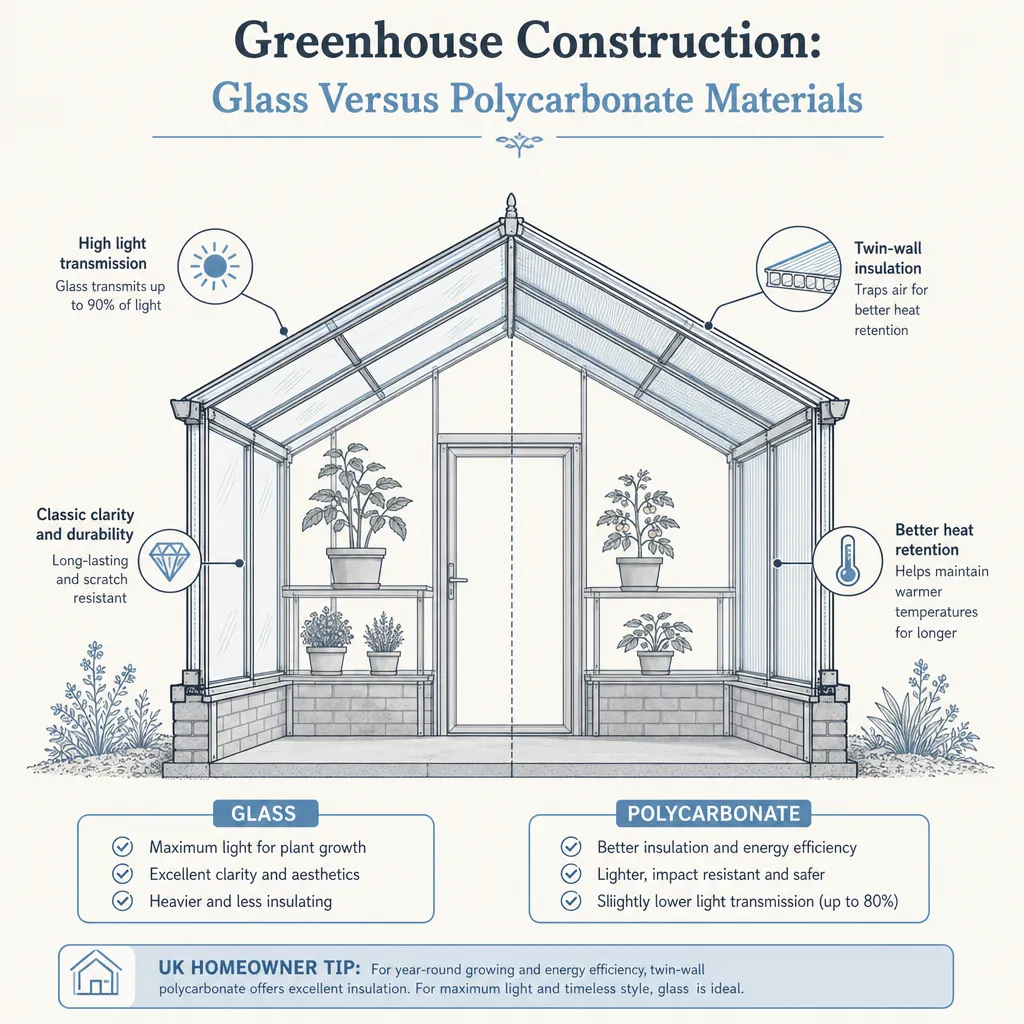
Greenhouse Construction: Glass Versus Polycarbonate Materials
Glass transmits around 90% of available light and lasts indefinitely if unbroken, but insulates poorly and shatters into sharp fragments.
 Improvement & Build
Installing a Fire Pit: Garden Features and Outdoor Space Design
Installing a garden fire pit in the UK is generally permitted, but Smoke Control Area rules prohibit open wood-burning in most towns and cities.
 Improvement & Build
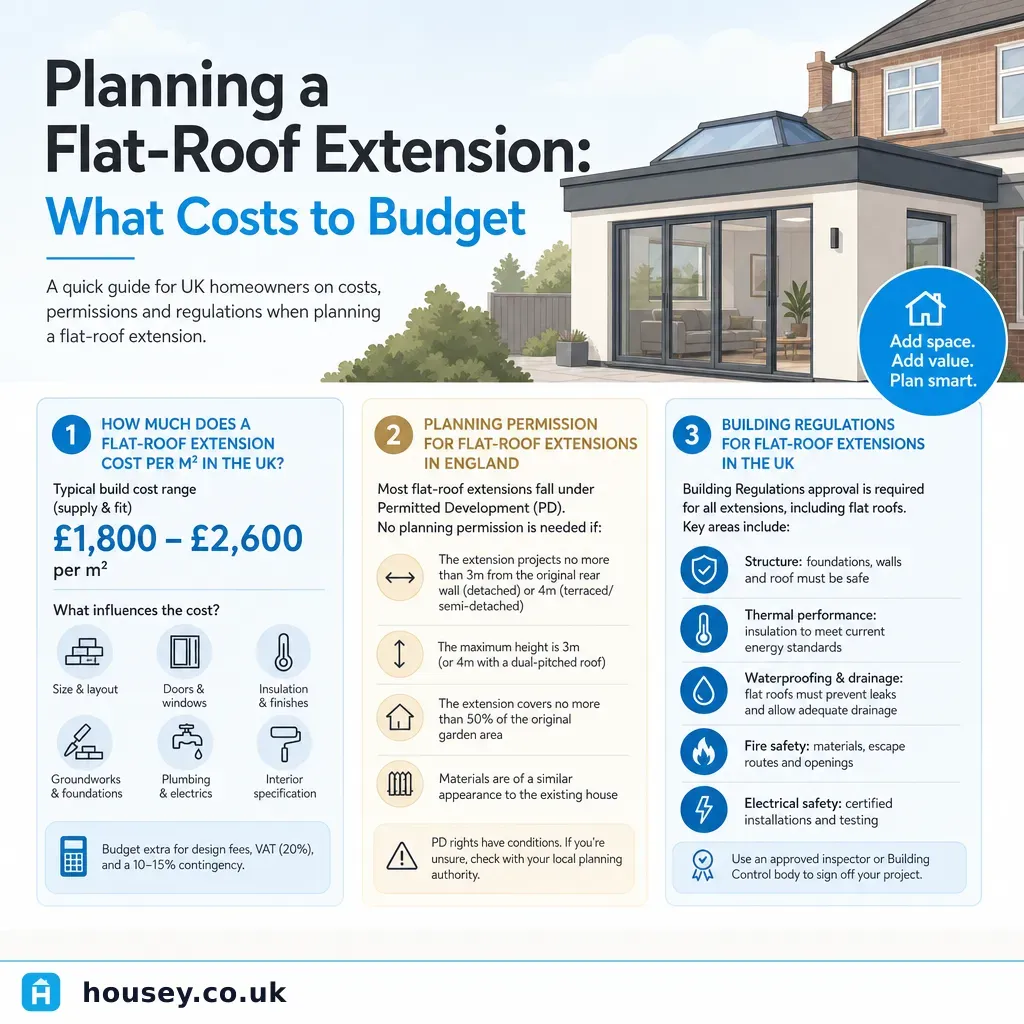
Planning a Flat-Roof Extension: What Costs to Budget
A flat-roof single-storey extension typically costs £1,500–£3,000 per m² in the UK, depending on size, specification, location, and roof membrane choice.
 Improvement & Build
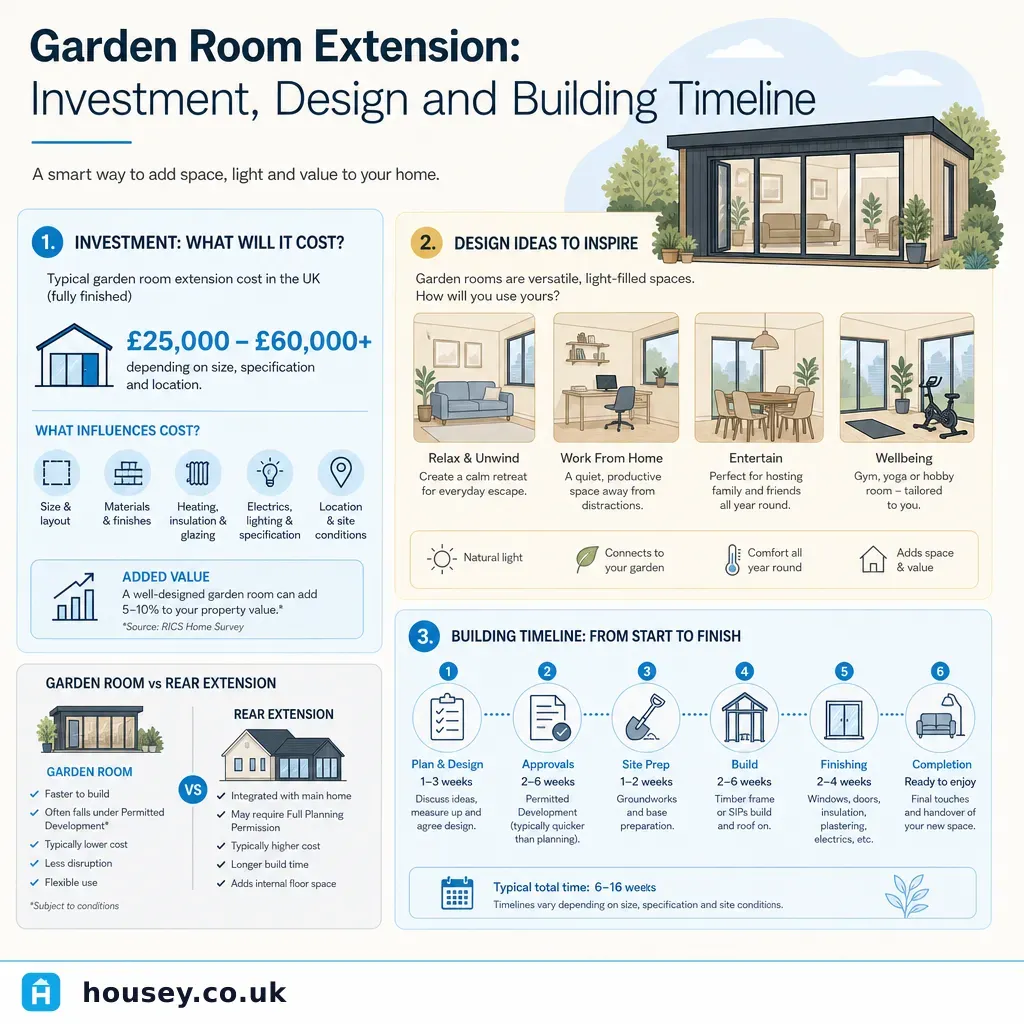
Garden Room Extension: Investment, Design and Building Timeline
A garden room or garden extension can add usable year-round space without always requiring planning permission.
 Improvement & Build
Building and Installing a Firebox: Hearth Construction Guide
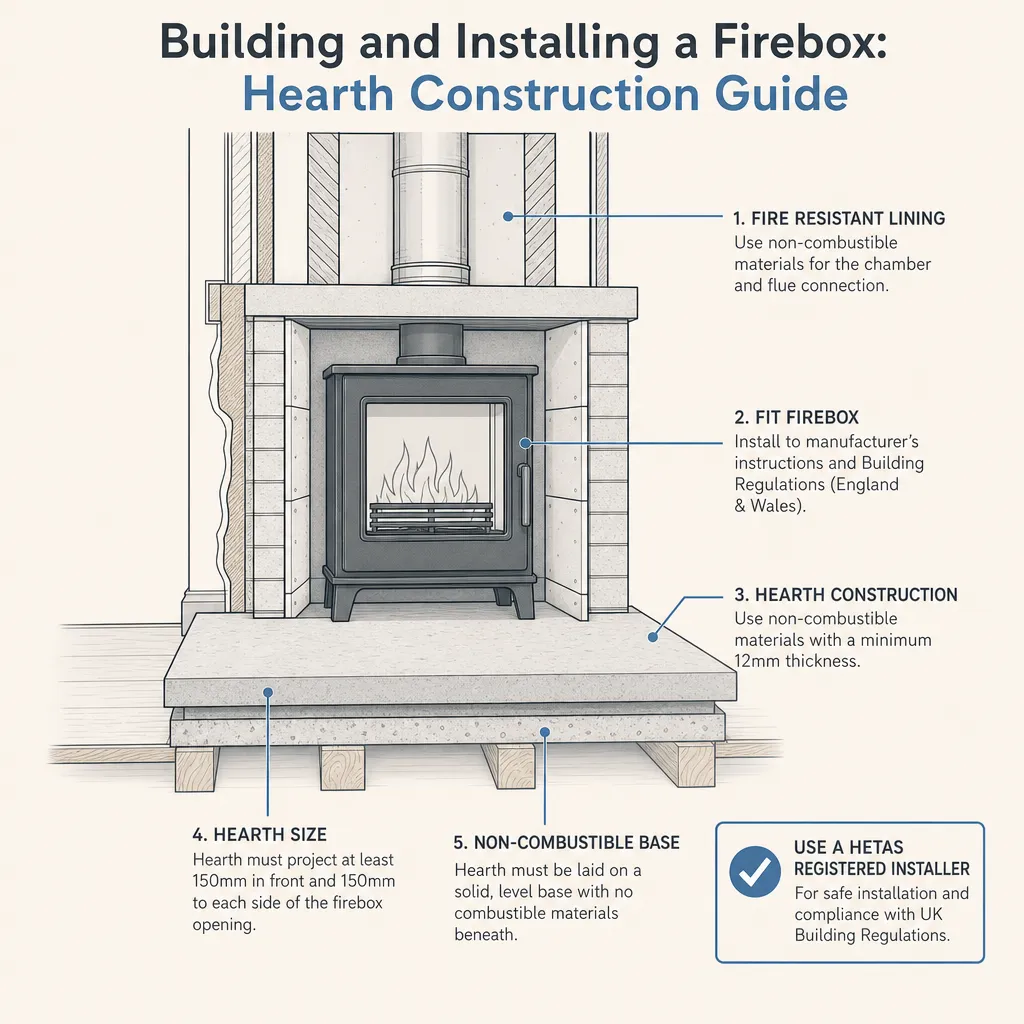
In the UK, any new firebox and hearth must comply with Building Regulations Approved Document J, which sets minimum standards including a 125mm non-combustible hearth and 200mm clearance to combustibles.