Why Your Home Feels Cold and How to Improve Thermal Comfort
By Housey · Last reviewed 1st of June 2026
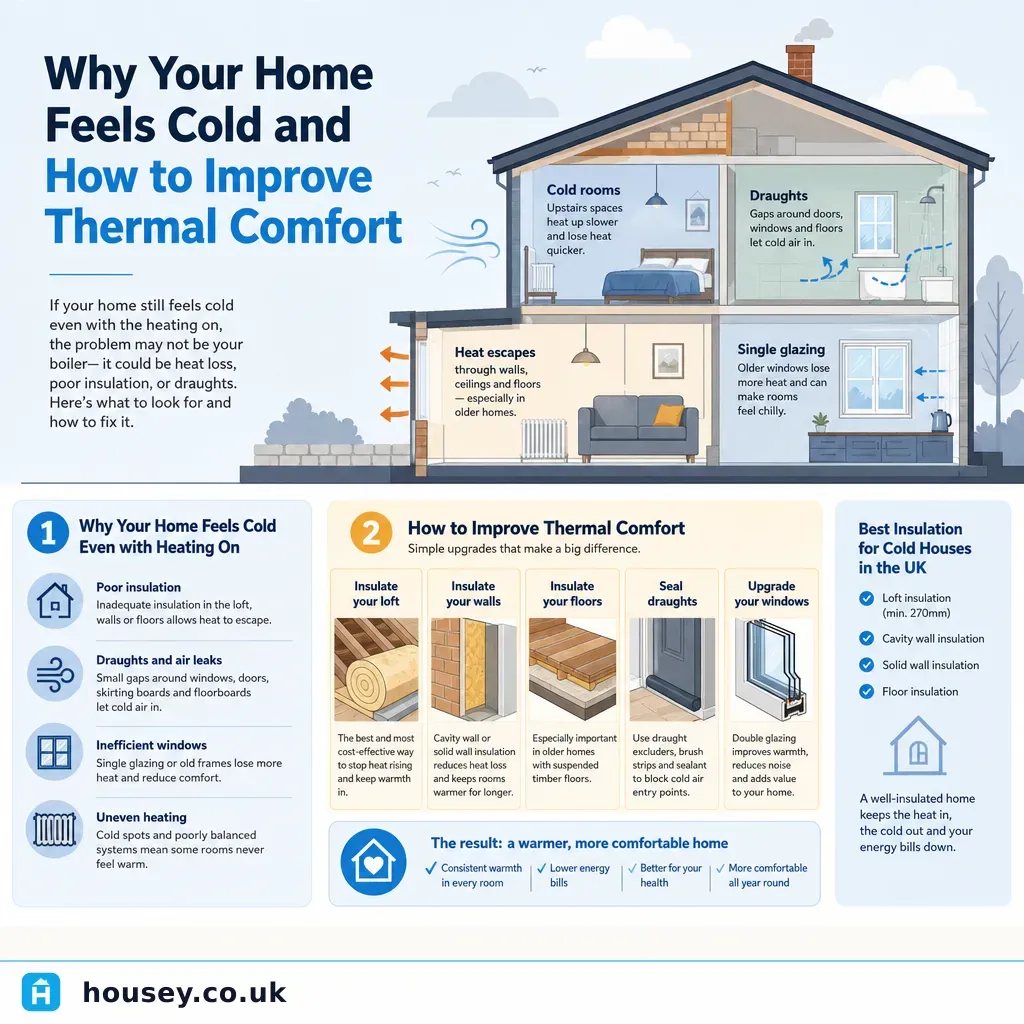
Why Your Home Feels Cold and How to Improve Thermal Comfort
A persistently cold home is among the most common complaints from UK homeowners, yet the cause is frequently misattributed. Many assume the boiler is at fault when, in reality, heat is escaping faster than the system can replace it. The issue typically comes down to the building fabric — walls, roof, floors, and windows — combined with uncontrolled air leakage, and understanding which factor is dominant makes the difference between an effective fix and wasted expenditure.
Key points
- Uninsulated solid walls, common in pre-1920 UK homes, can account for up to 45% of total heat loss, according to the Energy Saving Trust.
- Homes without loft insulation can lose up to 25% of heat through the roof; the recommended minimum installed depth for mineral wool is 270 mm under Building Regulations Part L.
- Draughts through gaps around doors, skirting boards, floorboards, and pipe penetrations can account for 15–25% of heat loss in older UK homes and are often the cheapest issue to address.
- EPC ratings (A–G) reflect the thermal performance of the building fabric; an EPC assessment identifies the measures likely to have the greatest energy impact on your specific property.
- Thermal bridging at wall junctions, window reveals, and floor edges can cause persistent cold spots and may lead to localised condensation and mould growth if not addressed.
Why does my home feel cold even with the heating on?
A home that feels cold despite the heating running is almost always losing warmth faster than it is being generated. The causes fall into three broad groups:
Building fabric — walls, floors, roof, and glazing that conduct heat outward.
Uncontrolled air leakage — gaps and cracks through which warm air escapes and cold air infiltrates.
Heating system performance — a boiler, heat pump, or radiator circuit that is not distributing heat efficiently or evenly.
Deciding where to look first
- Suspect building fabric if rooms are consistently cold regardless of how long the heating runs, or if the property is pre-1930 with solid walls, single glazing, or little to no loft insulation.
- Suspect air leakage if there are noticeable draughts near windows, doors, skirting boards, or the loft hatch, or if some rooms feel damp and stuffy while others are cold.
- Suspect the heating system if some rooms are warm while others remain cold, radiators are warm at the bottom but cold at the top (indicating air locks), the boiler short-cycles frequently, or the system is over 15 years old.
- Ask an energy-efficiency consultant if the property has multiple issues or you are planning significant upgrades — a whole-house assessment is the most reliable way to prioritise measures by impact and cost.
The most common sources of heat loss in UK homes
Walls
Cavity walls (typically post-1920 construction) can be insulated by injecting mineral fibre, polystyrene bead, or foam — usually within a day with minimal disruption. Solid walls (pre-1920 brick or stone) require either external wall insulation (EWI) or internal wall insulation (IWI), both more disruptive and costly, but capable of reducing wall heat loss substantially. Solid-wall insulation should always be specified by a qualified assessor to avoid moisture and ventilation problems.
Roof and loft
An uninsulated loft is one of the most straightforward and cost-effective fixes available. At 270 mm depth, mineral wool loft insulation meets Part L requirements and may be eligible for ECO4 and Great British Insulation Scheme (GBIS) funding for qualifying households. Rooms-in-the-roof and flat roofs require different approaches and professional specification.
Floors
Suspended timber ground floors are often draughty if boards or skirting boards are unsealed. Sealing gaps is low-cost and effective. Solid concrete floors can have rigid insulation installed above, though this adds floor height and may require skirting and door adjustments. Ground-floor heat loss is often overlooked relative to its contribution to overall discomfort.
Windows and glazing
Single-glazed windows have a U-value of around 5.0 W/m²K — roughly four to five times less efficient than a modern double-glazed unit (typically 1.2–1.6 W/m²K). Secondary glazing offers a lower-cost improvement and is often acceptable in conservation areas where replacement windows may require planning consent. Replacement windows and doors must comply with Building Regulations Part L and, in most cases, be installed by a FENSA-registered contractor or notified to building control.
Thermal bridging
Cold spots on internal wall surfaces — particularly at corners, window reveals, and floor junctions — often indicate thermal bridges, where heat bypasses the insulation layer. These can cause localised condensation and mould growth and are difficult to diagnose accurately without a professional assessment such as a thermographic survey.
Room-by-room heat loss checklist
Work through this checklist before consulting a professional to identify the highest-priority areas.
Living room and bedrooms
Kitchen and bathrooms
Loft hatch and stair area
Floors and skirting boards
What a professional heat loss assessment involves
When the source of heat loss is unclear or the property has multiple problems, a professional assessment goes significantly further than a visual inspection.
Assessment type | What it reveals | Typical output |
|---|---|---|
EPC assessment | Overall energy-efficiency rating based on standard assumptions | EPC certificate with improvement recommendations |
Thermographic survey | Heat loss patterns, cold bridges, and moisture ingress visible as infrared images | Detailed report identifying fabric defects and priority areas |
Air pressure test (blower door test) | Actual air leakage rate in m³/h.m² | Quantified leakage figure to guide draught-proofing priority |
Retrofit assessment (PAS 2035) | Full building fabric and systems analysis; mandatory for ECO4 and GBIS works | Medium-term improvement plan with costings and measure sequencing |
A thermographic survey is particularly useful in older or unusual properties where the source of heat loss is not visually obvious. A professional insulation assessment is recommended before committing to significant fabric upgrades such as solid wall insulation.
Grant funding to support improvements
Several government schemes may offset the cost of insulation and heating upgrades:
- ECO4 (Energy Company Obligation): funded improvements for lower-income households or those in energy-inefficient homes. Access via your energy supplier or local authority flexible eligibility route.
- Great British Insulation Scheme (GBIS): targets homes with EPC ratings D–G; covers loft and cavity wall insulation for eligible households.
- Boiler Upgrade Scheme (BUS): £7,500 towards the installed cost of an air source heat pump for eligible properties. If you are considering a heat pump, a heat pump survey can confirm whether your home's fabric and heating system are ready.
Eligibility criteria and funding levels can change; check GOV.UK for current scheme status before making any financial commitments.
When to get professional help
Draught-proofing and loft insulation top-ups are within reach of most homeowners. Seek professional advice if:
- There are persistent cold spots on internal walls or ceilings, particularly near window reveals or room corners — these may indicate thermal bridging or a hidden moisture problem.
- You are considering solid wall insulation (internal or external) — incorrect specification can cause condensation, mould, and structural damage. A retrofit assessment under PAS 2035 is strongly recommended.
- You have had a previous insulation retrofit and are now experiencing new damp problems — an insulation assessment should be carried out before any further intervention.
- You are in a listed building or conservation area — some insulation and glazing improvements require listed building consent or planning permission.
- You are planning to install a heat pump — building fabric adequacy should be confirmed by a qualified assessor before installation to avoid an undersized or oversized system.
How Housey can help
If your home feels persistently cold and you want to understand why, Housey can connect you with energy-efficiency consultants who carry out whole-house assessments and prioritise improvements by cost-effectiveness. For a more precise thermal diagnosis, our thermographic survey specialists use infrared imaging to show exactly where your home is losing heat.
Frequently asked questions
Why does my house feel cold even with the heating on?
The most common reason is that heat is leaving through the building fabric — walls, roof, floor, or single glazing — faster than the heating system replaces it. Poor radiator distribution, an ageing boiler, or uncontrolled draughts can compound the problem. A systematic room-by-room check for cold spots, draughts, and radiator performance usually points to the main cause.
What is the cheapest way to make my home warmer?
Draught-proofing is usually the most cost-effective starting point. Sealing gaps around doors, windows, floorboards, skirting boards, and pipe penetrations can be done for £100–£300 and has an immediate effect. Loft insulation is the next most impactful measure for most UK homes, and may be partially or fully funded through ECO4 or the Great British Insulation Scheme if you qualify.
Does cavity wall insulation cause damp?
Cavity wall insulation does not inherently cause damp, but should not be installed where the cavity is defective — for example, where wall ties are corroded, the cavity is already bridged, or the outer leaf has significant cracking. A pre-installation cavity wall survey is important. Use a TrustMark or CHAS-accredited installer and confirm wall suitability before proceeding.
What is a thermographic survey and do I need one?
A thermographic survey uses an infrared camera to detect heat escaping through the building fabric. It reveals cold bridges, areas of missing or degraded insulation, and air leakage points invisible to the naked eye. It is most useful in older or unusual properties where the source of heat loss is unclear. Surveys are best conducted in winter, when the temperature difference between inside and outside is greatest.
Sources and further reading
- Insulation: loft, cavity wall and solid wall — Energy Saving Trust
- Improving home energy efficiency — GOV.UK
- ECO4 scheme: how it works — GOV.UK
- Approved Document L: Conservation of Fuel and Power — GOV.UK / Planning Portal
- PAS 2035: Retrofitting dwellings for improved energy efficiency — BSI Group
Useful next reads
 Energy & Retrofit
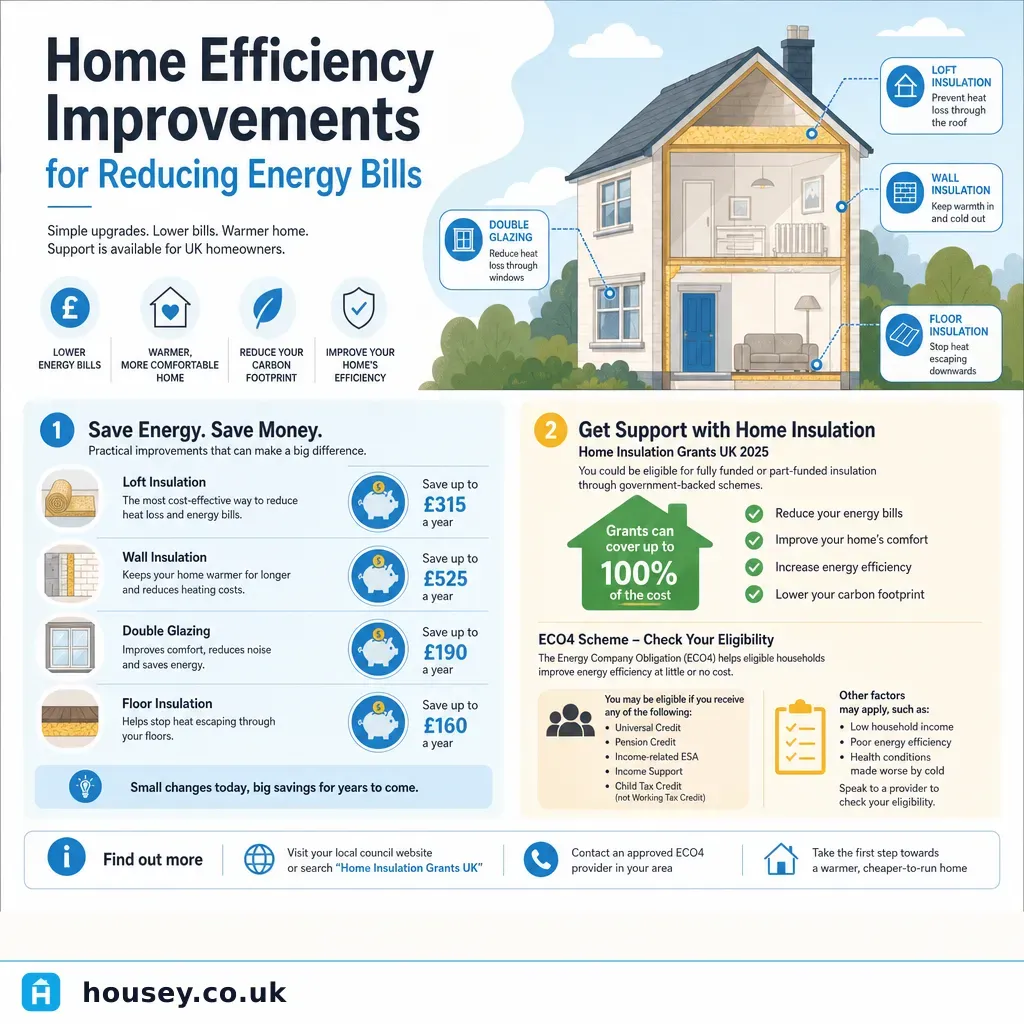
Home Efficiency Improvements for Reducing Energy Bills
The most cost-effective UK home efficiency improvements are usually loft insulation, cavity wall insulation, draught-proofing, and upgrading heating controls.
 Energy & Retrofit
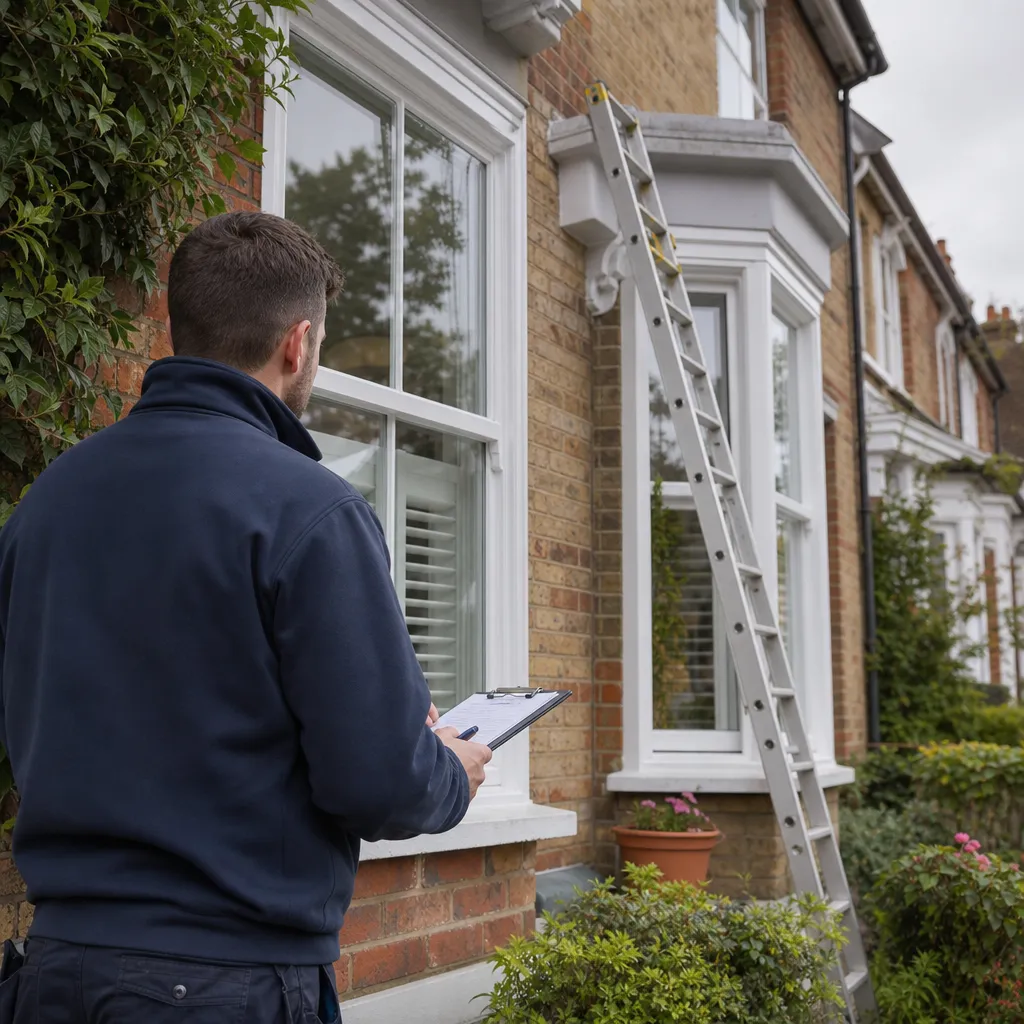
Practical Energy Saving Tips for Homeowners
Most UK households can meaningfully reduce their energy bills by making targeted changes: lowering the thermostat by 1°C, switching to LED lighting, and draught-proofing doors and windows.
 Energy & Retrofit
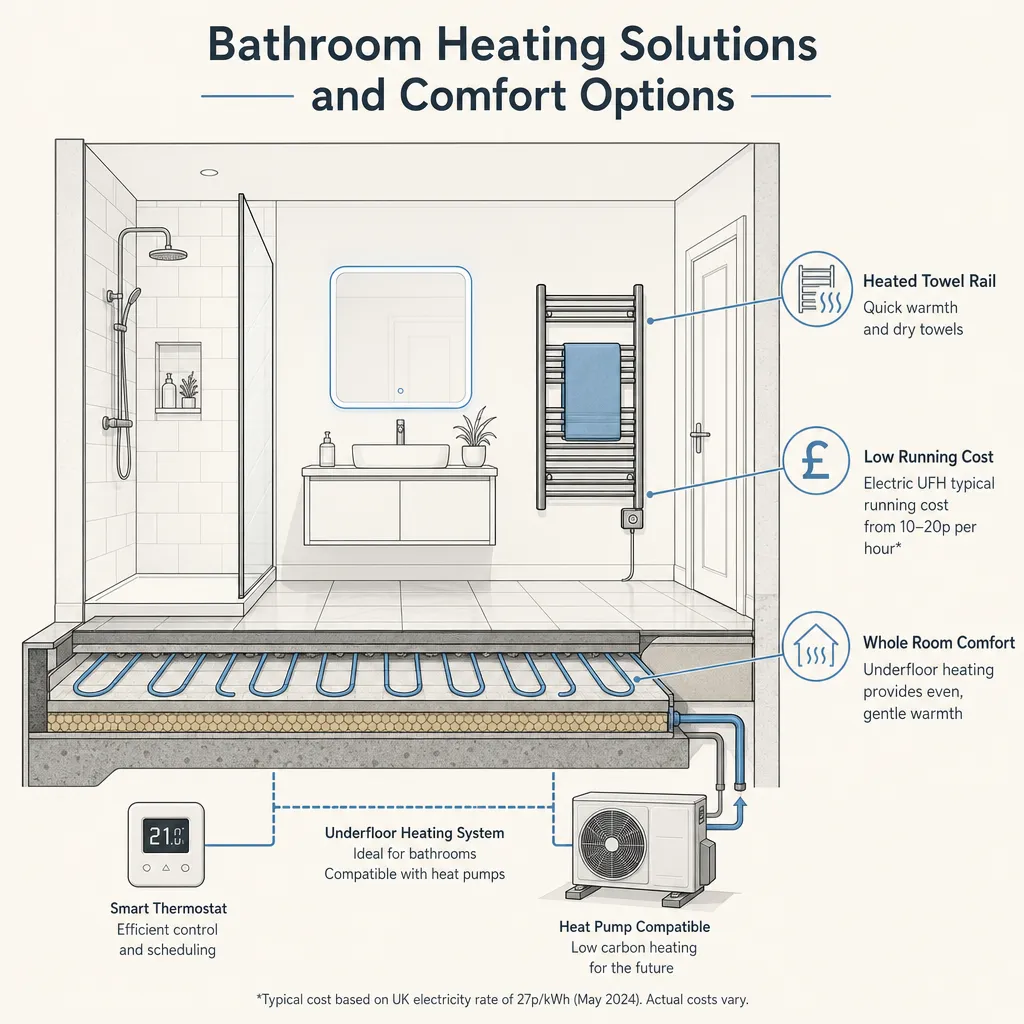
Bathroom Heating Solutions and Comfort Options
UK bathrooms can be heated using electric towel rails, wet radiators on the central heating circuit, electric or wet underfloor heating, or infrared panels.
 Energy & Retrofit
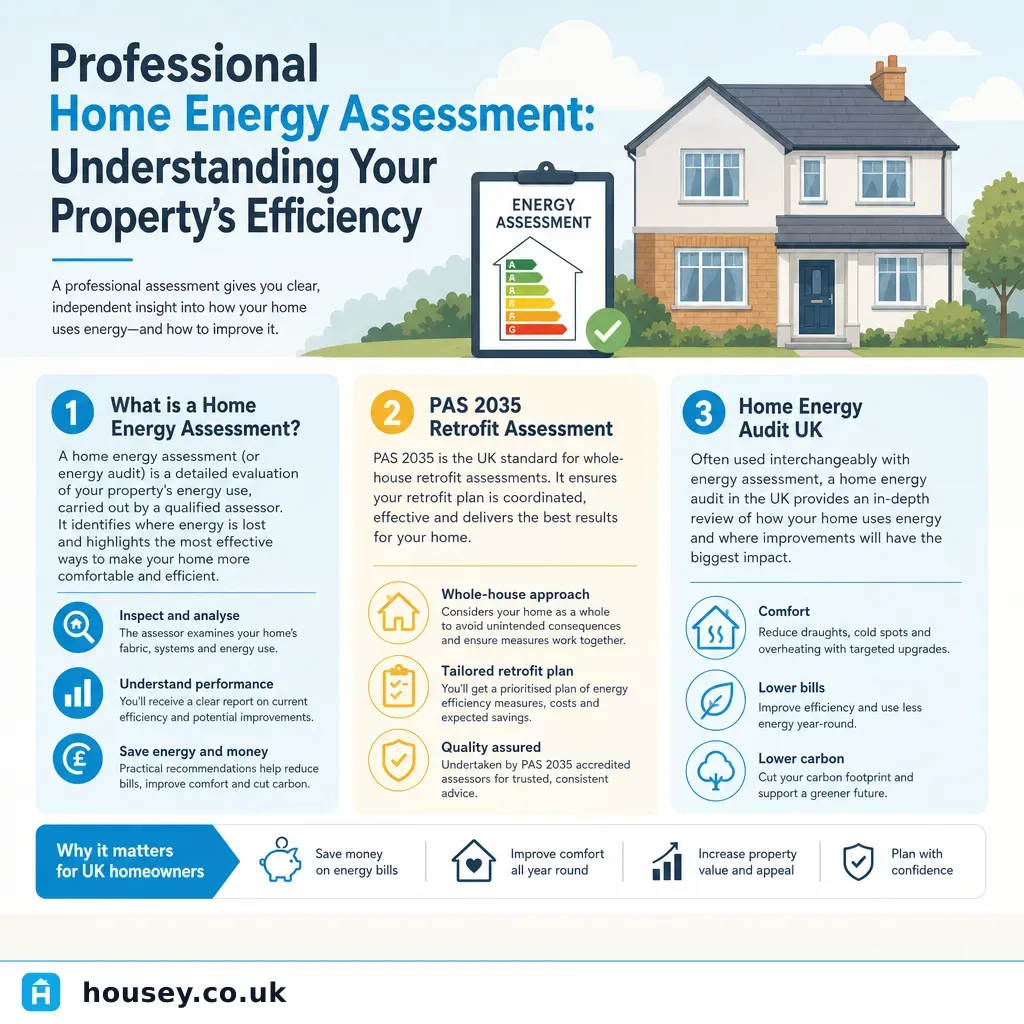
Professional Home Energy Assessment: Understanding Your Property's Efficiency
A professional home energy assessment goes beyond an EPC to evaluate how your property loses heat, where insulation is inadequate, and what improvements should be made in what order.
 Energy & Retrofit
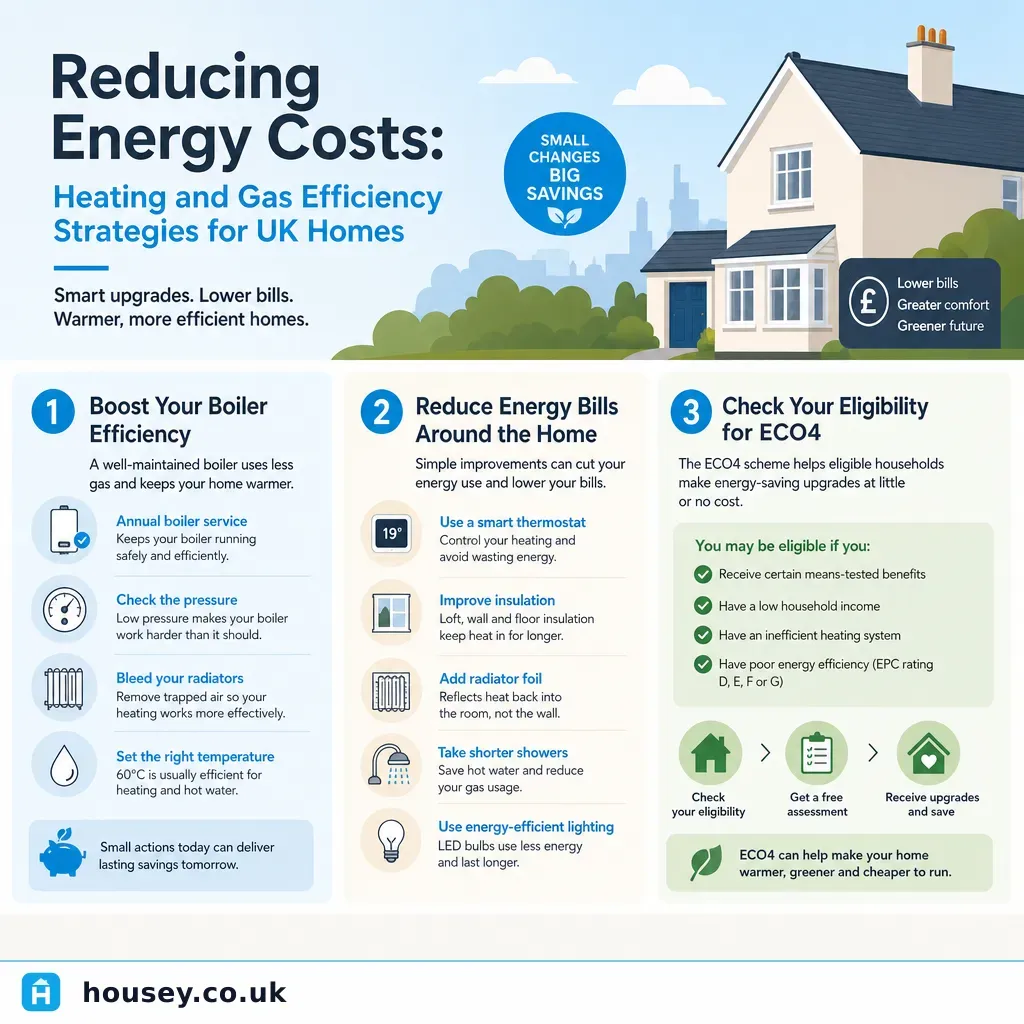
Reducing Energy Costs: Heating and Gas Efficiency Strategies for UK Homes
Most UK households spend around 55–60% of their energy bill on heating.