Reducing Energy Costs: Practical Strategies for Your Home
By Housey · Last reviewed 19th of May 2026
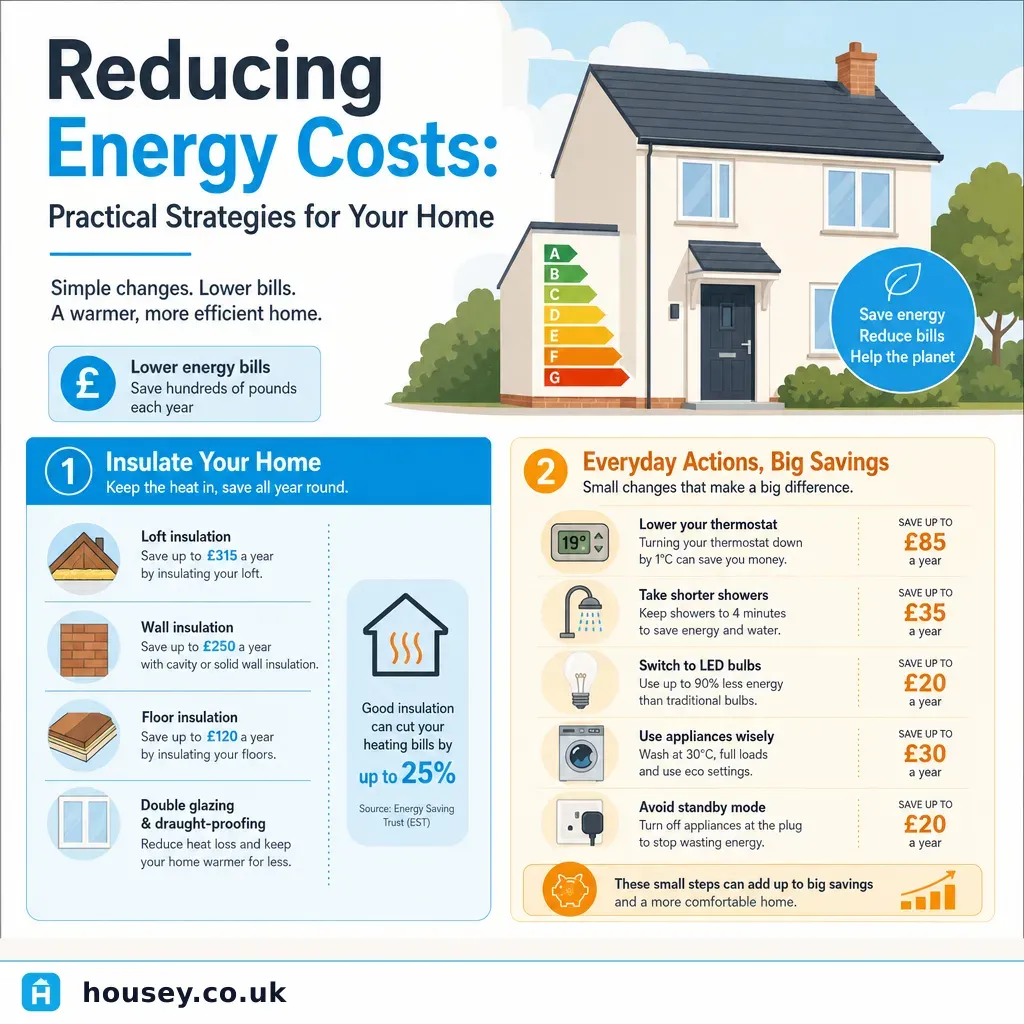
Reducing Energy Costs: Practical Strategies for Your Home
Energy bills have climbed sharply in recent years, making home efficiency improvements more financially worthwhile than at any point in the past decade. Whether you own a Victorian terrace, a 1930s semi, or a 1990s estate house, understanding which measures will deliver the best return for your specific property type helps you prioritise spending and sidestep costly mistakes.
Key points
- Loft insulation to 270mm depth can reduce heat loss through the roof by up to 25%, with payback periods typically under three years for most homes (Energy Saving Trust).
- The ECO4 scheme (Energy Company Obligation 4) provides fully funded insulation and heating upgrades for eligible low-income or fuel-poor households — check eligibility via GOV.UK.
- A smart thermostat combined with thermostatic radiator valves (TRVs) can reduce heating bills by around 10–15%, according to Energy Saving Trust estimates.
- Cavity wall insulation can save approximately £150–£300 per year in a typical semi-detached home; solid-wall external insulation can save more but costs significantly more to install. Indicative UK costs, last reviewed 2026-05-19.
- PAS 2035 is the British Standard governing whole-house retrofit; for homes receiving certain funded works, a qualified Retrofit Coordinator must oversee the project to manage moisture and ventilation risks.
Low-cost measures: the fastest wins
Before committing to major insulation or heating upgrades, address simple measures that cost very little and deliver fast returns:
- Draft-proofing doors, windows, letterboxes, and loft hatches typically costs £10–£50 in materials and repays the investment within a year.
- Insulating a hot water cylinder jacket costs around £20–£30 and can save £35–£55 per year (Energy Saving Trust).
- Switching to LED lighting throughout the home costs £2–£5 per bulb and uses roughly 75% less energy than incandescent bulbs.
- Reducing standby loads — using smart plugs or switching devices off at the wall — contributes a modest but consistent saving year-round.
These steps require no professional assessment and carry no structural or moisture risk.
Heating: where most of your energy bill is spent
In a typical UK home, space and water heating accounts for around 80% of energy use (Department for Energy Security and Net Zero). Reducing this is where the biggest savings lie.
Reducing your thermostat set-point by just 1°C can cut heating costs by around 10%. Smart thermostats allow zone-based scheduling and remote control, and many are compatible with heat pumps and solar thermal systems as well as conventional gas boilers.
Annual boiler servicing by a Gas Safe registered engineer keeps your heating system running efficiently and is a safety as well as cost measure. An unserviced boiler may run 10–15% less efficiently than a well-maintained one.
Insulation: the most impactful long-term investment
Measure | Typical annual saving (semi-detached) | Indicative installed cost | Best for | Key risk if wrong |
|---|---|---|---|---|
Loft insulation (270mm) | £150–£250 | £300–£500 | Most homes with accessible loft | Blocking eaves ventilation → condensation |
Cavity wall insulation | £150–£300 | £500–£1,500 | Cavity-wall homes (typically 1930s–1990s) | Unsuitable cavity → damp penetration |
Solid wall (external) | £250–£450 | £7,000–£15,000+ | Pre-1920 solid-brick homes | Planning restrictions on some properties |
Floor insulation | £50–£100 | £500–£2,000 | Suspended timber ground floors | Disruption to floor finish; ventilation impact |
Double/triple glazing | £80–£150 | £3,000–£8,000 | Draughty single-glazed homes | Condensation if ventilation not maintained |
Indicative UK costs and savings, last reviewed 2026-05-19. Figures vary by property size, location, and specification. Obtain at least three quotes before proceeding.
Cavity wall insulation is worth assessing carefully before committing. An installer or surveyor should confirm that the cavity is clean, of adequate width, and free from signs of damp bridging. Properties in wetter, exposed coastal areas may not be suitable.
Grants and funding in 2026
Several routes exist for UK homeowners to access subsidised or fully funded energy improvements:
- ECO4 (Energy Company Obligation 4): Fully funded insulation and heating upgrades for eligible households. Eligibility is income-based or linked to specific benefits. Apply through your energy supplier or check GOV.UK.
- Great British Insulation Scheme (GBIS): Partially funded single insulation measures for a broader range of households than ECO4. Delivered through energy suppliers.
- Boiler Upgrade Scheme (BUS): £7,500 grant towards an air source heat pump or ground source heat pump. Installation must be by an MCS-certified installer. Check GOV.UK for current terms.
- Local authority schemes: Many councils operate additional top-up funding. Check your local authority website for current availability.
Funding schemes change frequently. Always verify current eligibility and terms on GOV.UK or with your energy supplier before committing to works.
What not to assume
- "My home is already well insulated." Many homes built before 1995 have loft insulation below the recommended 270mm even if some is present. Check the actual depth with a tape measure before ruling out a top-up.
- "Cavity wall insulation suits every home." Properties with a history of damp, narrow or contaminated cavities, or solid-wall construction are not suitable. An insulation assessment will confirm suitability before any works are instructed.
- "A heat pump will automatically cut my bills." A heat pump performs best in a well-insulated home. Installing one without first improving insulation may increase bills rather than reduce them. Sizing requires specialist assessment.
- "Smart meters save energy by themselves." A smart meter provides accurate data but does not change energy use. The saving comes from the behaviour change the visibility enables.
- "Replacing the boiler is always the best first step." Insulating the home first usually reduces the size of heating system required and maximises the return on any new boiler or heat pump.
Homeowner energy-saving checklist
When to get professional help
Most low-cost behavioural and draught-proofing measures can be addressed without professional guidance. Consult a qualified professional if:
- You are considering cavity wall insulation and are unsure of your property's suitability — incorrect installation can cause damp penetration and structural damage
- You are considering solid-wall external or internal insulation — moisture management and vapour control require specialist knowledge under PAS 2035
- You want to retrofit a heat pump — sizing, system design, and distribution integration require a qualified assessor; a heat pump survey will establish whether your home is suitable and what system specification is needed
- Your home has persistent condensation, damp, or mould — additional insulation without addressing the root cause can worsen moisture problems significantly
- You are applying for funded works under ECO4 or similar schemes — PAS 2035-compliant oversight by a Retrofit Coordinator is required for most funded whole-house retrofit projects
How Housey can help
Housey connects you with vetted professionals for every stage of a home energy project. Whether you need an insulation assessment to confirm cavity-wall suitability, a retrofit assessment to plan a whole-house upgrade under PAS 2035, or an energy-efficiency consultant to help you prioritise the right measures for your property type and budget, you can compare quotes from local specialists through Housey.
Frequently asked questions
How much can I realistically save on energy bills through home improvements?
Savings depend on your starting point and which measures you install. A poorly insulated pre-1950 solid-wall home could see annual bill reductions of £500–£1,000 or more after a full retrofit programme. A 1990s home with existing cavity wall and loft insulation might save £150–£300 from targeted top-up measures. Your EPC report lists estimated savings for each recommended improvement, though actual savings depend on occupant behaviour, tariff, and property specifics. Indicative figures, last reviewed 2026-05-19.
Do I need planning permission to insulate my home?
Most insulation work — loft, cavity wall, floor, and internal wall insulation — does not require planning permission. External wall insulation changes the external appearance of a building and may require permission in conservation areas, on listed buildings, or where an Article 4 Direction applies. Always check with your local planning authority before starting any external works.
What is PAS 2035 and does it affect me?
PAS 2035 is the British Standard governing energy retrofit of domestic buildings. It is mandatory for retrofit projects receiving certain government funding, including many works carried out under ECO4. It requires a Retrofit Assessor to evaluate your home and a Retrofit Coordinator to oversee works to manage moisture, ventilation, and sequencing risks. For privately funded retrofit without grant support, following PAS 2035 principles is best practice rather than a legal requirement.
Is requesting a smart meter worth it?
Smart meters are available free from your energy supplier and provide near-real-time consumption data, eliminating estimated billing and helping identify high-consumption appliances or patterns. They do not automatically reduce bills — the saving comes from the behaviour change the visibility enables. Most UK energy suppliers are working towards full rollout; contact your supplier if you have not yet had one installed.
Sources and further reading
- Energy Saving Trust — Insulation advice — Energy Saving Trust
- GOV.UK — Energy Company Obligation (ECO4) — HM Government
- GOV.UK — Boiler Upgrade Scheme — HM Government
- GOV.UK — Great British Insulation Scheme — HM Government
- TrustMark — PAS 2035 overview — TrustMark
Useful next reads
 Energy & Retrofit
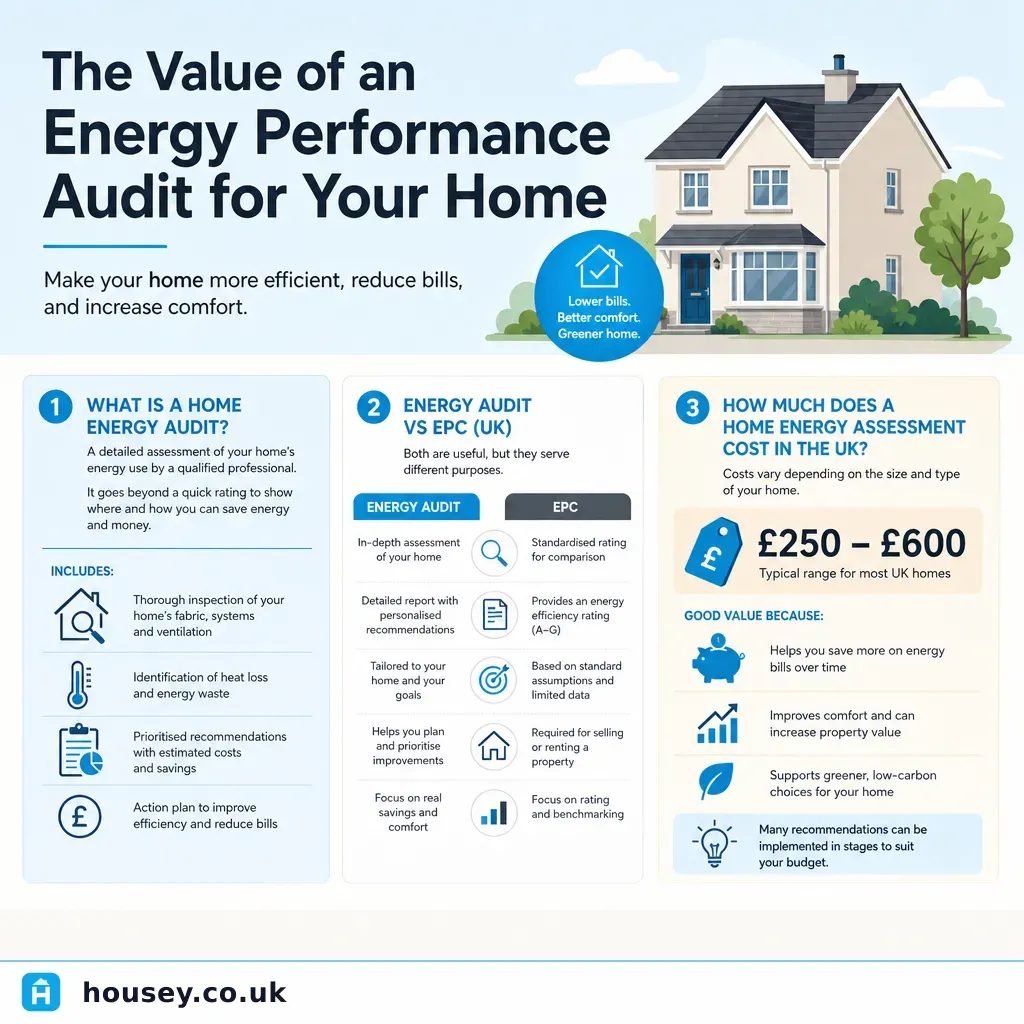
The Value of an Energy Performance Audit for Your Home
A home energy performance audit is a detailed, site-specific assessment of a property's fabric, heating, ventilation, and controls.
 Energy & Retrofit
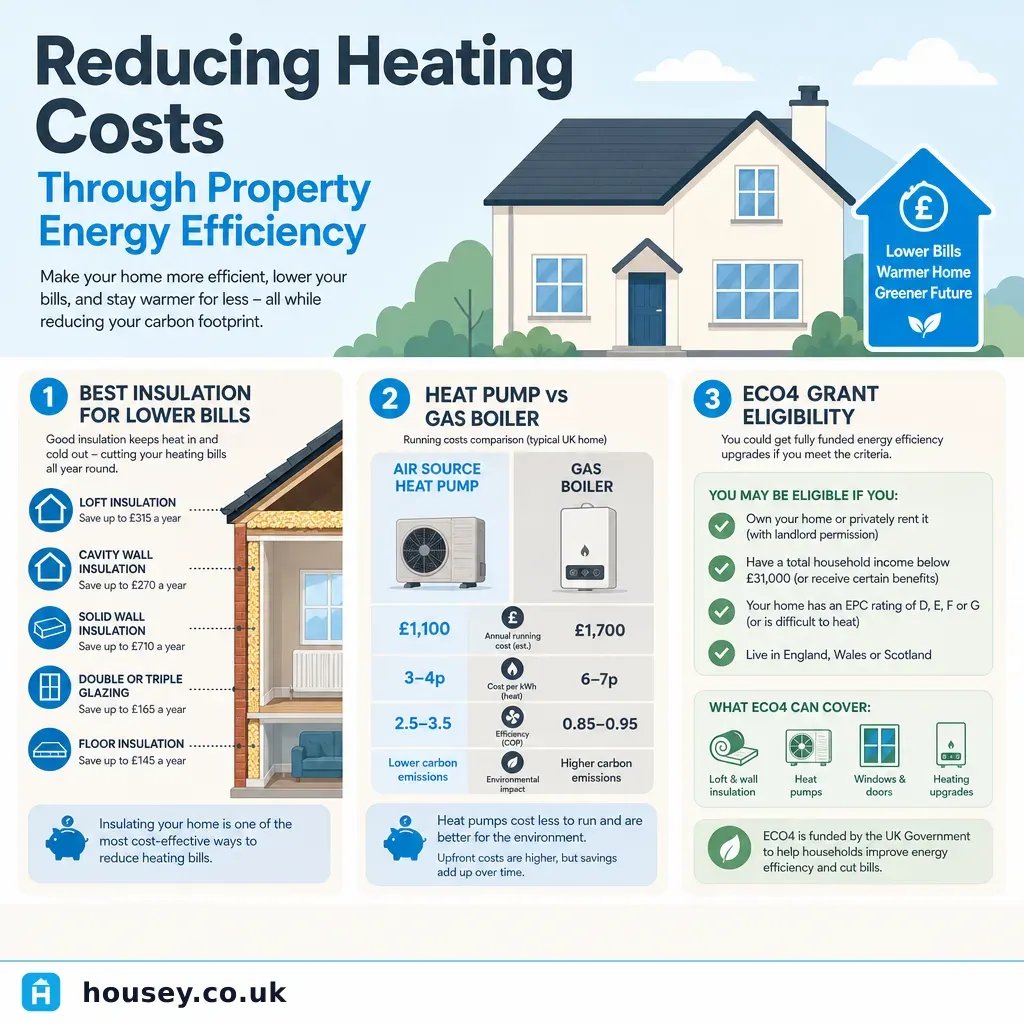
Reducing Heating Costs Through Property Energy Efficiency
Reducing heating costs starts with identifying where heat is lost — typically walls (30–35%), roof (20–25%), and windows.
 Energy & Retrofit
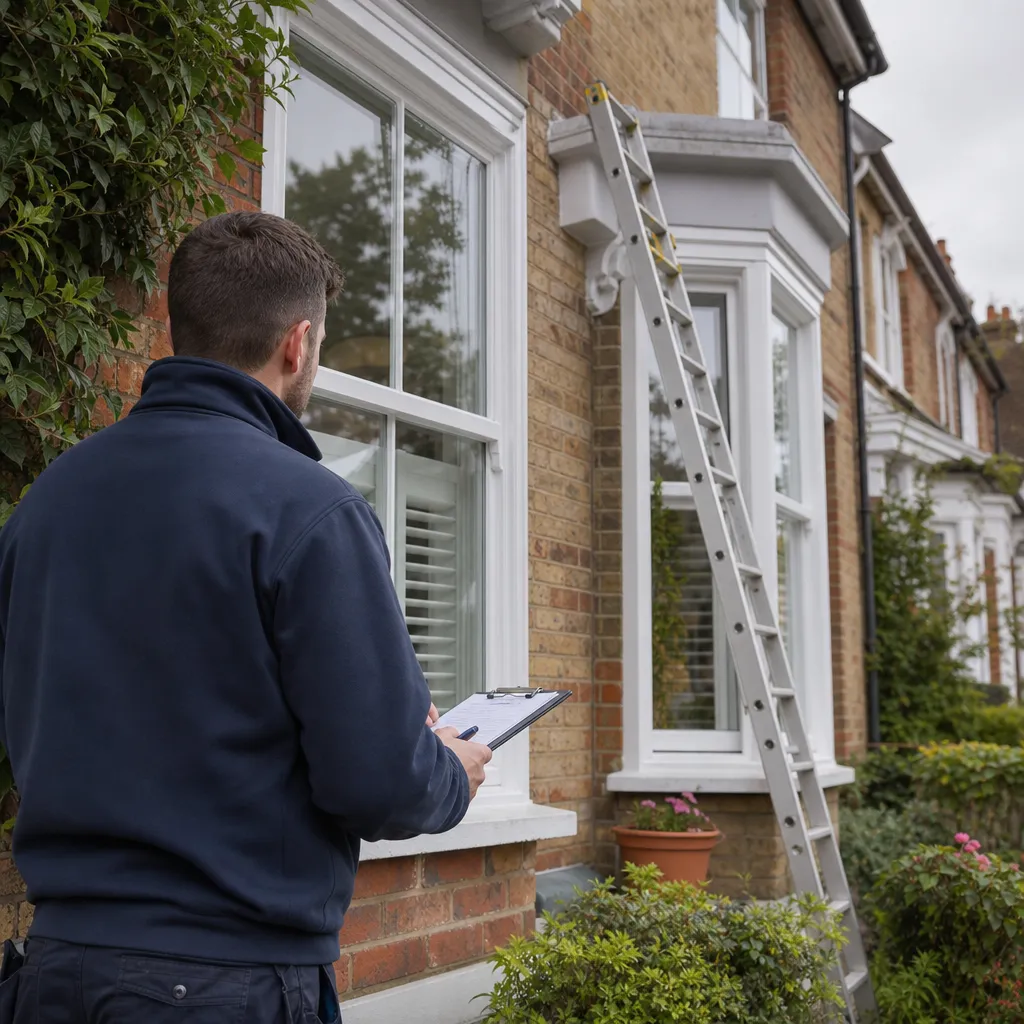
Practical Energy Saving Tips for Homeowners
Most UK households can meaningfully reduce their energy bills by making targeted changes: lowering the thermostat by 1°C, switching to LED lighting, and draught-proofing doors and windows.
 Energy & Retrofit
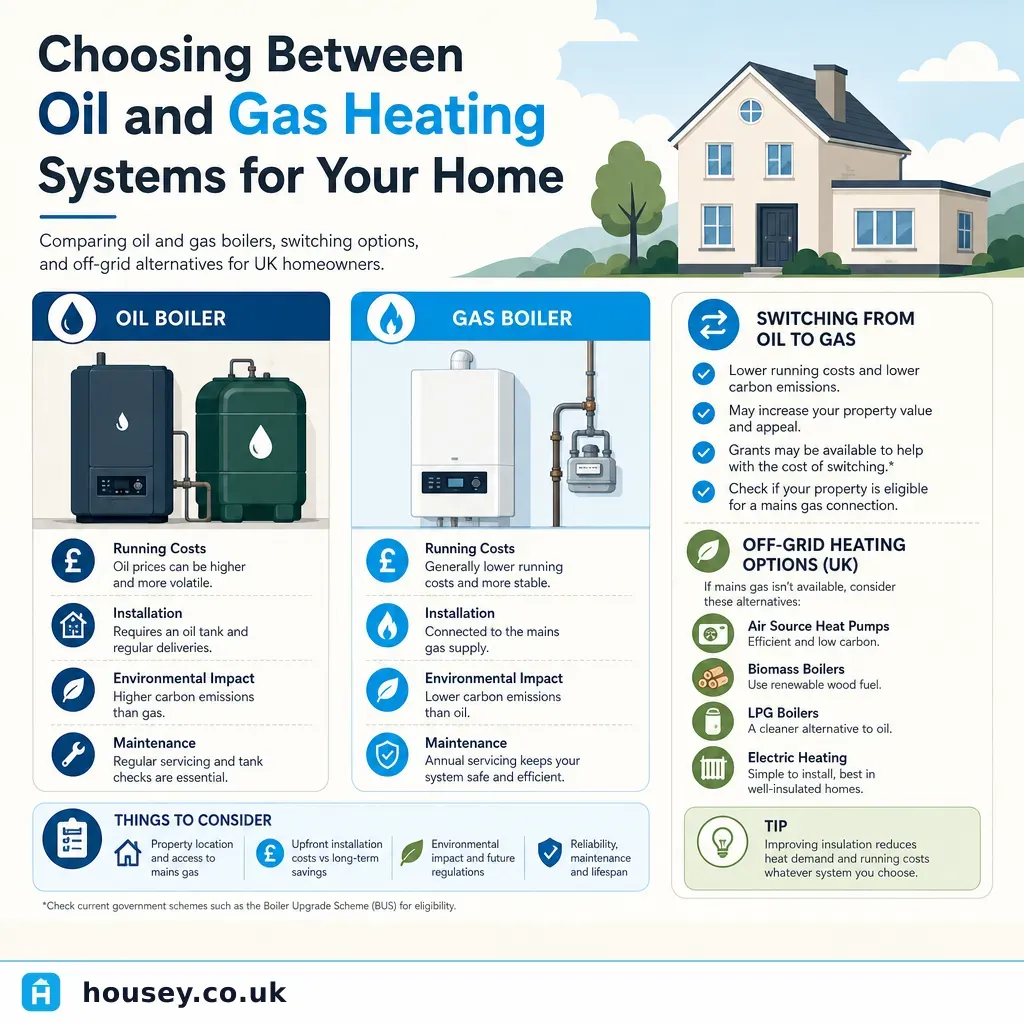
Choosing Between Oil and Gas Heating Systems for Your Home
Oil central heating suits rural UK properties without mains gas access, while gas remains the default for connected homes.
 Energy & Retrofit
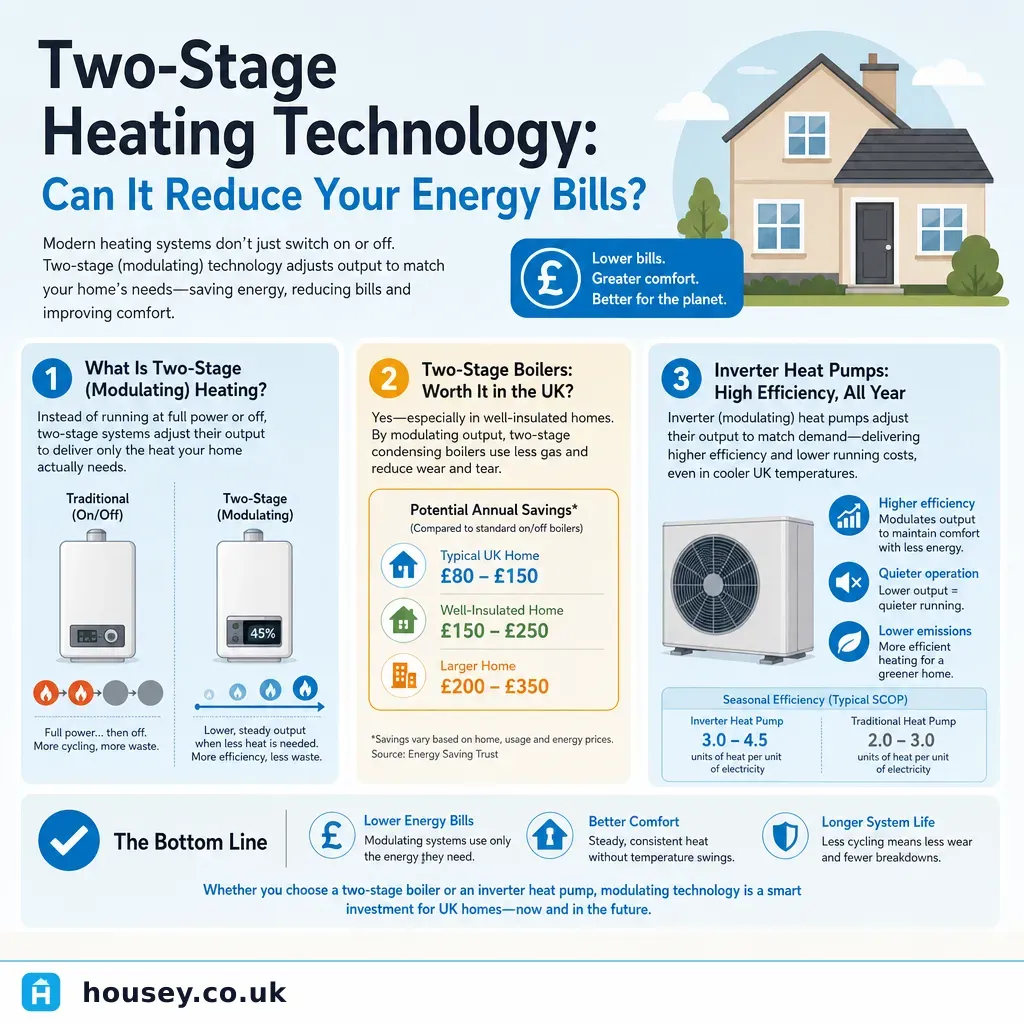
Two-Stage Heating Technology: Can It Reduce Your Energy Bills?
In UK homes, two-stage or modulating heating technology refers to modulating condensing gas boilers and inverter-driven heat pumps, not the forced-air furnaces common in North America.