Regional Property Market Dynamics: Where Properties Sell Fastest in the UK
By Housey · Last reviewed 10th of May 2026
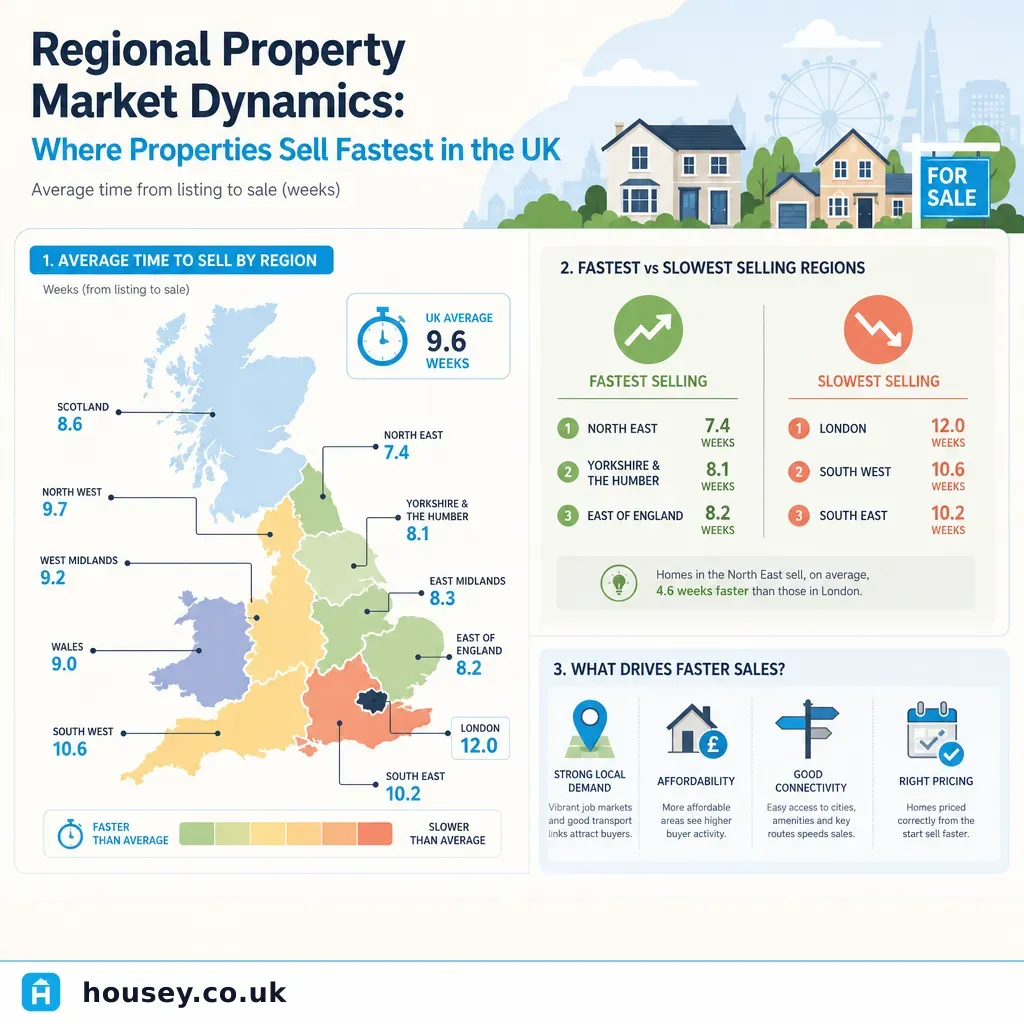
Regional Property Market Dynamics: Where Properties Sell Fastest in the UK
Homeowners planning to sell frequently ask how long the process is likely to take — and the honest answer is that it varies considerably by region, property type, price bracket, and the state of the local market at the time of listing. National averages reported in the press can mask significant local variation: a semi-detached house in a well-connected Manchester suburb may go under offer within days, while a similarly priced property in a slower market may sit for months. Understanding regional dynamics helps sellers set realistic expectations, price accurately, and time their listing more effectively.
Key points
- HM Land Registry publishes a monthly UK House Price Index covering completed transactions — the most reliable source for regional price trends, though it lags the market by around two months.
- Rightmove time-to-sale data, based on listings to Sold Subject to Contract (SSTC), consistently shows that several northern English cities including Manchester, Leeds, and Sheffield often have shorter average listing periods than the national average.
- Properties in higher price brackets typically take longer to sell regardless of region, as the pool of qualified buyers narrows with price.
- Seller asking prices set significantly above recent comparable sold values are consistently cited by estate agents as the primary cause of extended marketing periods.
- Local factors — school catchment areas, new transport infrastructure, regeneration announcements — can shift micro-market dynamics in ways that regional or national data does not capture.
What determines how quickly a property sells?
Speed of sale depends on several overlapping factors:
- Pricing accuracy: the strongest single predictor of time on market is how closely the asking price aligns with the level at which comparable properties have recently exchanged.
- Property type and condition: turnkey homes in good order tend to sell faster than those needing substantial renovation, all else being equal.
- Local supply and demand balance: in areas where listed stock is low relative to registered buyer demand, time on market shortens.
- Affordability and mortgage accessibility: regions with lower average prices see faster absorption because a larger share of buyers can finance purchases without complex arrangements.
- Seasonal patterns: spring (February–May) and early autumn (September–October) typically see higher transaction volumes; the Christmas period and August see lower activity in most markets.
Regional market comparison
The table below characterises UK regional markets based on publicly available data trends. Conditions vary significantly within regions and shift over time — treat this as a general guide, not a forecast.
Region | General market characteristics | Sale speed tendency | Key demand drivers |
|---|---|---|---|
Greater Manchester | Strong demand, tight stock in popular suburbs | Often faster than national average | Employment base, universities, regeneration investment |
West Yorkshire (Leeds, Bradford) | Active market, competitive at lower price points | Faster at mid-market price points | Growing professional population, affordability |
West Midlands (Birmingham) | Mixed by sub-market; benefited from HS2 anticipation | Variable | Second-city status, younger demographic |
Greater London | Wide variation; outer boroughs much faster than prime central | Prime central slow; outer zones more active | Global demand, employment density |
South East (excluding London) | Commuter belt remains active near rail hubs | Generally stable | London overspill, rail accessibility |
South West | Lifestyle and holiday demand; seasonal fluctuation | Coastal and rural slower off-season | Lifestyle migration, second-home demand |
Scotland (Central Belt) | Offers-over system creates concentrated transaction windows | Quick at legal close; process differs from E&W | Different legal system, strong FTB activity |
North East | Most affordable UK region; strong first-time buyer activity | Often fast at lower price points | Affordability, regeneration investment |
Indicative characterisation based on publicly reported trend data, last reviewed 2026-05-10. Regional conditions change — check current data via HM Land Registry and a local registered estate agent.
The Scotland difference
Property transactions in Scotland operate under Scots law and differ materially from England and Wales. Properties are typically marketed at an offers-over price, with a fixed closing date for offers. Successful offers are legally binding (missives) much earlier in the process. Sellers are also required to commission a Home Report — comprising a single survey, an energy report, and a property questionnaire — before marketing begins. This shifts some survey cost and timing to the seller rather than the buyer, and means buyers receive standardised condition information upfront.
Worked UK property scenario
Hypothetical illustration only — not financial or legal advice.
A homeowner in Leeds lists a three-bedroom 1980s semi at a price consistent with the most recent comparable completed sales in the postcode (verified via HM Land Registry sold prices). The property is well maintained and presented. In a market with low local stock, they receive multiple viewings in the first week and an offer at asking price within 12 days.
The same property listed 10% above recent comparable evidence receives fewer viewings, sits unsold for six to eight weeks, and eventually exchanges below the original asking price — often lower than it would have achieved had it been priced accurately from launch.
The lesson is consistent: accurate pricing from day one almost always produces a better outcome than starting high and reducing.
Red flags that a property may take longer to sell
Watch out for these factors before or during marketing:
- Asking price significantly above recent comparable sold prices. Check HM Land Registry for completed transactions, not portal asking prices, which are not evidence of what buyers actually paid.
- EPC rating of F or G. Some mortgage lenders restrict lending on very low-rated properties, reducing the buyer pool; proposed Minimum Energy Efficiency Standards (MEES) changes also create buyer uncertainty.
- Unresolved title or planning issues. Unapproved extensions, missing building control completion certificates, or boundary disputes will stall most transactions once a buyer's solicitor raises enquiries.
- Non-standard construction. Prefabricated concrete, timber frame, or steel frame properties can limit mortgage lender appetite, slowing the buyer pool regardless of price or condition.
- Leasehold complications. Short leases (below around 80 years), high service charges, or onerous ground rent terms attract lender scrutiny and can deter buyers.
- Flood risk. Properties in high-risk flood zones (check the Environment Agency flood risk map) face additional buyer caution and insurance complications.
When to get professional help
Before listing, consider appointing a RICS-accredited valuer if you need an objective opinion of market value — particularly for unusual, high-value, or complicated properties. Note that an estate agent's valuation is a marketing-price opinion, not a formal RICS valuation. For leasehold, title, or planning complications, consult a solicitor experienced in residential conveyancing before marketing — resolving issues pre-sale is almost always faster and cheaper than doing so mid-transaction under buyer pressure.
How Housey can help
Housey provides guides across all stages of the property lifecycle, from surveys and pre-purchase inspections through to improvement and energy retrofit works. If you are preparing to sell and want to understand which improvements are most likely to support your asking price or widen your buyer pool, explore Housey's improvement and build resources for guidance on qualified professionals and relevant works.
Frequently asked questions
How do I find out what properties have sold for in my area?
HM Land Registry published sold price data is free to search at gov.uk/search-house-prices. It shows completed transactions with addresses and prices, typically with a lag of around two months. Portal sites also display sold prices drawn from the same Land Registry data, sometimes in a more visual format. Use completed transaction data, not current asking prices, for meaningful comparisons.
Is spring really the best time to sell a house?
Spring — broadly February to May — typically sees higher buyer activity, which can produce quicker sales. More competing listings arrive at the same time, however, so the advantage is not absolute. The most reliable approach is to list when the property is correctly priced, well presented, and legally ready — rather than waiting for a calendar window if those conditions are already in place.
How does an EPC rating affect how quickly a house sells?
A rating of F or G can reduce buyer interest because some mortgage lenders are cautious about lending on very low-rated properties, and proposed Minimum Energy Efficiency Standards changes add perceived risk for buyers. Conversely, a high EPC rating is increasingly marketable as energy costs remain a significant consideration. Improving the rating before marketing can widen the buyer pool.
Does a short lease affect how quickly a flat sells?
Yes. Properties with a lease below approximately 80 years are harder to mortgage, reducing the pool of eligible buyers. Many lenders will not lend on leases below 70 years. Extending the lease before marketing is usually advisable if approaching these thresholds, though you must have owned the property for at least two years before formally requesting an extension under the Leasehold Reform, Housing and Urban Development Act 1993.
Sources and further reading
- UK House Price Index reports — HM Land Registry / GOV.UK
- Search sold house prices — HM Land Registry / GOV.UK
- Check long-term flood risk for a property — Environment Agency / GOV.UK
- Home Report guidance for sellers in Scotland — mygov.scot
Useful next reads
 General property advice
Scottish Property Market: Activity and Regional Trends
Scotland's property market operates under distinct legal rules: sellers must provide a Home Report before marketing, transactions become legally binding at conclusion of missives rather than exchange of contracts, and Land and Buildings Transaction Tax replaces Stamp Duty.
 General property advice
Property Market Trends: Activity Growth and Price Movements
UK property market activity is measured through completed sale registrations (HM Land Registry), lender mortgage data, and transaction volumes from HMRC.
 General property advice
Property Market Dynamics: Stamp Duty Relief Effects on Transaction Rates
Stamp duty relief periods create a predictable surge-and-cliff pattern in UK transaction volumes: demand concentrates ahead of the deadline, then dips sharply afterwards.
 General property advice
What to do when your boiler stops working
When your boiler stops working, check the pressure gauge (should read 1–1.
 General property advice
Installing a water main shut-off valve for your property
A water main shut-off valve — commonly called a stopcock — controls all water entering your home from the mains.