Rehau Window Systems: Quality Assessment and Performance Comparison
By Housey · Last reviewed 3rd of May 2026
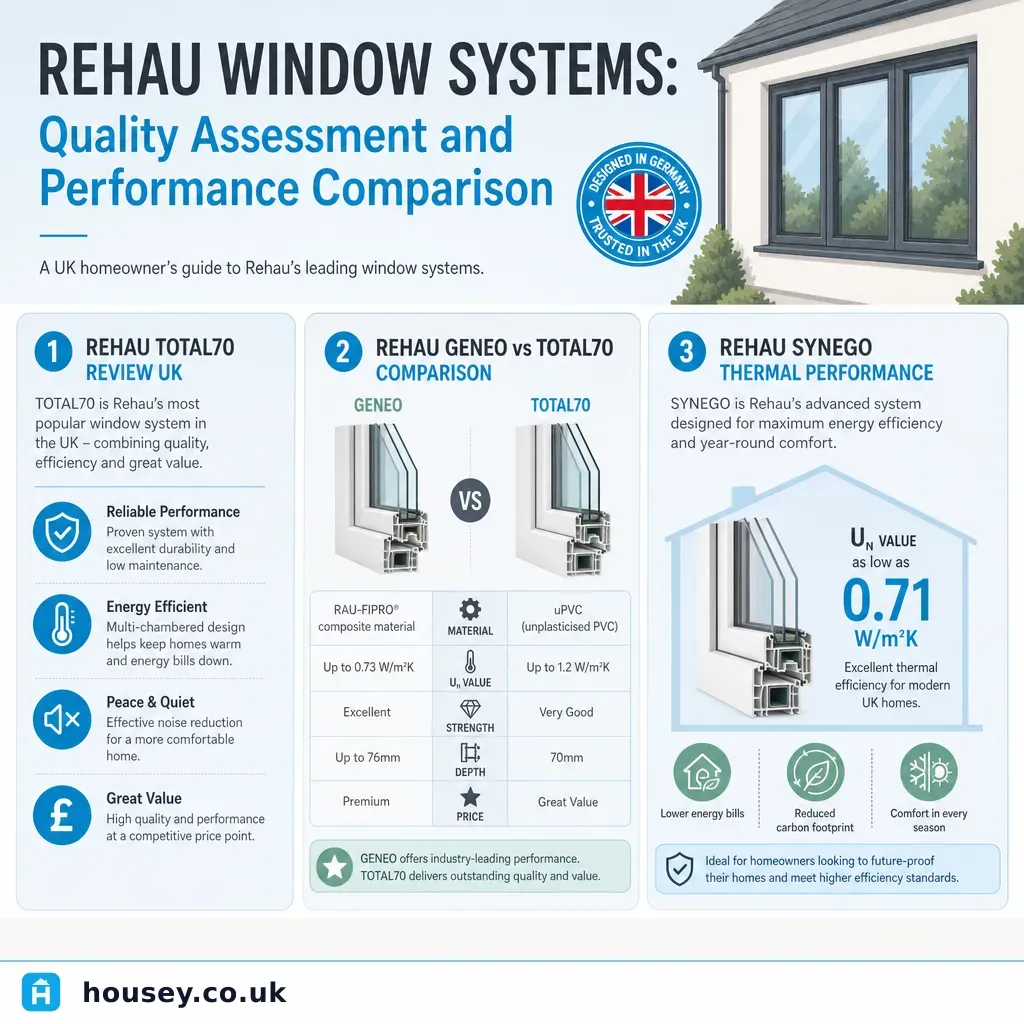
Rehau Window Systems: Quality Assessment and Performance Comparison
Rehau is a German polymer solutions manufacturer with a long-established presence in the UK fenestration market. Their uPVC window profiles are used across new-build and replacement sectors, and homeowners comparing quotes frequently encounter Rehau-profile systems alongside UK-made alternatives. Rehau's product range spans several distinct performance tiers, and understanding which system is being quoted — and why the difference matters — is essential before accepting any installation proposal.
Key points
- Rehau's UK window range includes at least three distinct product systems — TOTAL70, SYNEGO, and Geneo — with substantially different thermal performance ceilings and construction approaches.
- Building Regulations Part L (England) requires replacement windows to achieve a WER of Band C or a whole-window U-value of ≤1.6 W/m²K; Scotland and Wales have equivalent requirements under their own building standards.
- The Rehau Geneo system uses RAU-FIPRO — a glass-fibre-reinforced polymer — instead of conventional steel reinforcement, eliminating a significant thermal bridge and enabling Passivhaus Institute-compatible whole-window U-values.
- All replacement window installers must hold FENSA or CERTASS registration to self-certify compliance with building regulations, or notify local authority building control directly before work begins.
- Window energy performance is a function of the complete unit — frame geometry, glass specification, spacer bar type, and gas fill — not the profile system in isolation; always ask for the BFRC data sheet.
Rehau's UK product range explained
Rehau's UK-distributed window systems vary significantly in performance ceiling, construction approach, and intended application. Treating them as interchangeable is a common source of confusion when comparing quotes.
TOTAL70 is Rehau's mainstream replacement and new-build system. The 70 mm frame depth and multi-chamber design can achieve whole-window U-values of approximately 1.2–1.4 W/m²K with double glazing (argon-filled, low-emissivity glass and warm-edge spacer). It is widely available through FENSA-registered installers and is the system most commonly supplied in standard residential replacement quotations.
SYNEGO is a higher-specification system with a 76 mm frame depth and refined multi-chamber geometry that reduces conductive heat loss through the frame cross-section. It accommodates triple glazing more readily and can achieve whole-window U-values in the range of 0.9–1.2 W/m²K, making it appropriate for fabric-first energy retrofit projects where window performance is being upgraded as part of a broader programme of works.
Geneo is Rehau's premium system and the one most frequently referenced in energy retrofit and low-energy building discussions. It replaces conventional steel reinforcement with RAU-FIPRO — a glass-fibre-reinforced polymer — which eliminates the steel's thermal bridge through the frame section. This allows Geneo to achieve whole-window U-values compatible with Passivhaus Institute certification requirements. Geneo profiles are wider (86 mm), heavier than conventional uPVC, and require more precise installation tolerances; they are typically specified by architects or PAS 2035 Retrofit Coordinators rather than through a standard window replacement company.
Performance comparison across Rehau systems
Rehau system | Frame depth | Typical whole-window U-value | Suitable for | Key notes |
|---|---|---|---|---|
TOTAL70 | 70 mm | ~1.2–1.4 W/m²K (double-glazed) | Standard replacement, new-build | Widely available; mainstream pricing |
SYNEGO | 76 mm | ~0.9–1.2 W/m²K (triple-glazed) | Higher-performance retrofit | Supports triple glazing without excess weight |
Geneo | 86 mm | ~0.7–0.9 W/m²K (triple-glazed) | Passivhaus, EnerPHit retrofit | RAU-FIPRO reinforcement; specialist installation required |
Indicative UK figures, last reviewed 2026-05-03. Confirm specifications using the installer's BFRC product data sheet for the specific unit being supplied.
What actually differs between uPVC profile systems
Many homeowners assume that all uPVC window frames perform similarly and that thermal differences are mainly in the glass. There are real differences at frame level, though their practical significance varies with project context.
Reinforcement type: Most mainstream uPVC systems — including TOTAL70 — use steel box sections inside the frame chambers. Steel conducts heat efficiently, creating a thermal bridge that limits the overall frame U-value. Rehau's Geneo eliminates this with fibre polymer reinforcement. For TOTAL70 and SYNEGO, steel reinforcement is used, as with most competitor profiles.
Chamber geometry: More chambers and more optimised chamber geometry reduce conductive heat transfer through the frame section. SYNEGO's arrangement is improved over TOTAL70 for this reason.
Frame depth: Deeper frames accommodate wider glazing units and more thermally efficient spacer bar configurations. Geneo's 86 mm depth enables it to accept glazing packages that TOTAL70 cannot.
Surface finish options: Rehau profiles are available in white, cream, and foil finishes including anthracite grey (RAL 7016), golden oak, Irish oak, and dual-colour options (grey exterior, white interior). Foil finishes carry specific maintenance requirements.
How Rehau profiles compare to UK-manufactured alternatives
Rehau profiles are manufactured in Europe and distributed to UK installers. UK-manufactured alternatives include Liniar (Derbyshire), Veka, and Eurocell, among others. All are assessed to EN 12608 (the European standard for uPVC profile classification). Meaningful performance comparisons depend on the specific product within each brand's range rather than brand origin alone. A Rehau TOTAL70 window and a Liniar chamfered window at a similar specification will perform comparably; the Geneo system has no direct like-for-like equivalent in most mainstream UK product ranges.
Red flags when reviewing Rehau window quotes
- The quote refers to "Rehau system" without specifying which product tier — TOTAL70, SYNEGO, or Geneo
- No BFRC energy rating is stated for the complete unit, only a vague claim that windows are "A-rated"
- Spacer bar type is not specified; warm-edge spacers significantly outperform aluminium for edge-of-glass condensation resistance
- The installer cannot confirm or provide a current FENSA or CERTASS membership number
- A quotation describes the installation as "Passivhaus-compatible" but the system being supplied is TOTAL70 rather than Geneo
- No written workmanship guarantee is offered alongside the profile manufacturer's guarantee
What to ask before accepting a quote
- Which specific Rehau system is being quoted — TOTAL70, SYNEGO, or Geneo?
- What is the whole-window U-value and BFRC energy rating for the complete unit as specified?
- Are you FENSA or CERTASS registered, and will you provide the compliance certificate on completion?
- What spacer bar type is included — warm-edge or aluminium?
- Are the glass units argon-filled with low-e coating, and what is the pane count — double or triple?
- What does the installation workmanship guarantee cover and for how long?
- Is VAT included in this quote, and are there any provisional sums or exclusions?
When to get professional help
For standard replacement windows in a post-war or modern home, a FENSA-registered installer can usually specify and fit an appropriate system without additional professional involvement. Seek independent input if:
- You are planning a whole-house energy retrofit under PAS 2035 — a Retrofit Coordinator should specify window performance targets as part of a coordinated plan to avoid condensation and moisture risk from improved airtightness
- The property is in a conservation area or is listed — replacement window materials and appearance may require planning consent regardless of energy performance
- You are specifying Geneo or a Passivhaus-level system — installation tolerances are tighter and an architect or energy consultant should review the specification and installer competence
- Windows are being replaced as part of an extension or structural alteration — coordinate with the project lead to ensure the fenestration specification is consistent with the building regulations submission
How Housey can help
Housey can connect you with vetted window and door installers who can assess your property, recommend the appropriate Rehau system tier or comparable alternative, and provide FENSA-registered installation with certified compliance documentation. You can compare quotes from local providers before committing to any specification.
Frequently asked questions
Are Rehau windows good quality?
Rehau is a well-established European uPVC profile manufacturer whose systems range from mid-market (TOTAL70) to premium Passivhaus-capable (Geneo). Quality within the range is generally solid, but the right assessment depends on which system is being quoted and how competently it is installed. Always ask your installer to specify the product tier and provide the BFRC data sheet for the complete unit.
What is the difference between Rehau TOTAL70 and Geneo?
TOTAL70 is a standard multi-chamber uPVC system with steel reinforcement, suited to typical replacement windows and new-build projects. Geneo replaces steel with glass-fibre polymer reinforcement (RAU-FIPRO), eliminating the steel thermal bridge and enabling whole-window U-values compatible with Passivhaus Institute certification. Geneo is heavier, more expensive, and requires specialist installation; it is typically specified by architects or retrofit coordinators.
Do Rehau windows meet UK Building Regulations?
When correctly specified and installed by a FENSA or CERTASS registered company, Rehau window units can meet Part L requirements (WER Band C or whole-window U-value of 1.6 W/m²K or below). Compliance depends on the complete unit — frame, glass, spacer bar, and gas fill — not the profile alone. Ask your installer for the BFRC data sheet for the specific unit being installed.
How long do Rehau uPVC windows last?
uPVC windows generally last 20–35 years. Rehau profiles are manufactured to EN 12608, which covers UV stability, impact resistance, and dimensional accuracy. Actual lifespan depends on installation quality, site exposure, and whether drainage channels and perimeter seals are properly maintained. A poorly installed Rehau unit will underperform a lesser profile that has been fitted correctly.
Can Rehau windows achieve Passivhaus standard?
The Rehau Geneo system, with its RAU-FIPRO fibre-reinforced polymer frame construction and compatible triple glazing packages, can achieve whole-window U-values consistent with Passivhaus Institut requirements. Standard Rehau systems — TOTAL70 and SYNEGO — do not reach this performance level. If Passivhaus or EnerPHit certification is a project requirement, a specialist installer and a retrofit coordinator should specify the system.
Sources and further reading
- Building Regulations Approved Document L: Conservation of fuel and power — GOV.UK
- FENSA: Competent person scheme for window and door replacement — FENSA
- British Fenestration Rating Council: How BFRC ratings work — BFRC
- Passivhaus Institut: Window certification criteria — Passivhaus Institut
- PAS 2035: Retrofitting dwellings for improved energy efficiency — BSI
Useful next reads
 Improvement & Build
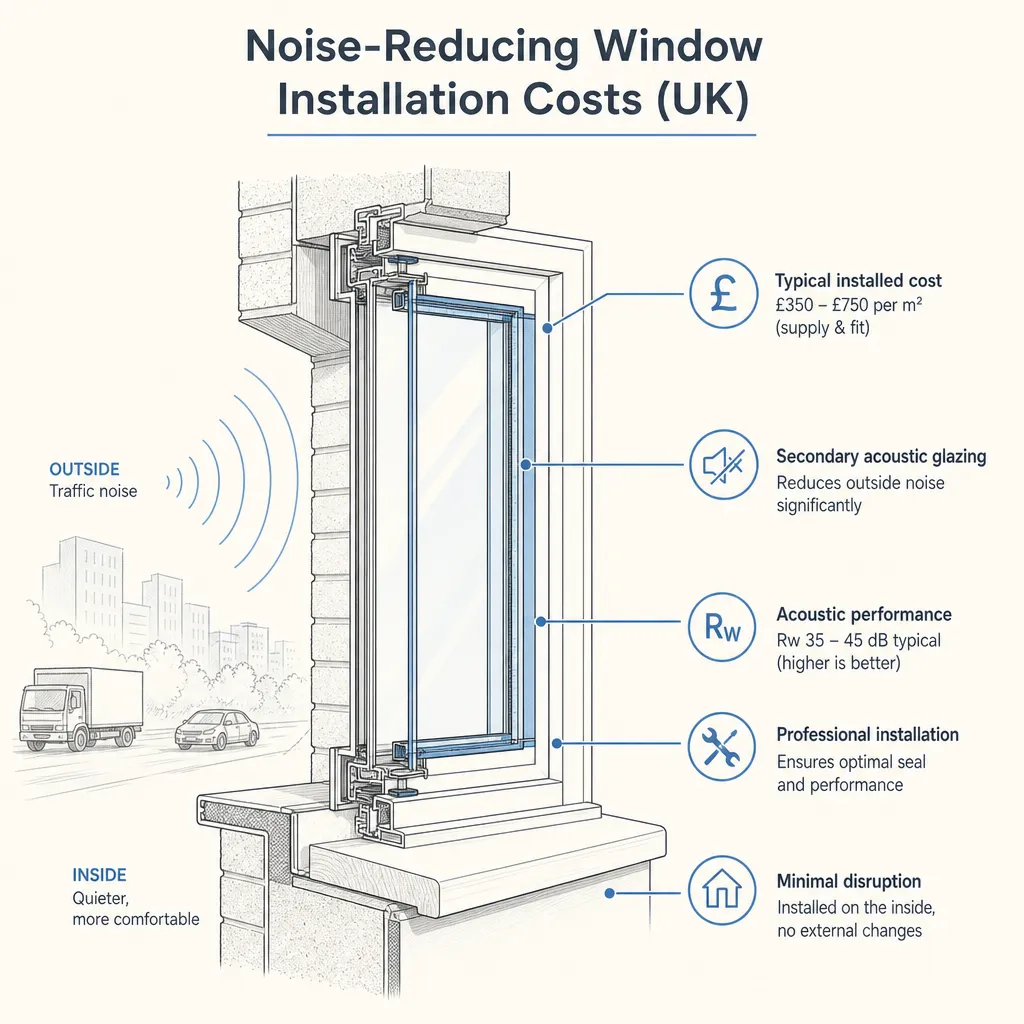
Noise-Reducing Window Installation Costs
Noise-reducing window installation in the UK typically costs £400–£1,500 per window depending on glazing specification, frame material, and property type.
 Improvement & Build
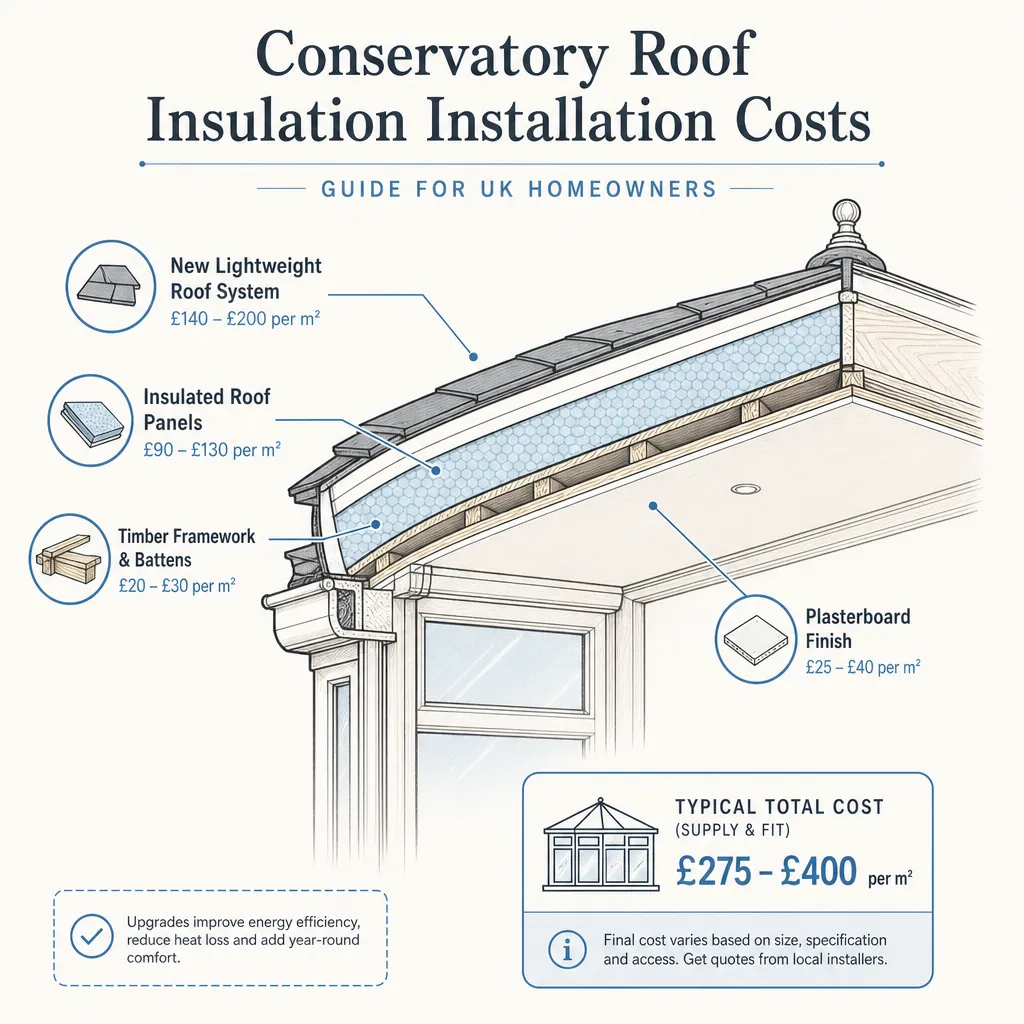
Conservatory Roof Insulation Installation Costs
Conservatory roof insulation costs typically range from around £1,500 to £4,000 for internal insulated panel systems, or £8,000 to £25,000 or more for a solid tiled roof replacement.
 Improvement & Build
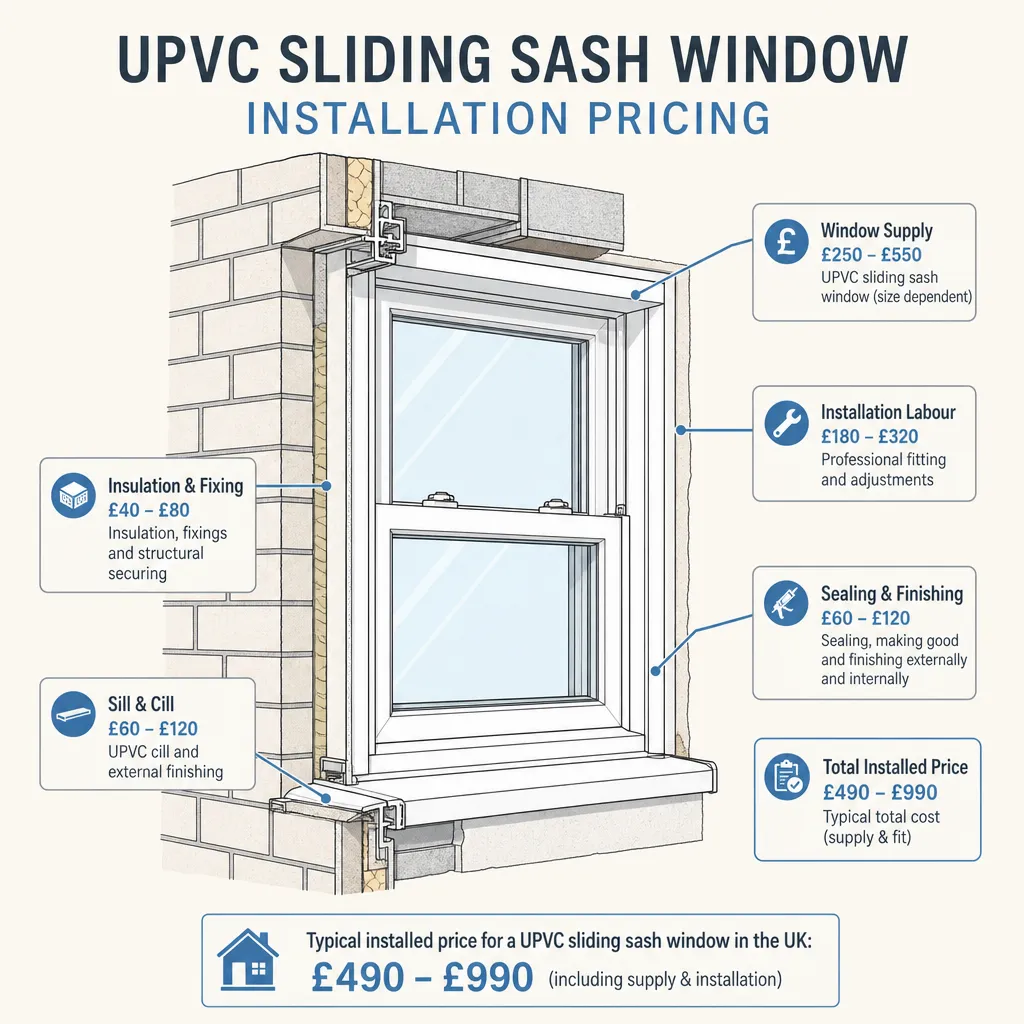
UPVC Sliding Sash Window Installation Pricing
UPVC sliding sash windows are priced by size, glazing specification, balance system, finish, and access requirements.
 Improvement & Build
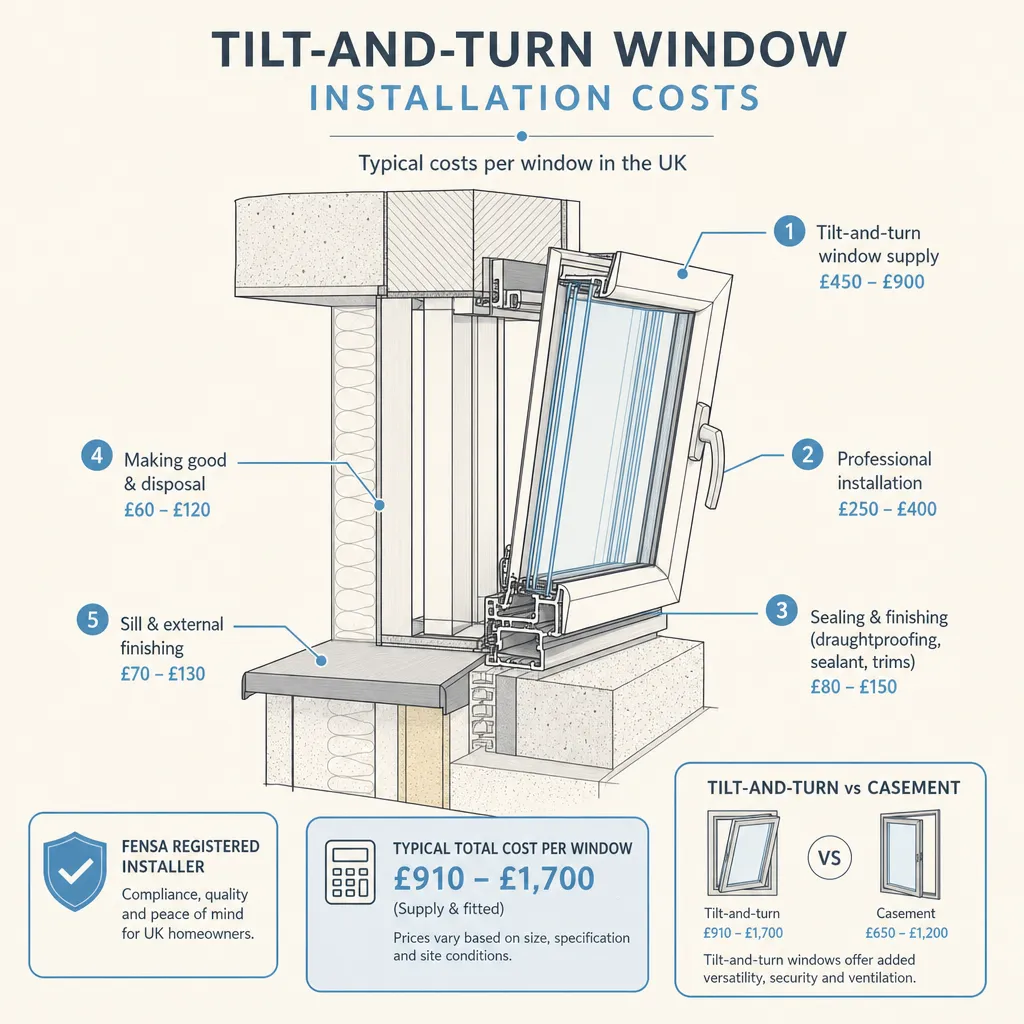
Tilt-and-Turn Window Installation Costs
Tilt-and-turn windows typically cost £400–£900 per window supply and fit in uPVC, rising to £600–£1,300 in aluminium and £700–£1,400 in timber.
 Improvement & Build
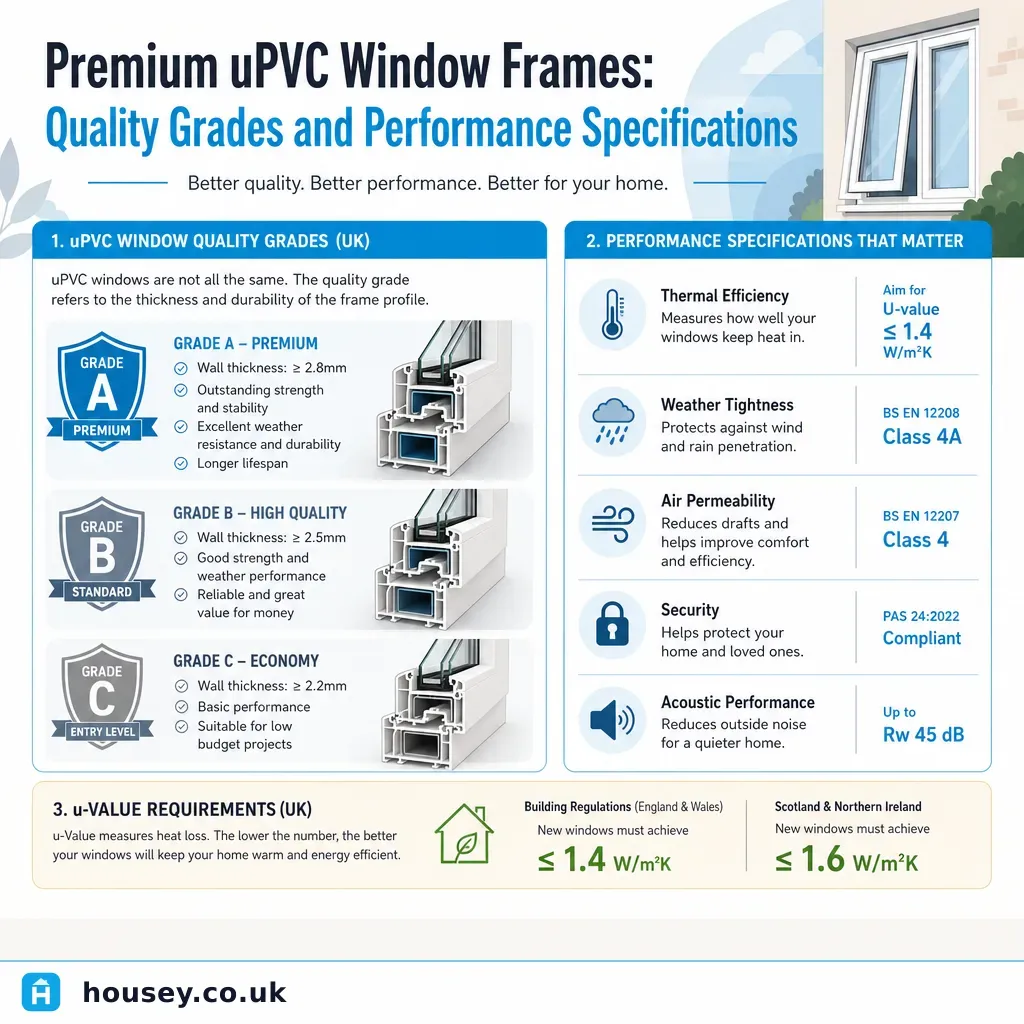
Premium uPVC Window Frames: Quality Grades and Performance Specifications
Premium uPVC windows use five- or six-chamber profiles meeting BS EN 12608 Class 1, with whole-window U-values typically between 0.