Tilt-and-Turn Window Installation Costs
By Housey · Last reviewed 11th of May 2026
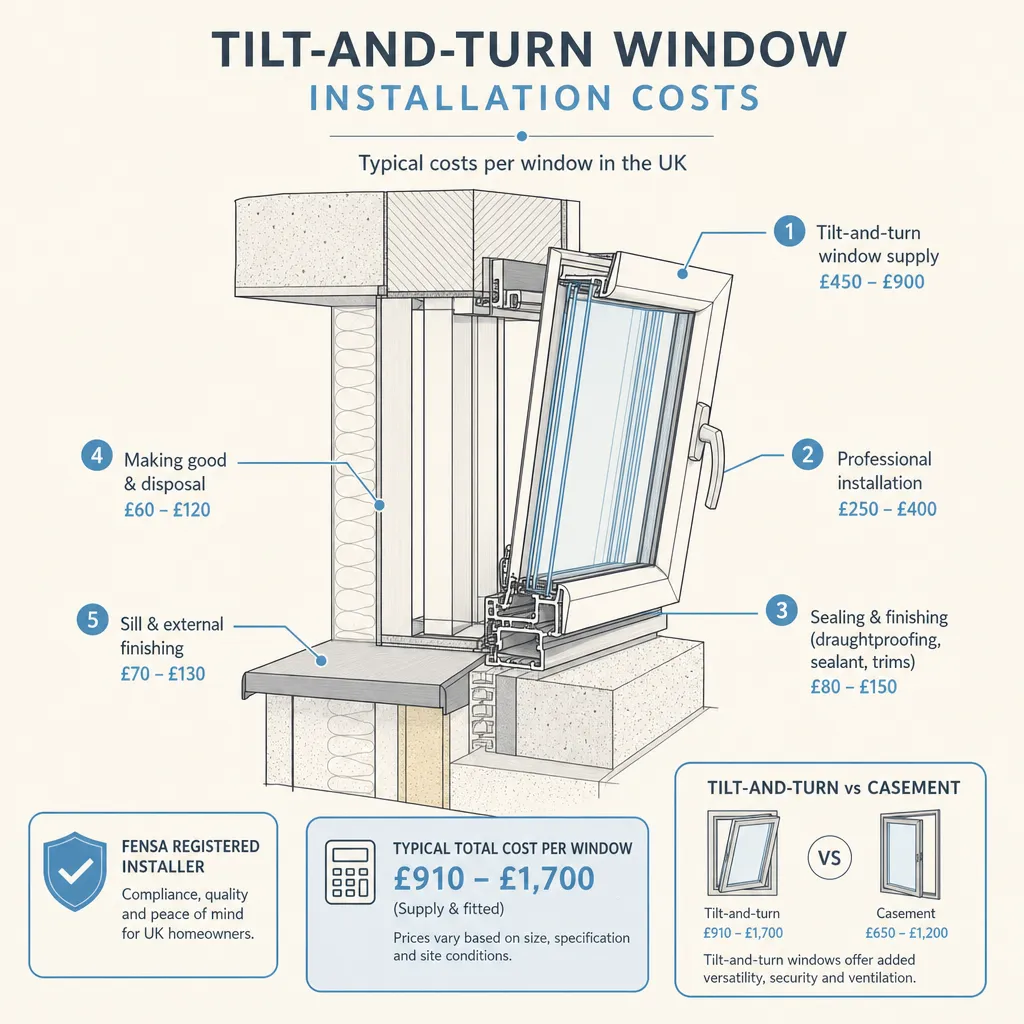
Tilt-and-Turn Window Installation Costs
Tilt-and-turn windows have grown steadily popular in the UK over the past decade, particularly in modern extensions, apartment refurbishments, and passivhaus-influenced projects. Understanding the cost factors — and whether this window style suits your property — will help you compare quotes from installers and make a sound decision before replacing or upgrading your glazing.
Key points
- Tilt-and-turn windows operate in two modes: the tilt position opens the top of the sash inward for ventilation; the turn position opens the full sash inward like a door, allowing easy cleaning from inside.
- Replacing windows in England requires either a FENSA-registered (or equivalent CERTASS) installer, or a building control application under Part L and Part Q of the Building Regulations.
- Indicative UK costs for uPVC tilt-and-turn windows range from £400–£900 per window (supply and fit, standard size); aluminium frames add 30–50% to that range; triple glazing adds a further 15–25%.
- Tilt-and-turn hardware is more complex than standard casement mechanisms; use an installer experienced with the product, as incorrect adjustment leads to draught and security problems.
- Properties in conservation areas or subject to an Article 4 Direction may need planning permission to replace windows regardless of style — always check with your local planning authority.
How tilt-and-turn windows work
A tilt-and-turn window uses a multi-point locking system and a single handle that operates in two positions:
- Tilt (handle horizontal): the top of the sash tilts inward by 10–15 cm for background ventilation, secure even in rain — well-suited to the UK climate.
- Turn (handle vertical): the sash swings fully open inward on a side hinge, like an inward-opening door. This makes the outer face of the glass fully accessible from inside the room.
Compared to standard outward-opening casement windows, this arrangement makes cleaning safe and straightforward, avoids the need for external access, and suits flats or properties where opening outward is impractical. The fully closed position typically achieves multi-point locking around the entire frame perimeter, with PAS 24-compliant models available for enhanced security ratings.
How much do tilt-and-turn windows cost in the UK?
Indicative UK costs, last reviewed 2026-05-11. Quotes vary significantly by frame material, glazing specification, window size, number of windows, and installer location.
Frame material | Typical cost per window (supply and fit, standard size ~1.0 × 1.2 m) | Notes |
|---|---|---|
uPVC | £400–£900 | Most common; low maintenance |
Aluminium (powder-coated) | £600–£1,300 | Slimmer sightlines; more design options |
Timber (softwood or engineered) | £700–£1,400 | Period properties; higher maintenance |
Aluminium-timber composite | £900–£1,600 | Best of both; premium cost |
Cost drivers:
- Number of windows: multi-window contracts attract volume discounts; installing all windows at once reduces labour cost per unit.
- Window size: oversized or structural openings require heavier frames and more complex installation.
- Glazing specification: double glazing (standard) vs triple glazing (typically 15–25% more per window).
- Access and removal: removing existing frames, repairing reveals, and making good increases labour cost.
- Height: upper-floor windows may require scaffolding or specialist access equipment.
Tilt-and-turn vs other window styles
Window type | Best for | Not ideal for | Thermal performance | Security potential |
|---|---|---|---|---|
Tilt-and-turn | Modern homes, flats, easy-clean requirements, passivhaus | Traditional period aesthetics | Excellent (multi-point seal) | Very good (PAS 24 available) |
Casement (outward-opening) | Most UK homes; traditional and modern | Where outward opening is obstructed | Good | Good (PAS 24 available) |
Sash (vertical sliding) | Victorian, Georgian, Edwardian period properties | High air-tightness requirements | Moderate (draughty unless upgraded) | Moderate |
Fixed light | Where ventilation is not needed | Any room requiring ventilation or egress | Excellent | Excellent |
Top-hung (hopper) | Restricted spaces, background ventilation | Easy cleaning or emergency egress | Good | Limited |
Which window style should you choose?
- Choose tilt-and-turn if the property is a flat, modern build, or extension where cleaning from inside is a priority or where high air-tightness is required.
- Choose casement if the property is a traditional house where an outward-opening window is practical and you want the widest choice of styles and profiles.
- Choose timber sash if the property is in a conservation area where planning restrictions require matching the original window type.
- Ask your installer for PAS 24-certified units if security is a priority — this is the standard referenced by most home insurers and required by Approved Document Q.
- Check with your local planning authority if the property is in a conservation area or subject to an Article 4 Direction before ordering any replacement windows.
Planning permission and building regulations
Replacing like-for-like windows in most houses is permitted development in England and does not require planning permission. However, it does trigger Building Regulations Part L and Part Q, which cover energy efficiency and security. Use a FENSA or CERTASS registered installer and you receive a compliance certificate on completion — the installer self-certifies. If you use an unregistered installer, you (the homeowner) must apply to your local building control body before installation.
Situations where planning permission may be required:
- Conservation areas — replacing windows may require prior approval or full planning permission depending on the local authority's requirements.
- Listed buildings — listed building consent is required for any window replacement.
- Flats and maisonettes — permitted development rights do not apply; check with your local planning authority.
- Article 4 Directions — some local authorities restrict window changes in particular streets or areas.
What to ask before accepting a quote
- Are the windows installed by a FENSA or CERTASS-registered company? (You should receive a compliance certificate on completion.)
- Are the frames PAS 24-certified for enhanced security?
- What glazing unit is specified — double or triple? What is the centre-pane U-value?
- Does the quote include removal and disposal of existing frames?
- Does the quote include making good to internal reveals and external decoration?
- What is the installation programme, and will the property be left secure if works span more than one day?
- Is VAT included?
When to get professional help
For most window replacements, a FENSA-registered installer handles the full project, including building regulations self-certification. Seek additional professional input if:
- The window opening is structural (e.g., a new or widened aperture in a load-bearing wall) — a structural engineer or building surveyor must design and approve the lintel before the installer proceeds.
- The property is listed — a conservation architect or heritage consultant should specify the appropriate window type before you engage an installer.
- Existing frames show evidence of rot extending into the structural surround or surrounding brickwork — a RICS chartered surveyor should assess the extent of repair needed.
How Housey can help
Housey connects homeowners with vetted window and door installers who can quote for tilt-and-turn and other window types. Comparing multiple quotes helps you benchmark cost, understand specification differences between products, and verify installer accreditations before committing.
Frequently asked questions
Are tilt-and-turn windows more expensive than standard casement windows?
Yes, typically by 15–30%. The more complex multi-point locking mechanism and inward-opening hardware add to manufacturing cost. However, easier cleaning and potentially better air-tightness can justify the premium for upper-floor rooms or high-performance builds where both access and thermal performance are priorities.
Do tilt-and-turn windows need planning permission?
Not usually for a standard replacement in a house. However, conservation areas, listed buildings, flats, and properties subject to Article 4 Directions may require planning permission — always check with your local planning authority before ordering replacement windows.
What is the thermal performance of tilt-and-turn windows?
Tilt-and-turn windows typically achieve excellent air-tightness because the multi-point locking system compresses the seal around the entire frame perimeter. A well-specified uPVC tilt-and-turn with double glazing can achieve a window U-value of around 1.2–1.4 W/m²K; triple glazing can reach 0.7–0.9 W/m²K.
How long do tilt-and-turn windows last?
A quality uPVC tilt-and-turn window should last 20–30 years; aluminium frames may last longer. The multi-point locking mechanism requires periodic adjustment and lubrication to maintain air-tightness and security — a qualified installer can service the hardware to extend service life.
Sources and further reading
- Building Regulations Approved Document L (conservation of fuel and power) — GOV.UK
- Building Regulations Approved Document Q (security) — GOV.UK
- FENSA: competent person scheme for window and door replacement — FENSA
- Planning permission: when you need it — GOV.UK
- Double and triple glazing — Energy Saving Trust
Useful next reads
 Improvement & Build
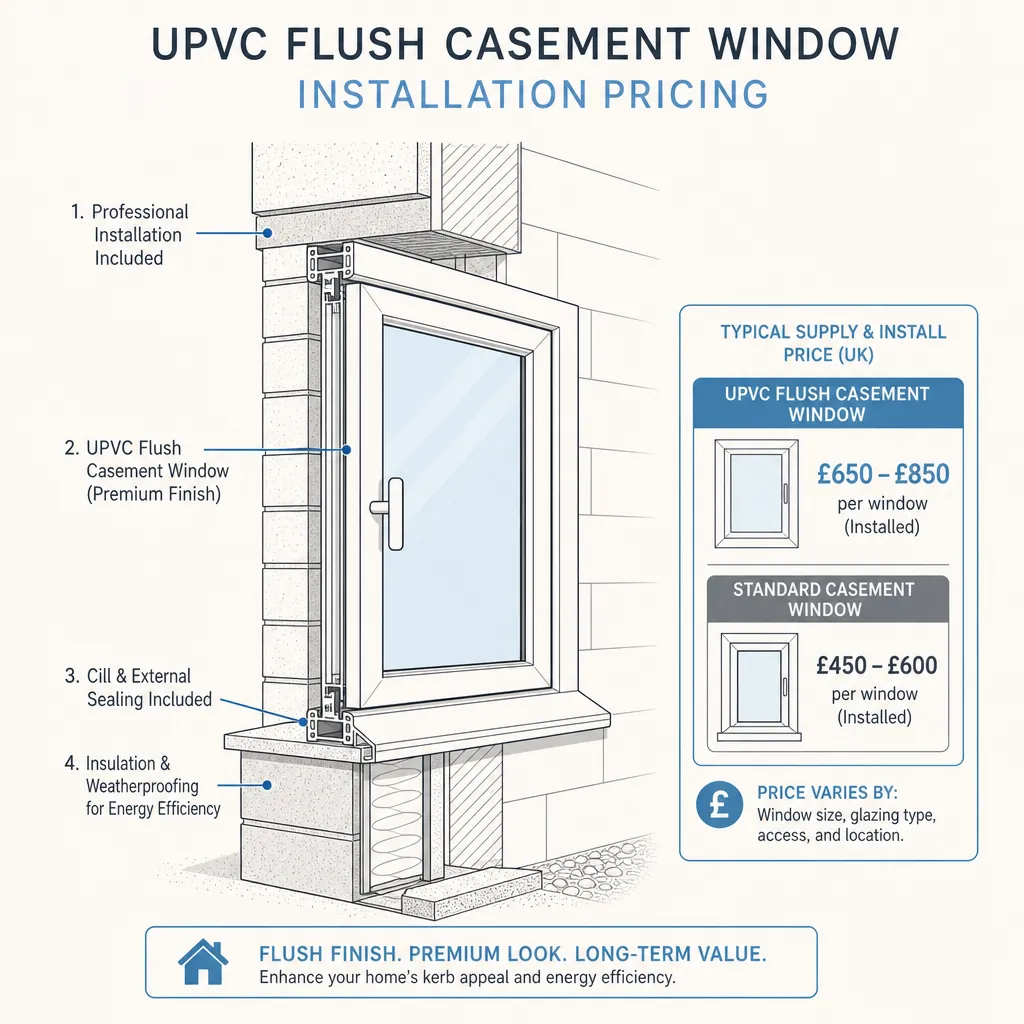
UPVC Flush Casement Window Installation Pricing
UPVC flush casement windows typically cost £400–£900 per window supplied and fitted in the UK, depending on size, glazing specification, and finish.
 Improvement & Build
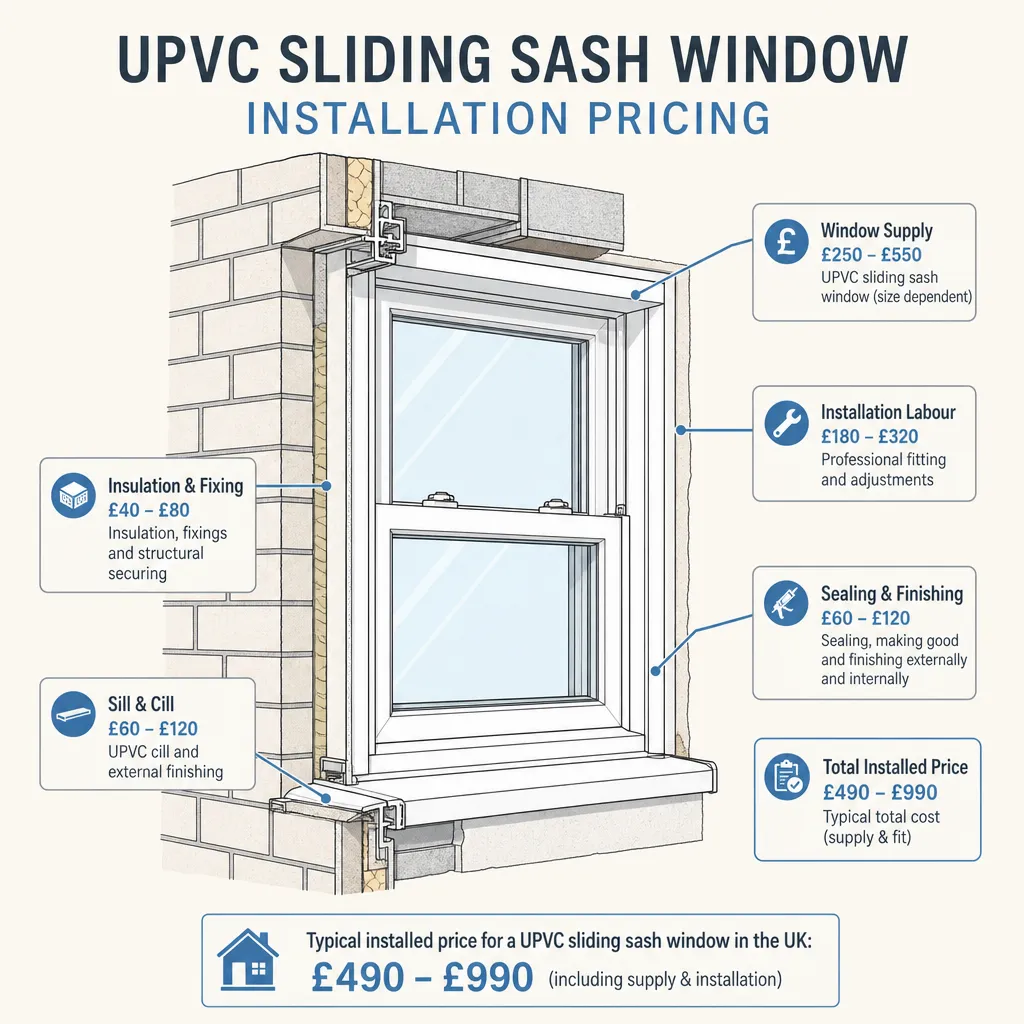
UPVC Sliding Sash Window Installation Pricing
UPVC sliding sash windows are priced by size, glazing specification, balance system, finish, and access requirements.
 Improvement & Build
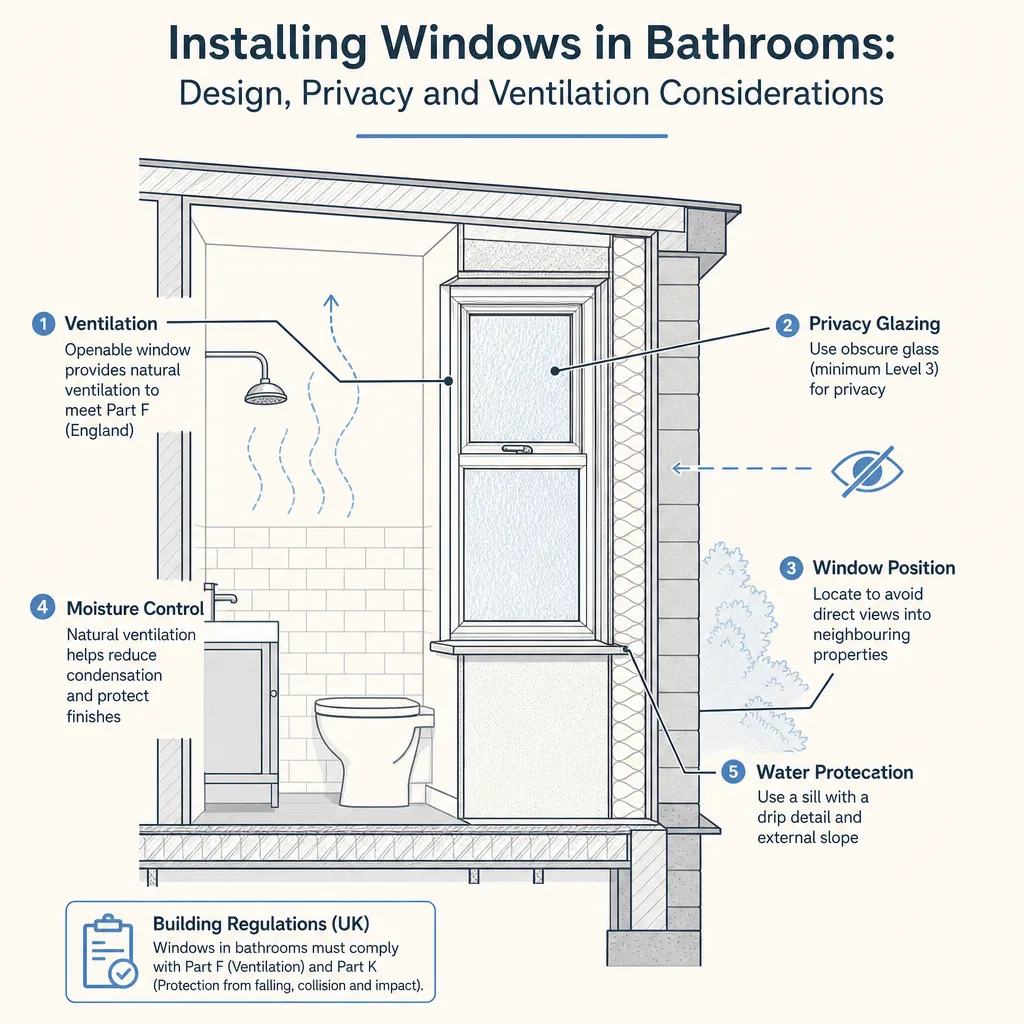
Installing Windows in Bathrooms: Design, Privacy and Ventilation Considerations
Bathroom windows in the UK must meet Building Regulations requirements for ventilation (Approved Document F) and safety glazing (Approved Document K).
 Improvement & Build
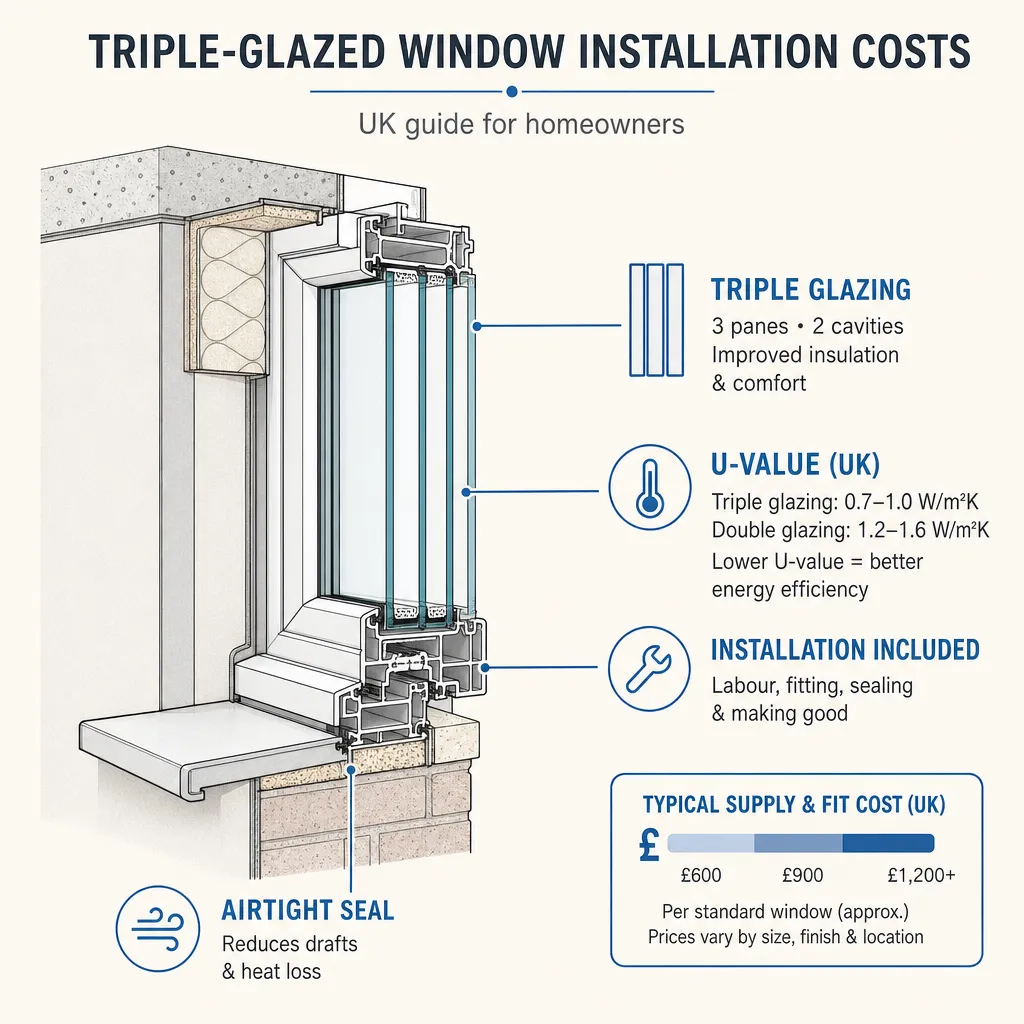
Triple-Glazed Window Installation Costs
Triple-glazed window installation in the UK typically costs £800–£1,800 per window, depending on size, frame material, and glazing specification.
 Improvement & Build
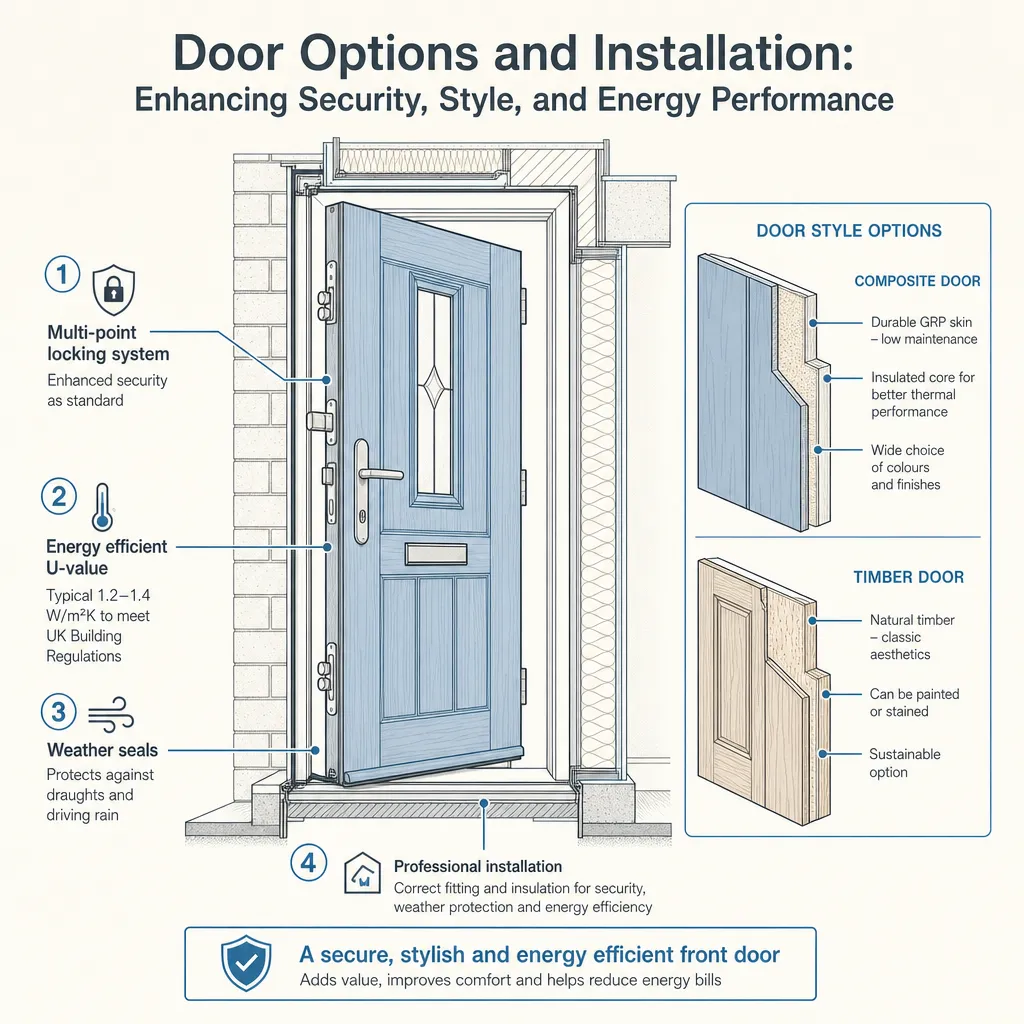
Door Options and Installation: Enhancing Security, Style, and Energy Performance
Choosing a new external door involves balancing security ratings, thermal performance, and style.