Understanding building foundations: what homeowners need to know
By Housey · Last reviewed 11th of May 2026
Understanding building foundations: what homeowners need to know
Foundations are the interface between a building and the ground beneath it — and when they fail, the consequences can range from cosmetic cracking to serious structural problems. Whether you are planning a new build, an extension, or investigating cracks in an existing property, understanding how foundations work helps you ask the right questions and recognise early warning signs before problems become expensive.
Key points
- Approved Document A of the Building Regulations sets out minimum structural requirements, including foundation depth and width relative to load and soil type.
- Strip foundations — the most common type in traditional UK housing — typically extend at least 1 metre deep in shrinkable clay soils to reach stable ground below the zone of seasonal moisture change.
- Clay soil covers roughly 30% of England and is the primary driver of subsidence-related insurance claims, as clay shrinks in dry summers and swells in wet winters.
- A ground investigation to BS 5930:2015 assesses soil bearing capacity, contamination, groundwater level, and seasonal movement risk before foundation design is finalised.
- Building Control must approve the foundation design as part of a Full Plans or Building Notice application before construction begins.
What types of foundations are used in UK homes?
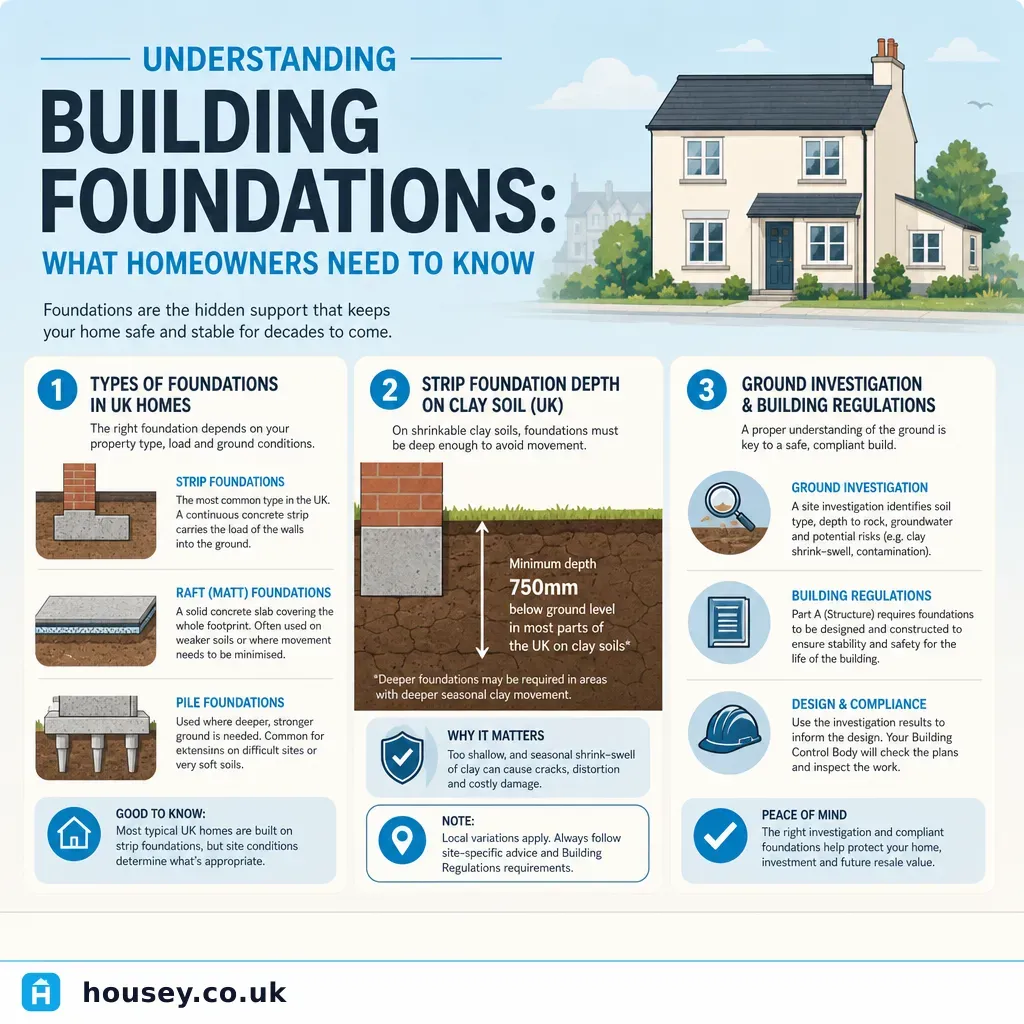
The foundation type depends on the building's load, the soil type, and the depth to stable ground. The main types used in UK residential construction are:
Foundation type | How it works | Typical use case | Key limitation |
|---|---|---|---|
Strip foundation | Continuous concrete strip under load-bearing walls | Traditional housing on stable or moderately shrinkable soils | Not suited to very soft or highly compressible ground |
Raft foundation | Reinforced concrete slab covering the full footprint | Weaker or variable soils; areas with mining history | More concrete-intensive; requires careful engineering design |
Pad foundation | Isolated concrete pads under columns or posts | Extensions, outbuildings, steel-framed structures | Only suited where loads are concentrated, not spread |
Pile foundation | Concrete or steel columns driven or bored to depth | Soft ground, sites near trees on clay, brownfield plots | Higher cost; requires specialist plant and structural design |
Trench fill | Strip-width trench filled with concrete to near-surface level | Clay soils where deeper excavation is required quickly | Less economical at very deep levels |
Most pre-1920 UK terraces and Victorian properties use strip foundations that are shallower by modern standards — often 450–600 mm deep. This is acceptable in stable ground but can become problematic if conditions change, such as through nearby tree removal, drought years, or altered drainage.
What affects foundation design and depth?
Several factors interact to determine how deep and wide a foundation must be:
Soil bearing capacity — How much load the ground can support without excessive settlement. Clay has lower bearing capacity than gravel or chalk; made ground (filled or imported land) is the most variable.
Soil type and shrinkability — The Building Research Establishment (BRE) classifies clay soils by shrinkage potential. High-shrinkage clays require foundations to reach at least 1 metre depth; where trees are present, BRE and NHBC guidance recommends depths of 1.5–3 metres depending on species and proximity.
Tree proximity — Trees extract moisture from clay soils, causing shrinkage and settlement. NHBC Standards Chapter 4.2 provides tables relating tree species, mature height, and required foundation depth or distance. Removing a mature tree can also trigger soil heave as moisture returns to the ground.
Groundwater level — A high water table affects excavation stability and may require waterproofing or a changed foundation strategy.
Site history — Brownfield sites, former mining areas, and made ground may have unpredictable bearing capacity and require more detailed investigation before a design can be confirmed.
Imposed loads — A two-storey rear extension places significantly more load on the ground than a single-storey garden room; the foundation must be sized accordingly.
How soil conditions affect foundations — and what to watch for
Ground movement causes the majority of foundation problems in UK homes. The key mechanisms are:
Shrinkage and heave — Clay soils contract when dry and expand when wet. This seasonal movement is predictable under stable conditions but becomes damaging when drainage changes, when trees are planted or removed nearby, or during prolonged drought.
Subsidence — Downward movement of the ground beneath a foundation, most often caused by clay shrinkage, water washing away soil from leaking drains, or soft or filled ground compressing under load.
Settlement — Normal compression of soil under a new load. Some settlement is expected in new construction. Differential settlement — where parts of the building sink at different rates — is the main concern.
Heave — Upward movement, most commonly seen after large trees are removed from clay-rich ground, as the soil reabsorbs moisture and expands.
Red flags that may indicate foundation movement
- Diagonal cracks running from the corners of windows or doors, particularly in a stepped pattern through brickwork
- Cracks that are wider at the top than at the bottom, or vice versa
- Sticking or ill-fitting doors and windows that have recently changed behaviour
- A visible lean or bow in a wall
- Sloping floors in a property where no deliberate slope exists
- Cracks that appear to widen or change with the seasons
Important: cracks have many causes, and most hairline or plaster cracks are cosmetic. If you are unsure, arrange a professional assessment before assuming a crack is foundation-related.
When do you need a ground investigation?
A ground investigation (also called a geotechnical investigation or site investigation) is typically required or recommended before:
- Designing foundations for a new build or substantial extension
- Building on a site with known ground risks — clay soils, brownfield land, former mining areas, or a high water table
- Investigating suspected subsidence or unexplained structural movement
- Designing a basement or any below-ground structure
A qualified geotechnical engineer or engineering geologist carries out the investigation under BS 5930:2015. The report typically covers soil classification and bearing capacity, groundwater level and seasonality, contamination screening (particularly on brownfield sites), and recommendations for foundation type and depth.
Building Control may require a ground investigation report before approving certain foundation designs.
Which professional do you need?
- Choose a structural engineer if you need foundation design for a new build, extension, or conversion, or if you are investigating existing cracks or suspected structural movement.
- Choose a geotechnical engineer if the site has complex ground conditions, contamination history, or you need a formal BS 5930:2015 ground investigation report.
- Choose a RICS Level 3 Building Survey if you are buying a property and want a detailed assessment of visible structural condition, including any signs of foundation movement.
- Instruct both a structural engineer and a geotechnical specialist if you are building on brownfield land, near trees on clay, or in an area with a history of mining.
- Contact your insurer first if you suspect active subsidence on an insured property — do not carry out works without their consent, as this may affect any claim.
Important limitations
This article provides general information about building foundations in UK residential construction. Foundation performance depends on site-specific conditions that no general guide can assess. Rules, depths, and requirements vary by soil type, site history, tree proximity, imposed load, and local planning conditions. A qualified structural engineer or geotechnical specialist should assess your specific property or project before any foundation work is designed or carried out.
What to ask a qualified professional
Before instructing a structural engineer or geotechnical specialist, ask:
- What type of investigation do you recommend for this site, and why?
- Will you produce a report to BS 5930:2015?
- How will the findings affect the foundation design and depth?
- Are there any tree-related risks on or adjacent to the site?
- Will Building Control accept your design without further investigation?
- How do you distinguish between active and historic movement?
- If subsidence is confirmed, what are the options and typical timescales?
When to get professional help
Contact a structural engineer or geotechnical specialist if:
- You see cracks that appear to be widening, particularly stepped cracks through brickwork or diagonal cracks from door or window corners
- Doors and windows have recently become harder to open or close
- You are planning a new build, extension, or conversion and need foundation design
- A home survey flags potential foundation movement or recommends further investigation
- You are buying a property with visible structural concerns and want a clearer picture before exchange
If you suspect active subsidence on an insured property, contact your insurer before instructing any remediation works.
How Housey can help
If you are planning a new build or extension on a challenging site, Housey connects you with qualified geotechnical and soil investigation specialists who can carry out a BS 5930:2015 ground investigation and provide site-specific recommendations. For foundation design and structural advice, our structural engineering service puts you in touch with chartered engineers experienced in UK residential construction.
Frequently asked questions
How deep do foundations need to be in the UK?
Foundation depth depends on soil type, clay shrinkability, tree proximity, and imposed load — there is no single national standard. Approved Document A provides minimum guidance, but Building Control requires site-specific design. In shrinkable clay soils without nearby trees, 1 metre is a common minimum depth. Close to trees on high-shrinkage clay, depths of 1.5–3 metres or piled foundations may be required. A structural engineer should specify depth based on a soil assessment.
Do I need building regulations approval for foundations?
Yes. Any new build, extension, or structural alteration requiring new or modified foundations must comply with Part A (Structure) of the Building Regulations. A structural engineer's design is typically submitted to Building Control as part of a Full Plans application, and approval must be granted before construction begins.
Can I build an extension over existing foundations?
It depends on the existing foundation's size, depth, condition, and the load the extension will impose. A structural engineer should assess whether existing foundations can take additional load or whether new or extended foundations are required. Never assume existing foundations are adequate without professional assessment — the consequences of getting this wrong can be severe and costly to remediate.
What is the difference between subsidence and settlement?
Settlement is the normal, expected compression of soil under a new load — it occurs in all new construction and generally evens out over time. Subsidence is unplanned downward movement after the property is built, typically caused by clay shrinkage, leaking drains, tree roots, or compressible ground. Subsidence is more serious, can affect insurance cover and property value, and usually requires professional investigation.
Sources and further reading
- Building Regulations Approved Document A: Structure — GOV.UK
- NHBC Standards Chapter 4.2: Building Near Trees — NHBC
- BRE Good Repair Guide: Subsidence, Heave and Landslip — Building Research Establishment
- BS 5930:2015 — Code of Practice for Ground Investigations — BSI Group
- Association of Geotechnical and Geoenvironmental Specialists — AGS
Useful next reads
 Planning & Pre-Build
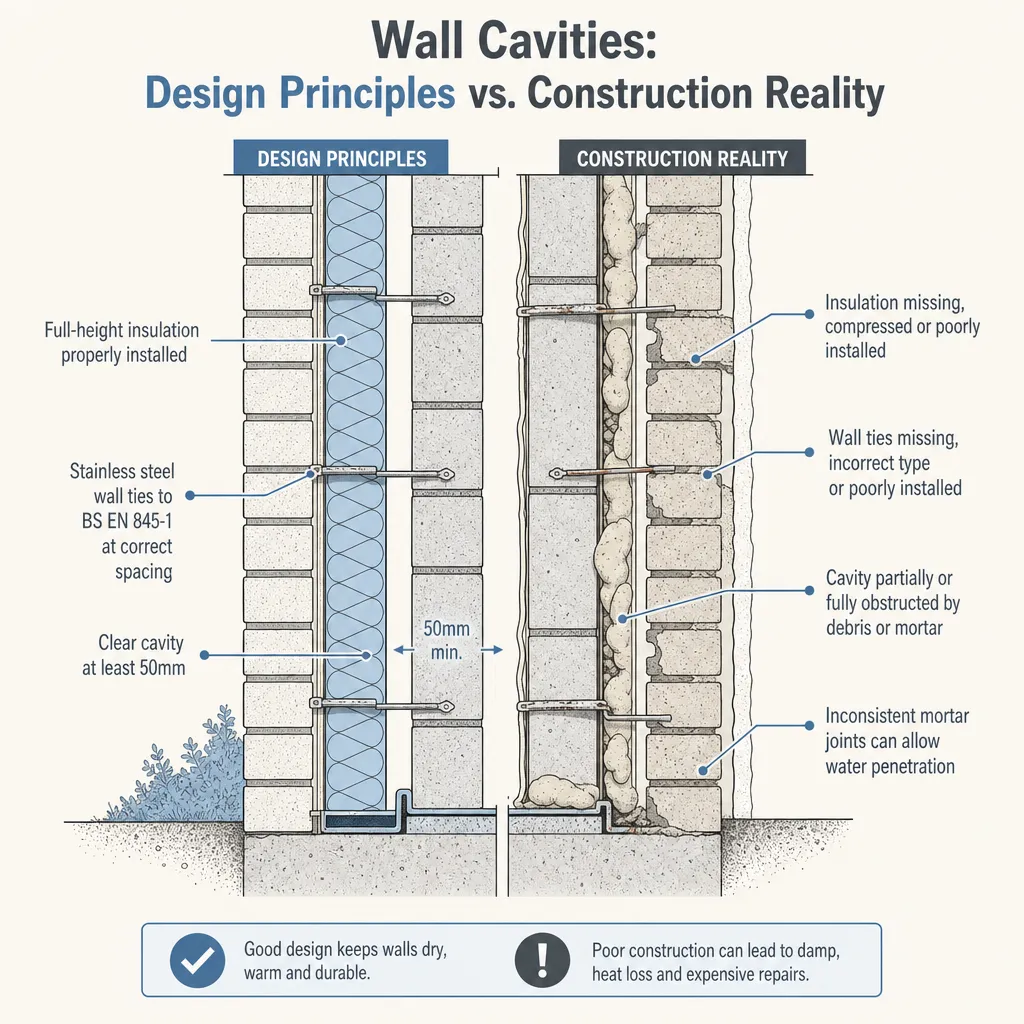
Wall Cavities: Design Principles vs. Construction Reality
A UK cavity wall is designed to resist weather, control heat loss, and structurally link two masonry leaves.
 Planning & Pre-Build
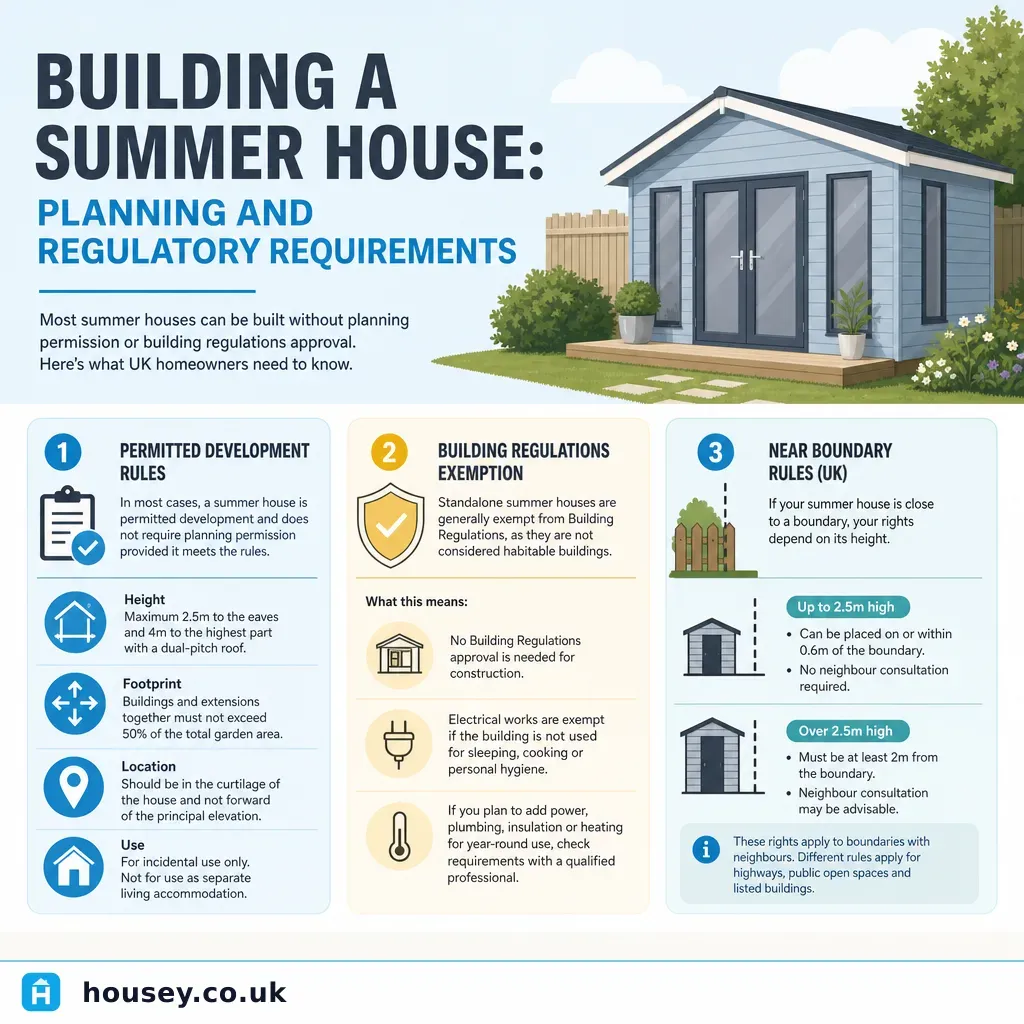
Building a Summer House: Planning and Regulatory Requirements
Most garden summer houses in England fall under Class E permitted development and need no planning permission, provided they are single-storey, within height limits, and not used for sleeping.
 Planning & Pre-Build
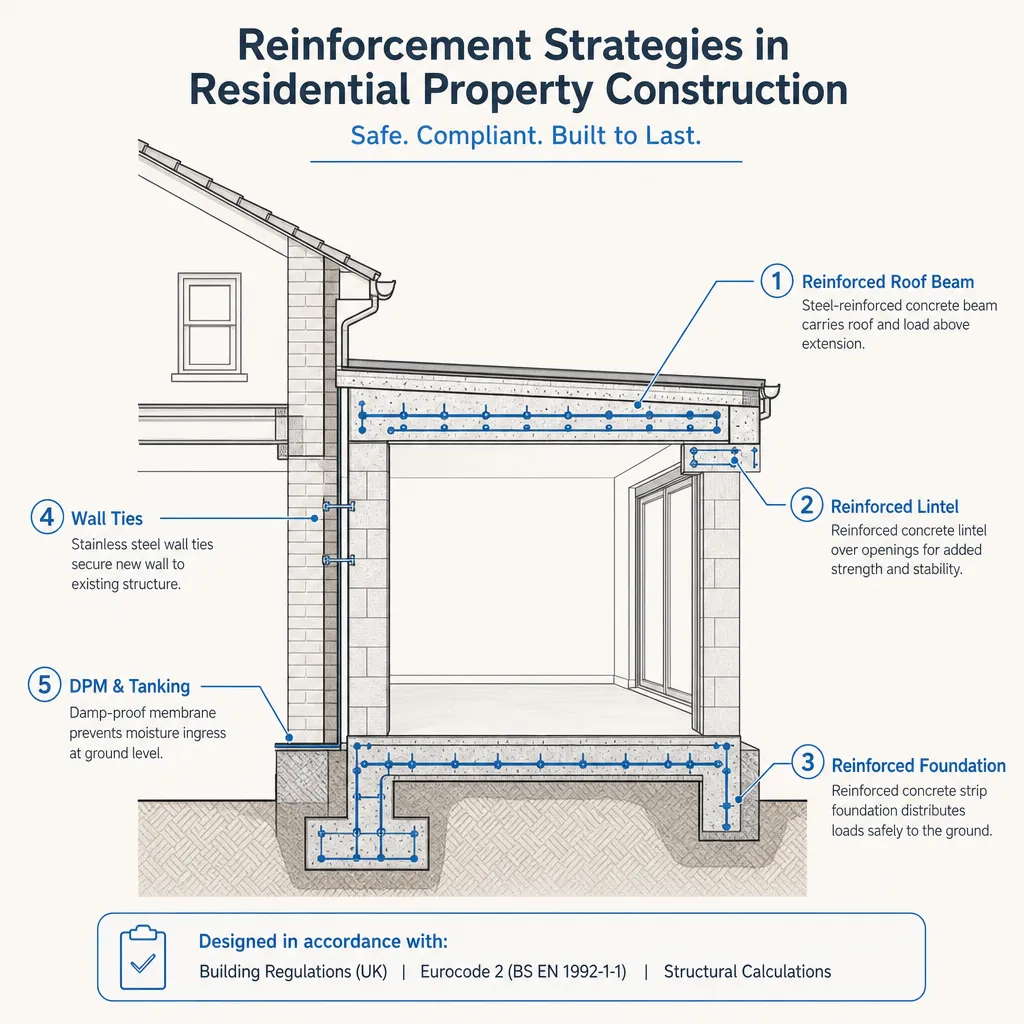
Reinforcement Strategies in Residential Property Construction
In UK residential construction, reinforcement is specified by a chartered structural engineer and must comply with Eurocode 2 and Building Regulations Approved Document A.
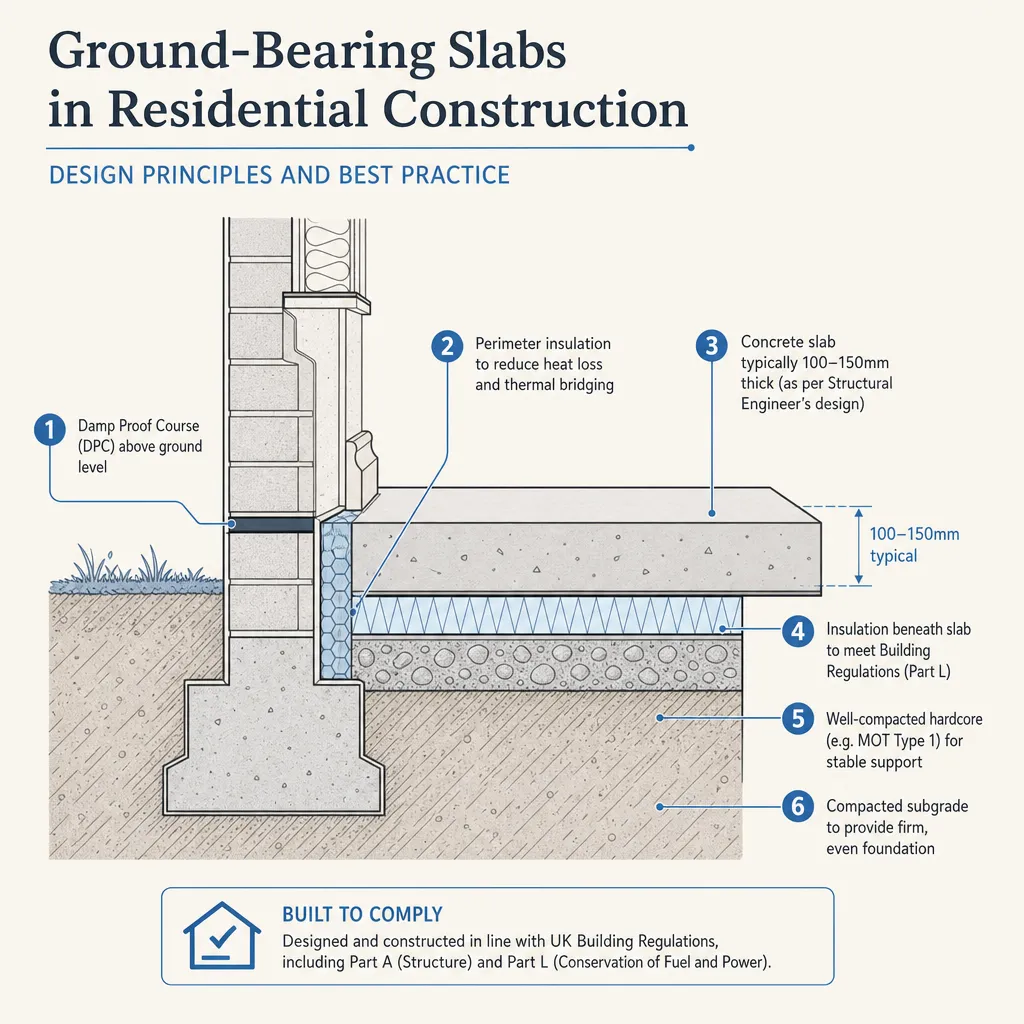 Planning & Pre-Build
Ground-Bearing Slabs in Residential Construction: Design Principles and Best Practice
A ground-bearing slab sits directly on compacted ground and must comply with Building Regulations Approved Documents A, C, and L.
 Planning & Pre-Build
Building a Bungalow in the UK: Design, Planning, and Costs
Building a bungalow in the UK typically costs £1,500–£3,000 per square metre, putting a 100m² bungalow at roughly £150,000–£300,000 in build costs before land, professional fees, and VAT.