Removal and Disposal Costs for Burglar Alarm Systems
By Housey · Last reviewed 6th of May 2026
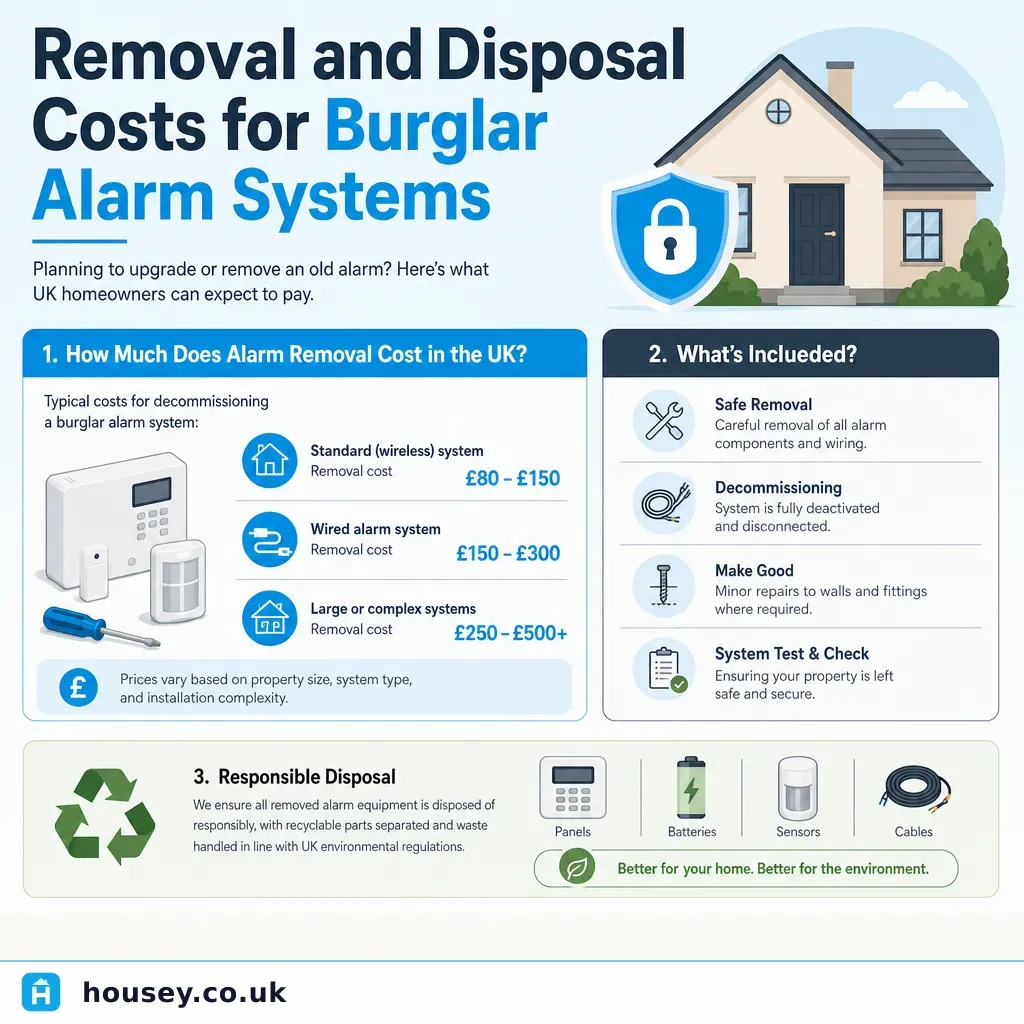
Removal and Disposal Costs for Burglar Alarm Systems
An outdated or non-functional burglar alarm is a common feature in UK homes — particularly those built or upgraded between the 1980s and early 2000s when wired systems were routinely installed. Whether you are preparing a property for sale, replacing an obsolete system, or simply removing a bell box that has not worked for years, understanding what removal and disposal involves helps you budget accurately, meet your legal obligations, and avoid unexpected costs.
Key points
- The Waste Electrical and Electronic Equipment (WEEE) Regulations 2013 require alarm components to be disposed of at an approved facility — standard household bins, general skips, and fly-tipping are not lawful disposal routes.
- Wired alarm systems cost significantly more to remove than wireless systems due to the labour required to trace, cap, and make good cabling run through walls, floors, and loft spaces.
- NSI (National Security Inspectorate) and SSAIB (Security Systems and Alarms Inspection Board) are the two main UK alarm industry inspection bodies — approved companies are held to formal professional standards.
- If your system is connected to an Alarm Receiving Centre (ARC) monitoring service, the monitoring contract must be cancelled separately before the hardware is decommissioned.
- An external bell box can often be removed as a standalone job, sometimes at lower cost than a full system decommission.
What removal typically involves
Removing a burglar alarm professionally is a multi-step process, not simply pulling components off the wall:
- Disabling the control panel and disconnecting the mains power supply.
- Disconnecting the backup battery — typically a sealed lead-acid unit, which requires separate disposal under battery regulations.
- Removing detection devices — passive infrared (PIR) sensors, door and window contacts, break-glass detectors, and any smoke or carbon monoxide detectors integrated into the system.
- Removing the control panel and associated back-boxes from the wall.
- Removing the external bell box — usually mounted high on the front or side elevation, which involves working at height.
- Making good — filling wall fixings, sealing external cable entry points, and capping any surface-run trunking, as agreed in writing beforehand.
- Disposing of all components correctly under the WEEE Regulations 2013.
The extent of making good varies between companies — clarify the scope in writing before authorising any work.
Wired versus wireless: how system type affects removal cost
| Wired alarm system | Wireless alarm system |
|---|---|---|
Removal complexity | Higher — cables often routed through walls, floors, and loft | Lower — components simply unmounted and taken away |
Typical labour time | 3–6 hours for a standard home | 1–3 hours |
Indicative removal cost | £150–£400+ | £80–£200 |
Making good required | Filled cable routes, sealed penetrations | Mainly wall fixing holes |
Risk of surface damage | Higher if cables are chased into plasterwork | Lower |
Indicative UK costs, last reviewed 2026-05-06. Costs vary by system complexity, property size, access conditions, and region.
Indicative costs for common scenarios
Scenario | Indicative cost (inc. VAT) |
|---|---|
External bell box removal only | £50–£150 |
Wireless system full removal (standard home) | £80–£200 |
Wired system full removal (3-bed property) | £150–£350 |
Wired system removal with full making good | £250–£500+ |
Same-day or emergency removal | Add 30–50% to base rate |
Indicative UK costs, last reviewed 2026-05-06. Obtain at least two written quotes; prices vary significantly by region and company.
WEEE disposal: your legal obligations
The Waste Electrical and Electronic Equipment (WEEE) Regulations 2013 (SI 2013/3113) are retained UK law requiring that electrical and electronic equipment is not disposed of in general household waste or by fly-tipping. Burglar alarm components — control panels, PIR sensors, bell boxes, keypads, and backup batteries — all fall within the WEEE classification.
In practice, a professional security company handles WEEE-compliant disposal as part of the job. If you are using a general builder or handyman, confirm that they:
- Can provide a waste transfer note as evidence of WEEE-compliant disposal.
- Will handle the backup battery separately — sealed lead-acid batteries are also subject to the Batteries and Accumulators (Placing on the Market) Regulations 2008.
- Will not dispose of components via a standard skip unless the contractor can confirm it accepts WEEE materials.
Your local council's household waste recycling centre (HWRC) will usually accept small electrical items for free under the WEEE take-back scheme — a useful option if you are managing disposal yourself after removing a simple wireless system.
Monitoring contracts: check before you decommission
If your alarm is connected to an Alarm Receiving Centre (ARC), that monitoring contract is entirely separate from the physical hardware. Before arranging removal:
- Contact your monitoring provider and give the required notice period — typically 30–90 days depending on your contract terms.
- Check for early termination fees and confirm whether any equipment is leased rather than owned outright.
- Confirm that the ARC will be notified on the specific day of decommissioning to prevent unnecessary emergency call-outs to your property.
Failing to cancel a monitoring contract before physical removal can result in continued monthly charges and false-alarm responses billed to you.
Red flags when hiring a removal company
Watch out for these warning signs before agreeing to any work:
- No written quote — a reputable company provides a fixed or clearly capped quote in writing before starting.
- No mention of WEEE disposal — ask specifically how components will be disposed of and request a waste transfer note.
- Pressure to upgrade before removal — some companies use a decommission visit to push new system sales; you are under no obligation to replace anything.
- No verifiable industry accreditation — look for NSI Gold or Silver approval, SSAIB certification, or membership of the British Security Industry Association (BSIA).
- Unusually low quotes — a very cheap price may exclude making good, proper WEEE disposal, or monitoring cancellation support.
- No public liability insurance — confirm the company holds adequate cover before any work begins on your property.
What to ask before accepting a quote
- Is the quote fixed, or could it change once work starts — and what would trigger a variation?
- Does the price include making good all wall fixings, cable routes, and external penetrations?
- How will you dispose of the components, and can you provide a WEEE waste transfer note?
- Are you NSI or SSAIB approved, and can you evidence this?
- Will you notify the Alarm Receiving Centre on the day of decommissioning if a monitoring contract is in place?
- Is VAT included in the quoted price?
- Do you carry public liability insurance, and can you confirm the level of cover?
When to get professional help
Removing a burglar alarm — particularly a wired installation — is not a straightforward DIY task. Use a qualified professional if:
- The system has a backup battery that requires safe disconnection and compliant disposal.
- Cables are run through the building fabric — walls, floors, or loft spaces — and need to be safely capped.
- The bell box is mounted at height on an external wall; working above 2 metres carries significant risk and requires appropriate access equipment.
- You have an active monitoring contract that requires formal handover and cancellation.
- The system uses proprietary technology requiring an engineer code to decommission without triggering a persistent fault condition.
For simple wireless systems with no monitoring contract, a competent handyman may be sufficient — but always confirm WEEE disposal arrangements before work begins.
How Housey can help
Housey helps UK homeowners find and compare quotes from vetted local tradespeople across a range of property services. If you need to remove an old alarm, decommission a wired system, or arrange a like-for-like replacement, Housey can help you connect with qualified providers in your area.
Frequently asked questions
Do I need a professional to remove a burglar alarm?
For simple wireless systems with no monitoring contract, a competent handyman can often remove the components. However, wired systems with backup batteries, cables routed through walls, or active monitoring connections should be decommissioned by an NSI or SSAIB approved security company to ensure safe working, correct disposal, and proper notification to any monitoring centre.
Can I leave a decommissioned bell box in place?
Yes — a non-functional bell box can legally remain on the exterior wall. Some homeowners leave a dummy box in place as a visual deterrent after the system has been decommissioned. If you want it removed, this can often be arranged as a standalone job at lower cost than a full system removal.
Will removing a burglar alarm affect my home insurance?
It may. Many insurers offer a discount for having an NSI or SSAIB approved alarm system, and removing it could increase your premium or affect cover conditions. Check with your insurer before decommissioning — some policies require notification of any material change to security measures at the property.
How long does burglar alarm removal take?
A wireless system in a standard home typically takes one to three hours. A wired system in a three to four bedroom property usually takes three to six hours, and longer if cables are extensively chased into plasterwork or the system is complex. Making good wall fixings and cable routes adds time to both scenarios.
What happens to the old alarm components?
A professional company should dispose of all components under the WEEE Regulations 2013, including the control panel, sensors, and backup battery. Ask for a waste transfer note as evidence of compliant disposal. Your local household waste recycling centre (HWRC) will usually accept small electrical items for free under the WEEE take-back scheme if arranging disposal yourself.
Sources and further reading
- WEEE Regulations 2013 — legislation.gov.uk
- NSI: National Security Inspectorate — find an approved company — National Security Inspectorate
- SSAIB: Security Systems and Alarms Inspection Board — SSAIB
- GOV.UK: Electrical waste — producer responsibilities — GOV.UK
- British Security Industry Association (BSIA) — BSIA
Useful next reads
 General property advice
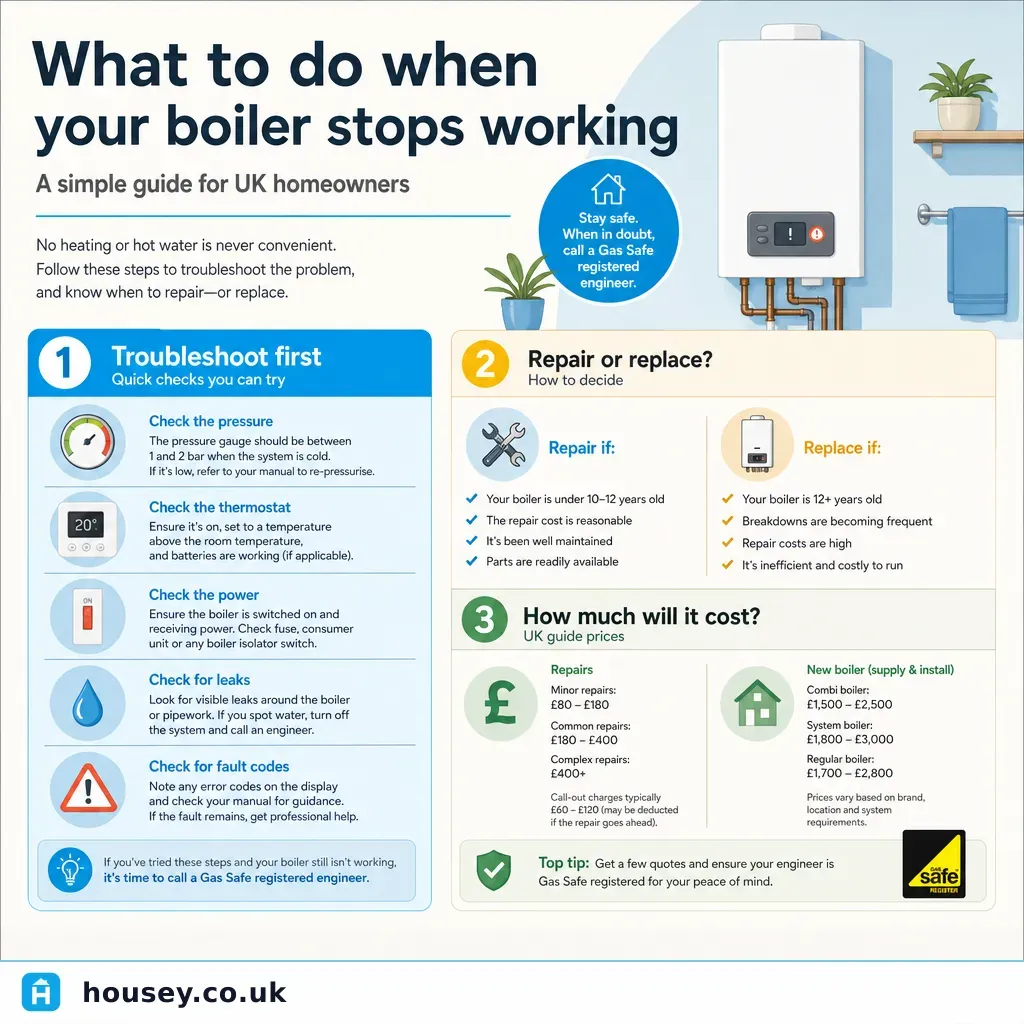
What to do when your boiler stops working
When your boiler stops working, check the pressure gauge (should read 1–1.
 General property advice
Property Market Trends: Activity Growth and Price Movements
UK property market activity is measured through completed sale registrations (HM Land Registry), lender mortgage data, and transaction volumes from HMRC.
 General property advice
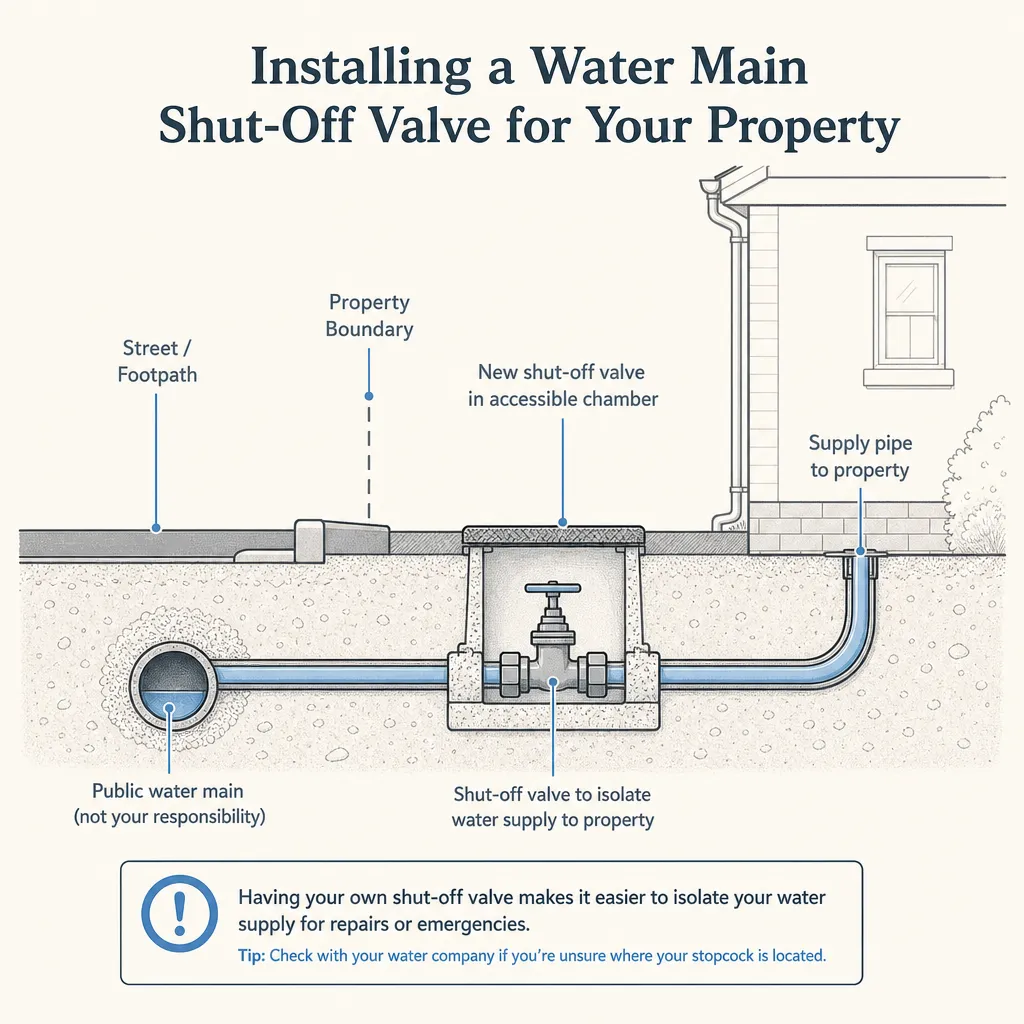
Installing a water main shut-off valve for your property
A water main shut-off valve — commonly called a stopcock — controls all water entering your home from the mains.
 General property advice
Monthly House Price Index: August Market Report and Analysis
The UK House Price Index is published monthly using completed Land Registry transaction data, meaning August figures typically reflect sales agreed months earlier.
 General property advice
Scottish Property Market: Activity and Regional Trends
Scotland's property market operates under distinct legal rules: sellers must provide a Home Report before marketing, transactions become legally binding at conclusion of missives rather than exchange of contracts, and Land and Buildings Transaction Tax replaces Stamp Duty.