Removing and Replacing Wooden Fence Posts
By Housey · Last reviewed 30th of May 2026
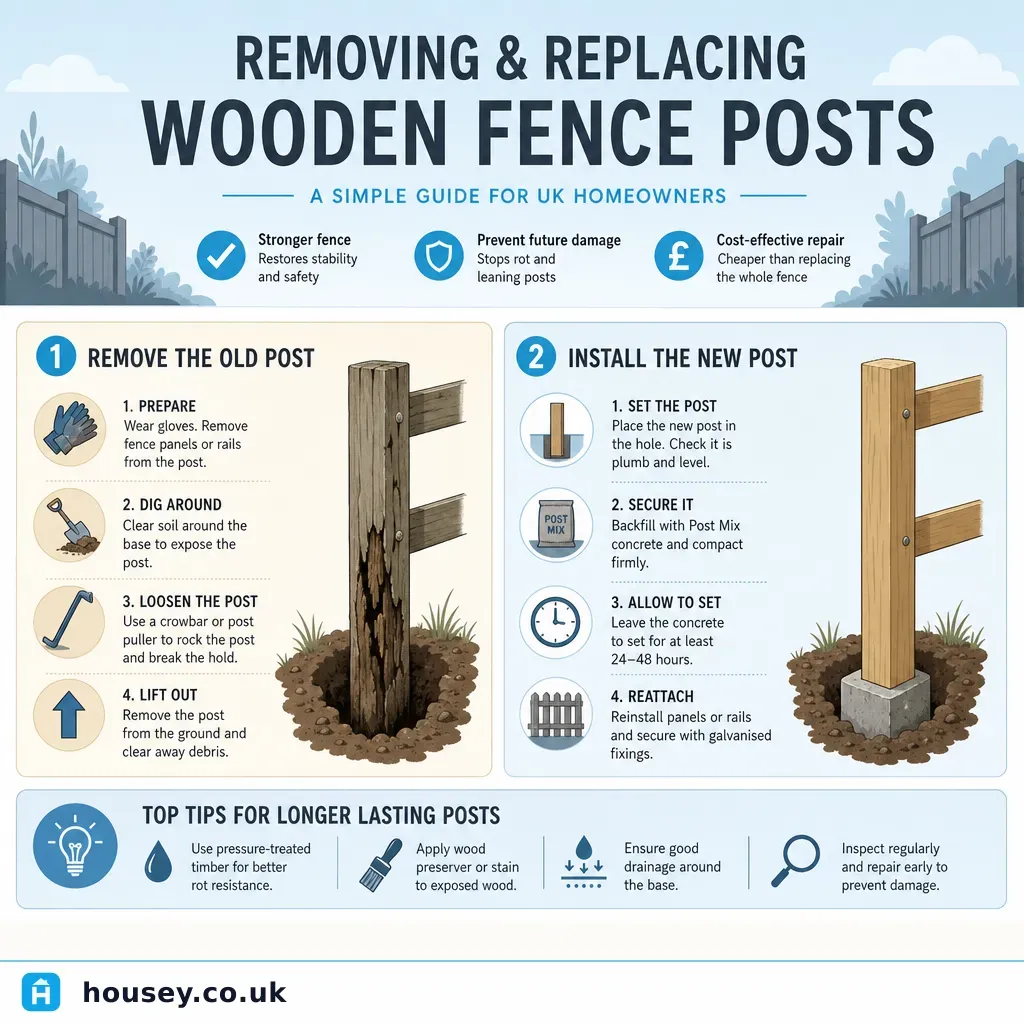
Removing and Replacing Wooden Fence Posts
Leaning or rotted fence posts are among the most common garden maintenance problems facing UK homeowners, particularly after a period of wet weather or following winter storms. The issue typically comes to a head when a panel has blown down or a post has failed visibly at ground level — and knowing what is involved before you start saves time, avoids repeat failures, and helps you obtain accurate quotes from contractors. Boundary responsibility, ground conditions, and fixing method all affect how the job should be approached.
Key points
- Fence post rot most commonly occurs at or just below ground level, where sustained moisture and soil contact combine — posts treated to Use Class 4 (UC4) are specified for ground contact and significantly outlast untreated timber.
- Concrete-set posts typically require a post-hole bar, crowbar, or manual post puller to extract — the concrete footing can weigh 30–60kg and may extend 450–600mm below the surface.
- Metal driving spikes are a faster alternative to poured concrete for replacement, but are suitable only for firm, unfrozen, stone-free ground and posts up to approximately 1.8m in height above ground.
- Fence boundary responsibility is usually recorded in your title deeds or title register at HM Land Registry — establish this before carrying out any work affecting a shared boundary.
- Permitted development rules do not require planning permission for most garden fences up to 2m high (or 1m where they adjoin a public highway), but listed buildings and conservation area properties may face restrictions.
Which fence post fixing method should you use?
The choice of fixing method affects how long the repair lasts and how easy future replacement will be.
Fixing method | Best for | Not ideal for | Typical longevity |
|---|---|---|---|
Concrete footing (poured in situ) | Posts up to 2.4m; exposed or windy sites; clay or sandy soil | Rocky ground; situations where removal may be needed again soon | 15–25 years with UC4-treated post |
Postcrete (fast-set dry mix) | DIY replacement; single posts; firm, well-drained soil | Waterlogged ground; posts under heavy lateral load | 10–20 years |
Metal driving spike | Replacement in firm, stone-free ground; lightweight panel fencing | Stony, soft, or waterlogged soil; tall or heavy posts in exposed locations | 10–15 years depending on spike quality |
Post support sleeve (surface-mounted) | Hard surfaces such as concrete or block paving; surface-mounted replacements | Soil or grassed areas | 10–20 years |
Repair spur (concrete or steel) | Extending the life of a partially rotted post where the upper section remains sound | Fully failed or structurally unsafe posts | 5–10 additional years |
DIY or hire a professional? A decision guide
- DIY is reasonable if you are replacing a single post, the old post is set in a spike or a modest footing, the ground is accessible and stone-free, and you have access to a post-hole bar or can hire one locally.
- Consider professional help if you are replacing more than three consecutive posts, the posts are set in large concrete blocks, the ground is very stony or heavy clay, or you are uncertain about underground services in the vicinity.
- Always instruct a professional if you plan to dig within 500mm of a suspected underground service run — check for gas, electric, water, and drainage pipes using the LSBUD service before any digging begins. Contact with buried services can be fatal.
- Check your title deeds first if there is any uncertainty about which property owns or is responsible for the fence — do not carry out work on a boundary fence without establishing this clearly.
How to remove a concrete-set fence post
Removal is often the most physically demanding part of the job. The method depends on how the original post was set:
Post set in poured concrete:
- Remove or detach the fence panels or rails from the post.
- Expose the concrete footing by digging around the base — typically 450–600mm deep and 300mm across.
- Use a post-hole bar (a heavy steel digging or fencing bar) to lever and loosen the footing from all four sides.
- If the post has rotted through at ground level, the concrete footing may lift out as a separate lump; use a crowbar or a manual post puller for better leverage.
- Break up old concrete with a club hammer and bolster chisel if the footing cannot be extracted in one piece.
- Remove all fragments and old post material before setting the replacement.
Post set in a driving spike:
Remove any rail or panel fixings, then twist and pull the post free. An undamaged spike can usually be reused in place, or removed using a purpose-made spike-extraction tool if replacement is needed.
Choosing the right replacement post
- Specify posts rated to Use Class 4 (UC4) — the use class for timber intended for ground contact. Look for this designation on the product label or technical data sheet at your builders' merchant or timber yard.
- Pressure-treated softwood (typically Scots pine or spruce treated with Tanalith-E or an equivalent preservative) is the standard choice across UK trade and builders' merchants.
- For a 1.8m-high fence, use a post with an overall length of approximately 2.4m, allowing around 600mm for embedment. A 75×75mm (3"×3") or 100×100mm (4"×4") cross section is appropriate depending on the weight and span of the panels.
- Hardwood posts (oak, sweet chestnut) are considerably more durable — potentially lasting 30+ years in ground contact — but typically cost three to five times the price of treated softwood.
- Gravel boards fitted at the base of fence panels keep the panel timber clear of soil contact and can significantly extend the life of the panels between post replacements.
Red flags: when replacement is more complex than expected
These signs indicate the job may need professional assessment before you proceed:
- Multiple consecutive posts leaning in the same direction — this can indicate inadequate footing specification throughout the run, soil movement, or a drainage problem rather than simple post rot at one location.
- Post failure at mid-height rather than at ground level — failure above ground can indicate timber defect, vehicle impact, or loadings the fence was not designed to carry; repeating the same specification may repeat the failure.
- Proximity to underground services — any digging within 500mm of a suspected service run should be carried out by hand, only after checking with LSBUD, and ideally by a qualified groundworker.
- Significant tree roots — roots can displace footings and cause repeat post failure; the root issue may need to be addressed alongside the repair rather than after.
- Posts on a slope or retaining bank — posts on sloped ground require deeper embedment and sometimes a different footing design; seek professional advice before proceeding.
- Fence in a boundary dispute — do not carry out repairs on a contested boundary fence; seek legal advice or mediation before any works start.
What to ask before hiring a fencing contractor
- How many posts are included in the quote, and what size, species, and use class will be used?
- Will old concrete footings be fully excavated and removed, and is waste disposal included in the price?
- What fixing method will you use, and is it appropriate for the ground conditions on this site?
- Are the posts rated to Use Class 4 (UC4) for ground contact?
- Do you carry current public liability insurance?
- Is VAT included in the quoted price?
- What happens if you encounter rock, large roots, or underground services during excavation?
When to get professional help
A single post replacement is often manageable for a capable homeowner, but use a professional if:
- You are replacing three or more posts, particularly where large concrete footings are involved
- Ground conditions are stony, waterlogged, or heavily compacted
- You are uncertain about underground services in the area — always check via LSBUD before digging
- The fence sits on a sloped or retaining bank where footing design is more critical
- A boundary dispute needs to be resolved before work can safely proceed
How Housey can help
Housey connects you with experienced groundworkers and landscapers who carry out fence post removal and replacement as part of garden and boundary maintenance work. A professional quote is especially worthwhile for longer runs of fencing or where ground conditions make the job more involved than a straightforward single-post replacement.
Frequently asked questions
Who is responsible for a fence between two properties in the UK?
Boundary responsibility is usually recorded in your title deeds or transfer document, often shown by a 'T' mark on the boundary plan — the property on whose side the T sits is typically responsible. The title register at HM Land Registry may also indicate this. If deeds are unclear, seek legal advice before carrying out work on or near the shared boundary.
How deep should a fence post be set?
The standard guidance is to set a post to approximately one-third of its total length. For a 1.8m-high fence using a 2.4m post, aim for around 600mm of depth. Posts on soft or waterlogged ground, or in exposed and windy locations, may need to be set deeper to achieve adequate stability.
How much does it cost to have a fence post replaced professionally in the UK?
Indicative UK costs for professional fence post replacement typically range from £80–£200 per post including labour and materials, depending on whether a large concrete footing needs to be excavated and removed, and on site and ground conditions. Indicative UK costs, last reviewed 2026-05-30. Prices vary by region — obtain at least three quotes.
Can I use a metal spike instead of setting a post in concrete?
Yes, in suitable conditions. Metal driving spikes are faster to install and easier to remove for future replacement, but they are not appropriate for soft, waterlogged, or very stony ground, and most manufacturers do not recommend them for posts taller than 1.8m in exposed locations. Always check the manufacturer's load and height specification for the spike size you are using.
Sources and further reading
- Fences, gates and garden walls – planning guidance — Planning Portal
- Boundary disputes guidance — GOV.UK
- LSBUD – checking for underground services before you dig — LSBUD
- Timber use classes and preservative treatment guidance — TRADA (Timber Research and Development Association)
Useful next reads
 Improvement & Build
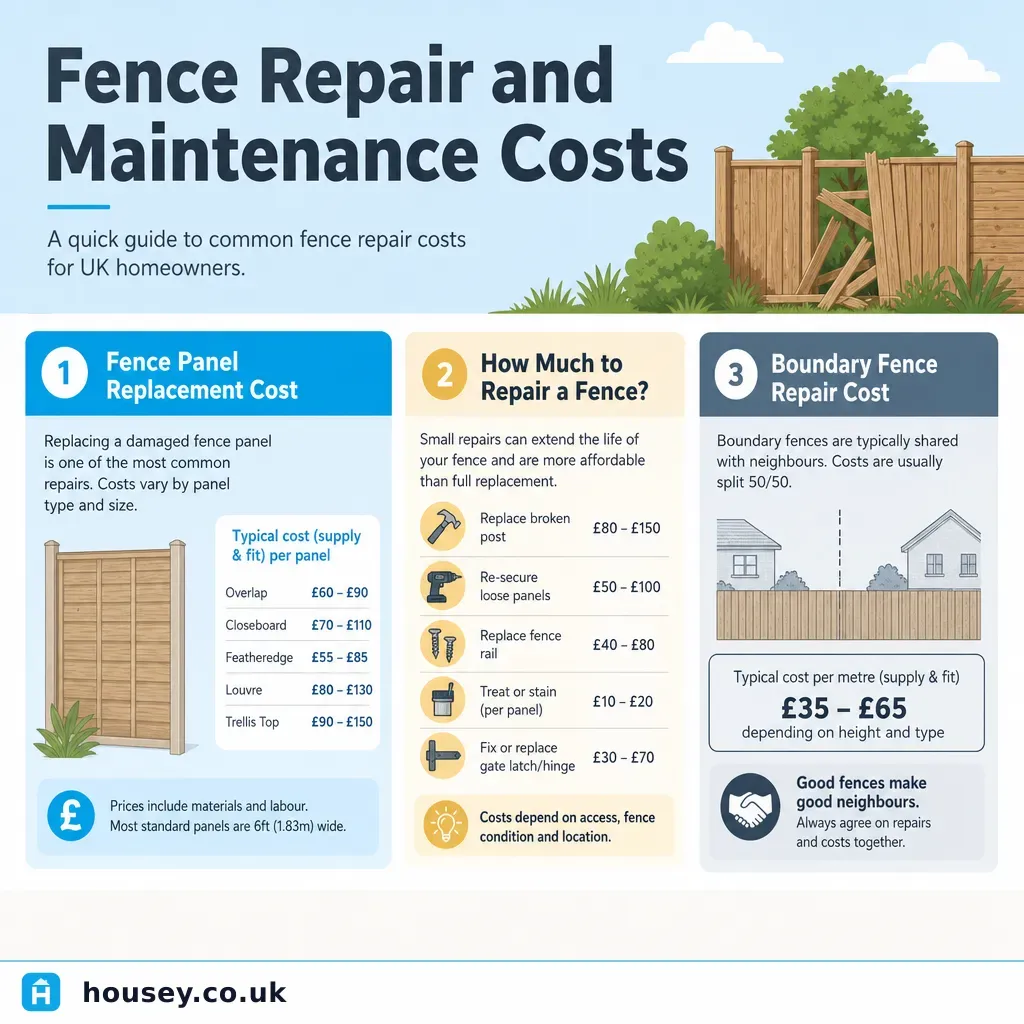
Fence Repair and Maintenance Costs
Fence repair costs in the UK typically range from £100–£250 for a single panel replacement to £500–£1,500 or more for multiple panels or post repairs.
 Improvement & Build
Fence Painting and Exterior Wood Treatment Costs
Professional fence painting or wood treatment in the UK typically costs £150–£400 for an average 30-panel garden fence, or roughly £5–£15 per panel.
 Improvement & Build
Protecting Your Garden: Plant Tunnels and Growing Structures
Plant tunnels and growing structures extend the UK growing season by protecting crops from frost, wind, and pests.
 Improvement & Build
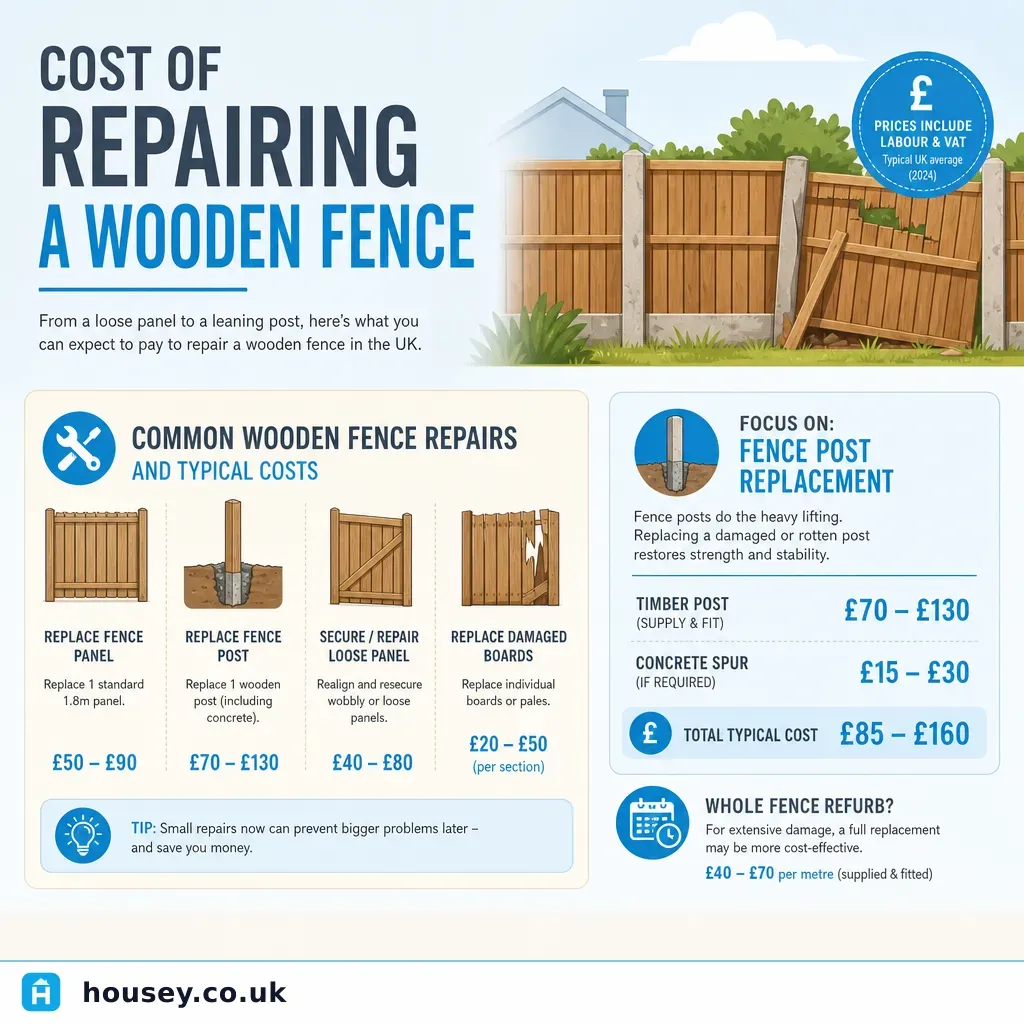
Cost of repairing a wooden fence
Repairing a wooden fence in the UK typically costs £100–£400 for minor work such as replacing boards or refixing panels, rising to £500–£1,500 for more extensive repairs including post replacement.
 Improvement & Build
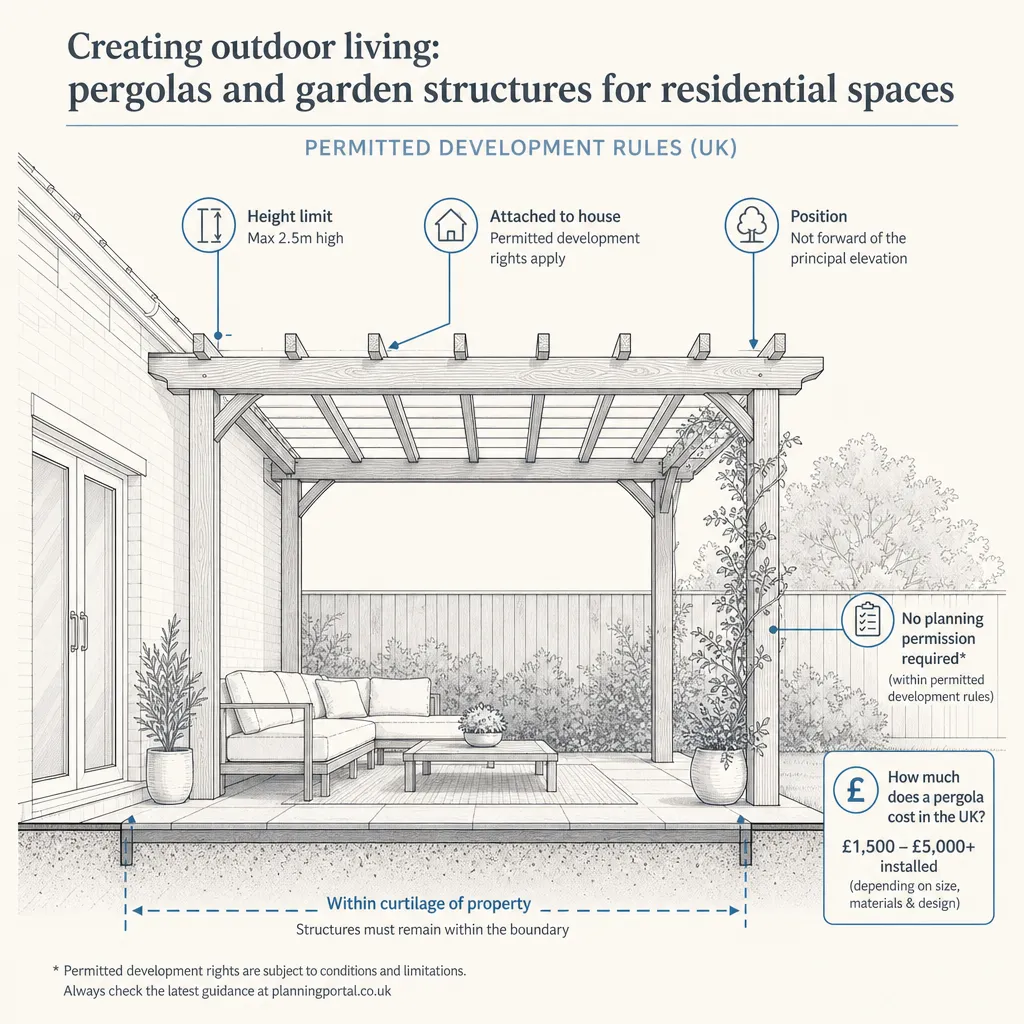
Creating outdoor living: pergolas and garden structures for residential spaces
Most freestanding pergolas in UK rear gardens are permitted development and don't need planning permission, provided they stay within height limits and outbuilding coverage stays below 50% of the original garden.