Removing Cavity Wall Insulation: When and How Much It Costs
By Housey · Last reviewed 5th of May 2026
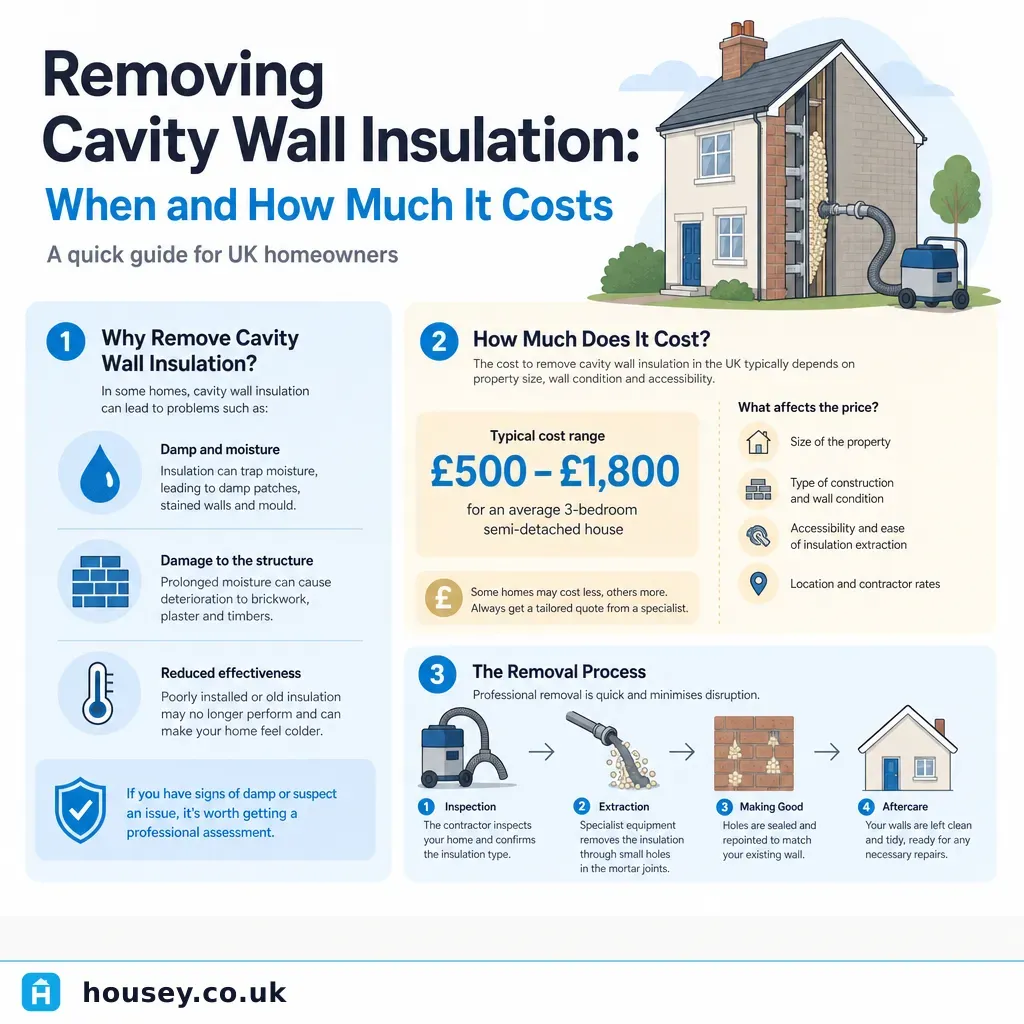
Removing Cavity Wall Insulation: When and How Much It Costs
Cavity wall insulation (CWI) was installed in millions of UK homes from the 1970s onwards, often through government-backed schemes including CERT, CESP, and ECO. A significant proportion of those installations have since caused problems — damp patches, peeling wallpaper, and mould around window reveals are common complaints, particularly in properties where the insulation was unsuitable for the wall type, exposure level, or cavity dimensions. Understanding when removal is necessary, what the process involves, and what it is likely to cost helps homeowners act on this without either ignoring a genuine problem or commissioning expensive work prematurely.
Key points
- Poorly installed or degraded CWI is a recognised cause of penetrating damp in UK homes, particularly in properties with narrow cavities (under 50mm), exposed locations, or non-standard construction.
- The Cavity Insulation Guarantee Agency (CIGA) administers 25-year guarantees for installations carried out under approved schemes — if the guarantee is in force, remediation or removal may be funded by the installer or their insurer at no cost to you.
- Indicative UK removal costs for a semi-detached property are £2,000–£6,000, depending on insulation type, property size, and access difficulty (indicative UK costs, last reviewed 2026-05-05).
- The standard removal method involves drilling 22mm extraction holes at regular intervals across the external wall, then using industrial vacuum equipment to extract the material.
- Not all walls can be re-insulated once the original material is removed; a specialist survey of wall-tie condition, cavity depth, and masonry integrity should precede any re-insulation decision.
Why cavity wall insulation fails
CWI performs well in many UK properties but can fail when installed in the wrong context. The most common failure modes are:
Unsuitable exposure zone. Properties in high or very severe wind-driven rain exposure zones — classified under BS 8104 — are at greater risk of moisture penetrating through masonry. Blown fibre and mineral wool insulation can absorb moisture and bridge it inward, causing penetrating damp on internal surfaces.
Narrow or non-standard cavity. Cavities narrower than 50mm are generally considered unsuitable for fill insulation. Some installations carried out under scheme pressure in the 1980s and 1990s filled cavities that did not meet minimum specifications.
Poor installation technique. Under-filled cavities, incorrect drill spacing, and use of material unsuited to the cavity width have all been documented in post-installation surveys.
Natural degradation. Blown mineral wool installed in the 1980s can compact and shift over time, creating cold bridges and uneven coverage.
EPS bead migration. Expanded polystyrene bead insulation, while generally more moisture-resistant than fibre products, can migrate through gaps in deteriorated mortar perps if cavity barriers have failed.
Signs that removal may be necessary
The following are red flags that CWI may be causing or worsening a damp problem. If you are seeing several together, commission a specialist assessment before spending on redecoration or internal damp treatments.
- Damp patches appearing on internal walls, particularly at mid-storey level or around window reveals, following heavy rainfall or sustained periods of wind-driven rain.
- Mould growth on external-facing walls that returns rapidly despite improvements to ventilation.
- A damp and timber survey confirming penetrating damp — rather than condensation or rising damp — as the primary mechanism.
- Evidence of failed or incorrectly distributed CWI visible through a borescope inspection hole.
- Your property is in a high or very severe exposure zone according to BS 8104 or NHBC guidance.
- The cavity is narrower than 50mm — a dimension a specialist can confirm by drilling a sample hole.
- Damp symptoms appeared or worsened after a CWI installation, rather than predating it.
The removal process: what happens
- Initial borescope inspection. A contractor drills a small sample hole and uses a borescope camera to inspect the existing material, confirm the insulation type, and assess how densely the cavity is filled.
- Extraction drilling. 22mm holes are drilled in a grid pattern across the external face of the wall — typically at 600mm vertical intervals — following BBA guidance or insurer requirements.
- Vacuum extraction. Industrial vacuum equipment draws the material out through the drilled holes. EPS beads can often be collected and recycled; mineral wool or blown fibre is bagged as waste.
- Hole reinstatement. Drill holes are filled with matching mortar and allowed to cure. On rendered properties, the render is patched to match the surrounding finish.
- Post-extraction camera inspection. A borescope or push camera confirms the cavity is clear.
- Drying period. Masonry should be allowed to dry thoroughly — typically a minimum of six months — before any re-insulation is considered.
The full process for a typical three-bedroom semi-detached house usually takes one to two working days.
How much does removal cost?
Costs depend on property size, insulation type, and access difficulty. The table below shows indicative UK ranges.
Property type | Indicative removal cost | Notes |
|---|---|---|
Mid-terrace (2-bed) | £1,500–£3,000 | Two external elevations only |
Semi-detached (3-bed) | £2,000–£4,500 | Three external elevations |
Detached (3–4 bed) | £3,000–£6,000 | Four elevations, more drilling |
EPS bead removal | Add 10–20% | Different extraction process |
Post-removal re-insulation | £1,200–£2,500 additional | Only if walls confirmed dry and suitable |
Indicative UK costs, last reviewed 2026-05-05. Costs vary by region and contractor. Always obtain at least three quotes.
These figures exclude any associated damp remediation, plaster hack-off, or internal redecoration — work that is often needed alongside extraction.
Will CIGA or the installer cover the cost?
If your CWI was installed under a government-backed scheme, it should carry a CIGA 25-year guarantee. If the installation is defective and the guarantee is still in force, CIGA's dispute resolution process can result in remediation or removal at the installer's or their insurer's expense.
To check whether a guarantee exists, search the CIGA online register using your property postcode. If the original installer is no longer trading, CIGA's Guarantee Protection Insurance may still cover the cost.
Where no CIGA guarantee applies — common for older or privately arranged installations — the homeowner usually bears the full cost.
Should you re-insulate after removal?
Not always. Use this decision guide before commissioning re-insulation work.
- Re-insulate if the cavity is confirmed clear and dry after at least six months, the masonry is in good condition, wall ties are sound, and the property is in a low or moderate exposure zone.
- Do not re-insulate if the exposure zone is high or very severe, the cavity is narrower than 50mm, or the masonry is porous or structurally defective.
- Seek specialist advice if the cavity contains significant mortar droppings, wall ties are corroded, or the construction type is non-standard — for example, prefabricated concrete or no-fines concrete.
- Consider alternative measures such as external wall insulation (EWI) or internal wall insulation (IWI) where the cavity cannot safely be refilled. A retrofit assessor accredited under PAS 2035 can advise on what is appropriate for your property.
Important limitations
The information in this article is general guidance only. Cavity wall insulation failure, penetrating damp, and remediation decisions are technically complex and vary considerably depending on your specific property — its construction era, exposure zone, existing damp profile, and wall-tie condition. No article can substitute for a professional survey and assessment. Rules around CIGA guarantees and installer liability can change; always verify the current position directly with CIGA or a specialist contractor. This article does not constitute structural, damp, or legal advice.
What to ask a qualified professional
Before instructing a contractor to remove cavity wall insulation, ask:
- What evidence confirms that the CWI — rather than another source such as condensation, rising damp, or a plumbing leak — is causing the damp?
- Will you carry out a borescope or camera inspection both before and after extraction?
- Is my installation registered with CIGA, and can you help me raise a guarantee claim before work begins?
- What insulation type is currently installed, and how does that affect the extraction method and total cost?
- What will you use to reinstate the drill holes, and will the finish match the surrounding masonry or render?
- How long should the wall dry before re-insulation is considered, and what evidence will you require before recommending it?
- What accreditations do you hold for extraction work — are you a CIGA member or TrustMark registered?
- Will you provide a written report confirming the cavity is clear after extraction, with before-and-after photographic records?
When to get professional help
Commission a specialist damp and cavity wall inspection before taking any action if:
- You have visible damp but are not certain CWI is the cause — condensation and plumbing leaks can produce similar symptoms and must be ruled out first.
- Your property is an unusual construction type — prefabricated concrete, steel frame, or timber frame — where standard extraction methods may not apply.
- You are planning to sell — unresolved CWI issues can complicate conveyancing and are likely to be identified by a buyer's surveyor.
- A CIGA claim has been disputed and you need independent evidence of defective installation.
How Housey can help
If you suspect your cavity wall insulation is failing, Housey can connect you with specialist insulation contractors and independent damp and timber survey professionals, so you can confirm the cause and compare quotes before any extraction work begins.
Frequently asked questions
Is cavity wall insulation removal covered by insurance?
Usually not under standard home insurance. If the installation was defective and covered by a CIGA guarantee, the installer or their insurer may meet the cost. For privately arranged installations without a guarantee, you are unlikely to have a route to third-party funding unless you can establish negligent installation through a surveyor's report.
How long does cavity wall insulation removal take?
A typical three-bedroom semi-detached house takes one to two working days. Larger detached properties with four exposed elevations may take two to three days. EPS bead extraction can take longer than mineral wool removal due to different vacuum requirements.
Can I have insulation put back in after removal?
Possibly, but not immediately. The masonry needs a minimum of six months to dry out fully before any new insulation is installed. If the property is in a high-exposure zone, re-insulating the cavity may not be appropriate at all — alternative approaches such as external wall insulation should be explored with a PAS 2035 retrofit assessor.
Does removal require planning permission or building regulations approval?
Removing existing CWI generally does not require planning permission or building regulations approval. However, if you intend to re-insulate with a different system such as external wall insulation, building regulations Part L may apply. Check with a building control officer or your local planning authority if you are unsure.
Will removal fix the damp straight away?
Not instantly. Once the insulation is removed, the masonry needs time to dry before internal conditions improve noticeably. Internal redecoration — including hack-off of salt-contaminated plaster in some cases — may also be needed. Full resolution of symptoms typically takes six to twelve months.
Sources and further reading
- Cavity Insulation Guarantee Agency (CIGA) — guarantee register, claims process, and installer accreditation
- GOV.UK: ECO scheme overview — DESNZ, background on government-backed CWI schemes
- PAS 2035:2023 — Retrofitting Dwellings for Improved Energy Efficiency — BSI, the specification governing retrofit assessments and coordinator roles
- NHBC Technical Standards — NHBC, exposure zone classification and cavity fill suitability guidance
Useful next reads
 Energy & Retrofit
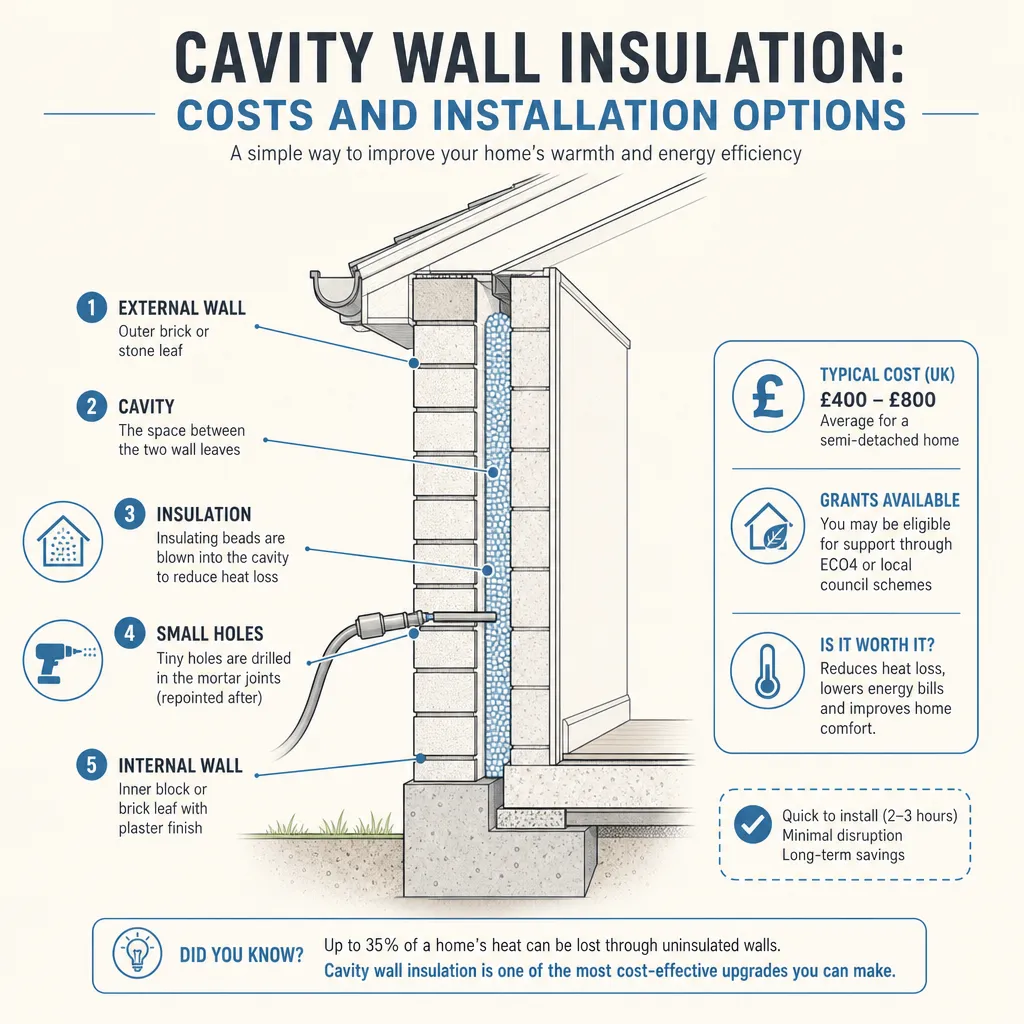
Cavity Wall Insulation: Costs and Installation Options
Cavity wall insulation typically costs £400–£1,200 for a standard UK semi-detached home, though eligible households may pay nothing under ECO4.
 Energy & Retrofit
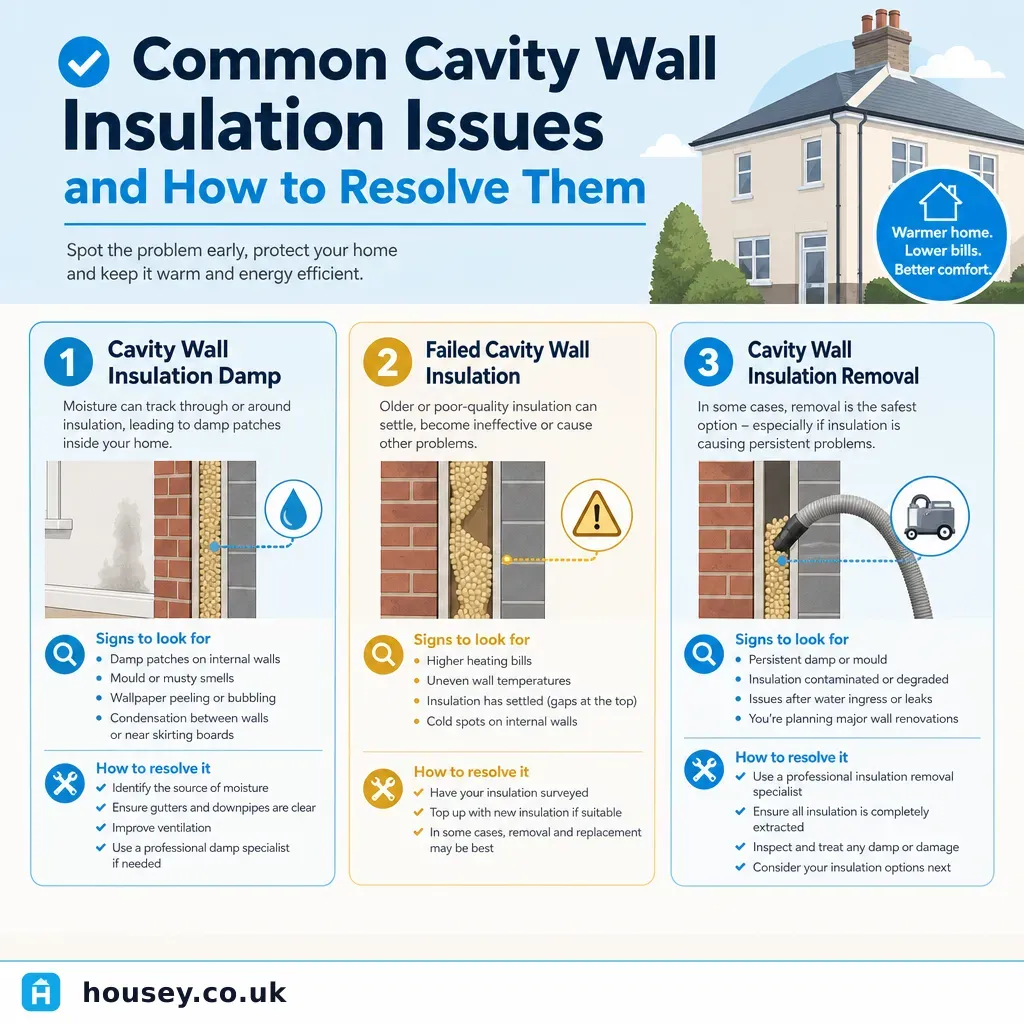
Common Cavity Wall Insulation Issues and How to Resolve Them
Cavity wall insulation problems typically include damp penetration through the outer leaf, settlement leaving voids in the cavity, and cold bridging causing condensation on internal walls.
 Energy & Retrofit
Electric Versus Gas Boiler Systems: A Practical Comparison
Electric boilers convert nearly all electricity into heat (98–99% efficiency) but electricity costs roughly 3–4 times more per kWh than gas, making running costs higher in most UK homes.
 Energy & Retrofit
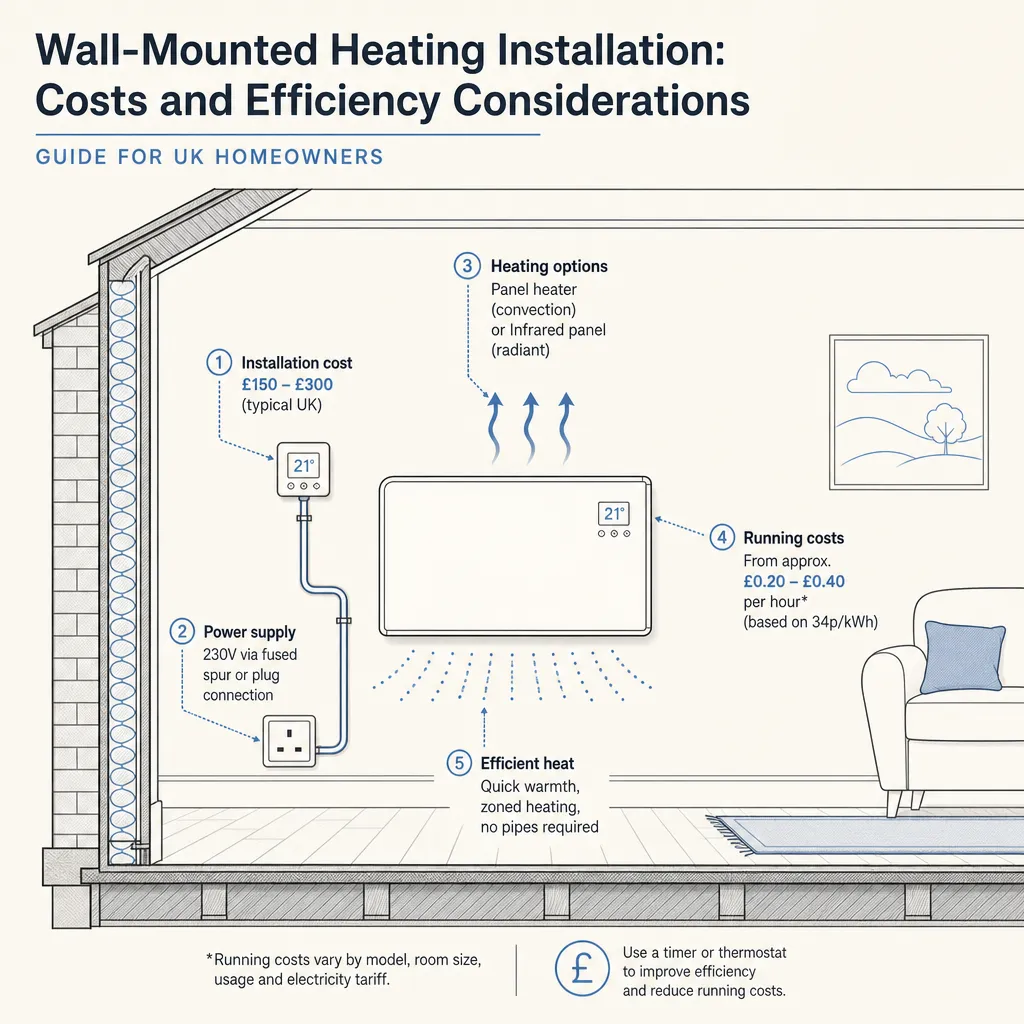
Wall-Mounted Heating Installation: Costs and Efficiency Considerations
Wall-mounted electric heaters fall into three main types: convection panel heaters, infrared panels, and electric wall radiators.
 Energy & Retrofit
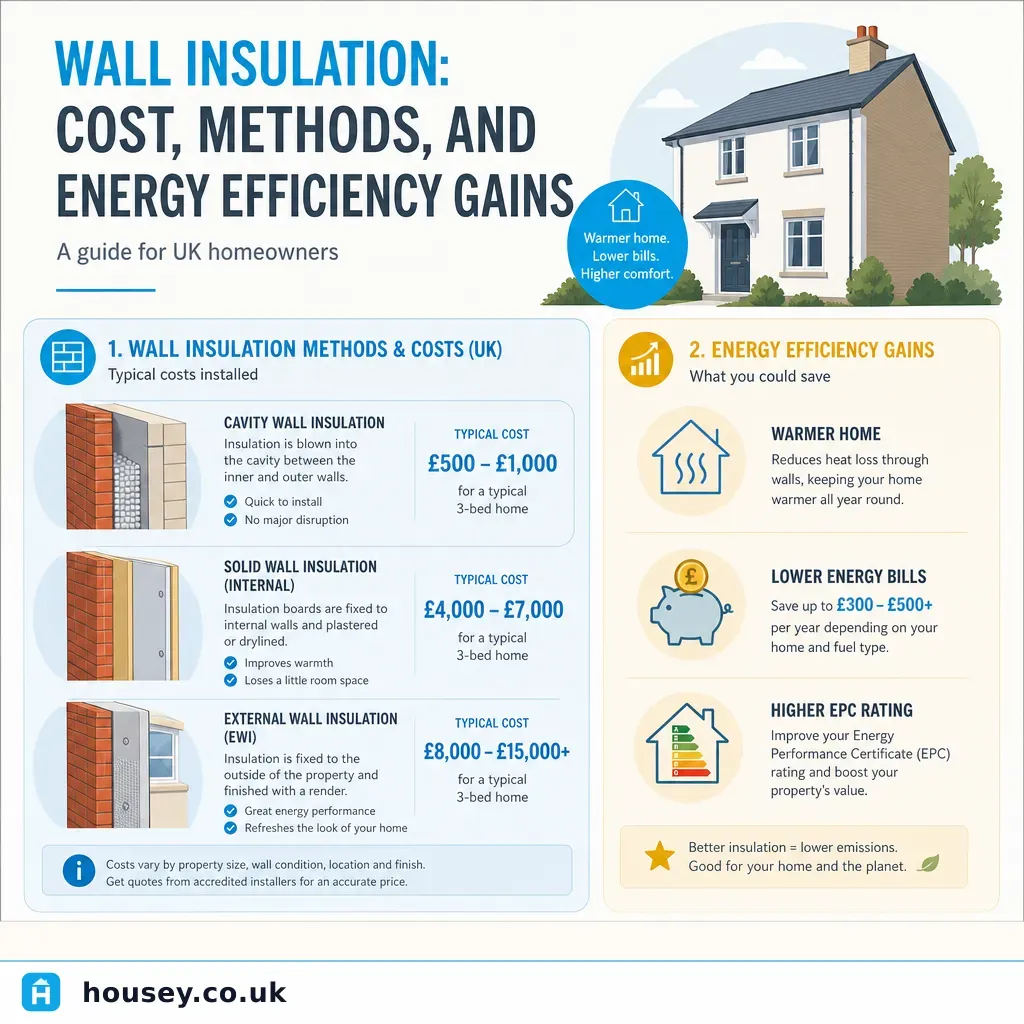
Wall Insulation: Cost, Methods, and Energy Efficiency Gains
Wall insulation in UK homes uses one of three main methods: cavity wall insulation for post-1920 homes with an unfilled cavity, external wall insulation for solid-walled properties, and internal wall insulation where external changes are not permitted.