Removing Conifer Trees: Safety, Logistics, and Costs
By Housey · Last reviewed 6th of May 2026
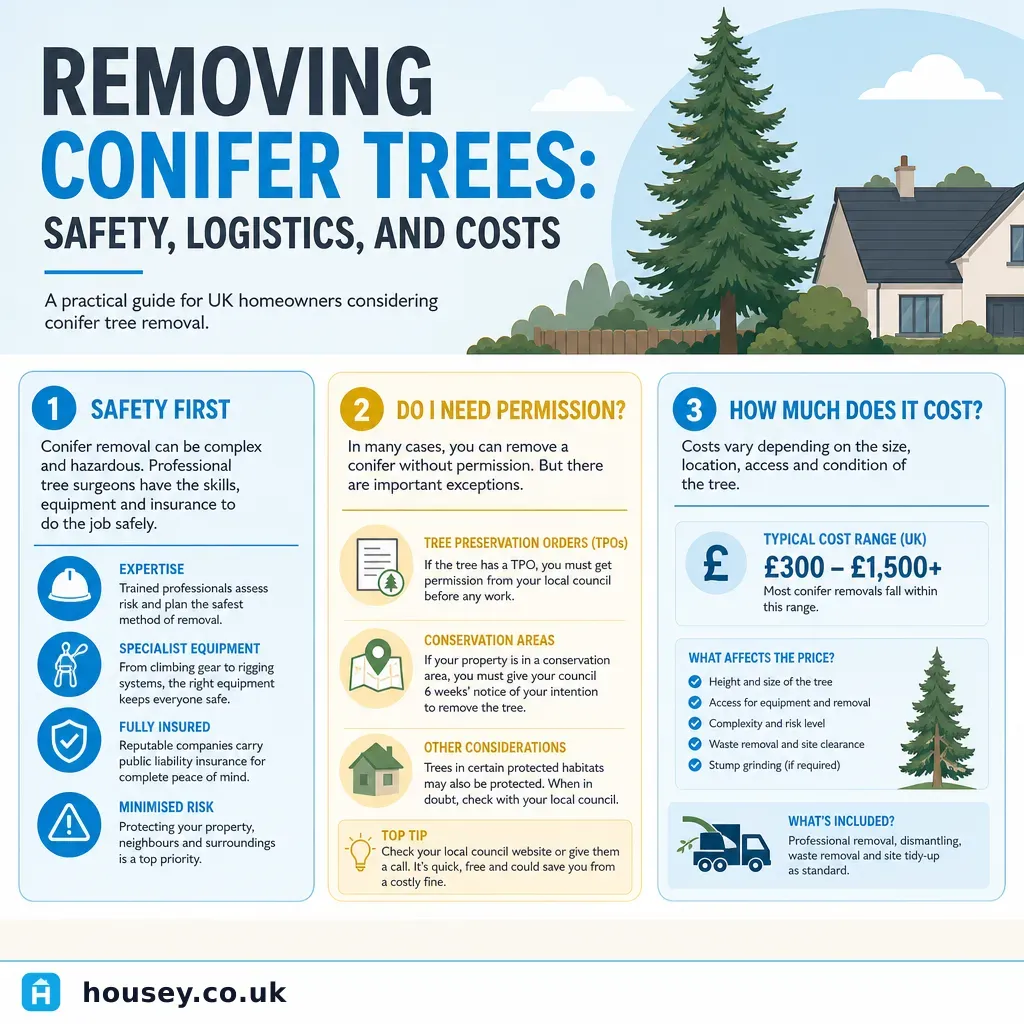
Removing Conifer Trees: Safety, Logistics, and Costs
Conifer removal is one of the most common tree surgery jobs requested by UK homeowners, particularly where fast-growing Leylandii hedges and screens have outgrown their welcome. The decision to remove a large conifer involves more than hiring a chainsaw — it raises questions about planning consent, contractor safety, neighbour notification, and disposal of several tonnes of timber and green waste.
Key points
- Conifers subject to a Tree Preservation Order (TPO) cannot be removed without prior written consent from your local planning authority (LPA); unauthorised removal is a criminal offence under the Town and Country Planning Act 1990.
- Trees over 75mm diameter at 1.5m height in a designated conservation area require a Section 211 notification to the LPA at least six weeks before any work begins.
- Leylandii (x Cuprocyparis leylandii) can grow up to 90cm per year and may be covered by high-hedge legislation under the Anti-social Behaviour Act 2003 Part 8, even when not subject to a TPO.
- Professional tree surgeons should hold NPTC/Lantra Awards qualifications (or equivalent) and carry public liability insurance of at least £5 million; always request proof of both before work starts.
- Stump grinding is almost always quoted separately from felling; factor this into your total budget when comparing quotes.
Do you need permission to remove a conifer?
Whether consent is required depends on whether the tree is protected or sits in a designated area. Most garden conifers are not covered by a TPO, but it is worth confirming before booking a contractor.
Tree Preservation Orders (TPOs): These are placed on individual trees, groups, or woodlands by the LPA. Your LPA's planning portal lists TPOs registered in your area, or you can submit a written enquiry to the tree officer. Removing a TPO-protected tree without consent can result in an unlimited fine and a requirement to replant.
Conservation areas: If your property is in a conservation area, any tree with a trunk diameter over 75mm measured at 1.5m above ground level is protected under Section 211 of the Town and Country Planning Act 1990. You must submit a written notification to the LPA and wait six weeks — or receive a formal no-objection response — before proceeding.
Leylandii and high hedges: Height alone does not trigger planning consent for removal. Under the Anti-social Behaviour Act 2003 Part 8, councils can issue remedial notices requiring height reduction of evergreen hedges causing a nuisance. Removal of the hedge itself is outside that regime unless individual trees carry TPO protection.
If the status of a tree is unclear, contact your LPA's tree officer before instructing any contractor.
Conifer types and removal complexity
Different conifers vary considerably in height, root structure, and proximity risk. The table below offers a general guide.
Conifer type | Typical mature height | Root behaviour | Removal complexity |
|---|---|---|---|
Leylandii (x Cuprocyparis leylandii) | 20–35m if unmanaged | Relatively shallow, spreading | High — large material volume, proximity risks |
Scots Pine (Pinus sylvestris) | 15–25m | Deep taproot | Moderate–high — height and dense crown |
Norway Spruce (Picea abies) | 15–25m | Shallow, plate-like | Moderate — can destabilise in waterlogged ground |
Thuja / Western Red Cedar | 10–20m | Moderate depth | Moderate — fibrous root system |
Lawson Cypress (Chamaecyparis lawsoniana) | 10–20m | Shallow | Moderate — commonly used in hedging rows |
Garden juniper (various) | 2–10m | Tap and lateral roots | Low–moderate — smaller scale |
How conifer removal works in practice
Professional conifer removal is almost always a sectional felling operation. The tree is taken down in sections from the top, with each section rigged — roped and lowered in a controlled manner — to avoid damage to structures, fencing, and neighbouring gardens.
Typical stages:
- Site assessment: The contractor identifies hazards, overhead cables, proximity to structures, and access constraints.
- Consent check: Responsible contractors confirm TPO or conservation area status before starting work.
- Sectional dismantling: The climber ascends by rope or a Mobile Elevated Work Platform (MEWP) is used; sections are lowered by rope.
- Branch chipping: A chipper converts brash — small branches and foliage — to woodchip on site.
- Trunk sections: Cut into manageable lengths for removal or left for the homeowner as firewood.
- Stump grinding (if included): A petrol-driven grinder reduces the stump to below ground level.
- Site clearance: Chippings are either removed or spread as mulch at the homeowner's request.
A large Leylandii typically requires a team of two or three and takes half a day to a full day, depending on size, access, and proximity to structures.
How much does conifer tree removal cost?
Costs vary significantly by tree height, access, location, and regional market rates.
Indicative UK costs, last reviewed 2026-05-06. Quotes vary by region, tree size, access, and site conditions.
Tree size | Indicative removal cost | Stump grinding (additional) |
|---|---|---|
Small (up to 4m) | £150–£350 | £50–£100 |
Medium (4–10m) | £350–£700 | £100–£200 |
Large (10–20m) | £700–£1,500 | £150–£300 |
Very large (20m+) | £1,500–£3,000+ | £200–£400+ |
Key cost drivers:
- Access: A narrow garden that prevents a chipper truck getting close increases labour time considerably.
- Proximity to structures: Trees overhanging a house, garage, or conservatory require more careful rigging and take longer.
- Stump size: Larger stumps require more grinding time; stumps near drainage runs or foundations may need specialist attention.
- Disposal distance: If large vehicles cannot reach the site, additional haulage may increase costs.
- Multiple trees: Clearing several conifers in a single visit often attracts a lower per-tree rate.
Always obtain at least three written quotes. If one quote is significantly below the others, ask exactly what is excluded.
Red flags when hiring a tree surgeon
Not all operators marketing themselves as tree surgeons hold appropriate qualifications or insurance. Rogue traders in this sector can cause serious property damage and personal injury.
Watch out for:
- Inability or unwillingness to provide proof of NPTC/Lantra Awards qualifications when asked.
- No certificate of public liability insurance, or a coverage limit below £5 million.
- Quoting for large tree work without visiting the site in person.
- Demanding full cash payment before work begins.
- No written quote detailing scope, inclusions, and exclusions.
- Arriving on site with only a chainsaw and no rigging equipment for a medium or large tree.
- No confirmation that TPO or conservation area status has been checked.
The Arboricultural Association maintains an Approved Contractor register of operators who meet training, insurance, and safety standards.
What to ask before accepting a quote
- What qualifications does the lead climber hold, and who will carry out the climbing work?
- What is your public liability insurance limit, and can I see your current certificate?
- Have you confirmed whether this tree has a TPO or is in a conservation area?
- Is stump removal included, and how deep will you grind?
- How will material — woodchip and timber sections — be disposed of, and is there an additional charge?
- Will you provide a written scope of works before starting?
- What site access do you require, and could any vehicles or equipment damage hard landscaping?
- Is VAT included in the quoted price?
When to get professional help
Conifer removal at any significant height is not a DIY task. Chainsaw use at height, rigging of heavy sections, and working near structures all carry serious risks of personal injury and property damage. Do not attempt to fell a conifer above approximately 2m without professional training and appropriate equipment.
Contact a qualified tree surgeon or seek specialist advice if:
- A conifer is leaning noticeably and you are concerned about structural stability — particularly after storm damage.
- Branches or the crown are overhanging live power lines or telecommunications cables. Contact your network operator before any tree work takes place near overhead lines.
- You discover a tree may be subject to a TPO after work has already begun — stop immediately and seek advice from the LPA.
- A neighbour objects to planned removal — consider arboricultural mediation before proceeding.
- Root systems are close to drainage runs, foundations, or retaining walls.
How Housey can help
Housey connects you with vetted tree surgeons who can assess, quote, and carry out conifer removal safely. Use the Housey quote-request service to receive up to four competitive quotes from qualified local contractors, with no obligation to proceed.
Frequently asked questions
Do I need planning permission to remove a conifer tree?
Planning permission is not usually required to remove a conifer in a typical garden unless the tree has a Tree Preservation Order or is in a conservation area. In conservation areas, a Section 211 notification must be submitted to your local planning authority at least six weeks before removing any tree with a trunk over 75mm in diameter at 1.5m height.
Can I remove a conifer on my boundary with a neighbour?
If the trunk sits on your land, you are generally entitled to remove it. Branches overhanging a neighbour's property can technically be cut back to the boundary line by the neighbour. Check whether any boundary agreement or restrictive covenant applies, and speak to your neighbour before work starts. Seek legal advice if the position is unclear.
What happens to the roots after a conifer is removed?
After stump grinding, the root system is usually left in the ground to decay naturally over several years. Stump grinding typically reduces the visible stump to around 200–300mm below ground level. If you intend to build over the area or replant a large tree in the same spot, deeper extraction or a root survey may be advisable.
How long does conifer removal take?
A medium-sized Leylandii removal by a two-person team typically takes three to six hours. Very large trees or rows of multiple conifers may take a full day or more. Access constraints, proximity to structures, and whether stump grinding is included all affect the total time on site.
Is stump grinding always necessary?
Stump grinding is optional but usually worthwhile. An unground stump can be a trip hazard, may produce new growth — Leylandii in particular can reshoot readily — and occupies usable garden space. If you plan to lay hard landscaping or replant in the same area, grinding to an adequate depth is strongly recommended.
Sources and further reading
- Tree Preservation Orders and trees in conservation areas — GOV.UK
- High hedges: complaining to the council — GOV.UK
- Tree work health and safety — Health and Safety Executive
- Town and Country Planning Act 1990, Section 211 — legislation.gov.uk
- Arboricultural Association Approved Contractor register — Arboricultural Association
Useful next reads
 Improvement & Build
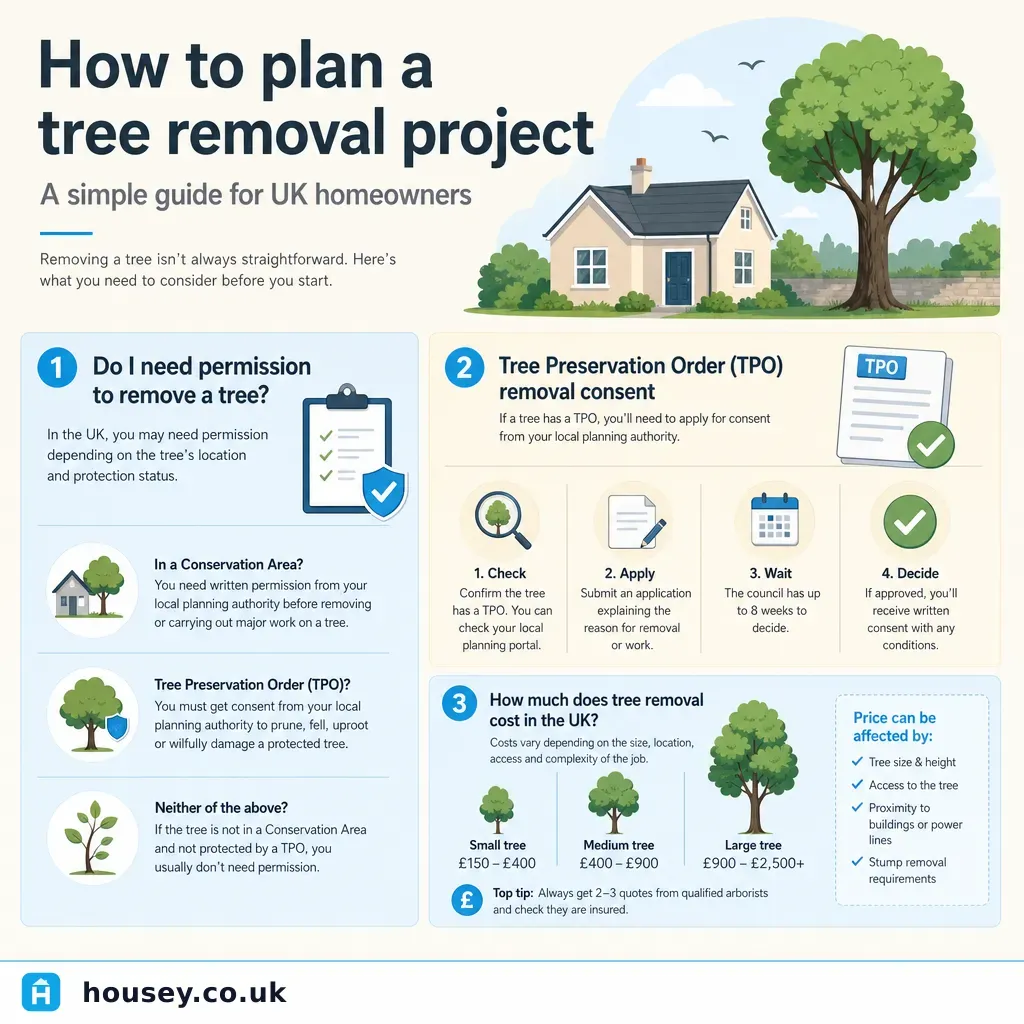
How to plan a tree removal project
Planning a tree removal project starts with checking whether the tree is protected by a Tree Preservation Order or sits in a conservation area, as both require council consent before any work begins.
 Improvement & Build
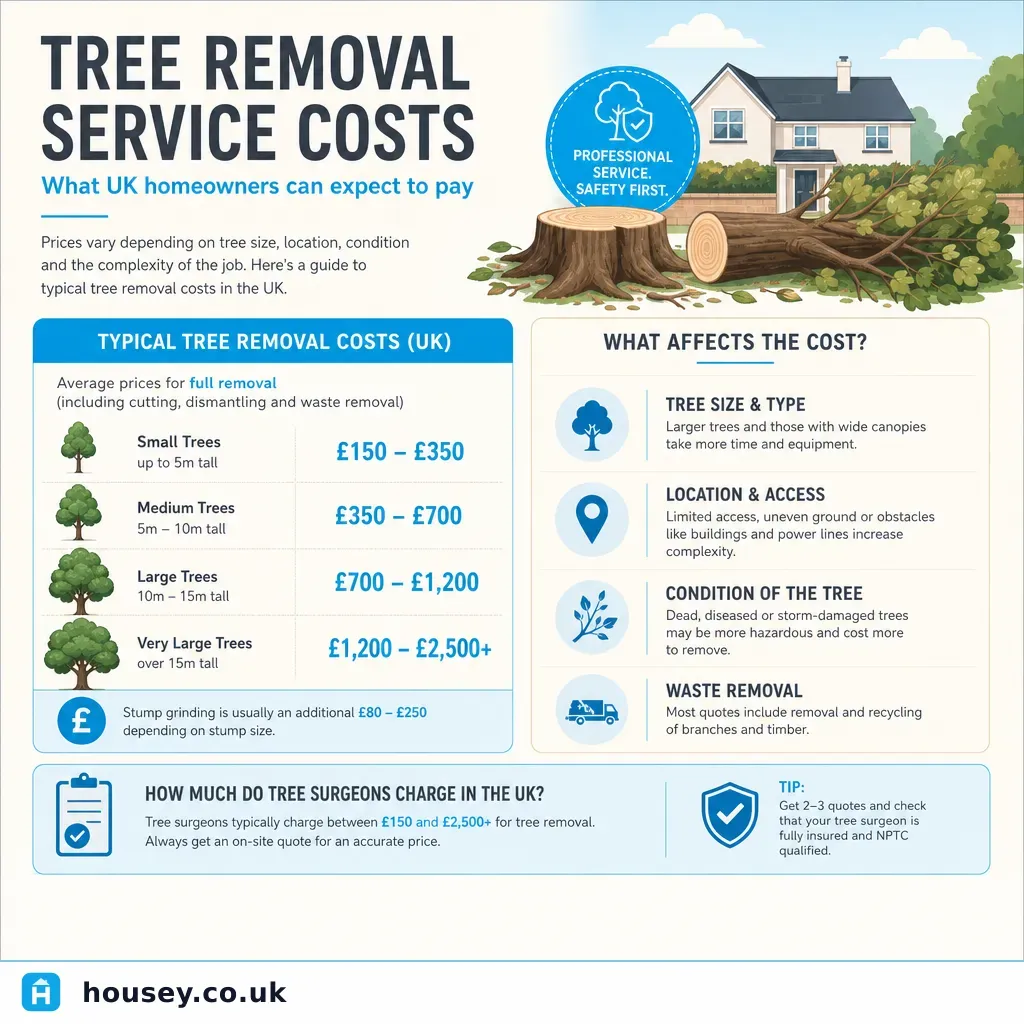
Tree Removal Service Costs
Professional tree removal costs in the UK depend on tree height, access, species, and the scope of work included.
 Improvement & Build
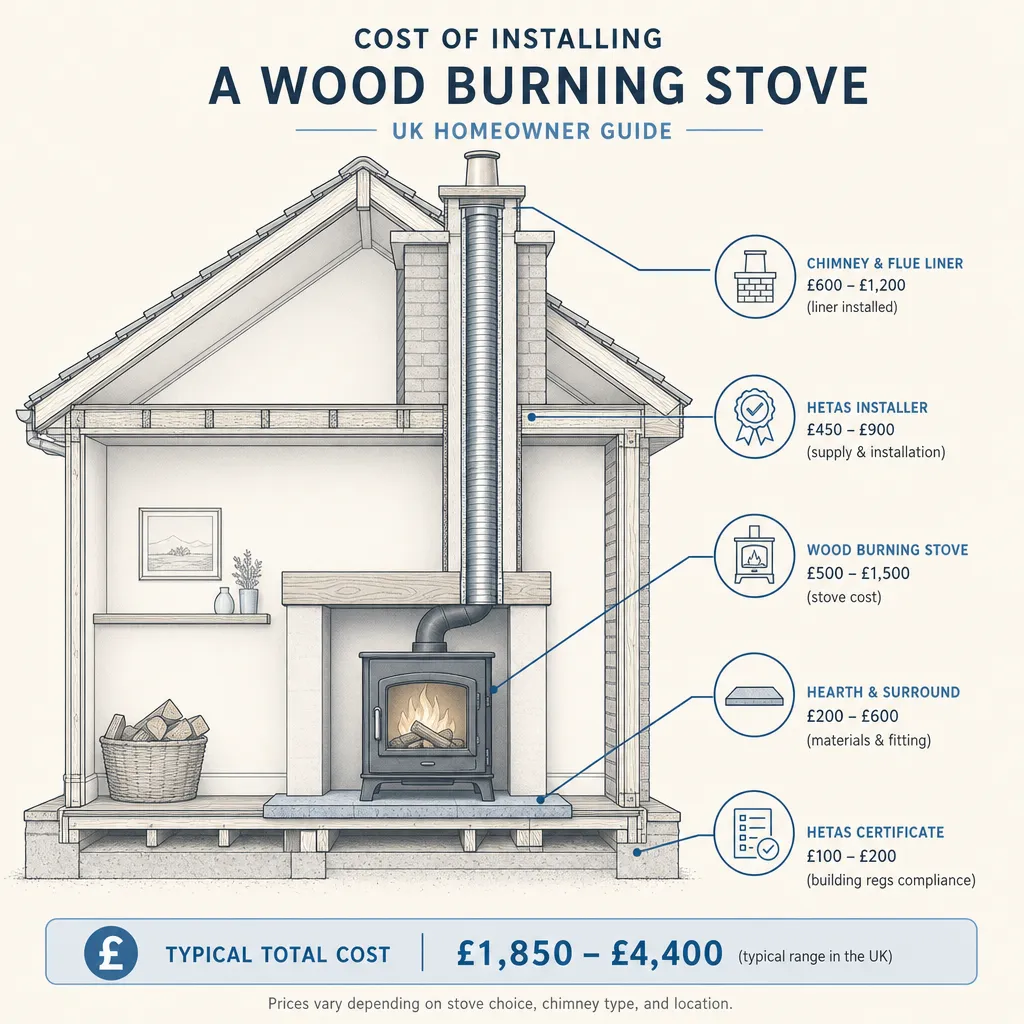
Cost of installing a wood burning stove
Installing a wood burning stove in the UK typically costs £2,000–£5,500 in total, covering the stove, flue liner, hearth, and HETAS-registered installation.
 Improvement & Build
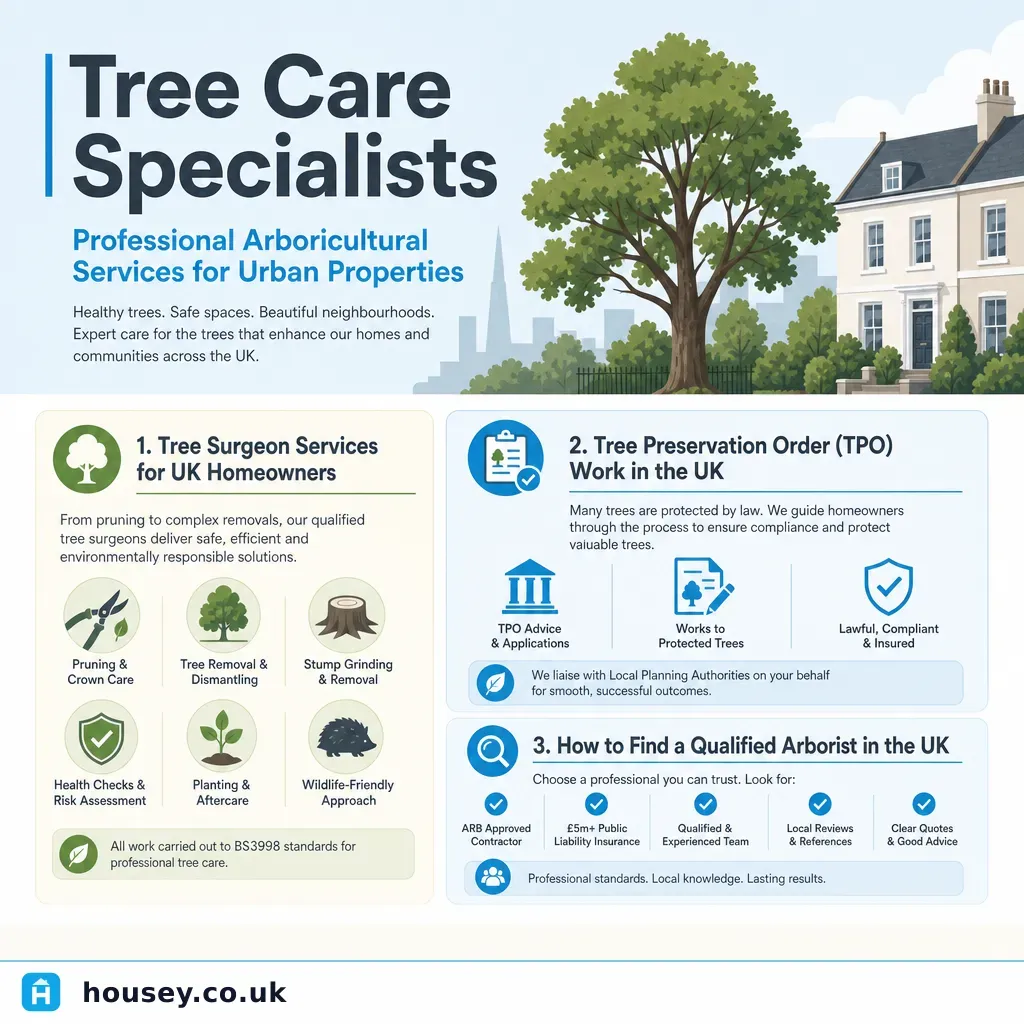
Tree Care Specialists: Professional Arboricultural Services for Urban Properties
Professional arboricultural services cover tree surgery, pruning, crown reduction, felling, and health assessments.
 Improvement & Build
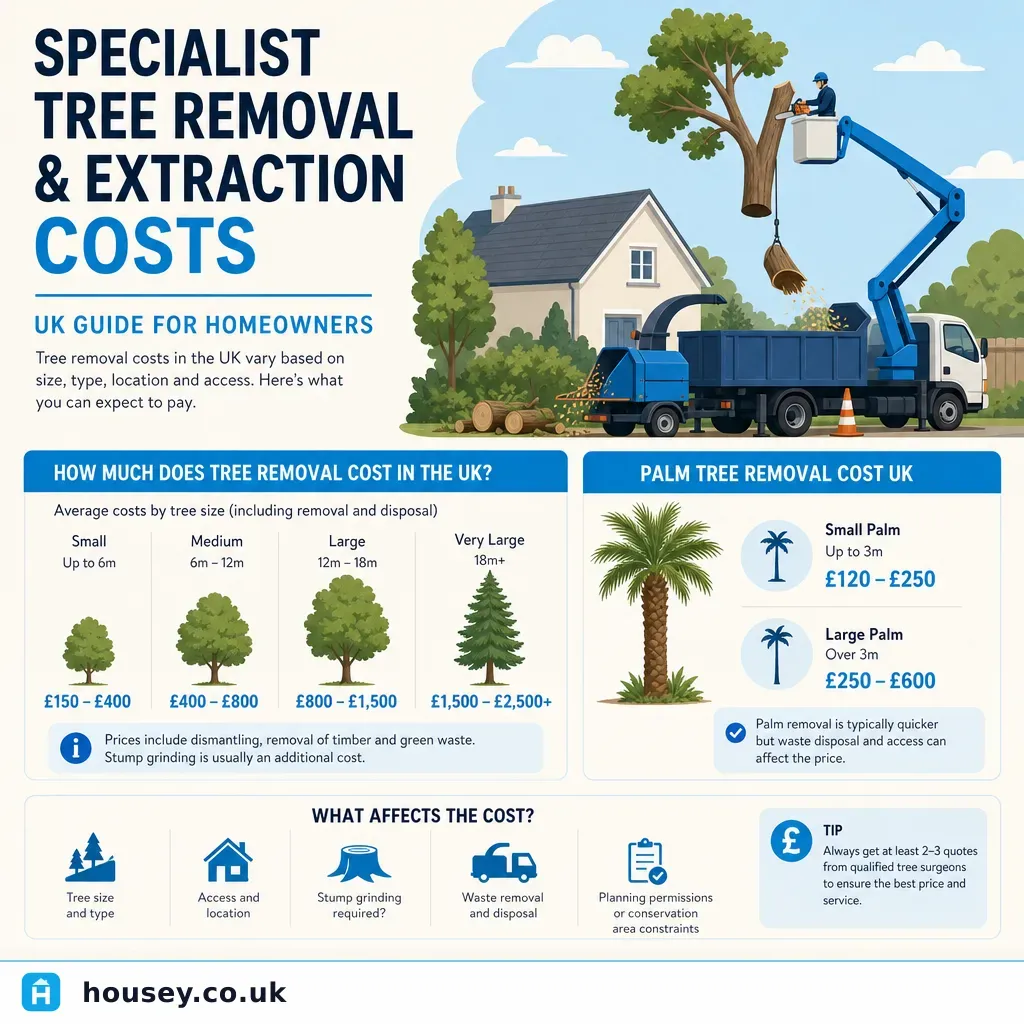
Specialist Tree Removal and Extraction Costs
Specialist tree removal costs in the UK range from around £150 for small trees to £3,000 or more for large mature specimens, with palm trees typically costing more due to specialist technique.