Tree Care Specialists: Professional Arboricultural Services for Urban Properties
By Housey · Last reviewed 24th of May 2026
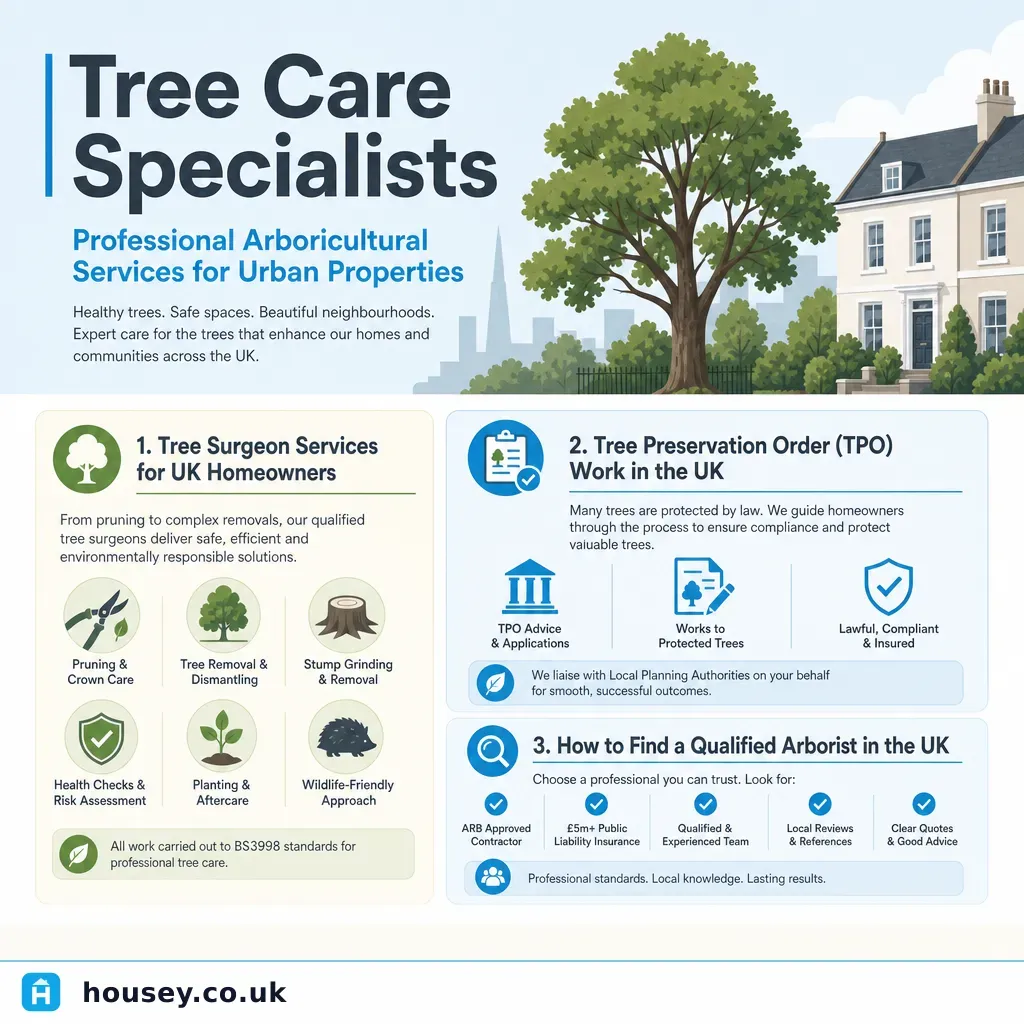
Tree Care Specialists: Professional Arboricultural Services for Urban Properties
Urban trees add ecological value, character, and amenity to UK properties — but they also carry legal responsibilities, safety requirements, and maintenance demands that many homeowners underestimate. Questions about tree work typically arise when a tree is visibly declining, encroaching on a structure, causing subsidence concerns, or forming part of a planning condition. Getting arboricultural care right from the outset avoids enforcement penalties, neighbour disputes, and the unnecessary loss of mature trees.
Key points
- Trees protected by a Tree Preservation Order (TPO) cannot be pruned, felled, or significantly altered without prior written consent from the local planning authority (LPA); breaching a TPO is a criminal offence carrying an unlimited fine.
- In conservation areas, you must give the LPA six weeks' written notice (a section 211 notice under the Town and Country Planning Act 1990) before carrying out specified works to any tree with a trunk exceeding 75mm diameter at 1.5m height.
- Qualified arborists should hold NPTC (National Proficiency Tests Council) units or equivalent City & Guilds qualifications; the Arboricultural Association Approved Contractor scheme provides an independently verified professional register.
- Professional arboricultural work — including aerial tree surgery — requires current public liability insurance, typically £5 million or above, due to the inherent risks of chainsaw operations at height.
- Root Protection Areas (RPAs) are calculated to BS 5837:2012; development or construction work within an RPA without a tree protection plan can cause irreversible root damage and is frequently controlled by planning conditions.
What services do arboricultural specialists provide?
Professional tree care covers a range of operations; the right service depends on the tree's health, size, location, and any applicable legal protections:
Service | What it involves | When you need it |
|---|---|---|
Crown reduction | Reducing overall canopy size while maintaining natural shape | Tree outgrowing its space, casting excessive shade |
Crown lifting | Removing lower branches to increase ground clearance | Obstruction to paths, buildings, vehicles, or sight lines |
Crown thinning | Selective removal of branches to increase light and airflow | Dense canopy causing shade or excessive wind resistance |
Deadwooding | Removing dead, dying, or structurally weak branches | Routine safety maintenance; required for most large urban trees |
Tree felling | Full removal, with or without stump grinding | Dead, diseased, structurally unsound, or unwanted trees |
Stump grinding | Mechanical removal of the remaining stump | Preventing regrowth; clearing for landscaping or planting |
Formative pruning | Early shaping of young or recently planted trees | Training structure in newly planted specimens |
Tree health assessment | Diagnosis of pests, disease, decay, or structural weakness | Before major works, after storm damage, suspected subsidence |
Which professional do you need?
Situation | Professional to instruct | Why |
|---|---|---|
Routine pruning, deadwooding, or felling | Qualified tree surgeon (NPTC-certified) | Practical competence for chainsaw and aerial operations |
TPO consent application or conservation area notice | Arboricultural consultant | Planning knowledge; can draft applications and section 211 notices |
Pre-development tree impact assessment | Arboricultural consultant with BS 5837:2012 experience | Produces tree survey, constraint plan, and arboricultural impact assessment |
Suspected structural root damage or subsidence | Arboricultural consultant or structural engineer | Root investigation may require specialist assessment |
Landscape design incorporating trees | Landscape architect or landscaper | Species selection, planting plans, long-term management |
Tree Preservation Orders and conservation areas
Tree Preservation Orders
A TPO is made by the local planning authority under the Town and Country Planning (Tree Preservation) (England) Regulations 2012. It protects individual trees, groups, or woodlands considered to have significant amenity value. Before carrying out any works on a TPO tree — including crown reduction, major pruning, or felling — you must submit a prior written application to your LPA and wait for written consent. The LPA has eight weeks to respond; a lack of response is not deemed consent.
To check whether a tree has a TPO, search your local council's planning portal or contact the council tree officer directly.
Conservation areas
If your property lies in a conservation area, the section 211 notice requirement applies to most trees above the threshold trunk diameter. You give the LPA six weeks' written notice; the LPA may then make a TPO (freezing works), issue a no-objection notice, or take no action — in which case you may proceed after six weeks. Emergency works to remove an immediate danger are exempt but must be reported to the LPA as soon as reasonably practicable.
Neighbour's trees
If branches from a neighbour's tree overhang your property, you are generally entitled to cut them back to the boundary — but you cannot cut further, should offer cuttings back to the tree owner, and must not damage the tree's overall health. TPO and conservation area rules apply even when the trunk is on a neighbour's land.
Decision tree: do I need council consent?
- Is the tree subject to a TPO? — If yes: apply for TPO consent before any work. Do not start without written LPA approval.
- Is the property in a conservation area? — If yes and the trunk exceeds 75mm at 1.5m: submit a section 211 notice to the LPA at least six weeks before starting.
- Is the property or its setting listed? — If yes: check whether works affect the setting of the listed building; consult the LPA if uncertain.
- None of the above apply? — No formal consent required, but instruct a qualified arborist to ensure works comply with BS 3998:2010 (Tree Work Recommendations).
- Unsure whether a TPO exists? — Contact your LPA tree officer or search the planning register before instructing any works.
What to ask before hiring a tree surgeon
- What NPTC units or City & Guilds qualifications do you and your operatives hold?
- Is your public liability insurance current, and what is the level of cover?
- Are you registered with the Arboricultural Association as an Approved Contractor?
- Have you checked whether this tree has a TPO or is in a conservation area?
- What specification of works do you propose, and how is it justified?
- What will happen to the arisings — brash, logs, and the stump?
- Will you provide a written specification and completion record?
- What assumptions is the quote based on, and what could change the price?
- Is VAT included in your quotation?
An independent arboricultural survey carried out before instructing works provides a baseline condition assessment and can clarify the appropriate specification and scope.
Worked UK property scenario
A homeowner in Bristol has a mature oak in their rear garden, approximately 18m tall. They want the crown reduced because branches cast excessive shade over a rear extension. A neighbour mentions the tree 'has a preservation order.'
Steps the homeowner should take:
- Contact Bristol City Council's tree officer or search the planning register to confirm whether a TPO applies.
- If a TPO is confirmed, submit a prior written application via the council's planning portal before instructing any work.
- Obtain quotations from qualified tree surgeons specifying crown reduction to BS 3998:2010 standards.
- Do not allow any contractor to begin work until written TPO consent is received.
Carrying out crown reduction on a protected mature oak without consent risks prosecution and an unlimited fine under section 210 of the Town and Country Planning Act 1990 — making the checking step non-negotiable.
When to get professional help
All significant tree work — including chainsaw use, aerial operations, and root investigations — must be carried out by qualified, insured arborists. Never attempt tree felling or large branch removal yourself.
Seek expert advice urgently if:
- A tree leans significantly or has shifted lean following storms.
- Signs of basal decay are present, such as fungal brackets, soft wood at the base, or disturbed ground around roots.
- Branches overhang electricity lines or occupied structures.
- Cracks are visible at major branch unions.
- Roots are visibly close to foundations or drainage runs.
Contact your LPA tree officer promptly if you believe a TPO tree poses an immediate safety hazard — emergency works are permitted but must be reported to the LPA without delay.
How Housey can help
Housey connects UK homeowners with vetted qualified tree surgeons who can carry out safe, consent-compliant arboricultural work. If you need an independent condition report before commissioning works, Housey can also connect you with specialists offering an arboricultural survey.
Frequently asked questions
What is a Tree Preservation Order and how does it affect my property?
A Tree Preservation Order is a legal protection made by the local planning authority under the Town and Country Planning Act 1990. It prevents pruning, felling, topping, or other harmful actions to a protected tree without prior written LPA consent. Breaching a TPO is a criminal offence and can result in an unlimited fine. The order runs with the tree, not the owner, and remains in force regardless of who owns the property.
Do I need permission to prune a tree in a conservation area?
If your property is in a conservation area and the tree has a trunk exceeding 75mm in diameter at 1.5m height, you must give your local planning authority six weeks' written notice under section 211 of the Town and Country Planning Act 1990. The LPA may make a TPO, issue a no-objection notice, or take no action. Failure to give notice is a criminal offence. Emergency works to remove immediate danger are exempt but must be reported to the LPA promptly.
What qualifications should a tree surgeon hold?
At minimum, tree surgeons should hold NPTC certificates or equivalent City & Guilds units relevant to their scope — for example, CS30 (chainsaw maintenance), CS31 (felling and processing), and CS38 or CS39 for aerial chainsaw operations. Membership of the Arboricultural Association as an Approved Contractor provides additional assurance that the business meets professional standards and carries adequate insurance.
How much does tree surgery cost in the UK?
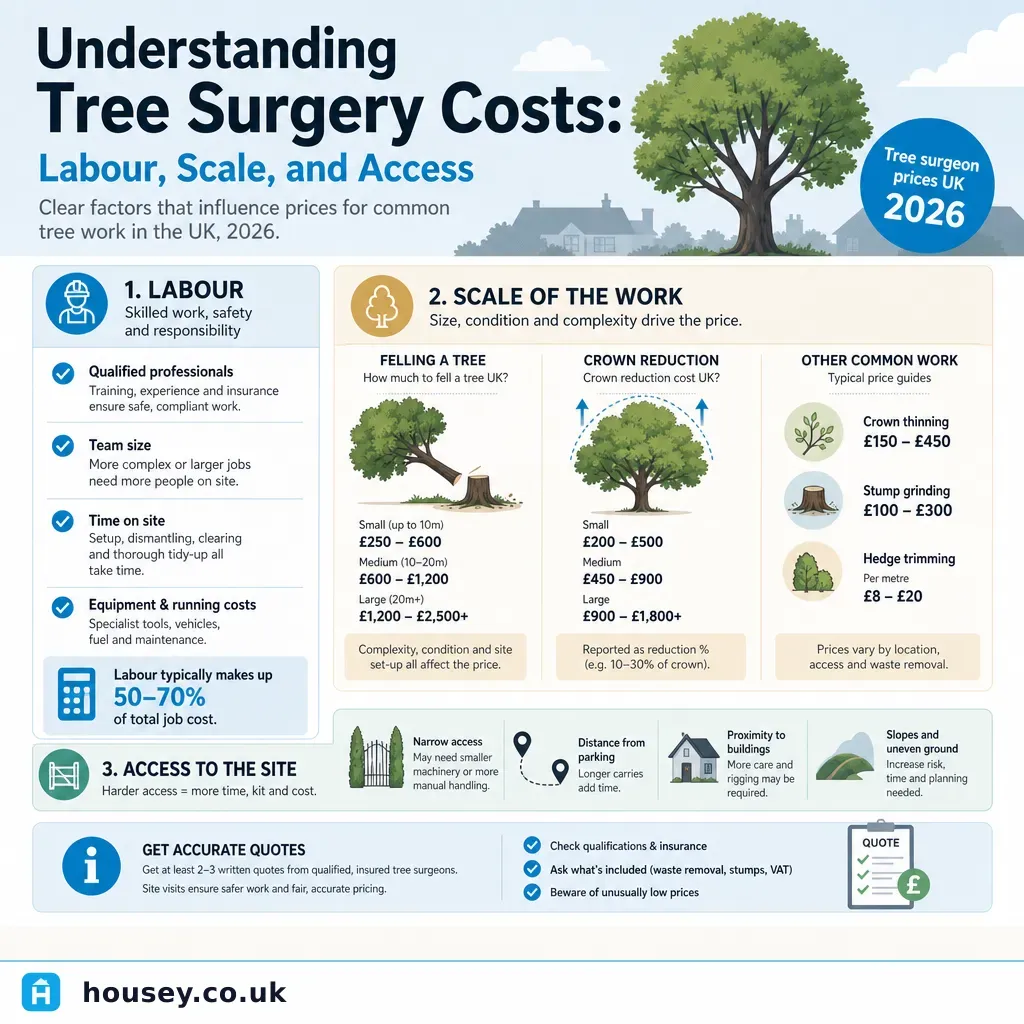
Costs vary by tree size, access, species, and the works required. A small tree removal might cost £200–£500; a crown reduction on a large mature tree might cost £400–£1,200 or more; stump grinding typically adds £75–£250. Always obtain at least three written quotations. Indicative UK costs, last reviewed 2026-05-24; quotes vary significantly by region, contractor, and site conditions.
Sources and further reading
- Tree Preservation Orders and trees in conservation areas (GOV.UK) — official planning guidance for TPOs and section 211 notices
- Town and Country Planning (Tree Preservation) (England) Regulations 2012 (legislation.gov.uk) — full regulatory text
- Arboricultural Association Approved Contractor scheme — professional register, consumer guidance, and contractor finder
- Health and Safety Executive: Arboriculture and tree work — chainsaw and tree-work safety requirements
- Town and Country Planning Act 1990 (legislation.gov.uk) — primary legislation including sections 210 and 211
Useful next reads
 Improvement & Build
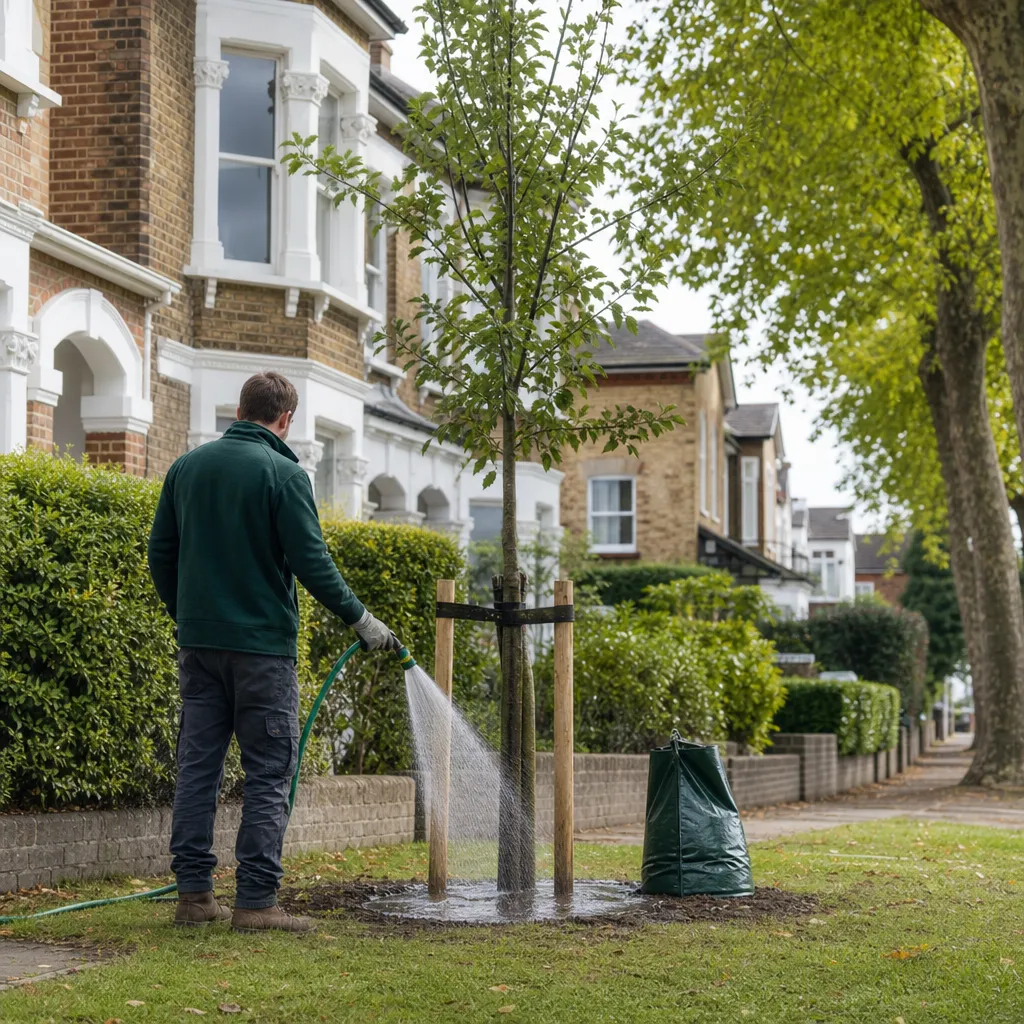
Watering Large Trees: Techniques and Frequency for Establishment
Newly planted large trees typically need 50–90 litres of water per week during the growing season for the first two to three years.
 Improvement & Build
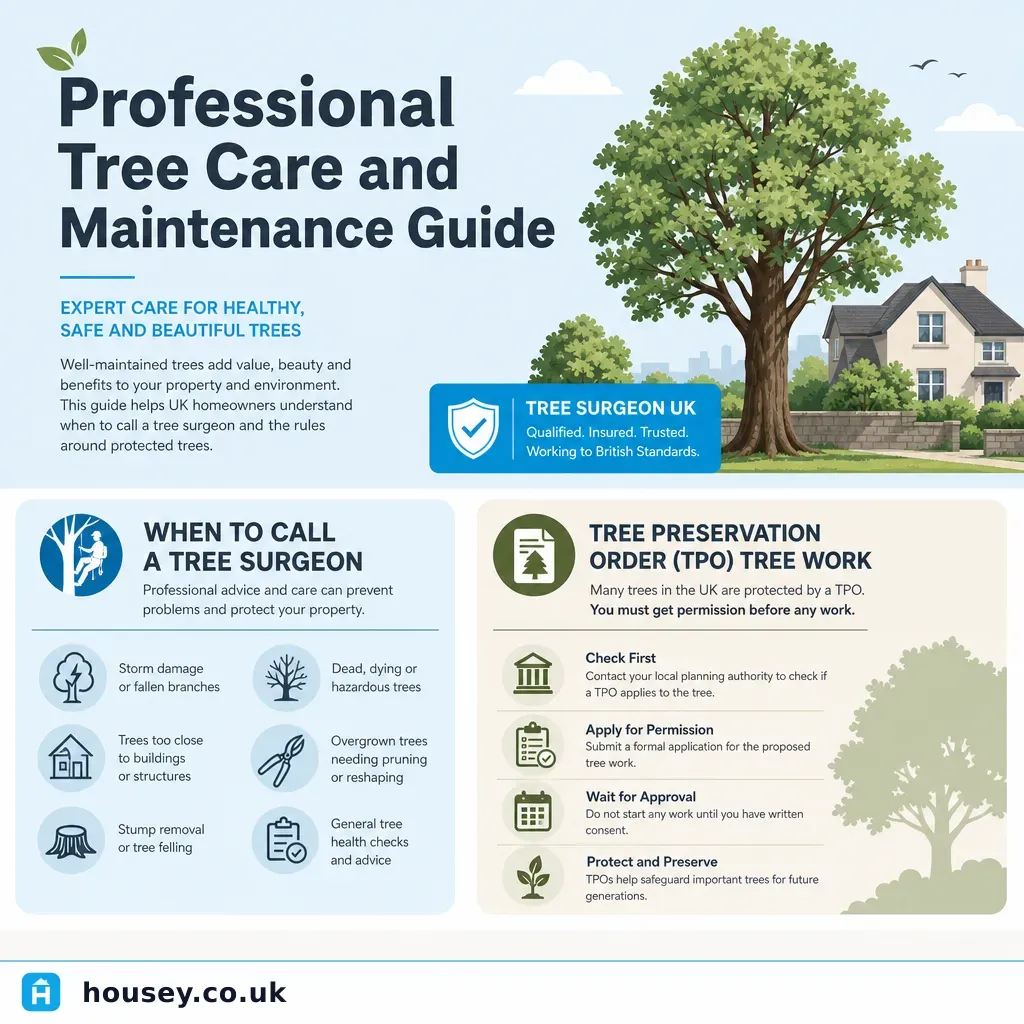
Professional Tree Care and Maintenance Guide
Professional tree care covers pruning, crown reduction, felling, and health assessments carried out by qualified arborists.
 Improvement & Build
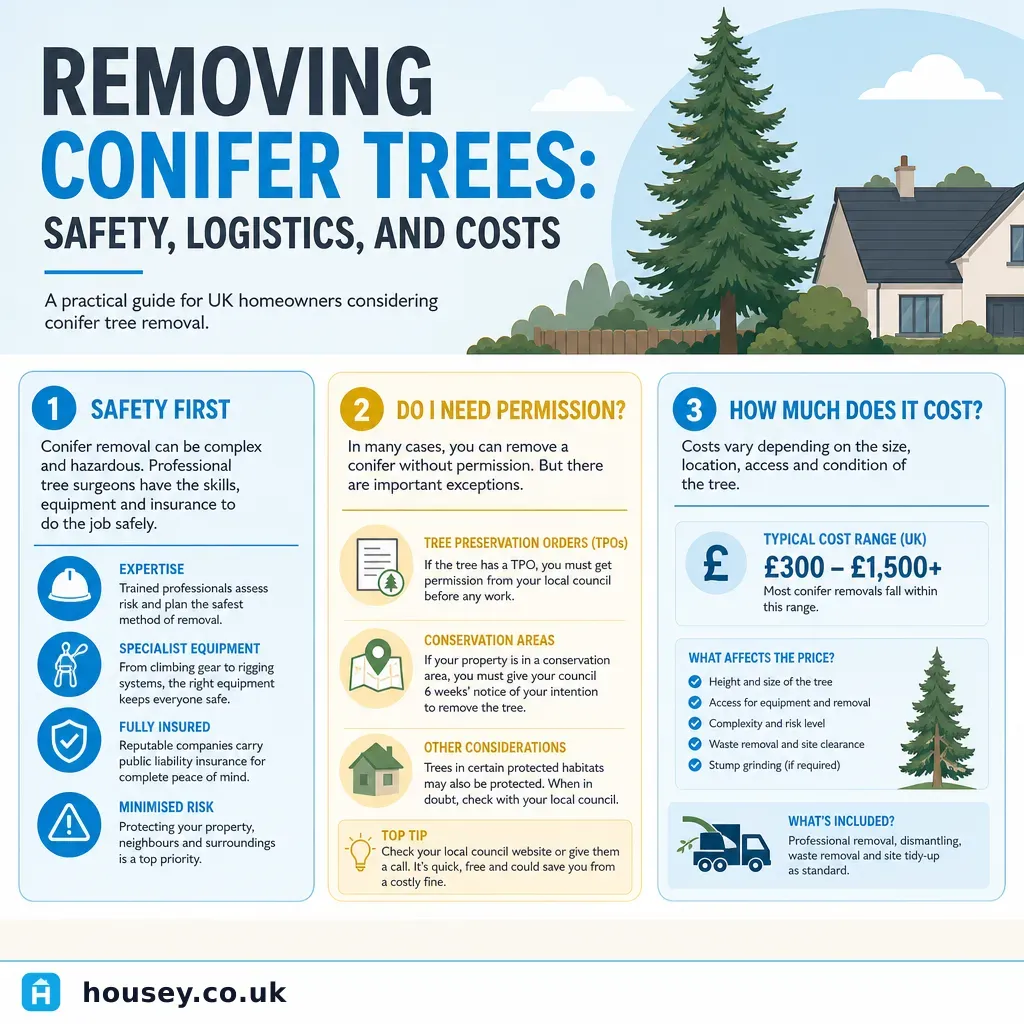
Removing Conifer Trees: Safety, Logistics, and Costs
Removing a conifer tree in the UK usually requires a qualified tree surgeon.
 Improvement & Build
Tree Topping: Why It's Harmful and Better Alternatives for Tree Care
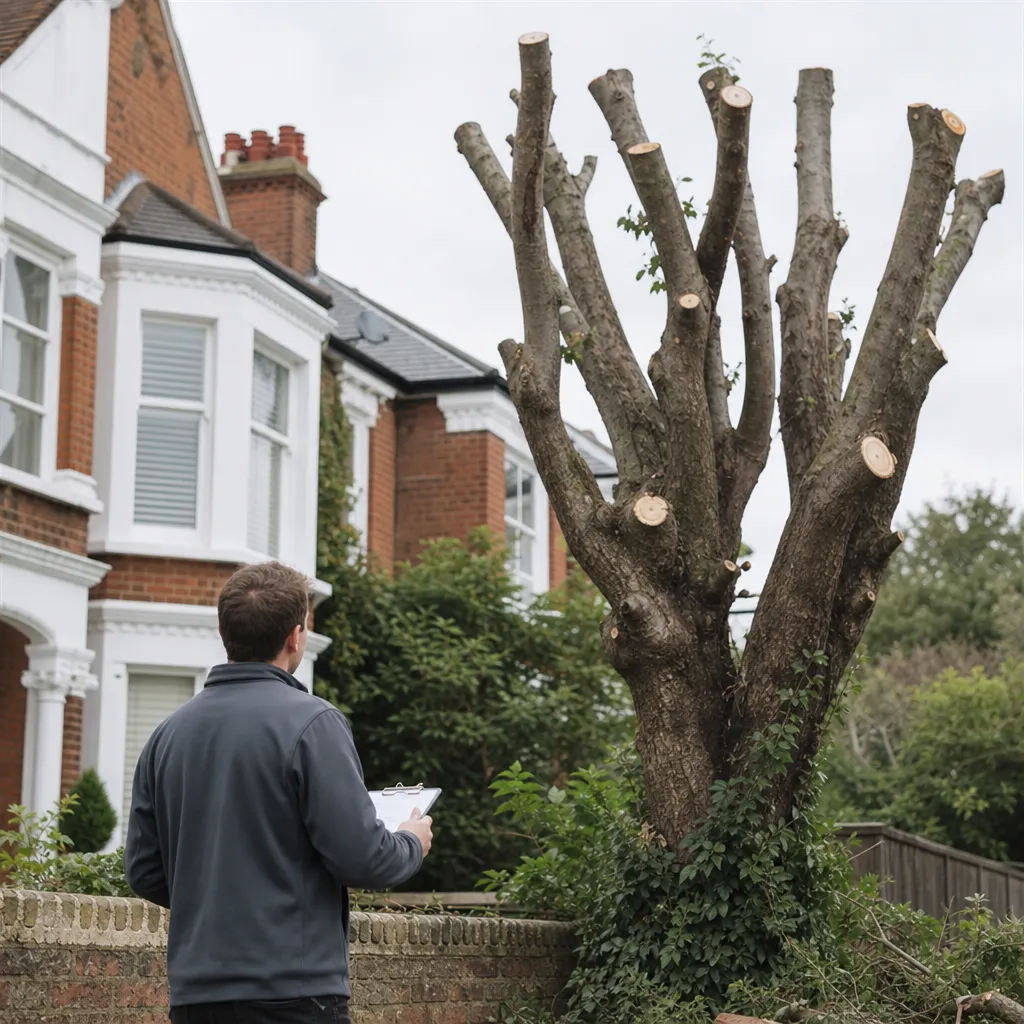
Tree topping — removing large sections of a tree's crown through indiscriminate cuts — causes serious structural weakness, fungal decay, and vigorous but poorly attached regrowth.
 Improvement & Build
Understanding Tree Surgery Costs: Labour, Scale, and Access
Tree surgery costs in the UK depend on tree height, species, condition, and site access.