Removing render to expose original brick walls
By Housey · Last reviewed 6th of May 2026
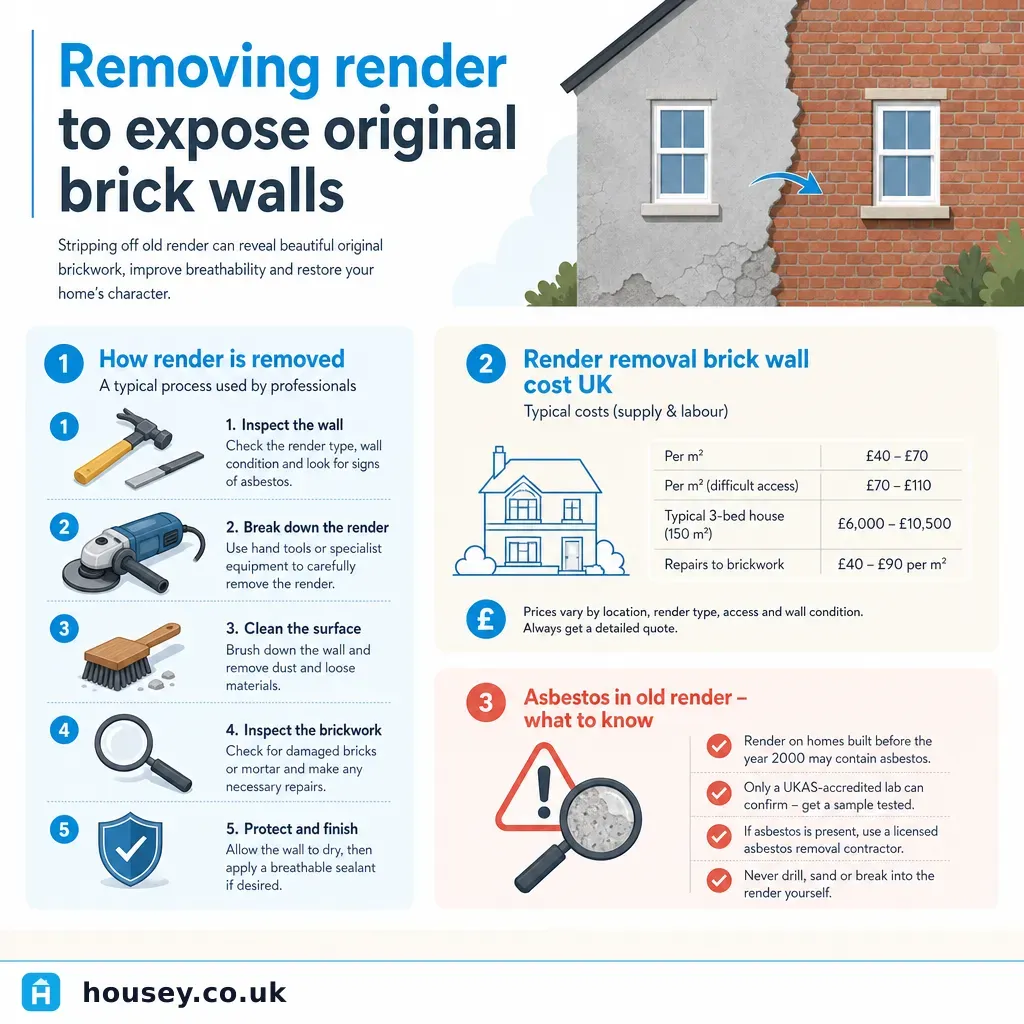
Removing render to expose original brick walls
Beneath the pebbledash, tyrolean, or smooth cement render on thousands of UK homes lies Victorian and Edwardian brickwork that many homeowners are keen to uncover. The decision to remove render is often driven by aesthetics, a desire to resolve persistent damp, or simply to return a property to its original character. It is not, however, a straightforward or risk-free undertaking — older renders may contain asbestos, the brickwork beneath may be in poor condition, and the wrong approach can cause lasting damage to the fabric of your home.
Key points
- Renders applied to UK properties before 2000 may contain asbestos fibres (typically chrysotile in tyrolean, pebbledash, or textured spray coatings); material must be tested before any disturbance under the Control of Asbestos Regulations 2012.
- Hard Portland cement renders, particularly those applied post-1950, can bond tightly to soft pre-1919 brickwork and cause surface spalling or brick face loss on removal.
- Listed building consent is required before removing or altering the external render of a listed building in England and Wales; conservation area properties may also face restrictions.
- Repointing with an appropriate mortar is almost always needed after render removal — using hard Portland cement mortar on Victorian soft brickwork can accelerate deterioration through moisture entrapment and freeze-thaw action.
- Indicative UK costs for render removal are £30–£80 per m², plus £20–£60 per m² for repointing; scaffolding for a typical semi-detached house adds £700–£2,500 or more (Indicative UK costs, last reviewed 2026-05-06).
Important limitations
This article provides general guidance for UK homeowners considering render removal. Asbestos regulations, listed building consent requirements, conservation area rules, and appropriate mortar specifications all vary by property type, age, location, and local authority. This guidance does not replace a professional inspection, a Type 2 refurbishment asbestos survey, or advice from a licensed contractor or conservation officer. Do not disturb any render you suspect contains asbestos until a qualified asbestos surveyor has assessed it — disturbing asbestos-containing material without appropriate controls is a criminal offence under the Control of Asbestos Regulations 2012.
Understanding what render you have
The first step is identifying the render type, its approximate age, and likely asbestos risk. Visual inspection alone is insufficient for asbestos — but it can help you understand the likely removal difficulty and inform your contractor conversations.
Render type | Approximate era | Asbestos risk | Removal difficulty |
|---|---|---|---|
Lime render | Pre-1920s | Negligible | Low to moderate — often friable and separates more cleanly |
Sand-cement render | 1920s–present | Low, but possible if applied pre-2000 with mixed aggregates | Moderate to high on soft brick |
Pebbledash | 1920s–1980s | Possible in the textured topcoat layer | High — bonded aggregate resists hand tools |
Tyrolean / textured spray | 1950s–1990s | Possible — chrysotile sometimes added for strength and flexibility | High — mechanical removal risks dust release |
Smooth cement render | 1960s–2000 | Possible if applied before 2000 | High on old brickwork — tight bond common |
Modern acrylic or silicone render | Post-2000 | Negligible | Moderate — less firmly bonded than cement |
If your property was rendered before 2000 and you are unsure of the render composition, commission a Type 2 refurbishment asbestos survey (as defined in the HSE's HSG264 guidance) before any work begins.
Asbestos risk: do not skip this step
Asbestos fibres were used as a reinforcing additive in some textured renders, particularly tyrolean and pebbledash coatings, until their general ban in the UK in November 1999. The Health and Safety Executive (HSE) is clear: materials containing asbestos that are to be disturbed during refurbishment require prior assessment by a competent person, and high-risk removal must be carried out by a licensed asbestos contractor.
Do not proceed with mechanical render removal on any property rendered before 2000 without a Type 2 refurbishment asbestos survey. The cost of a survey — typically £300–£600 for a standard house — is a fraction of the potential liability, remediation cost, and risk to health that unlicensed disturbance creates.
If asbestos is confirmed in the render:
- Low-risk asbestos-containing material (ACM) in good, non-friable condition may sometimes be managed in place or encapsulated rather than removed.
- High-risk ACMs — damaged, friable, or materials to be mechanically disturbed — must be removed by a licensed asbestos contractor under the Control of Asbestos Regulations 2012.
- Licensed asbestos removal generates controlled waste that must be disposed of at a licensed facility; your contractor is responsible for arranging this.
The render removal process (where asbestos has been ruled out)
Once a Type 2 survey confirms the render is safe to disturb, removal follows these stages.
1. Test-chip to assess bonding and brick condition
Before committing to full-scale removal, a contractor should chip away a small test area in an inconspicuous location to assess how tightly the render is bonded and the condition of the brick beneath. Soft, porous bricks common in pre-1919 construction are at considerably greater risk of surface damage than harder engineering bricks or wirecut flettons.
2. Choose the removal method
- Hand tools (bolster chisel and lump hammer): Slower but less damaging to soft brickwork. Most appropriate for lime-bonded renders, smaller areas, or delicate historic masonry.
- SDS rotary hammer with chisel bit: The most common method for residential work; speed depends on render bond and geology beneath. Risk of brick damage increases with harder cement renders.
- Mechanical grinding, needle gun, or scabbler: Faster for large areas of well-bonded cement render on harder brick, but generates more dust and carries a higher risk of brick surface damage.
No method guarantees zero brick damage. All render removal carries some risk to the underlying masonry, and experienced contractors will manage expectations accordingly.
3. Remove render keys and clean joints
After the main render layer is removed, residual mortar keys — where the render has penetrated brick joints — need raking out carefully. Leaving old cement keys in joints can prevent proper repointing and cause moisture retention.
4. Repoint with an appropriate mortar
Historic England's guidance on repointing brickwork is clear that mortar should be weaker and more flexible than the brick it beds. For pre-1919 soft-stock brickwork, a Natural Hydraulic Lime (NHL) mortar is usually more appropriate than a Portland cement mix, which can be too hard and trap moisture, leading to spalling and frost damage over time. For post-1945 harder brickwork, a sand-cement mortar may be appropriate — check with your contractor.
5. Assess and treat the exposed brick
Depending on brick condition, you may need gentle cleaning (low-pressure washing, dry methods, or careful chemical treatment), consolidation of friable areas, or replacement of badly damaged individual bricks. The wall should be allowed to dry and breathe thoroughly, particularly if the render was previously masking damp ingress.
Should you remove your render? A decision guide
- Consider removal if the render is cracked, hollow, or demonstrably trapping moisture behind it; you have tested a small area and confirmed the brickwork beneath is attractive and structurally sound; and the property is not listed or subject to conservation area controls.
- Proceed with caution if your property was rendered before 2000 (arrange an asbestos test first); the brickwork is pre-1919 soft-stock brick; or the property has existing damp or structural problems that the render may be masking.
- Think twice if the render is performing well as weatherproofing and is in good condition; the test-chip reveals the brickwork beneath is heavily patched, inconsistent, or in poor condition; or local property market preference favours rendered finishes.
- Do not proceed without specialist advice if the property is listed (listed building consent is likely required); it is in a conservation area with an Article 4 direction; or asbestos has been identified in any part of the render.
- Consult a structural engineer or specialist surveyor if the render has been acting as a tie or reinforcing element, or if there is evidence of historic structural repairs involving the render layer.
Red flags to watch for
Pause and seek professional advice before proceeding if you notice any of the following:
- Render that sounds hollow over large continuous areas, suggesting widespread detachment and possible moisture accumulation behind
- Visible cracks running through the render, particularly stepped cracks following mortar joints, which may indicate structural movement the render has been masking
- Staining, tide marks, or efflorescence on internal walls adjacent to the area being worked on — possible signs of penetrating or interstitial damp
- Any fibrous or unusual texture when a small sample is broken or drilled — stop work immediately and arrange an asbestos test before continuing
- Render applied directly over a cavity wall where wall tie positions are visible — removal in these areas could disturb or expose corroded ties, a separate structural concern
- Any sign of cracking, bowing, or movement in the wall itself, beyond surface render cracking
Costs: what to budget
Indicative UK costs, last reviewed 2026-05-06:
- Type 2 refurbishment asbestos survey: £300–£600 for a standard house
- Licensed asbestos removal (if ACMs confirmed): £500–£2,000 or more per day; highly variable by quantity and fibre type
- Render removal (no asbestos present): £30–£80 per m², depending on method, access, and render type
- Repointing after removal: £20–£60 per m² for standard brickwork; specialist lime work on listed or historic buildings may cost more
- Scaffolding: £700–£2,500 or more for a typical semi-detached house, depending on height and access
These are indicative ranges. Always obtain at least three written, itemised quotes from contractors with verifiable experience in render removal on similar property types.
What to ask a qualified professional
Before instructing a contractor for render removal, ask:
- Has an asbestos survey been carried out, or will you arrange one before any work begins?
- What removal method do you propose for this type of brick and render, and why?
- Can you show me a test-chip area before committing to full-scale removal?
- What repointing specification will you use, and is it appropriate for the brick type?
- What remedial options are available if brick damage is more extensive than expected?
- Can you provide examples and references from comparable render removal projects?
- What waste disposal arrangements are in place for render debris and any contaminated material?
- What are your public liability insurance details and policy limit?
- If the property is listed or in a conservation area, have you worked on similar consented projects?
When to get professional help
Render removal is rarely appropriate as a DIY project on external walls, particularly at height, on older properties, or where asbestos has not been definitively excluded. Always use a qualified, insured contractor.
Seek professional guidance before starting any work if:
- You have not had an asbestos survey on a pre-2000 property
- The property is listed or in a conservation area
- The brickwork beneath appears damaged, patched, or structurally unusual
- There is existing evidence of damp, cracking, or structural movement
- The render covers more than a small test area and you are uncertain about the outcome
How Housey can help
Housey can connect you with vetted UK contractors and surveyors experienced in external wall works, render assessment, asbestos surveying, and historic masonry repointing. Use Housey to request quotes and compare specialists working in your area before committing to render removal works.
Frequently asked questions
Is it worth removing render from an old brick house?
It can be, if the brickwork beneath is in sound, attractive condition and the render is trapping moisture or causing maintenance problems. However, the combined cost of asbestos testing, removal, repointing, and any remedial brick repairs can be significant. Ask a contractor to test-chip a small area first so you can assess brick quality before committing to full-scale render removal.
Will my bricks be damaged during render removal?
There is always a risk of surface damage, particularly with soft Victorian or Edwardian stock bricks. Hard cement renders that have bonded tightly can pull brick faces off on removal. An experienced contractor will test a small area first and select the most appropriate technique, but zero brick damage cannot be guaranteed — especially on pre-1919 properties with softer masonry.
Do I need planning permission to remove external render?
For most standard residential properties in England, removing render does not require planning permission. However, if your property is a listed building you will need listed building consent before altering the external appearance. In a conservation area you should check with your local planning authority, as visible changes to the external character of buildings can be controlled under Article 4 directions.
How do I know if my render contains asbestos?
You cannot tell by visual inspection alone. The only reliable method is to have a sample analysed by a UKAS-accredited laboratory as part of a Type 2 refurbishment survey carried out by a competent asbestos surveyor under the HSE's HSG264 guidance. If your property was rendered before 2000, commission a survey before disturbing any render — do not scrape or drill samples yourself.
How much does render removal cost per m²?
Indicative UK costs for render removal (excluding any asbestos work) are £30–£80 per m², with repointing adding approximately £20–£60 per m² for standard brickwork. Scaffolding for a typical semi-detached house adds £700–£2,500 or more. Access difficulty, render type, and brick condition all affect the final price. Always obtain at least three itemised quotes. Indicative UK costs, last reviewed 2026-05-06.
Sources and further reading
- Control of Asbestos Regulations 2012 — legislation.gov.uk
- Asbestos: the survey guide HSG264 — Health and Safety Executive
- Asbestos guidance hub — Health and Safety Executive
- Repointing brickwork — technical guidance — Historic England
- Listed buildings — what designation means — Historic England
Useful next reads
 General property advice
What to do when your boiler stops working
When your boiler stops working, check the pressure gauge (should read 1–1.
 General property advice
Property Market Trends: Activity Growth and Price Movements
UK property market activity is measured through completed sale registrations (HM Land Registry), lender mortgage data, and transaction volumes from HMRC.
 General property advice
Installing a water main shut-off valve for your property
A water main shut-off valve — commonly called a stopcock — controls all water entering your home from the mains.
 General property advice
Monthly House Price Index: August Market Report and Analysis
The UK House Price Index is published monthly using completed Land Registry transaction data, meaning August figures typically reflect sales agreed months earlier.
 General property advice
Scottish Property Market: Activity and Regional Trends
Scotland's property market operates under distinct legal rules: sellers must provide a Home Report before marketing, transactions become legally binding at conclusion of missives rather than exchange of contracts, and Land and Buildings Transaction Tax replaces Stamp Duty.