Removing Textured Coatings: Options for Smooth Wall Finishes
By Housey · Last reviewed 7th of May 2026
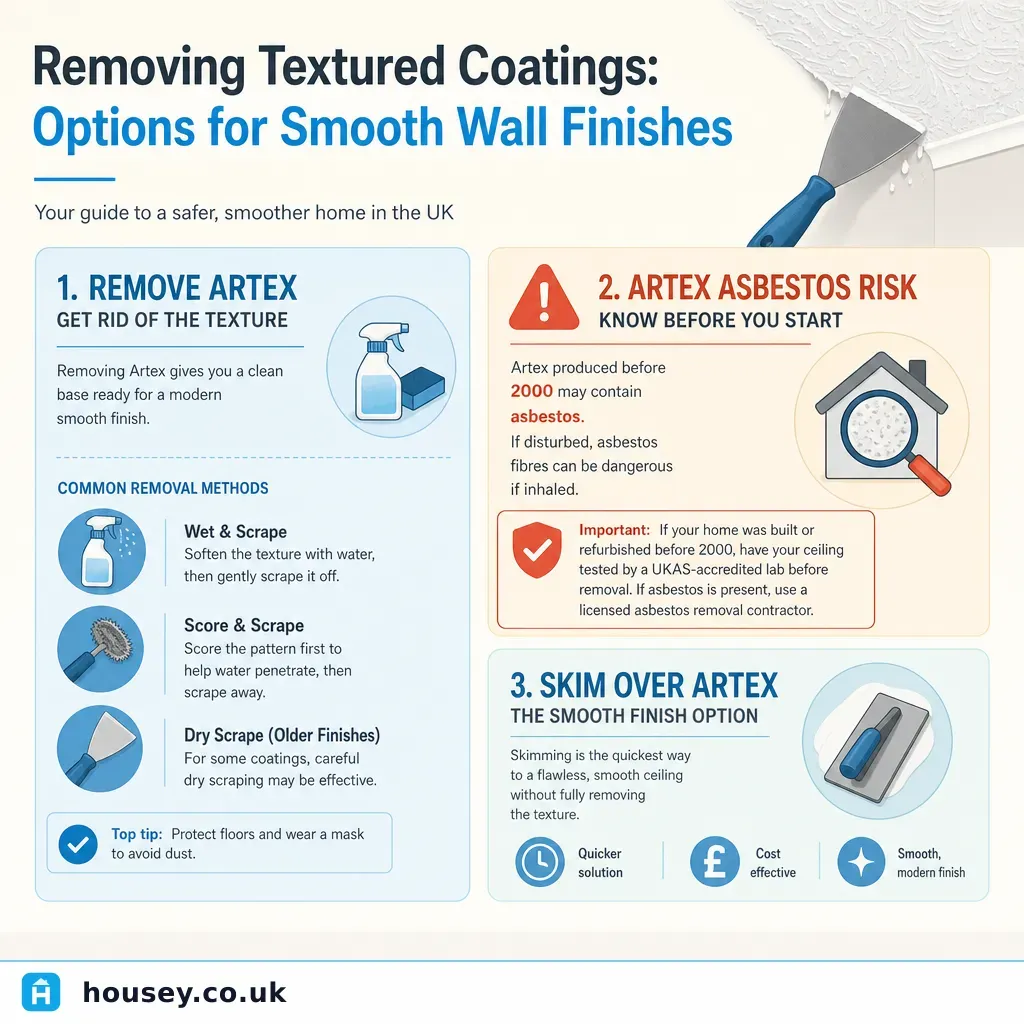
Removing Textured Coatings: Options for Smooth Wall Finishes
Textured wall and ceiling coatings — most famously sold under the Artex brand — were applied extensively in UK homes from the 1950s through to the 1990s. Homeowners today often want to remove or cover them for a smooth, contemporary finish, but the right method depends critically on when the coating was applied and whether it might contain asbestos. Choosing an approach without first establishing this can expose occupants and tradespeople to serious health risk and put contractors in breach of the Control of Asbestos Regulations 2012.
Key points
- Textured coatings applied before 2000 may contain chrysotile (white) asbestos in bound form; properties built or refurbished before 1985 carry the highest risk.
- The Control of Asbestos Regulations 2012 (SI 2012/632) requires anyone liable to disturb asbestos during work to manage that risk before starting — this applies to tradespeople in domestic properties.
- Disturbing chrysotile in a textured coating is classed as notifiable non-licensed work (NNLW) under CAR 2012 — not routine decorating and not suitable for DIY.
- Three main approaches exist: skim plaster over the coating, dry-line with plasterboard, or full removal; skimming and dry-lining avoid disturbing the existing material.
- A UKAS-accredited asbestos analyst can take a sample for laboratory testing, typically costing £30–£100 per sample plus analysis fees.
The asbestos risk: what you need to know first
Treat any textured coating in a pre-2000 property as potentially containing asbestos until laboratory testing by a UKAS-accredited analyst confirms otherwise. The Control of Asbestos Regulations 2012 requires that anyone liable to disturb asbestos must manage that risk. In practice this means:
- Do not sand, scrape, dry-scrape, or use power tools on suspect coatings. Dry disturbance releases airborne fibres invisible to the naked eye.
- Arrange a sample test before any work begins. A UKAS-accredited analyst takes a small sample for laboratory analysis. The HSE provides guidance on asbestos in buildings including advice on when sampling is appropriate.
- If asbestos is confirmed, any removal is classified as NNLW. Contractors must notify the relevant enforcing authority, maintain health records, and follow HSE NNLW guidance. This is not a job for a general decorator.
For most homeowners, the practical response to confirmed or suspected asbestos is to choose an approach that does not require disturbance: skimming over or dry-lining.
Your three main options
Option 1: Skim plaster over the coating
A plasterer applies a thin coat of finish plaster directly over the existing texture, embedding and smoothing it.
Pros: No disturbance of existing coating; lower cost; faster turnaround; suitable where asbestos may be present.
Cons: Slight reduction in ceiling or wall depth; adhesion can fail on heavily textured or delaminating surfaces; quality depends on the skill of the plasterer and condition of the coating.
Typical cost (indicative, last reviewed 2026-05-07): £150–£400 per room. Obtain at least three written quotes.
Option 2: Dry-lining (overboard with plasterboard)
Plasterboard — typically 9.5mm or 12.5mm — is fixed over the existing surface, then skimmed smooth.
Pros: Completely encapsulates the coating with no disturbance risk; reliable finish over deep textures; can improve thermal or acoustic performance.
Cons: Reduces room height or wall depth by approximately 12–15mm plus skim; electrical back-boxes and fittings need extending; may affect coving or architrave lines; higher material cost.
Typical cost (indicative, last reviewed 2026-05-07): £200–£600 per room.
Option 3: Full removal
The coating is wetted and scraped away mechanically, or softened with a chemical stripper.
Pros: Clean substrate; no future concerns about hidden material.
Cons: Highest risk if asbestos is present; most disruptive; may damage the substrate; must only be attempted once testing confirms the coating is asbestos-free.
Typical cost (indicative, last reviewed 2026-05-07): £200–£700+ per room.
Which option is right for your situation?
Situation | Recommended option | Reason |
|---|---|---|
Pre-2000 property, no asbestos test done | Skim or dry-line only | Do not disturb until tested |
Pre-2000 property, asbestos confirmed | Skim or dry-line | NNLW removal possible but costly; encapsulation is lower risk |
Pre-2000 property, asbestos test negative (UKAS lab) | Any option | Confirm with written lab result before proceeding |
Post-2000 property | Any option | Very low asbestos risk; check substrate adhesion first |
Deep stipple or patterned texture | Dry-line | Skim may not fully conceal deep texture |
Delaminating or water-damaged coating | Professional assessment first | Skim adhesion uncertain; hidden damage may need addressing |
Decision tree: which approach suits your home?
- Is the coating pre-2000 or of unknown age? → Arrange UKAS-accredited asbestos sampling before any other decision.
- Asbestos confirmed? → Choose skim or dry-lining. If removal is essential, instruct an NNLW-compliant contractor who will notify the enforcing authority under CAR 2012.
- Asbestos not present, confirmed in writing by a UKAS lab? → Choose based on texture depth, room height tolerance, and budget.
- Deep or uneven texture? → Dry-lining typically gives a more reliable finish than skimming alone.
- Shallow texture in good condition? → Skim plaster is usually the most cost-effective route.
- Coating showing delamination or water damage? → Have a plasterer assess the surface before committing to a method.
Important limitations
This article provides general information for UK homeowners and is not a substitute for a professional asbestos survey, a qualified plasterer's on-site assessment, or advice from a licensed asbestos contractor. Asbestos classification, notification requirements, and safe working methods under the Control of Asbestos Regulations 2012 depend on the specific material, its condition, the quantity involved, and the scope of the planned work. A qualified professional should assess your specific property before any disturbance of suspect coatings takes place.
When this becomes urgent
Stop all work and seek professional advice immediately if:
- You have already sanded, drilled, or scraped a pre-2000 textured coating without prior asbestos testing, especially in an enclosed space.
- Dust or debris from a suspect coating has been disturbed and anyone present is experiencing respiratory symptoms.
- A contractor has begun removal work on a pre-2000 coating without first providing evidence of asbestos testing.
- The coating is visibly crumbling or delaminating, increasing the risk of uncontrolled fibre release.
For concerns about possible asbestos exposure, the HSE asbestos pages provide guidance on next steps.
What to ask a qualified professional
- Have you worked with potentially asbestos-containing textured coatings before?
- Are you aware of the NNLW requirements under CAR 2012 and can you demonstrate compliance?
- Can you arrange or recommend a UKAS-accredited asbestos sample test before starting work?
- If asbestos is confirmed, are you able to proceed under NNLW notification procedures, or will you refer to a specialist contractor?
- What is your approach if the coating is delaminating or the substrate is damaged?
- Does your quote include preparation, finish materials, and making good around light fittings, switches, and coving?
- Is VAT included in the price?
When to get professional help
Any work on a textured coating in a pre-2000 UK property should involve a qualified professional. Beyond the asbestos question, plastering over a textured surface or dry-lining a ceiling involves technical decisions about adhesion, loading, and substrate preparation that affect the long-term quality of the result. Seek professional advice before proceeding if:
- You are unsure when the coating was applied or whether it has been tested previously.
- The surface shows signs of delamination, staining, or water damage.
- You are planning any sanding, scraping, or power tool use on a suspect surface.
- The property is a listed building or has original decorative plasterwork you want to preserve.
- The work forms part of a larger renovation requiring building control sign-off under Building Regulations.
How Housey can help
Housey can help you find qualified plasterers and building contractors experienced in working safely with pre-2000 interior surfaces. Request quotes through Housey to compare tradespeople in your area before committing to a method.
Frequently asked questions
Is Artex always dangerous?
Not necessarily. Artex and similar coatings applied after around 1984 are less likely to contain asbestos, and post-2000 coatings almost certainly do not. However, the only reliable confirmation is laboratory testing by a UKAS-accredited analyst. The HSE advises treating all pre-2000 textured coatings as potentially containing asbestos until testing proves otherwise.
Can I skim over Artex myself?
Skimming is a skilled trade and achieving a smooth finish over a textured surface requires multiple coats and technique. Poor results are common and costly to put right. If the coating may contain asbestos, a plasterer who understands NNLW obligations should carry out the work. For confirmed asbestos-free surfaces, a competent DIYer may attempt a small area, but ceiling work is difficult without practice.
How much does it cost to deal with a textured coating in a room?
Indicative UK costs, last reviewed 2026-05-07. A typical bedroom or living room ceiling costs approximately £150–£700 depending on the method — skim, dry-line, or removal — the room size, and whether asbestos testing is needed. Sampling typically adds £60–£150 per sample. Always obtain multiple written quotes; costs vary by region and contractor.
Do I need to disclose asbestos in textured coatings when selling my home?
You are not generally required to proactively declare undisturbed intact asbestos-containing materials to a lender or insurer unless asked. However, if you are aware of ACMs and are selling, this should be disclosed on the TA6 property information form under material information requirements. Always check your specific obligations with a solicitor before exchange.
Will a smooth ceiling increase my home's value?
Smooth ceilings are generally more desirable than heavy textured finishes in the current UK market and can improve the presentation of a property, particularly in urban areas. The impact on value depends on the wider property condition and buyer expectations. A smooth finish is unlikely to add measurable value alone but can improve first impressions at viewings.
Sources and further reading
- Control of Asbestos Regulations 2012 — legislation.gov.uk / HSE
- Asbestos in buildings — HSE guidance — Health and Safety Executive
- Notifiable non-licensed work with asbestos — Health and Safety Executive
- Find a UKAS-accredited asbestos testing laboratory — United Kingdom Accreditation Service
Useful next reads
 Improvement & Build
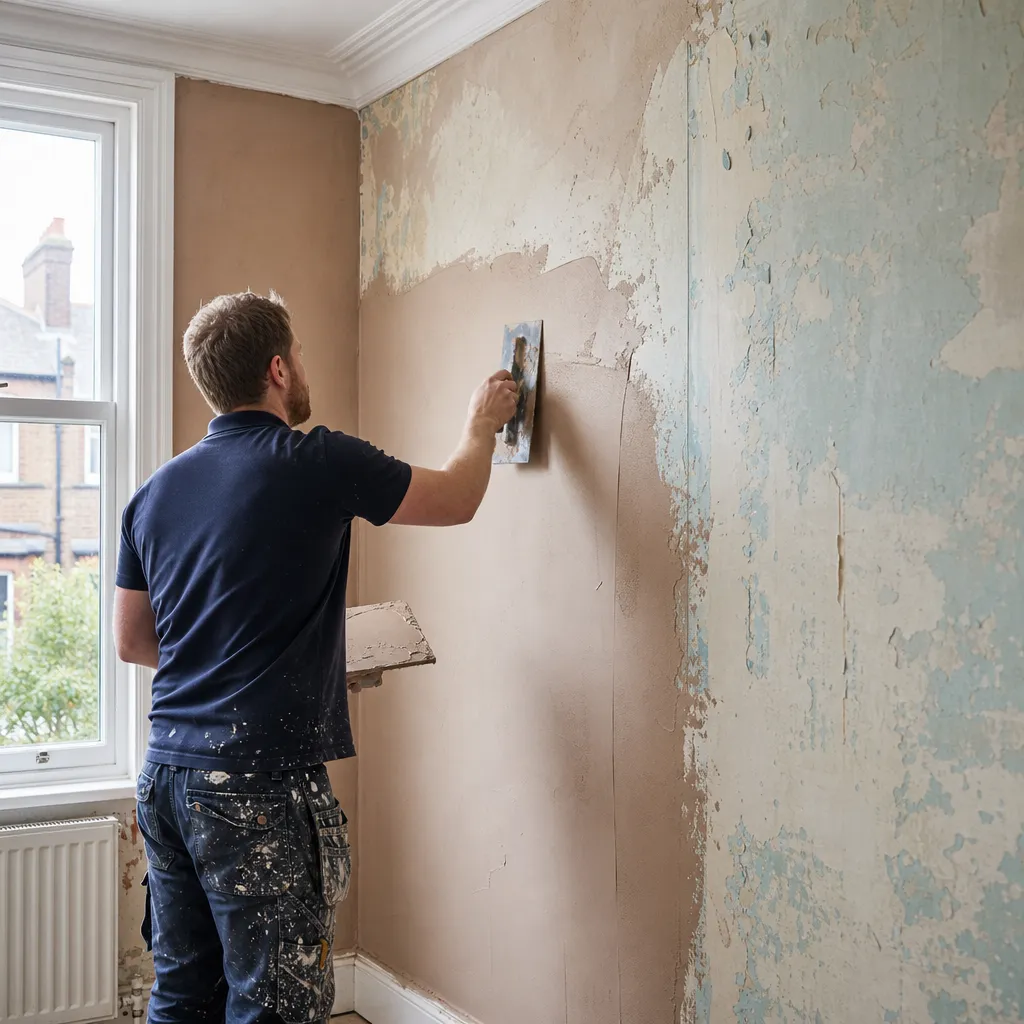
Plaster Skimming Costs for Wall and Ceiling Finishes
Skim plastering a typical bedroom costs £400–£750 for walls and ceiling combined; a single ceiling runs £150–£350 and a single wall £80–£180.
 Improvement & Build
Plastering Over Existing Paint and Wallpaper: Surface Prep and Technique
Whether you can plaster over existing paint or wallpaper depends on surface condition and adhesion.
 Improvement & Build
Painting Interior Doors: Preparation and Technique
Painting interior doors well depends on preparation rather than paint choice.
 Improvement & Build
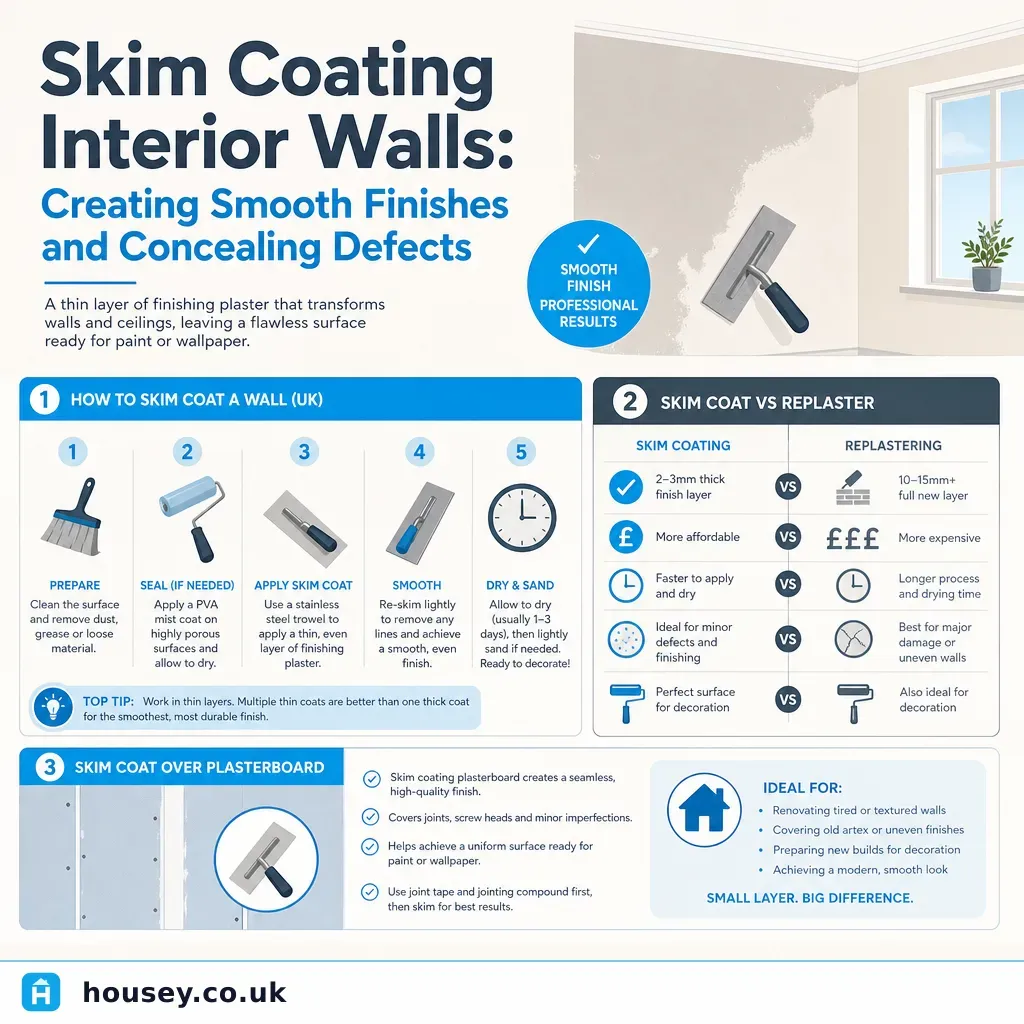
Skim Coating Interior Walls: Creating Smooth Finishes and Concealing Defects
Skim coating applies a 2–3 mm layer of finish plaster over prepared plasterboard or existing plaster, creating a smooth, paint-ready surface.
 Improvement & Build
Installing Peel-And-Stick Wallpaper: Application Techniques
Peel-and-stick wallpaper works best on smooth, emulsion-painted walls cured for at least 30 days, in rooms between 13°C and 30°C.