Renovating Older Properties: Key Advantages and Challenges
By Housey · Last reviewed 30th of May 2026
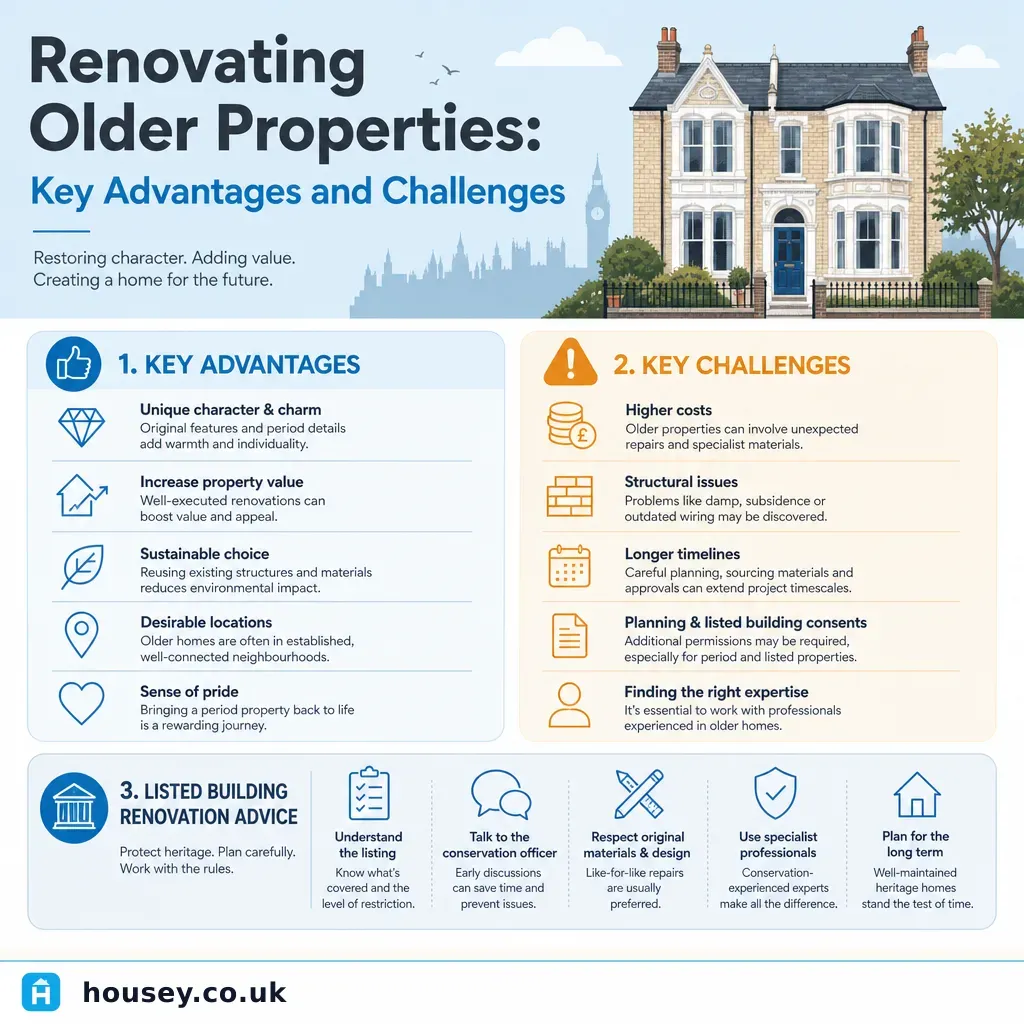
Renovating Older Properties: Key Advantages and Challenges
Older properties — whether a Victorian terrace, an Edwardian semi, a 1930s detached, or a pre-war cottage — make up a substantial share of the UK's housing stock, and many buyers are drawn to them for their character, location, and perceived value. Yet older properties carry a distinctive set of risks that newer builds do not, and the decision to renovate one significantly requires careful preparation, appropriate surveys, and realistic budgeting before any work begins.
Key points
- Properties built before 1985 may contain asbestos-containing materials (ACMs) in textured coatings, floor tiles, roof sheets, or pipe lagging — most notifiable removal work requires a licensed contractor under the Control of Asbestos Regulations 2012.
- Listed buildings (Grade I, II*, and II in England) require Listed Building Consent for works affecting their character, including internal alterations; unauthorised works can result in criminal prosecution.
- Pre-1919 solid-wall construction cannot be upgraded with standard cavity wall insulation; external wall insulation (EWI) or internal wall insulation (IWI) carries moisture management risks that must be assessed under PAS 2035.
- A RICS Level 3 Building Survey is strongly recommended before purchasing any property built before 1960, or any property with visible defects, undocumented extensions, or altered construction.
- Budget contingencies of 20–25% above the estimated renovation cost are commonly advised for older properties; 30% or more is appropriate for pre-1919 buildings with unknown histories.
The advantages of older property renovation
Renovating an older property offers genuine advantages that newer builds cannot match, provided the risks are understood and managed.
Character and architectural quality: Older properties often feature original details — cornicing, fireplaces, period tiles, solid timber floors — that are expensive to replicate and add both character and resale value when retained sympathetically. Conservation area designations, which cover many Victorian and Edwardian streets, protect the streetscape and can support house prices over time.
Established locations: Pre-war housing was typically built in locations that have since become established urban and suburban centres, close to transport links, schools, and amenities. These advantages are difficult to replicate in new-build developments, which are more often on peripheral or brownfield sites.
Value uplift potential: In many markets, properties requiring renovation are available at a discount relative to renovated equivalents on the same street. The gap between purchase price plus renovation cost and the end value can be meaningful when works are well-specified and managed.
Retrofit and energy improvement potential: Older properties with poor energy ratings (EPC D or below) may be eligible for schemes such as ECO4 (for eligible households) or the Great British Insulation Scheme. Correct specification under PAS 2035 by a qualified Retrofit Coordinator is essential to avoid moisture and condensation risks in solid-wall construction.
The challenges: a realistic assessment
Challenge | Why it matters | Typical mitigation |
|---|---|---|
Asbestos-containing materials (ACMs) | Disturbing ACMs during renovation can cause fatal disease; most notifiable removal requires a licensed contractor under CAR 2012 | Commission a refurbishment asbestos survey before any intrusive works |
Structural movement | Cracks, settlement, and subsidence are more common in older properties; not all movement is historic and stable | RICS Level 3 survey; structural engineer's report where movement appears active |
Damp and timber decay | Solid-wall construction, failed DPCs, and poor ventilation create conditions for rising damp, penetrating damp, and wet rot | Damp and timber survey before renovation; PAS 2035-compliant retrofit design |
Planning and listed building consent | Conservation areas and listed buildings restrict what can be altered, sometimes significantly | Pre-application advice from the local planning authority; heritage consultant for listed buildings |
Unknown building fabric | Previous owners may have made undocumented alterations — removed load-bearing walls, buried services, or non-compliant electrics | Intrusive investigation and Electrical Installation Condition Report (EICR) before works begin |
Budget overruns | Hidden defects, asbestos, structural issues, and planning delays are the main cost drivers | 20–30% contingency; fixed-price contracts where achievable |
Red flags to investigate before exchange of contracts
The following observations during a viewing or in a surveyor's report warrant further investigation before you commit to purchase or a renovation programme:
- Diagonal or stepped cracks through masonry, particularly near lintels, corners, or bay windows — may indicate structural movement or lintel failure.
- Damp patches or tide marks on ground-floor walls or ceilings above flat-roof extensions — potential rising damp, penetrating damp, or roof drainage failure.
- Extension work without visible planning permission or building regulations history — check with the local authority before proceeding.
- Artex-style textured ceiling or wall coating in a property built before 2000 — a potential source of ACMs requiring an asbestos survey before any disturbance.
- Original or uninspected consumer unit, boiler, or pipework — arrange an EICR and a Gas Safe engineer's inspection before exchange.
- Evidence of previous underpinning or subsidence — ask the seller's solicitor to disclose any insurance claims or structural warranty history before exchange.
Important limitations
This article provides general information about older property renovation in the UK. Every property is different — construction method, local geology, planning history, condition, and tenure all vary significantly. Nothing in this guide constitutes structural, legal, environmental, or financial advice. Always instruct a qualified professional — a RICS-accredited surveyor, structural engineer, asbestos consultant, planning consultant, or solicitor — appropriate to your specific circumstances before committing to purchase or renovation works. Rules and risks vary; a qualified professional should assess your individual property and situation.
What to ask a qualified professional
Before engaging contractors or committing to renovation works on an older property, ask:
Of your surveyor or structural engineer:
- Is there evidence of active (ongoing) structural movement, or is any movement historic and stable?
- Are there signs of moisture ingress, and what is the likely cause and remediation path?
- Are there elements of the construction that may contain asbestos-containing materials?
Of your planning consultant or heritage and conservation consultant:
- Is this property listed or within a conservation area, and what consents will my planned works require?
- Are there enforcement notices, planning conditions, or Article 4 Directions affecting this property?
Of your asbestos surveyor:
- Which type of survey is appropriate — management survey or refurbishment and demolition survey?
- Which materials have been sampled, and what are the laboratory results for each?
- What does the report recommend for each identified ACM — management in place, encapsulation, or licensed removal?
Of your contractor:
- Do you have experience working with pre-war construction, solid walls, and heritage materials?
- How do you handle unforeseen defects or ACMs discovered during works?
- Are you familiar with listed building consent requirements and local authority expectations in this area?
When to get professional help
Beyond instructing a surveyor before purchase, seek specialist professional advice if:
- The property is listed or within a conservation area — a heritage and conservation consultant can advise on consent requirements before you commit to a renovation programme.
- The property pre-dates 1985 and you plan any intrusive works — a refurbishment and demolition asbestos survey from a UKAS-accredited provider is required before disturbing suspected materials. Do not disturb any suspected asbestos-containing material without professional advice.
- Cracks are widening, stepped through brickwork, or accompanied by sticking doors or windows — ask a chartered structural engineer to inspect before any renovation work proceeds.
- You plan to insulate a solid-wall property — engage a PAS 2035-qualified Retrofit Coordinator to assess moisture risk before specifying any insulation system.
- You are considering an extension — an experienced extension builder familiar with period properties can advise on structural tie-in, material matching, and planning constraints.
How Housey can help
Housey connects homeowners with professionals experienced in older and period property renovation across the UK. Whether you need a heritage and conservation consultant to navigate listed building consent, an asbestos survey before intrusive works, a damp and timber survey to understand moisture risk, or an extension builder with period property experience, compare quotes from vetted local professionals through Housey.
Frequently asked questions
Do I need listed building consent to change the internal layout of a listed property?
Yes, in most cases. Listed Building Consent is required for any works that would affect the character of a listed building — including removing walls, replacing windows, altering original features, and in some cases redecorating with unsuitable materials. The duty falls on the property owner; unauthorised works can result in enforcement action and criminal prosecution. Seek advice from your local planning authority or a heritage consultant before starting.
Is a RICS Level 2 survey sufficient for a Victorian terrace?
Often not. A RICS Level 2 Home Survey may miss hidden defects in pre-1919 solid-wall construction, particularly where the property has been altered, extended, or shows any visible deterioration. A RICS Level 3 Building Survey provides more detailed inspection and includes maintenance and repair advice, making it the more appropriate choice for older, larger, or visibly defective properties.
What is the difference between a management asbestos survey and a refurbishment and demolition survey?
A management survey identifies accessible asbestos-containing materials without intrusive investigation and is designed for in-use properties. A refurbishment and demolition survey involves intrusive sampling of materials that would be disturbed during works and is required before any renovation or structural alteration. The R&D survey is almost always required before a significant older-property renovation. Both must be carried out by a UKAS-accredited surveyor.
Can I get grant funding to insulate a solid-wall older property?
Possibly. The ECO4 scheme may provide support for solid-wall insulation in properties with lower EPC ratings, subject to household income and tenure eligibility. However, solid-wall insulation in pre-1919 buildings requires specialist design under PAS 2035 to manage moisture risk — incorrect installation can cause condensation, mould, and structural damage. A qualified Retrofit Coordinator should be your first point of contact.
Sources and further reading
- Control of Asbestos Regulations 2012 — legislation.gov.uk
- Historic England: listed buildings and consent guidance — Historic England
- RICS Home Survey Standard — RICS
- PAS 2035: retrofitting dwellings for improved energy efficiency — BSI
- GOV.UK: Energy Company Obligation (ECO4) — GOV.UK
- HSE: asbestos — the survey guide (HSG264) — HSE
Useful next reads
 Improvement & Build
Patio Door Types and Styles for Home Extensions
For most UK home extensions, sliding doors suit openings up to 3.
 Improvement & Build
Open Plan Living Space Conversion Costs
Opening up a living space in the UK typically costs £3,000–£15,000+ depending on whether walls are load-bearing, the beam specification required, and the extent of remodelling.
 Improvement & Build
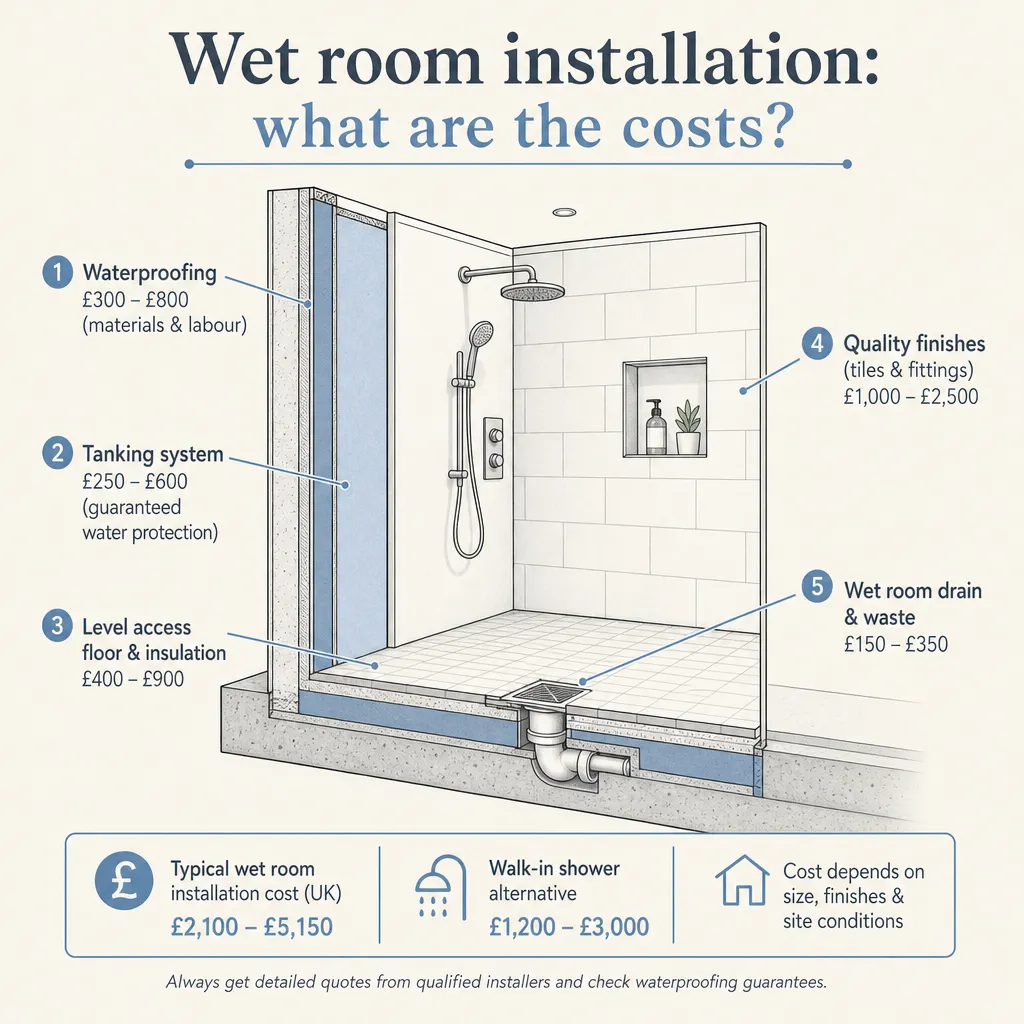
Wet room installation: what are the costs?
A wet room installation in a UK home typically costs between £3,500 and £10,000 depending on room size, materials, and structural requirements.
 Improvement & Build
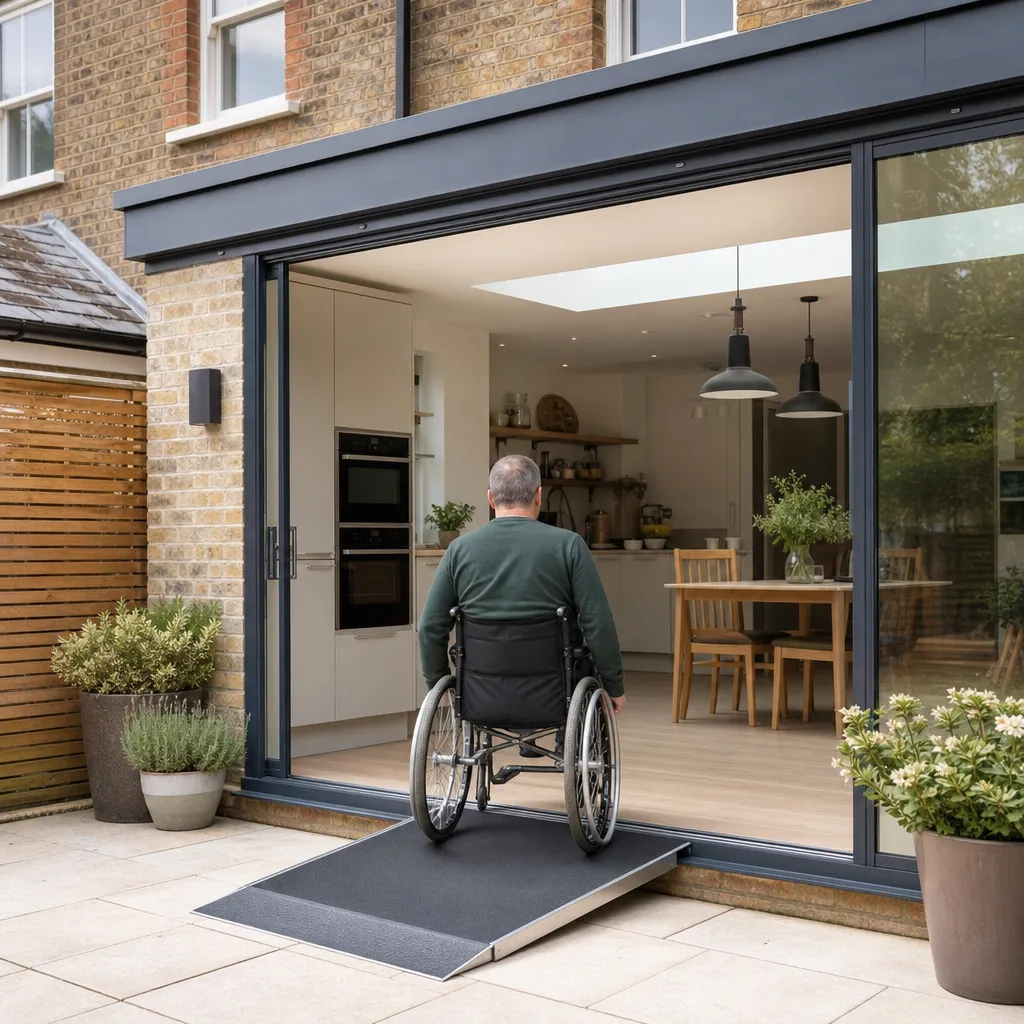
Accessible Home Renovation: Combining Style With Inclusive Design
Accessible home renovation incorporates level thresholds, wider doorways, lever handles, and wet rooms into quality design from the outset.
 Improvement & Build
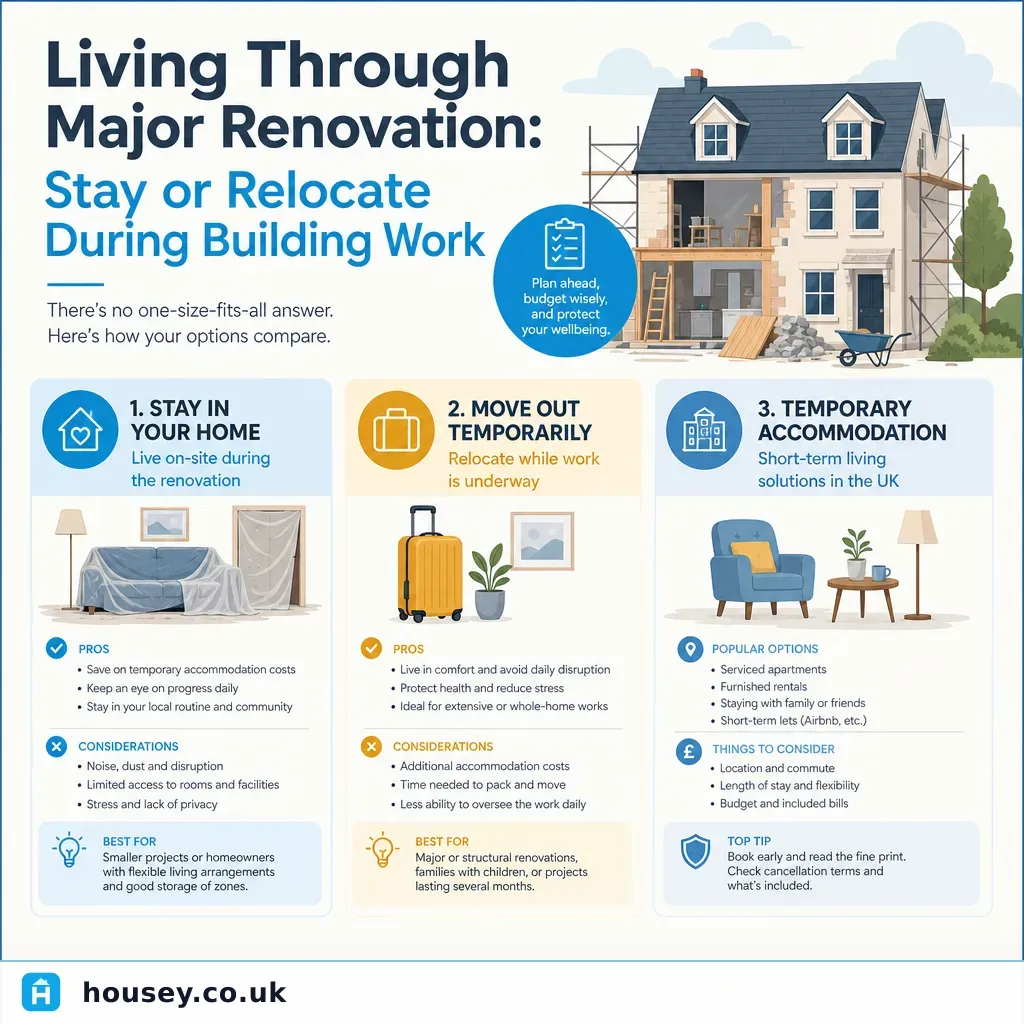
Living Through Major Renovation: Stay or Relocate During Building Work
Whether to stay in your home or relocate during major building work depends on the project scope, programme, and your household's circumstances.