Renovation Expertise: Professional Tips for Successful Home Transformation
By Housey · Last reviewed 18th of May 2026

Renovation Expertise: Professional Tips for Successful Home Transformation
Whether you're extending a 1930s semi, updating a Victorian terrace, or converting a loft, renovation projects in the UK carry real regulatory, financial, and practical complexity. The difference between a smooth project and a stressful one often comes down to preparation, choosing the right professionals, and knowing which rules apply before a single wall comes down.
Key points
- Extensions beyond 4 metres deep for a detached house (or 3 metres for other house types) typically require planning permission; permitted development limits under the Town and Country Planning (General Permitted Development) (England) Order 2015 set out what can be built without an application.
- Building Regulations approval is separate from planning permission and is required for structural work, electrical installations, extensions, loft conversions, and new bathrooms — failure to obtain it can complicate resale and mortgage approvals.
- The Party Wall etc. Act 1996 requires homeowners to serve a Party Wall Notice on adjoining owners at least two months before work begins on a shared wall, boundary wall, or excavation near a neighbour's foundations.
- Standard buildings and contents insurance usually does not cover active building work; a contract works or self-build insurance policy should be in place before works start.
- VAT on approved alterations to a listed building is zero-rated; most other domestic renovation work attracts 20% VAT, except conversions of non-residential buildings to dwellings, which may qualify for the reduced 5% rate.
Which works need planning permission?
Many renovation works fall under permitted development (PD) rights, which allow certain works without a planning application. PD rights are restricted or removed for listed buildings, properties in conservation areas, and those subject to Article 4 Directions. Your local planning authority (LPA) can confirm the position for your specific property.
Decision tree: does this work need planning permission?
- Single-storey rear extension up to 4 m deep (detached) / 3 m (other houses): usually permitted development — notify the LPA under the prior approval process.
- Two-storey or large rear extension: planning application required in most cases.
- Loft conversion with rear dormer: usually PD on houses, within volume limits (40 m³ for terraced, 50 m³ for others). Check conservation area status first.
- Garage conversion to habitable room: usually no planning needed, but Building Regulations apply.
- Internal structural alterations: no planning permission required, but Building Regulations approval is usually needed.
- Any works to a listed building or in a conservation area: contact your LPA before starting — listed building consent may be required for internal as well as external changes.
- Check your local planning authority if you have already extended before: previous additions may have used up permitted development allowances.
Building Regulations: what they cover
Building Regulations set minimum standards for construction quality, safety, energy performance, and accessibility. They apply to most significant building work regardless of whether planning permission is also needed.
Approved Documents A–R set out how compliance can be demonstrated. Key parts for renovation include Part A (structure), Part B (fire safety), Part F (ventilation), Part L (energy efficiency), and Part P (electrical safety in dwellings).
Work type | Building Regs needed? | Notes |
|---|---|---|
New extension | Yes | Structure, drainage, Part L thermal performance |
Loft conversion | Yes | Floor loading, fire escape route, staircase |
Removing load-bearing wall | Yes | Structural calculations, steel specification required |
Replacement windows | Usually | FENSA-registered installers can self-certify |
New bathroom or en-suite | Usually | Drainage, ventilation, electrics near water |
Reroofing (like-for-like) | Usually not | Only if structure is not altered |
New boiler installation | Yes | Gas Safe engineer self-certifies under Competent Persons Scheme |
New electrical circuits | Often | NICEIC or NAPIT-registered electrician can self-certify |
Internal decoration | No | — |
A completion certificate issued by Building Control (or an approved inspector) is an important document at resale — mortgage lenders frequently request it. Keep it with your property paperwork.
Choosing and managing contractors
Choosing the right tradespeople and managing them well is where most UK renovation projects succeed or fail.
Homeowner renovation checklist
Before starting any significant project:
What to ask before accepting a quote
- What is specifically included and excluded from this price?
- Will work be carried out by your own staff or subcontracted — and to whom?
- What qualifications, trade body memberships, or accreditations do you hold?
- Who will apply for Building Regulations approval?
- Is VAT included in the quoted price?
- What liability and employer's insurance do you carry, and can I see a copy?
- What contract form do you use — JCT Minor Works or equivalent?
- What could change the price or delay the programme?
Renovation red flags: when to walk away
The following warning signs warrant serious caution before committing to a contractor:
- Cash-only payment with no VAT invoice — eliminates your paper trail and may indicate undeclared work.
- No written contract — verbal agreements provide minimal protection if disputes arise.
- Unusually low quote — may indicate excluded items, inferior materials, or a contractor without the capacity to deliver.
- Pressure to start immediately without adequate time to check credentials or seek alternative quotes.
- Cannot provide references or examples of comparable completed work upon request.
- No liability or employer's insurance — leaves you exposed if a worker is injured on your site.
- Claims that Building Regulations do not apply to structural or controlled work, without a clear and verifiable explanation.
When to get professional help
For minor works — decorating, like-for-like repairs, basic landscaping — a single reliable tradesperson may be sufficient. For anything structural, involving regulated services (gas, electrics), or extending the building's footprint, professional oversight pays for itself.
Consider engaging a project manager when:
- The project involves three or more separate trades working in sequence.
- You cannot be on-site regularly during the build programme.
- The project value is £30,000 or above.
- Works are near a party wall, in a conservation area, or involve a listed building.
A RIBA Chartered Architect or CIAT-accredited architectural technologist can prepare drawings for planning and Building Regulations, specify materials to a standard that reduces defect risk, and administer the contract on your behalf.
How Housey can help
Housey connects UK homeowners with vetted local professionals. Whether you need experienced extension builders for a rear or side addition, a dedicated project manager to coordinate trades and keep your programme on track, or specialist roofers for a re-roof or loft conversion, Housey's marketplace lets you request and compare quotes from professionals in your area.
Frequently asked questions
Do I need planning permission for internal renovation works?
In most cases, internal alterations do not require planning permission. However, Building Regulations approval is often still needed — for example, removing a load-bearing wall, adding a new electrical circuit, or fitting a new bathroom. If you live in a listed building, any works, including internal changes, may require listed building consent from your local planning authority before work begins.
What contract should I use with a builder?
For most domestic renovation projects, the JCT Minor Works Building Contract or the JCT Homeowner Contract is a widely used, balanced option. It sets out scope, payment milestones, and dispute resolution procedures clearly. For complex or high-value projects, an architect or solicitor can review the terms before you sign. Always use a written contract — verbal agreements offer minimal protection if disputes arise.
Can I live in my house during a renovation?
This depends on the scale of works. Loft conversions and kitchen renovations can often be managed around occupation. Works affecting structural integrity, electrical supply, drainage, or fire compartmentation may make the property temporarily unsuitable. Discuss the construction sequence — and whether the property will be habitable at each stage — with your contractor before signing a contract.
How long does a typical single-storey rear extension take?
A single-storey rear extension typically takes 10–16 weeks on-site, plus lead time for planning permission (around 8 weeks for a standard application) and Building Regulations approval. Common causes of delay include late material deliveries, unexpected structural conditions during groundworks, and waiting for Building Control inspection slots. A written programme with clear milestones helps both parties manage expectations.
Sources and further reading
- Planning permission guidance — GOV.UK
- Building Regulations Approved Documents — GOV.UK
- Party Wall etc. Act 1996: explanatory booklet — Ministry of Housing, Communities and Local Government
- TrustMark: find a registered trader — TrustMark
- Hiring a trader — Citizens Advice
Useful next reads
 Improvement & Build
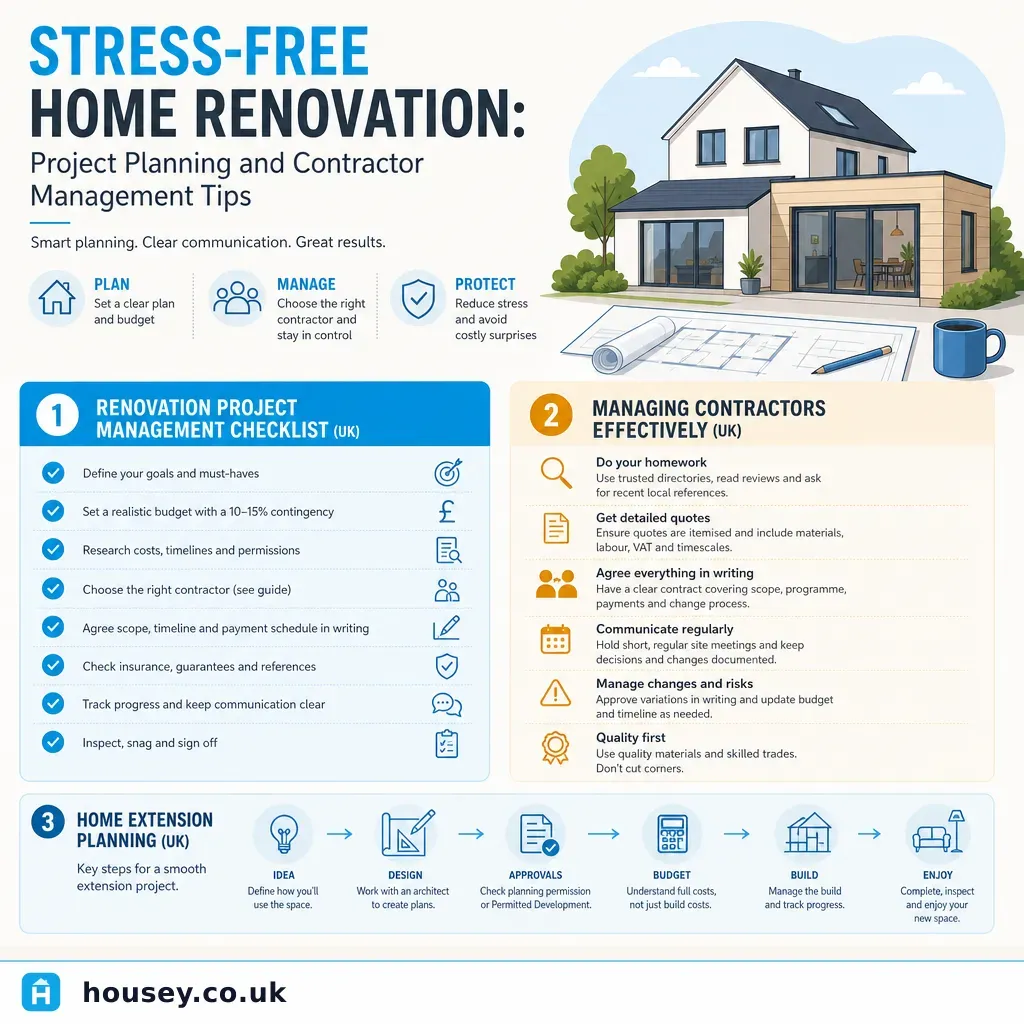
Stress-Free Home Renovation: Project Planning and Contractor Management Tips
The home renovations that stay on budget and on time share one characteristic: clear upfront planning.
 Improvement & Build
Renovation Tips From Experienced Homeowners: Practical Advice
Experienced UK homeowners consistently identify the same lessons: set a contingency of 10–20%, obtain at least three written itemised quotes, confirm whether planning permission and Building Regulations approval are both needed, and always sign a contract with a written scope of works before work starts.
 Improvement & Build
Home Renovation: Contractor Advice and Professional Tips for Property Owners
Successful renovations depend on preparation, clear contracts, and vetted contractors.
 Improvement & Build
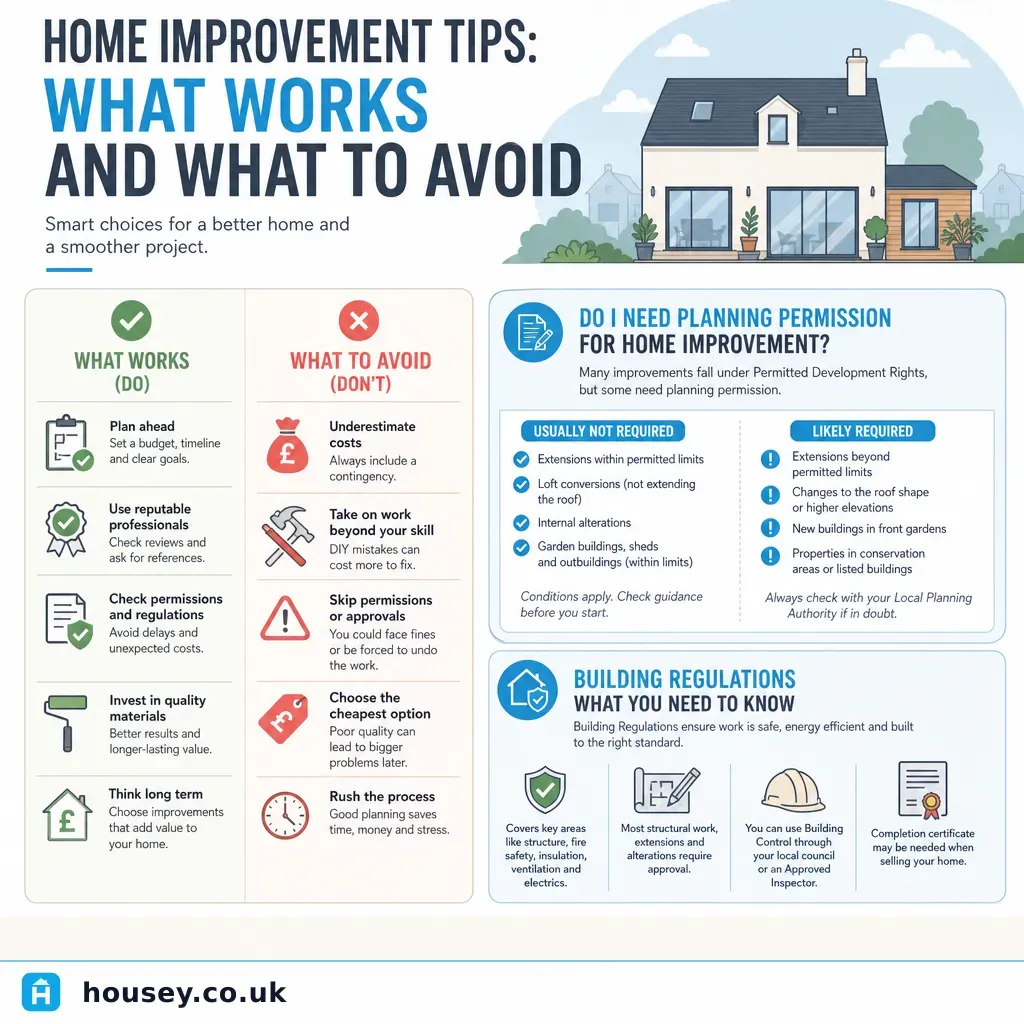
Home Improvement Tips: What Works and What to Avoid
Successful home improvement in the UK depends on knowing which projects need planning permission, which need building regulations approval, and how to choose reliable contractors.
 Improvement & Build
Renovation Insights: Tips From Professional Home Renovation Experts
Professional renovation guidance consistently covers three areas: understanding your property's history and construction before work begins, sequencing trades in the correct order, and allowing a realistic contingency of 10–15%.