Renovation Tips From Experienced Homeowners: Practical Advice
By Housey · Last reviewed 10th of May 2026

Renovation Tips From Experienced Homeowners: Practical Advice
Renovation projects across the UK regularly surface the same pressure points: budget overruns driven by hidden costs, contractor disputes rooted in poorly defined scope, and planning delays caused by assumptions that turn out to be wrong. Homeowners who have completed extensions, loft conversions, re-roofing works, and structural alterations — across a range of budgets and property types — identify a consistent set of lessons that are rarely apparent before work starts. This guide draws on those recurring themes to help you avoid the most common and costly mistakes.
Key points
- The Federation of Master Builders recommends obtaining at least three written quotes for any significant building work; research consistently shows many homeowners obtain fewer.
- Contingency budgets of 10–15% are appropriate for modern properties in good condition; 15–20% is more prudent for pre-1919 homes where hidden structural and services issues are more likely.
- Planning permission and Building Regulations approval are two separate legal requirements — assuming one covers the other is among the most common errors in self-managed renovations.
- Retaining 5% of the contractor's payment until the snagging list is resolved is standard construction industry practice and provides effective leverage to ensure defects are addressed before final payment.
- A written specification of works agreed before contract signing — covering scope, materials, exclusions, and programme — prevents the majority of disputes that arise during a build.
What experienced homeowners wish they had known
What not to assume
Many renovation problems begin with an incorrect assumption. This table summarises the misunderstandings UK homeowners most commonly report after completing a project.
What homeowners often assume | What is often actually the case |
|---|---|
"Permitted development covers my extension" | Permitted development rights can be removed by conditions on the original planning permission — check the original consent for your property before starting |
"The builder will handle Building Regulations" | Unless explicitly stated in the contract, some contractors expect the client to apply to building control separately |
"The quote includes VAT" | Many sole traders and small builders quote excluding VAT — always confirm in writing before signing |
"My neighbour's wall is the party wall" | Party Wall etc. Act 1996 notices apply to walls astride a boundary, even if the wall is technically within your own land |
"A structural engineer isn't needed for a straightforward extension" | Building control often requires structural calculations — omitting them delays sign-off and can halt the build |
"The project will finish on time" | Add 20–30% to any quoted programme for weather, material lead times, and subcontractor availability |
Pre-renovation checklist
Work through this checklist before appointing any contractor. It covers the checks most likely to prevent costly problems later in the project.
Budgeting: where costs are regularly underestimated
Budget overruns are common in UK renovation projects. The Federation of Master Builders' State of Trade surveys consistently identify poor initial budgeting and unexpected discoveries on site as leading causes of disputes and project delays. Experienced homeowners highlight several areas where costs are routinely missed at quotation stage:
Preliminaries and site setup: Scaffolding, skip hire, temporary fencing, and welfare facilities can add £2,000–£8,000 to a project budget and are often omitted from early quotes. Always ask explicitly whether they are included.
Structural investigations: Opening up walls, floors, or roof voids frequently reveals issues not visible from a pre-tender inspection. On pre-1919 properties, budget for at least some level of unforeseen structural work as a base expectation.
Professional fees: Architect fees, structural engineering calculations, party wall surveyor fees, building control application fees, and planning application fees are all separate from the build cost. They can add 10–15% to the overall project cost and should be budgeted explicitly from the outset.
VAT: Renovation and repair work is charged at 20% VAT. Confirm whether your contractor's quote includes or excludes VAT in writing before signing a contract.
What to ask before appointing a contractor
Before signing any contract with a builder or specialist contractor, ask the following questions and expect clear, direct answers:
- Can you provide two or three references from similar projects completed within the last two years?
- Are you a member of the Federation of Master Builders, registered with Trustmark, or accredited by CHAS or Constructionline?
- Do you carry public liability insurance, and can I see a current certificate?
- Who will carry out the physical work — your own employed team or subcontractors?
- What is your programme, and what are the key milestone dates?
- How do you manage changes to scope during the build — is there a written change-order process?
- Is VAT included in your quote?
- What are your payment terms, and will you agree to a 5% retention for snagging?
Red flags when hiring renovation contractors
- No written contract offered — a verbal agreement is very difficult to enforce if a dispute arises over scope, quality, or payment.
- Unwilling to provide references — a credible contractor with a track record will share recent client references without hesitation.
- Requests a large upfront payment — asking for more than 25–30% upfront before any work has begun is unusual for established contractors.
- Does not raise planning permission or Building Regulations for structural or external work that clearly requires both.
- Substantially lower quote than all others — if one quote is 30–40% below competitors for the same scope, investigate carefully what has been excluded or whether the contractor carries appropriate insurance.
- Pressure to start immediately — legitimate contractors work to a programme; urgency tactics are a warning sign worth taking seriously.
Managing the build: communication lessons
Homeowners who report smooth renovation projects consistently describe structured, regular communication with their contractor throughout the build. Practical approaches include:
- Weekly progress check-ins — even a brief Monday-morning site visit or call helps surface issues before they escalate into disputes or delays.
- A shared project log — recording what was agreed, when, and by whom protects both parties if questions arise later.
- Change orders in writing — any deviation from the original scope should be agreed in writing before the contractor proceeds, with a price and programme impact noted.
- Understanding building control stage inspections — know when your building control officer needs to visit and confirm in writing who is responsible for booking those inspections.
When to get professional help
If your project involves structural changes, planning applications, listed building consent, or coordinating multiple trades over several months, professional management adds measurable value. An experienced project manager can help prevent the budget and programme overruns that most commonly arise on mid-to-large renovation projects.
How Housey can help
Whether you are planning a rear addition and need experienced extension builders, a complex renovation that would benefit from a dedicated project manager, or roofing works requiring qualified roofers, Housey lets you request quotes from vetted UK professionals and compare them in one place.
Frequently asked questions
How much contingency should I budget for a UK home renovation?
Most construction professionals recommend 10–15% contingency for modern properties in reasonable condition. For pre-1919 homes — Victorian terraces, Edwardian semis, older cottages — 15–20% is more prudent, given the likelihood of finding hidden structural or services issues when walls and floors are opened. A clear written specification also reduces scope creep, which is the other leading cause of budget overruns.
Do I need to notify my mortgage lender before renovating?
For routine decoration and minor repairs, notification is not usually required. For structural work that materially alters the property — extensions, loft conversions, or significant structural alterations — check your mortgage terms, as some lenders require prior consent. Your buildings insurer must also be notified before structural work begins; failing to do so may affect your cover during the build period.
How do I find and verify a reputable builder in the UK?
Ask for references from recent, similar projects and contact those clients directly. Check whether the builder is a member of the Federation of Master Builders, registered with Trustmark, or holds CHAS or Constructionline accreditation. Request a current public liability insurance certificate. A reputable builder will provide all of this readily. Obtaining at least three written, itemised quotes for the same scope of works is the recommended minimum due diligence before appointing anyone.
What is a snagging list and when should I use one?
A snagging list is a record of minor defects, incomplete items, or quality issues identified at or around practical completion of a build. It is standard practice to carry out a snagging inspection before issuing final payment. Common items include paint finishes, misaligned joinery, incomplete external works, and outstanding mechanical or electrical items. Retaining 5% of the contract value until agreed items are resolved gives you practical leverage.
Sources and further reading
- How to find a builder — Which?
- FMB State of Trade Survey — Federation of Master Builders
- Party Wall etc. Act 1996: explanatory booklet — GOV.UK
- Building Regulations: apply for approval — GOV.UK
- Home improvements guidance — Citizens Advice
Useful next reads
 Improvement & Build
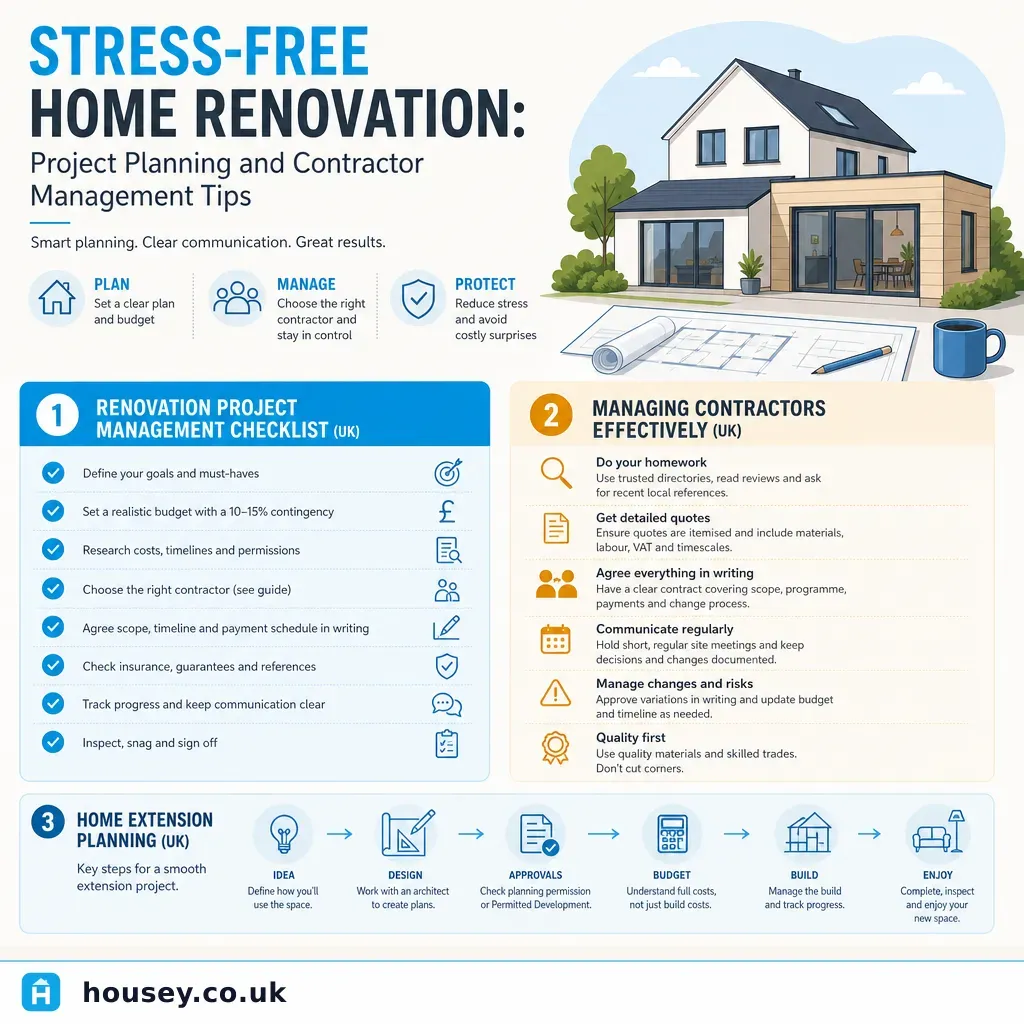
Stress-Free Home Renovation: Project Planning and Contractor Management Tips
The home renovations that stay on budget and on time share one characteristic: clear upfront planning.
 Improvement & Build
Home Renovation: Contractor Advice and Professional Tips for Property Owners
Successful renovations depend on preparation, clear contracts, and vetted contractors.
 Improvement & Build
Renovation Insights: Tips From Professional Home Renovation Experts
Professional renovation guidance consistently covers three areas: understanding your property's history and construction before work begins, sequencing trades in the correct order, and allowing a realistic contingency of 10–15%.
 Improvement & Build
Renovation Expertise: Professional Tips for Successful Home Transformation
Successful UK home renovation depends on understanding when planning permission or Building Regulations approval is required, choosing accredited contractors, using a written contract, and arranging the right insurance.
 Improvement & Build
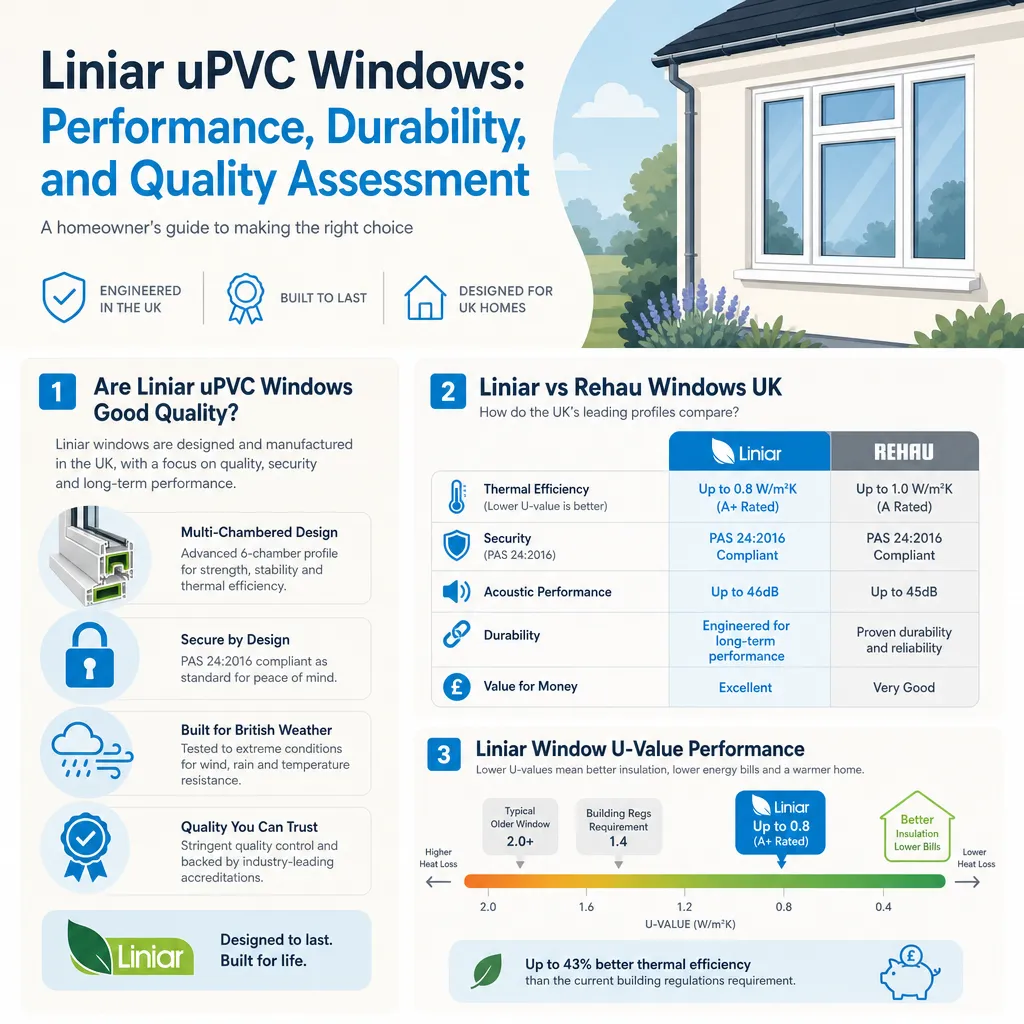
Liniar uPVC Windows: Performance, Durability, and Quality Assessment
Liniar uPVC window profiles are manufactured in the UK using multi-chambered, foamed frames.