Rental Property Improvements: Investment Decisions and ROI Planning
By Housey · Last reviewed 18th of May 2026
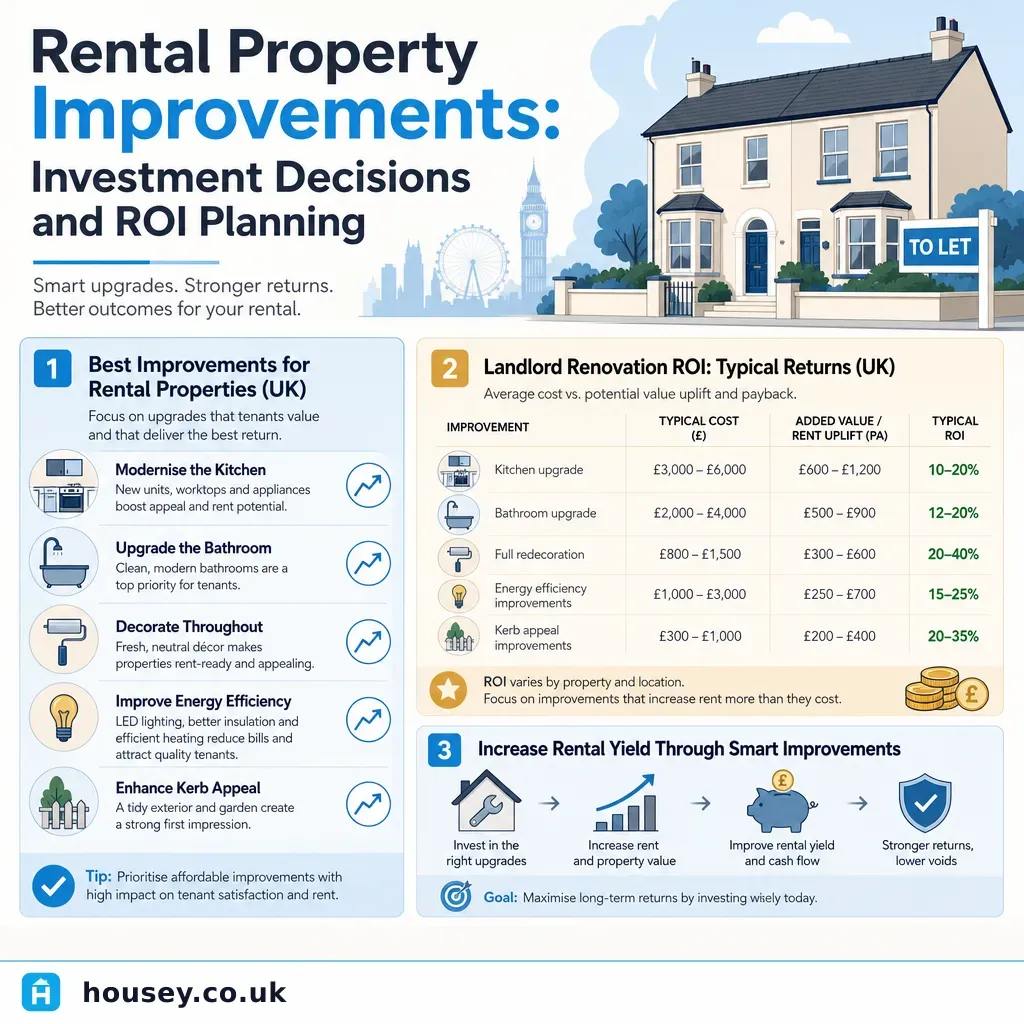
Rental Property Improvements: Investment Decisions and ROI Planning
Landlords in the UK face a dual pressure that has intensified over the past decade: a tightening regulatory environment mandating minimum property standards, and a competitive rental market in which tenants increasingly expect higher-quality accommodation. The question of which improvements to invest in — and how to sequence them — is rarely straightforward. The wrong choice consumes capital without improving rental income or reducing void periods; the right sequence protects asset value, satisfies compliance requirements, and delivers measurable yield improvements.
Key points
- Private rented properties in England and Wales must hold a minimum EPC rating of E before a tenancy can be granted or renewed under The Energy Efficiency (Private Rented Property) (England and Wales) Regulations 2015; proposed policy under government consultation in 2026 would require a minimum of C for new tenancies.
- The ECO4 (Energy Company Obligation) scheme may fund insulation, heating system upgrades, and other energy measures for eligible rental properties where the tenant meets qualifying benefit or income criteria.
- Houses in Multiple Occupation (HMOs) with five or more occupants across two or more households require a mandatory HMO licence from the local authority, carrying specific space, fire safety, and amenity requirements.
- An Electrical Installation Condition Report (EICR) must be carried out every five years or at the start of each new tenancy, with a copy provided to tenants within 28 days and to the local authority on request.
- Improvements that reduce void periods — reliable heating, functional kitchens and bathrooms, and sound external maintenance — typically deliver stronger returns than cosmetic upgrades in the short to medium term.
The compliance baseline: address legal requirements first
Before considering discretionary improvements, confirm the property meets its legal obligations. Failing to do so exposes landlords to civil penalties, prohibition notices, and in some cases criminal liability. The minimum compliance checklist for most residential rental properties in England includes:
- EPC rating of E or above — required before any tenancy can be granted or renewed under Minimum Energy Efficiency Standards (MEES).
- Annual Gas Safety Certificate — issued by a Gas Safe registered engineer; must be renewed every 12 months and provided to tenants before they move in.
- EICR every five years — carried out by a qualified NICEIC or NAPIT registered electrician; remediation must follow any unsatisfactory finding, and a completion certificate provided to tenants.
- Smoke alarm on every storey, CO alarm in every room with a fixed combustion appliance — required under the Smoke and Carbon Monoxide Alarm (Amendment) Regulations 2022 (gas cookers are exempt from the CO alarm requirement).
- Legionella risk assessment — landlords have a duty under the Health and Safety at Work etc. Act 1974 to manage legionella risk; a documented assessment is required, with formal testing where a risk is identified.
- HHSRS compliance — the Housing Health and Safety Rating System requires landlords to manage Category 1 hazards (including excess cold, damp and mould, and fire) or face local authority enforcement action.
Comparison table: improvement types by ROI profile
Improvement | Typical purpose | Impact on rental income | Impact on void periods | ROI profile |
|---|---|---|---|---|
Boiler replacement or heating upgrade | Compliance + comfort | Moderate | High — heating reliability is a top tenant priority | Strong; older boilers drive emergency callouts and disputes |
Roof repair or replacement | Asset protection | Low directly | Moderate — prevents water damage that causes voids | Essential; deferred costs escalate sharply |
Damp proofing and drainage | Compliance (HHSRS) + asset protection | Low directly | High — damp is a leading cause of tenant complaints | Strong where active damp is present |
Kitchen refurbishment | Tenant appeal | Moderate to high | Moderate — affects re-let speed | Good in mid-to-high rental markets |
Bathroom refurbishment | Tenant appeal | Moderate | Moderate | Similar profile to kitchens |
Loft or cavity wall insulation | EPC compliance + running costs | Low to moderate | Low | Strong long-term; may unlock ECO4 or GBIS funding |
Window and door replacement | Energy efficiency + security | Low to moderate | Low to moderate | Good where glazing is original and draughty |
Extension or additional bedroom | Yield increase | High | Low | High but capital-intensive; subject to planning permission |
Driveway improvement | Kerb appeal | Low | Low | Low ROI except in premium rental markets |
Cosmetic redecoration | Tenant appeal | Low | Moderate — accelerates re-let | Moderate; low cost and easy to time between tenancies |
Which improvements tend to deliver value in UK rental properties
Heating and energy efficiency are consistently the strongest performers. A boiler replacement removes the single most common source of emergency callouts and tenant complaints. Coupling a boiler upgrade with loft or cavity wall insulation — potentially funded through ECO4 for eligible tenants — can lift an EPC rating from D to C, satisfying likely future compliance requirements ahead of any regulatory deadline. Indicative costs for a boiler replacement in England: £2,000–£4,500 installed, last reviewed 2026-05-18; quotes vary considerably by specification and region.
Roofing is not glamorous, but a failing roof is the fastest route to serious damp, ceiling damage, and emergency spend that substantially outweighs the cost of preventative maintenance. An annual roof inspection is good practice for any property over 20 years old.
Damp proofing is critical where active damp is present. The HHSRS treats damp and mould as a Category 1 hazard — the highest risk rating — meaning local authorities can issue improvement or prohibition notices. Damp is also a leading driver of tenant dissatisfaction and early tenancy termination.
Kitchens and bathrooms that are genuinely beyond repair should be addressed. A mid-range fitted kitchen that is functional and easy to maintain typically outperforms a high-specification kitchen in a standard rental, where tenants value reliability over premium finishes. Indicative costs: £3,000–£8,000 for a fitted kitchen in a standard two-bedroom rental, last reviewed 2026-05-18; quotes vary by specification, materials, and regional labour rates.
What to ask before commissioning an improvement
Work through this checklist before instructing any contractor on a rental property improvement:
- Does this improvement address a legal compliance requirement or safety issue, or is it discretionary? Compliance-driven works take priority in all circumstances.
- Will this improvement allow me to raise the rent, re-let more quickly, or reduce ongoing maintenance costs? If none of these apply, consider deferring it.
- Is this improvement eligible for ECO4, the Great British Insulation Scheme (GBIS), or a local authority retrofit grant scheme?
- Have I obtained at least three written quotes with clearly itemised scope, materials, timelines, and payment terms?
- Does the contractor hold the appropriate accreditations: Gas Safe (heating), NICEIC or NAPIT (electrical), TrustMark or a recognised trade body for general building work?
- Will the improvement require building regulations approval, and who is responsible for making that application?
- How will works be managed if a tenant is in occupation — what notice periods apply, and what are the landlord's obligations under the Landlord and Tenant Act 1985?
Sequencing improvements effectively
A common mistake is spending on cosmetic work before structural and compliance essentials. A recommended sequence for a rental property improvement programme:
- Safety and legal compliance first — heating, electrical, smoke and CO alarms, gas safety, and any HHSRS Category 1 hazards.
- Building fabric protection — roof, rainwater goods, damp proofing, and structural defects. Water ingress compounds rapidly and undermines later improvements.
- Energy performance upgrades — insulation, glazing, and heating efficiency to meet EPC requirements. Explore grant eligibility before paying privately.
- Functional space improvements — kitchen and bathroom where genuinely deteriorated.
- Yield-enhancing works — extensions, HMO conversion, or significant reconfigurations where the finances, planning position, and management capacity all support it.
- Cosmetic refresh — redecoration, flooring, and external tidying, timed to coincide with tenancy changeovers to minimise void periods.
When to get professional help
Seek professional advice before:
- Any structural alteration, extension, or loft conversion — building regulations approval and potentially planning permission are required.
- Suspected asbestos in properties built before 2000 — do not disturb any suspected materials without a formal asbestos survey.
- HMO conversion — licensing, fire safety, and space standard requirements vary significantly by local authority.
- Active damp or mould that has not responded to routine maintenance — an HHSRS Category 1 assessment may be warranted.
- An EPC rating of F or G — the route to compliance may require a professional whole-house retrofit assessment under PAS 2035.
How Housey can help
Housey connects landlords with vetted professionals across the most important rental property improvement categories. Whether you need damp proofing specialists to resolve active moisture issues, roofers for inspections and repairs, insulation installers to improve your EPC rating, or window and door installers for energy-efficient glazing, Housey can match you with local providers and help you compare quotes.
Frequently asked questions
What is the current minimum EPC rating for rental properties in England?
Rental properties in England and Wales must hold a minimum EPC rating of E before a tenancy can be granted or renewed under the Minimum Energy Efficiency Standards (MEES). As of 2026, the government is consulting on raising this to a minimum of C for new tenancies. Monitor GOV.UK guidance for updates, as the proposed timeline and scope remain subject to change.
Can I deduct rental property improvements from my tax?
Capital improvements — works that enhance the property beyond its original condition — are generally not deductible against rental income in the year of expenditure, but may reduce Capital Gains Tax liability on eventual disposal. Repairs that restore the property to its original condition are usually deductible against rental income. The distinction is not always straightforward — seek advice from a qualified accountant with property taxation experience.
Is it worth converting a rental property to an HMO?
HMO conversion can significantly increase rental yield but requires mandatory licensing for larger HMOs, compliance with fire safety standards, space standards, and amenity requirements, and more intensive ongoing management. Many lenders apply different mortgage terms to HMO properties. Viability depends heavily on local rental demand, licensing costs, and your capacity to manage a more complex tenancy arrangement.
How do I access ECO4 funding for an energy upgrade in a rental property?
ECO4 (Energy Company Obligation 4) is available where tenants meet qualifying benefit or income thresholds, or where the property is in a local authority-designated low-income area. Contact your energy supplier directly or consult the GOV.UK ECO4 guidance page. Some local authorities also run separate retrofit grant schemes — check with your council before paying privately for insulation or heating upgrades.
Sources and further reading
- Minimum Energy Efficiency Standards guidance for landlords — GOV.UK
- ECO4 scheme guidance — GOV.UK
- Housing Health and Safety Rating System guidance for landlords — GOV.UK / MHCLG
- Landlord gas safety obligations — Gas Safe Register
- EICR guidance for landlords — Electrical Safety First
- Smoke and Carbon Monoxide Alarm (Amendment) Regulations 2022 — legislation.gov.uk
Useful next reads
 Improvement & Build
Home Renovation vs House Relocation: Cost and Lifestyle Analysis
Renovating often makes financial sense when a property has strong fundamentals but lacks space or condition, while moving tends to suit those seeking a different location, school catchment, or a fundamentally different type of home.
 Improvement & Build
Maximising Value Through Strategic Home Improvement Projects
In the UK, loft conversions and kitchen extensions tend to deliver the strongest return on investment, with loft conversions potentially adding around 20% to property value according to Nationwide data.
 Improvement & Build
Home improvements for selling: investments that increase your property value
Not all home improvements deliver equal return when selling.
 Improvement & Build
Spring Garden Transformations: Design Ideas to Enhance Your UK Property
Spring is the best time to transform a UK garden, with mild temperatures and longer days ideal for planting and landscaping.
 Improvement & Build
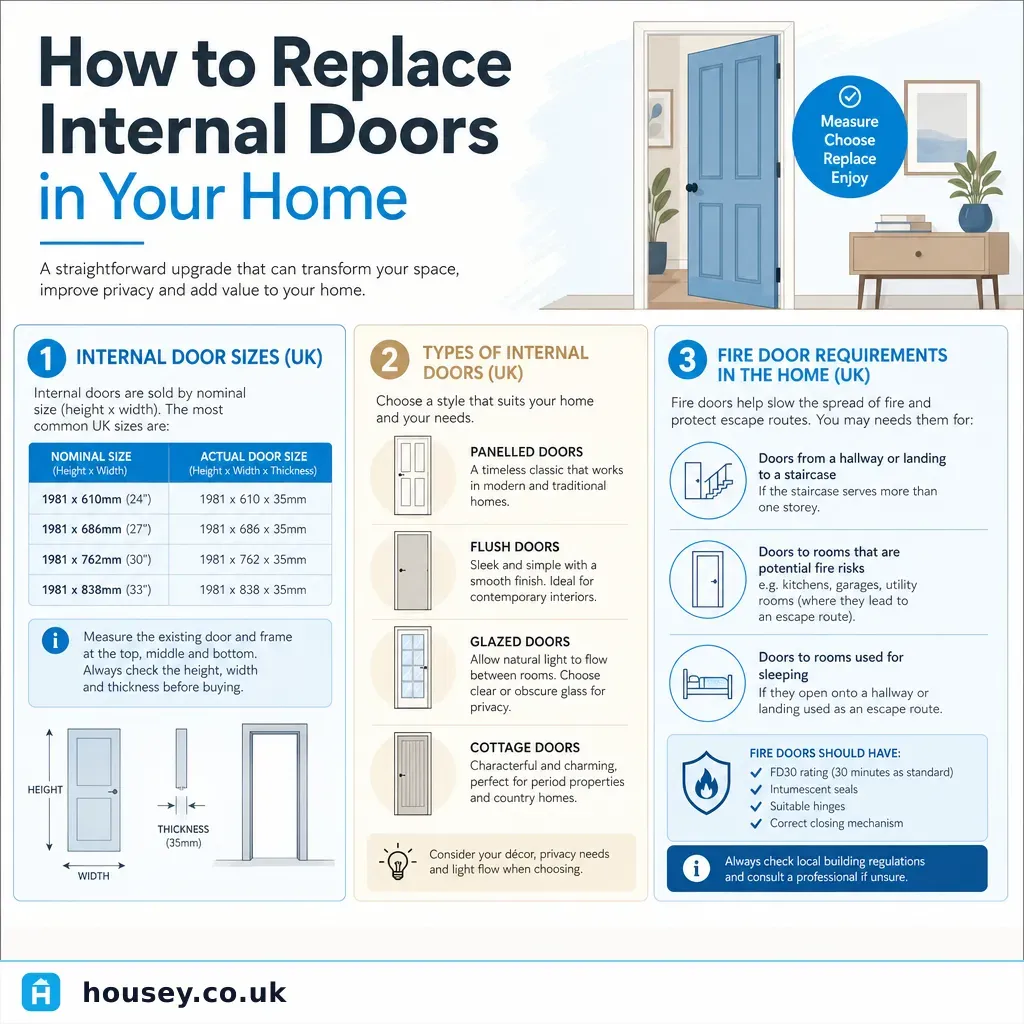
How to Replace Internal Doors in Your Home
Replacing internal doors is a straightforward home improvement that most competent DIYers or a joiner can complete.