Repairing Structural Cracks in Concrete: When to Inject and How
By Housey · Last reviewed 11th of May 2026
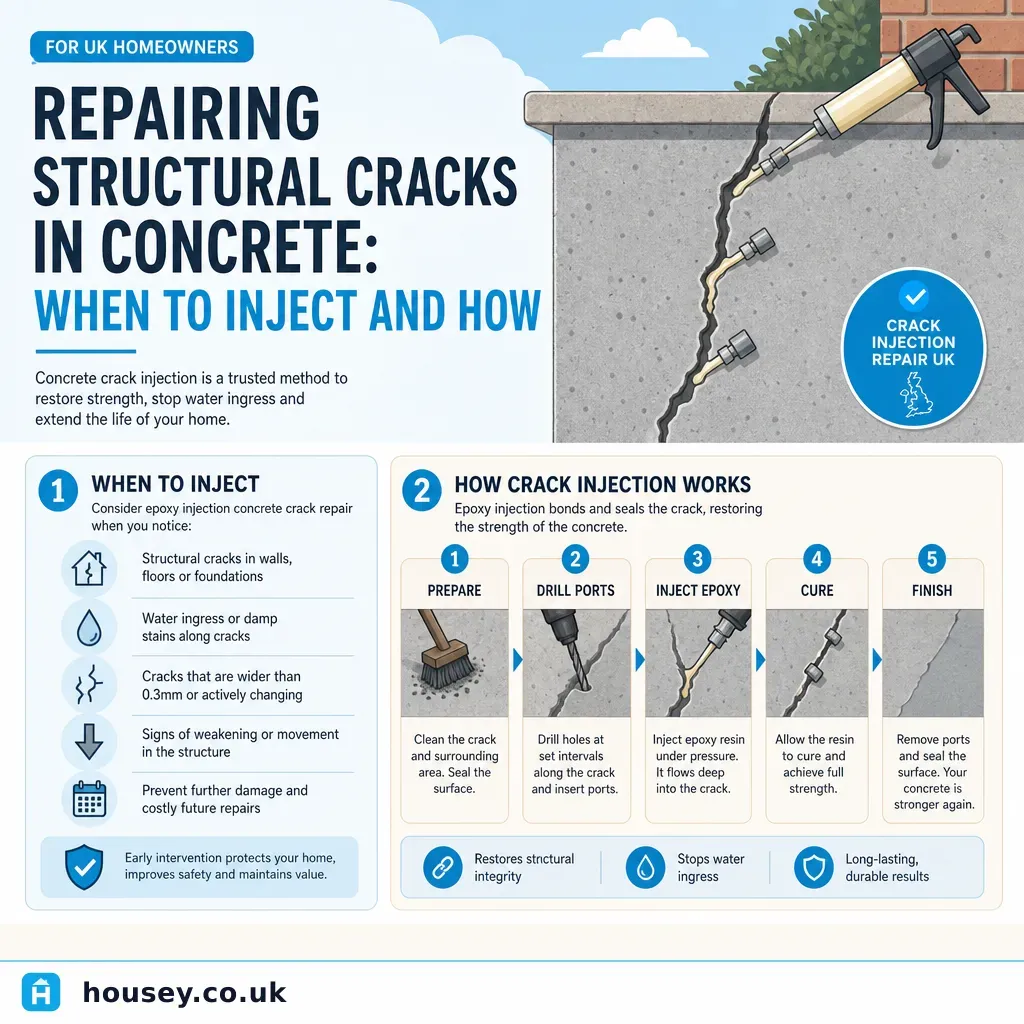
Repairing Structural Cracks in Concrete: When to Inject and How
Concrete cracking is common in UK buildings, from 1930s solid-floor extensions to modern poured foundations — but not every crack signals the same problem, and the wrong repair method can mask a worsening defect. Understanding when injection is appropriate, and when a structural engineer must assess first, is essential before any remedial work begins.
Key points
- Cracks in concrete are classified by width: hairline (<0.2 mm), fine (0.2–0.5 mm), medium (0.5–1 mm), and wide (>1 mm). BS EN 1992-1-1 (Eurocode 2) sets 0.3 mm as the serviceability limit for reinforced concrete in most exposure classes.
- Active cracks (still moving) must be diagnosed and the underlying cause addressed before injection; injecting an active crack is very likely to fail.
- Epoxy resin injection bonds cracked concrete permanently and restores structural capacity; polyurethane injection seals cracks but does not restore structural strength.
- A structural engineer or chartered building surveyor should assess any crack wider than 0.5 mm, any crack associated with movement, or any crack in a load-bearing concrete element.
- Building Regulations Part A (Structure) requires that structural work — including repairs that affect load-bearing capacity — is carried out competently; building control notification may be required for significant repairs to structural elements.
Is the crack structural or cosmetic?
Not all cracks in concrete require injection. Many surface cracks are caused by plastic shrinkage during curing, thermal movement, or carbonation of the surface layer — none of which necessarily compromise structural integrity.
A crack is more likely to be structural if:
- It passes through the full thickness of a slab, wall, or beam.
- It is associated with deflection, settlement, or differential movement elsewhere in the building.
- It is wider than 0.5 mm or is measurably widening over time.
- It runs diagonally from the corner of an opening or from a column base.
- It is accompanied by rust staining, suggesting reinforcement corrosion beneath the surface.
What not to assume
A crack that looks superficial may not be. Conversely, a wide but stable crack in a lightly loaded element may require only surface sealing. Visual inspection alone is rarely sufficient for load-bearing elements — a professional condition assessment is the appropriate starting point before any repair decision is made.
Which injection method is right?
Crack injection is divided broadly into two systems: epoxy resin and polyurethane. These are not interchangeable.
Method | Best for | Not ideal for | Structural strength restored? | Main risk if wrong choice |
|---|---|---|---|---|
Epoxy resin injection | Dry, inactive cracks in load-bearing elements where tensile continuity must be restored | Active or damp cracks; ongoing movement | Yes | Bond failure if the crack is damp or still moving |
Polyurethane resin injection | Water-bearing or damp cracks; sealing against water ingress in basements | Where structural capacity must be restored | No | Owner assumes structure is repaired when only sealed |
Cementitious grout injection | Wide voids in mass concrete or older foundations | Fine cracks (<0.5 mm); reinforced concrete | Partial | Shrinkage can leave residual voids |
Surface repair mortar | Shallow surface defects and spalling; cosmetic cracks in non-structural elements | Through-cracks; reinforcement corrosion | No | Hides an active defect without addressing its cause |
The injection process: a professional-only overview
Crack injection is carried out by specialist contractors and typically involves:
- Assessing crack width, depth, and activity using a crack monitor or tell-tale.
- Cleaning the crack with compressed air to remove dust and debris.
- Installing injection ports at intervals proportional to crack depth — typically 100–200 mm spacing for epoxy resin.
- Sealing the crack face between ports with a surface cap.
- Injecting under low pressure (typically 0.3–0.5 MPa) until resin appears at the next port.
- Curing and removing ports; grinding flush if required.
Low-pressure injection preserves the crack profile and avoids widening. A qualified contractor selects equipment and pressure based on a site assessment.
Decision tree: which approach should you take?
- Choose epoxy injection if the crack is dry, inactive, and in a load-bearing element where full structural continuity must be restored — and a structural engineer has confirmed this is the appropriate specification.
- Choose polyurethane injection if the primary concern is water ingress through a damp or wet crack and structural capacity restoration is not required.
- Choose surface repair mortar if the crack is cosmetic, dry, and in a non-structural element such as a floor screed.
- Do not inject if the crack is active (still widening or seasonal movement confirmed). Address the cause first.
- Commission a structural engineer if the crack is in a column, beam, suspended slab, retaining wall, or foundation, or if the cause is unclear.
- Check with your local building control if the repair is to a load-bearing element — notification under Building Regulations Part A may be required.
Red flags that require immediate professional attention
- Cracks wider than 1 mm in a suspended concrete floor, beam, or column.
- Rust staining alongside a crack, indicating corroding reinforcement and potential delamination.
- Any crack associated with visible deflection, sag, or lateral lean.
- A crack in a retaining wall, especially if accompanied by forward lean or water seeping through the face.
- A crack that has measurably widened within a three-month monitoring period.
- Spalling concrete exposing reinforcement bars (loss of cover to steel).
Important limitations
This guide provides general information about concrete crack repair methods. The appropriate repair specification, professional requirements, and applicable standards vary by structural element type, exposure class, concrete grade, reinforcement layout, and the specific cause of cracking. A qualified structural engineer or chartered building surveyor should inspect and specify any repair to a load-bearing concrete element. Nothing in this guide constitutes a structural assessment or repair specification.
What to ask a qualified professional
Before instructing a structural engineer or specialist repair contractor, ask:
- What is causing this crack, and is the cause ongoing or historic?
- Has the crack been monitored, and over what period?
- Is this element load-bearing, and what is the structural consequence of leaving the defect unaddressed?
- What repair specification do you recommend, and which standard does it conform to?
- Will building control need to be notified before or after the repair?
- What warranty or guarantee accompanies the repair?
- How will you confirm the repair has been carried out correctly — for example, pull-out tests or inspection ports?
When to get professional help
Any crack in a concrete beam, column, suspended slab, retaining wall, or foundation warrants a structural engineer's assessment before repair work begins. The situation is urgent if:
- A crack is widening, or new cracks are appearing elsewhere in the building.
- The crack is accompanied by deflection, sticking doors or windows, or noticeable floor movement.
- Reinforcement bars are visibly exposed where concrete cover has spalled away.
- Water is entering through a crack in a basement or ground-bearing slab in a way that may indicate ground movement.
How Housey can help
If you need a professional assessment before deciding on a repair route, Housey can connect you with experienced engineers and surveyors. Get quotes for a structural survey to understand the cause and severity of cracking before committing to a repair specification. Where moisture is also a concern, a damp and timber survey can help identify whether water ingress is contributing to the defect.
Frequently asked questions
How do I know if a crack in concrete is structural?
Key indicators include location in a load-bearing element, width above 0.5 mm, a diagonal orientation running from an opening or column, associated movement, and rust staining. A crack monitor or tell-tale can confirm whether it is still active. If in doubt, a structural engineer or chartered building surveyor should assess the crack before any repair is attempted.
What is the difference between epoxy and polyurethane crack injection?
Epoxy resin bonds the two faces of a crack together, restoring tensile strength across the section — it is used where structural continuity must be recovered. Polyurethane reacts with moisture to form a flexible foam or gel that seals the crack against water ingress but does not restore structural capacity. Choosing the wrong product can mask a defect without addressing it.
Can I repair concrete cracks myself?
Surface cosmetic cracks in non-structural elements — such as a garage floor screed — can sometimes be filled with a proprietary repair mortar. Injection repairs to load-bearing elements should always be carried out by a specialist contractor following a structural engineer's specification. Attempting structural injection without correct equipment and pressure control is likely to produce an ineffective repair.
How much does crack injection repair cost in the UK?
Indicative UK costs, last reviewed 2026-05-11. Low-pressure epoxy injection for a short residential crack typically ranges from £200 to £600, though costs rise for longer sections, difficult access, or where a structural engineer's specification and post-repair inspection are required. Obtain at least three written quotes and request a clear repair specification. Costs vary by region, crack depth, and contractor.
Sources and further reading
Useful next reads
 Surveys & Inspections
Sagging Lintel Repair Costs and Structural Solutions
A sagging lintel is a structural defect requiring prompt professional assessment.
 Surveys & Inspections
Asbestos Survey And Removal: Finding Qualified Contractors
An asbestos survey establishes whether asbestos-containing materials are present in your property and their condition.
 Surveys & Inspections
Structural Building Survey Costs
A RICS Level 3 Building Survey typically costs £500–£1,500 in the UK, depending on property size, age, and location.
 Surveys & Inspections
Asbestos Identification: Where to Look and What to Watch For
Asbestos can be present in dozens of locations in UK homes built before 2000, from textured ceiling coatings and floor tiles to pipe lagging and roof panels.
 Surveys & Inspections
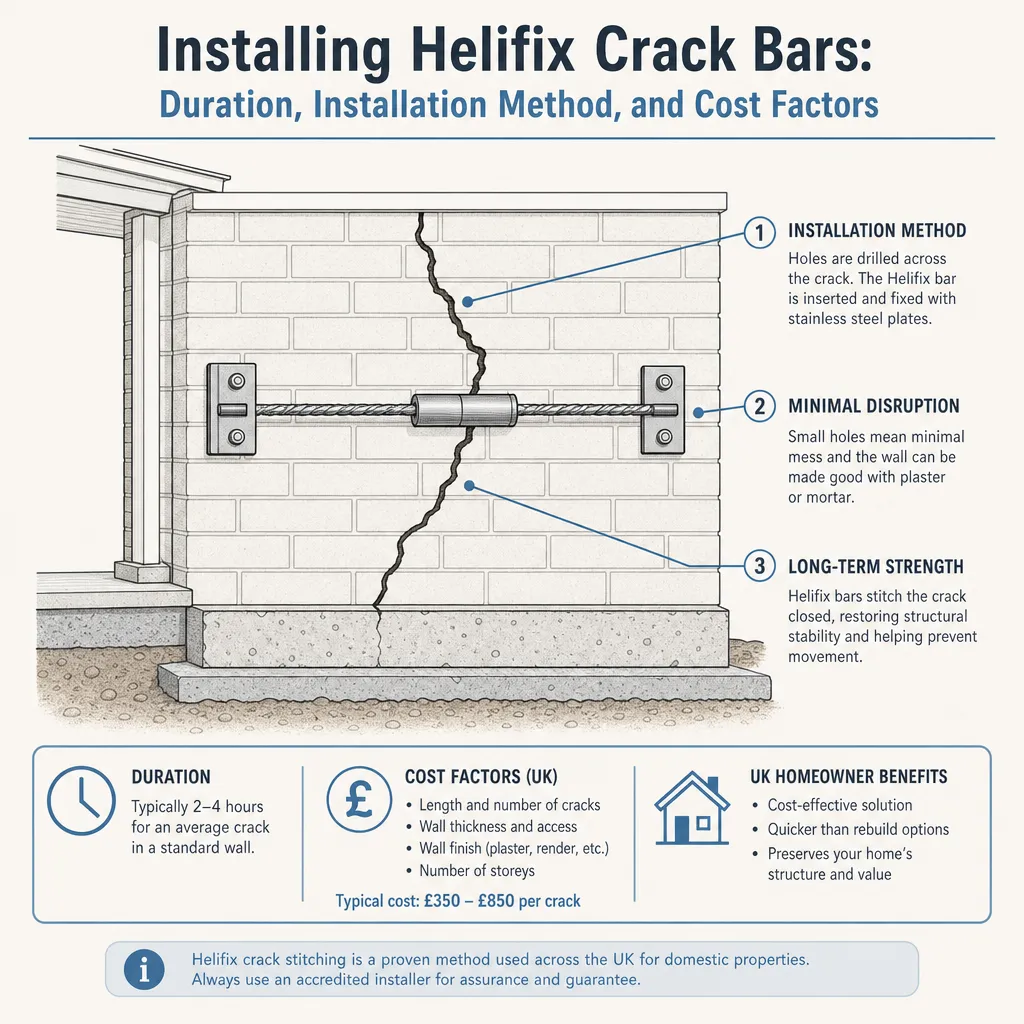
Installing Helifix Crack Bars: Duration, Installation Method, and Cost Factors
Helifix crack bar stitching on a standard domestic property typically takes one to three days, depending on the number of cracks and access requirements.