Replacing a Damaged Light Switch and Wiring
By Housey · Last reviewed 6th of May 2026
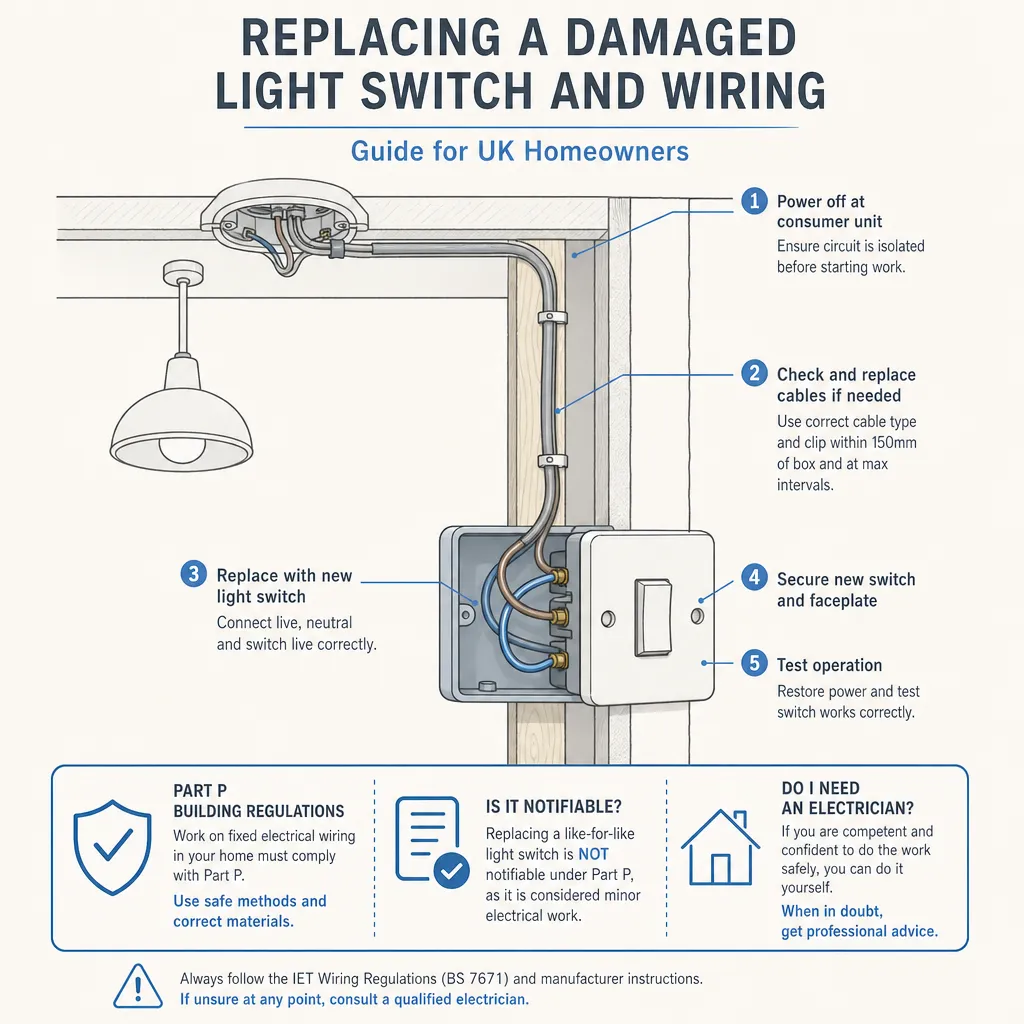
Replacing a Damaged Light Switch and Wiring
A cracked faceplate, a switch that feels warm to the touch, or a light that flickers and fails can all point to a damaged light switch or an underlying wiring fault. Understanding what the repair involves, who should carry it out, and what UK regulations require helps homeowners avoid both unsafe shortcuts and unnecessary cost — particularly because visible damage is sometimes a symptom of a deeper electrical problem rather than a simple component failure.
Key points
- Like-for-like replacement of a light switch in an existing position is not notifiable under Part P of the Building Regulations in England, but the work must still meet BS 7671 (the IET Wiring Regulations, 18th edition).
- Any new cabling, new circuit, or electrical work in a bathroom or shower room must be carried out by a registered electrician enrolled in a competent person scheme and notified to building control.
- A registered electrician issues either a Minor Electrical Installation Works Certificate (MEIWC) or an Electrical Installation Certificate (EIC) as evidence that the work meets current wiring regulations.
- A warm or hot switch plate, scorch marks, or a circuit breaker that trips repeatedly when the light is used indicate a potentially serious wiring fault, not a cosmetic switch failure.
- Uncertified electrical work that should have been notified can complicate the conveyancing process when selling, as solicitors routinely request electrical certificates.
What Part P of the Building Regulations requires
Part P of the Building Regulations (England) governs fixed electrical installations in dwellings. It requires that certain electrical work is either carried out by an electrician registered with a competent person scheme (such as NICEIC, NAPIT, or ELECSA), or notified to local authority building control and certified before use.
Generally not notifiable under Part P (England):
- Replacing a like-for-like fitting such as a switch or socket in an existing position, without altering the wiring.
- Adding or replacing cables that are not in a kitchen, bathroom, or other special location, and not embedded in walls.
Notifiable under Part P (England):
- Installing a new circuit from the consumer unit.
- Any switch, socket, or luminaire replacement or addition in a bathroom or shower room.
- Replacing damaged cabling rather than just the switch faceplate.
- Any work at the consumer unit.
In Scotland, Wales, and Northern Ireland, equivalent electrical safety requirements apply under their respective Building Regulations, though Part P is specific to England.
Signs the problem is more than a switch
Visible damage to a switch faceplate can be a symptom of a deeper wiring fault. Before assuming a replacement faceplate is all that is needed, check carefully for the following warning signs.
Red flags that require a qualified electrician
- The switch plate is warm, hot to the touch, or discoloured from heat.
- There is visible scorch marking, melting plastic, or a burning smell at the switch position.
- The circuit breaker trips when the light is switched on or off.
- Flickering or failure affects multiple fittings on the same circuit.
- Wiring behind the switch is damaged, or the installation mixes pre-2004 colour coding (red live, black neutral) with modern harmonised colours (brown live, blue neutral) without proper labelling — a common issue in partially updated older properties.
- Connections inside the back box appear loose or use connector blocks rather than correctly rated switch terminals.
If any of these are present, isolate the circuit at the consumer unit and instruct a registered electrician to assess the full circuit before any work proceeds.
Decision tree: who should carry out the work?
- Damage is purely cosmetic — cracked faceplate, stiff mechanism, no heat or burning, no circuit fault: A competent adult may replace a like-for-like switch in the same position after isolating the circuit at the consumer unit, provided existing wiring connections are undamaged. If in doubt, instruct a registered electrician.
- Switch is in a bathroom, shower room, wet room, or other special location: Work is notifiable under Part P. Instruct a registered electrician.
- Any sign of heat damage, burning smell, or repeated circuit tripping: Do not attempt any work. Isolate the circuit and instruct a registered electrician to inspect the installation.
- Repair requires new cabling, a new circuit, or changes beyond the faceplate: Notifiable work under Part P. Instruct a registered electrician.
- Property is a rented dwelling and you are the landlord: Under the Electrical Safety Standards in the Private Rented Sector (England) Regulations 2020, all electrical repair work must be carried out by a qualified person. Instruct a registered electrician.
What a registered electrician does
A registered electrician follows a systematic process that protects both the occupant and the installer:
- Isolate and verify: The circuit is isolated at the consumer unit and confirmed dead using a calibrated voltage indicator before the switch is opened.
- Inspect the existing installation: Condition of existing wiring, connections, and the back box is checked before any component is replaced.
- Replace components: The faceplate — and any damaged cabling — is replaced to the current edition of BS 7671.
- Test and certify: The installation is tested for insulation resistance, continuity, and correct polarity. A MEIWC is issued for minor work; an EIC is required if a new circuit has been installed.
What to ask before instructing an electrician
- Are you registered with a Part P competent person scheme such as NICEIC, NAPIT, or ELECSA?
- Will you issue a certificate (MEIWC or EIC) on completion?
- Have you assessed whether the fault is limited to the switch, or does it extend to the wiring or the wider circuit?
- Is VAT included in the quote, and what are your call-out and hourly rates?
- If the fault proves more extensive than a switch replacement, how will you communicate the additional scope and cost before proceeding?
Homeowner checklist before the electrician arrives
When to get professional help
Always instruct a registered electrician if there are any signs of heat damage, burning, or a fault on the circuit; if the switch is in a bathroom or other special location; if new cabling or a new circuit is involved; or if the property is a rental. Registered electricians can be found through the NICEIC, NAPIT, and ELECSA online contractor directories, and through Electrical Safety First's registered electrician search.
How Housey can help
Housey is a UK marketplace for home services. If you need a qualified, registered electrician to assess a damaged light switch or investigate an underlying wiring fault, Housey can help you compare quotes from vetted local professionals so you can make a confident, informed decision.
Frequently asked questions
Do I need to notify building control if I replace a light switch?
In most cases, no. Replacing a like-for-like switch in an existing position in an ordinary living room, bedroom, or hallway is not notifiable under Part P in England. However, any new circuit, new cabling, or work in a bathroom is notifiable and must be carried out by a registered electrician or submitted to your local authority building control.
Does an electrician need to issue a certificate for a light switch replacement?
For a straightforward like-for-like replacement that is not notifiable, a formal certificate is not always legally required, but many registered electricians will issue a Minor Electrical Installation Works Certificate as good practice. If the work involves new wiring or is in a special location such as a bathroom, a certificate is required under Part P.
Can I replace a light switch myself in the UK?
For a simple like-for-like faceplate replacement in a non-notifiable location, there is no legal requirement to use a registered electrician, but the work must still meet BS 7671. Any new cabling, new circuit, or work in a bathroom must be done by a registered electrician. If there is any sign of a wiring fault, always instruct a professional.
How much does it cost to have a light switch replaced by an electrician?
Indicative UK costs, last reviewed 2026-05-06. A like-for-like switch replacement typically costs between £50 and £150 depending on location, call-out rate, and whether a certificate is issued. If underlying wiring faults are discovered, additional investigation and repair costs will apply. Always request a written quote before work begins.
What does a warm or hot light switch indicate?
A warm or hot switch plate almost always indicates a wiring fault — typically a loose connection, overloaded circuit, or incorrect wiring — rather than a faulty switch mechanism alone. Isolate the circuit at the consumer unit and instruct a registered electrician to inspect the full installation before any further work is carried out.
Sources and further reading
- Approved Document P: electrical safety — dwellings — GOV.UK
- Find a registered electrician — Electrical Safety First
- NICEIC registered contractor search — NICEIC
- Electrical Safety Standards in the Private Rented Sector (England) Regulations 2020 — legislation.gov.uk
- IET Wiring Regulations (BS 7671) — IET
Useful next reads
 General property advice
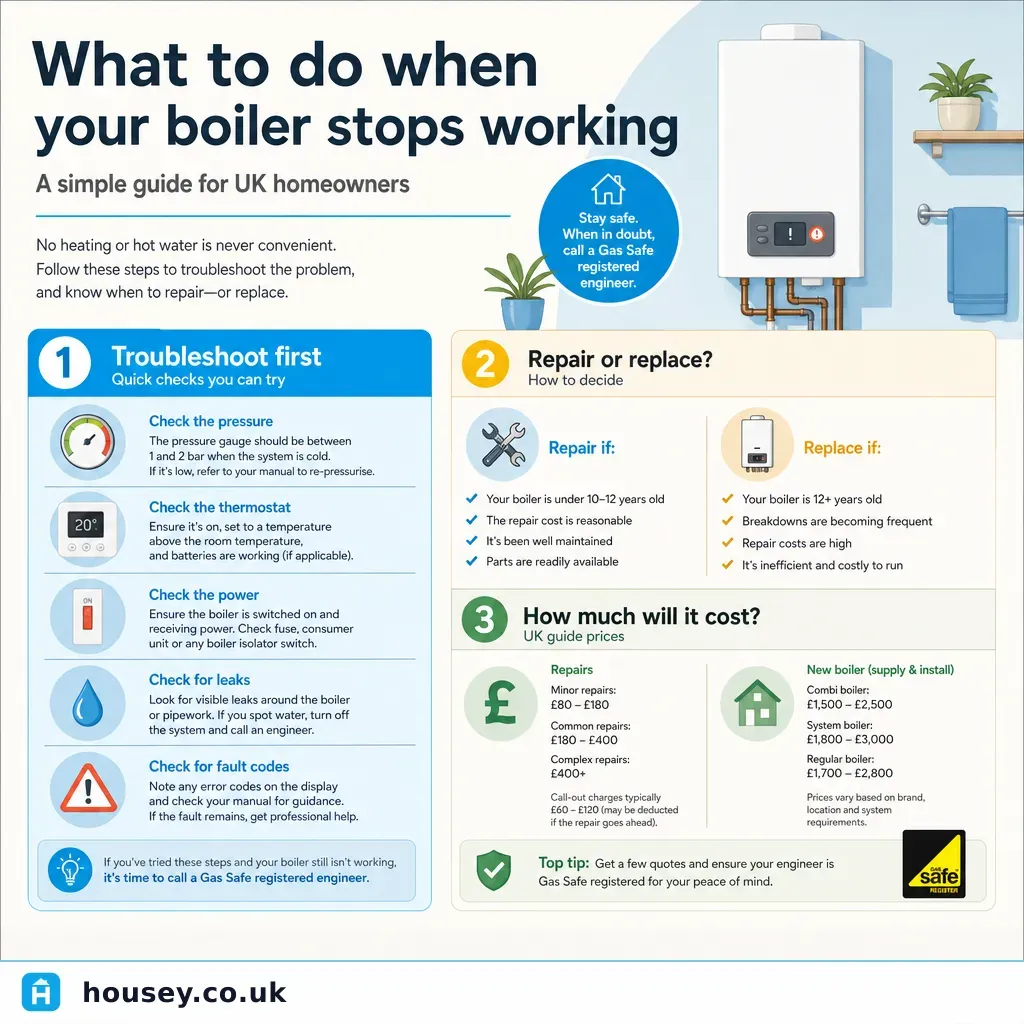
What to do when your boiler stops working
When your boiler stops working, check the pressure gauge (should read 1–1.
 General property advice
Property Market Trends: Activity Growth and Price Movements
UK property market activity is measured through completed sale registrations (HM Land Registry), lender mortgage data, and transaction volumes from HMRC.
 General property advice
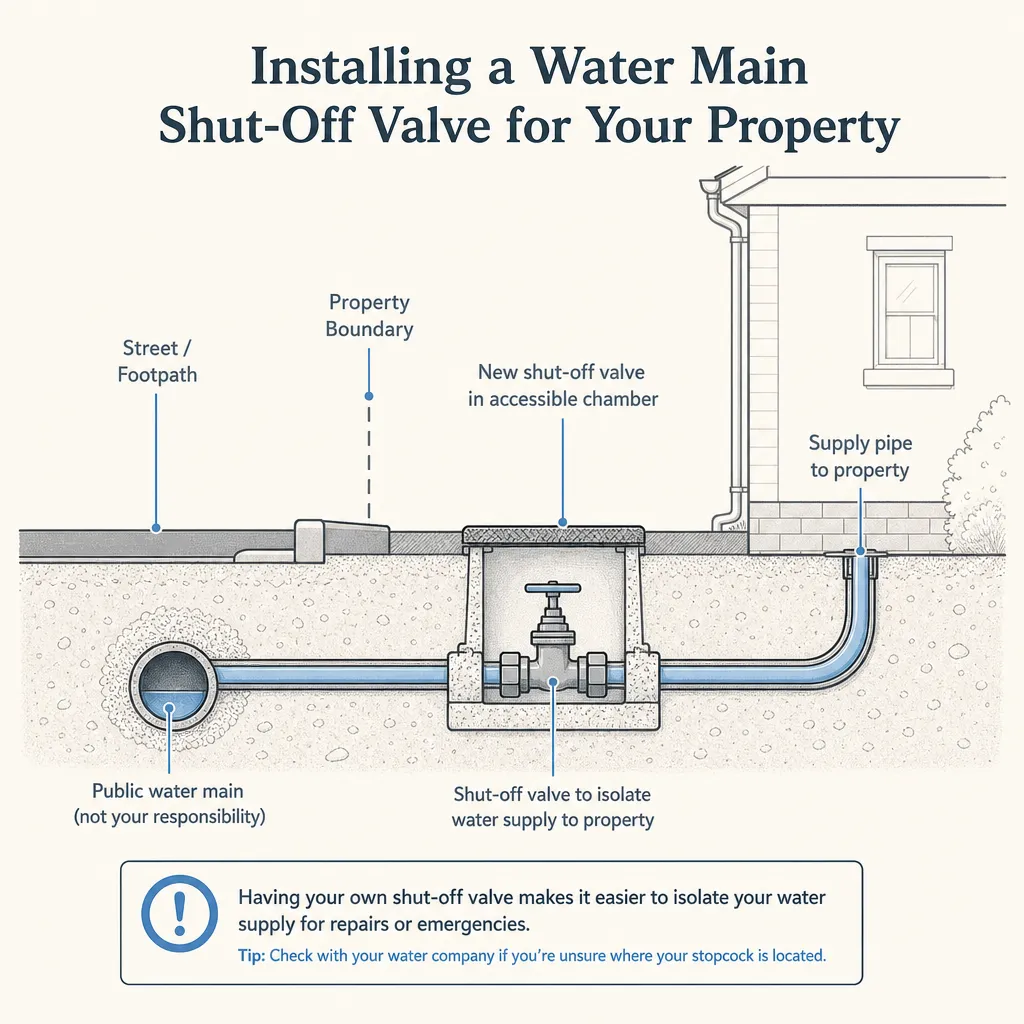
Installing a water main shut-off valve for your property
A water main shut-off valve — commonly called a stopcock — controls all water entering your home from the mains.
 General property advice
Monthly House Price Index: August Market Report and Analysis
The UK House Price Index is published monthly using completed Land Registry transaction data, meaning August figures typically reflect sales agreed months earlier.
 General property advice
Scottish Property Market: Activity and Regional Trends
Scotland's property market operates under distinct legal rules: sellers must provide a Home Report before marketing, transactions become legally binding at conclusion of missives rather than exchange of contracts, and Land and Buildings Transaction Tax replaces Stamp Duty.