Replacing a Front Door in a Flat or Leasehold Property: Lease and Planning Restrictions
By Housey · Last reviewed 5th of May 2026
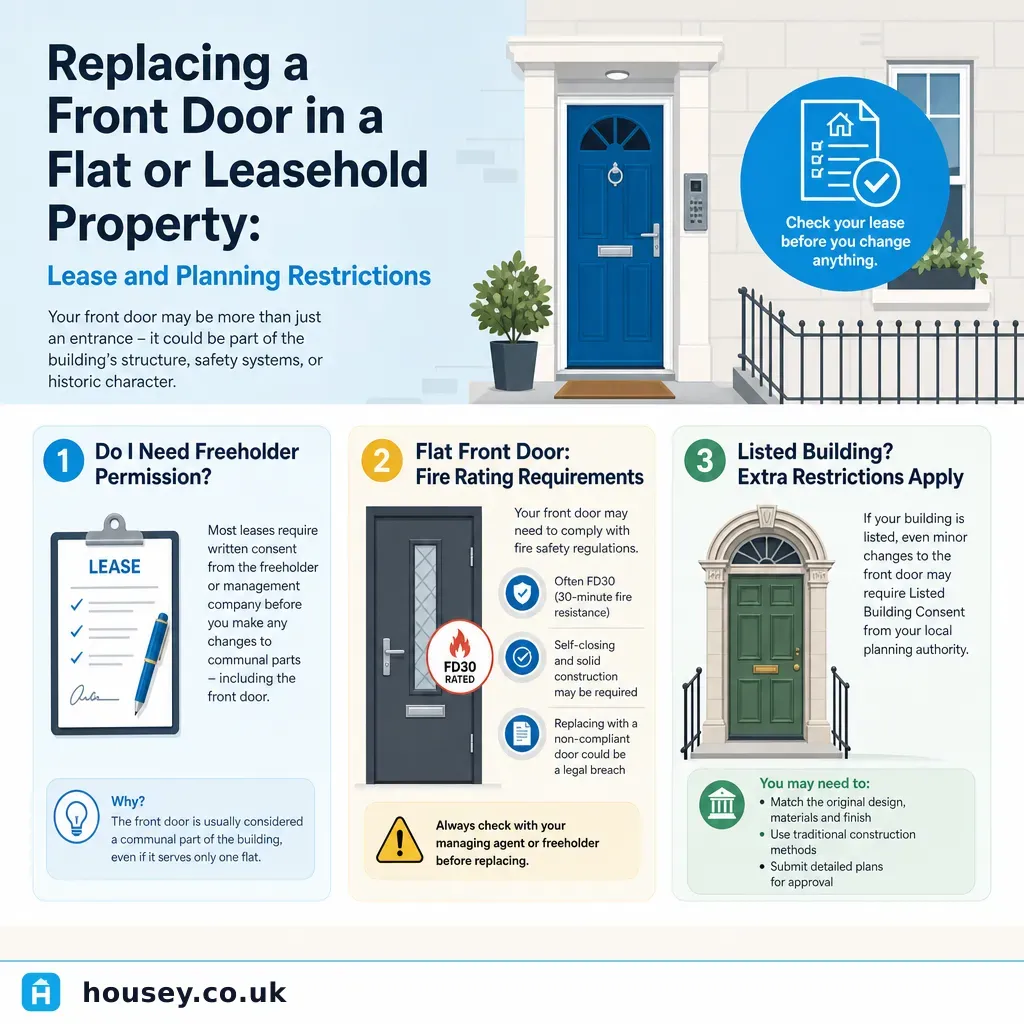
Replacing a Front Door in a Flat or Leasehold Property: Lease and Planning Restrictions
Flat owners often assume that replacing a tired or draughty front door is a straightforward weekend project — but in leasehold properties, the front door sits at the intersection of lease law, fire safety regulation, and sometimes planning control. Getting this wrong can create problems at resale, with your insurer, or with your freeholder, and in purpose-built blocks the stakes are higher still given modern fire safety legislation.
Key points
- Most leases require written consent (a licence to alter) from the freeholder or managing agent before any front door replacement — check your lease before ordering a door.
- Flat entrance doors in purpose-built blocks are typically required to be fire-rated to FD30s (30-minute fire and smoke resistance) under the Fire Safety Act 2021 and Building Safety Act 2022.
- In a conservation area or listed building, replacing an external door may need planning permission or listed building consent regardless of tenure.
- Unauthorised alterations can affect buildings insurance, flag on conveyancing searches, and in serious cases trigger lease breach proceedings.
- Your lease may also specify approved materials, colours, or styles — particularly in purpose-built blocks or managed estate developments.
Does your lease allow you to replace the front door?
In a typical long leasehold flat, the front door is usually demised to you — it forms part of your individual demise — but it remains subject to lease terms governing alterations. Some leases treat the external face of the door as part of the common parts, meaning the freeholder retains control even over what appears to be an internal-facing change.
The first step is to read your lease carefully. Look for:
- An alterations clause (sometimes headed "Alterations" or "Not to Alter") — this states whether consent is required and whether certain works are prohibited outright.
- A decoration clause — some leases specify that any replacement must match the existing style, colour, or material used elsewhere in the block.
- A common parts definition — to establish whether your door sits solely within your demise or partly within shared areas.
If the lease requires consent, you will need a licence to alter from the freeholder or their managing agent. This is a formal written agreement, and most freeholders charge a fee (typically £300–£800 or more, depending on complexity). Indicative UK costs, last reviewed 2026-05-05.
Do you need planning permission?
For most leasehold flats in ordinary residential buildings, replacing a like-for-like front door does not require planning permission. However, there are important exceptions:
Conservation areas: If your building is within a designated conservation area, permitted development rights for external alterations may be restricted. Local planning authorities can remove these rights for external door and window changes via an Article 4 Direction.
Listed buildings: If your flat is within a listed building, listed building consent is required for any alteration that affects the character of the building — including external doors. This applies even if the alteration appears minor.
Flats in England generally: Householder permitted development rights apply to houses, not flats. In practice, like-for-like replacements in unlisted buildings outside conservation areas rarely attract enforcement action — but in sensitive locations, always check with the local planning authority before proceeding.
Fire safety and building regulations requirements
This is the area where flat door replacement most often goes wrong. The front door of a flat in a purpose-built block typically serves as a fire door, separating individual dwellings from common circulation areas (corridors, stairwells, and lobbies).
Under the Fire Safety Act 2021 and the Building Safety Act 2022, responsible persons — usually the freeholder or their managing agent — must ensure flat entrance doors in multi-occupied residential buildings meet appropriate fire resistance standards. The standard for flat entrance doors in England is generally FD30s: 30 minutes of fire and smoke resistance, with intumescent strips and cold smoke seals fitted to the frame.
If you replace your front door without ensuring it meets FD30s standards, you may:
- Breach your lease
- Invalidate the building's fire risk assessment
- Be required to reinstate the original door at your own expense
- Create potential personal liability if a fire occurs
Any replacement door should carry third-party fire door certification — look for schemes such as the BWF-CERTIFIRE scheme or BM TRADA Q-Mark. Building Regulations Approved Document B (Fire Safety) governs fire door performance requirements in England.
Consent requirements by scenario
Situation | Lease consent needed? | Planning permission needed? | Fire door standard likely to apply? |
|---|---|---|---|
Purpose-built flat, no listed status, no conservation area | Usually yes — licence to alter | No (like-for-like) | Yes — FD30s typically required |
Flat in a conservation area | Usually yes | Possibly — check with local planning authority | Yes — FD30s typically required |
Flat in a listed building | Usually yes | Yes — listed building consent required | Yes — FD30s typically required |
Converted house (freehold or share of freehold) | Depends on title deeds or lease | No (like-for-like) | May apply — check building's fire risk assessment |
Ground-floor flat with a separate external entrance | Usually yes | No (like-for-like) | May apply — check building's fire risk assessment |
What to ask your freeholder or managing agent
Before submitting a formal request for a licence to alter, obtain the following in writing:
- Does my lease require consent for front door replacement?
- What materials, colours, or styles are approved for this building?
- What fire rating is required for my flat entrance door, and is there a certified specification already in use across the block?
- Is there an approved supplier or installer list?
- What is the fee for a licence to alter, and what supporting documents are required?
- How long does the consent process typically take?
- Who is the responsible person for the building's fire risk assessment, and do I need their confirmation?
Red flags — when unapproved door replacement causes problems
Be alert to the following situations, which may indicate a compliance issue:
- A door replaced without matching the fire door specification of the rest of the block
- No visible intumescent strip or smoke seal around the door or frame
- A door replaced without evidence of a licence to alter — this can surface on conveyancing searches and delay or complicate a sale
- A non-standard colour or material that does not align with the lease's decoration requirements
- A RICS surveyor flagging the door as potentially non-compliant during a pre-purchase Level 2 or Level 3 survey
If you are buying a flat and the existing front door appears to have been replaced without evidence of consent or fire door certification, raise this with your conveyancer before exchange.
Important limitations
This article provides general information only. Lease terms vary significantly — some prohibit alterations outright, others require only informal notification, and others grant broad permissions subject to reasonable conditions. Planning and listed-building rules depend on your specific property, its location, and local authority policy. Fire safety requirements depend on the height, age, and type of building. Nothing in this article constitutes legal advice, planning advice, or a fire safety assessment. Always consult a solicitor for lease interpretation, your local planning authority or a planning consultant for planning status, and a qualified fire assessor or building control body for fire door specification before proceeding.
What to ask a qualified professional
Solicitor or licensed conveyancer:
- What does my specific lease say about door replacements and alterations?
- Is a licence to alter legally required, and what are the consequences of proceeding without one?
- Can a retrospective licence be obtained if work has already been carried out without consent?
Local planning authority or planning consultant:
- Is my building subject to an Article 4 Direction that removes permitted development rights for external alterations?
- Does a like-for-like replacement require permission given the building's listed status or conservation area designation?
Fire assessor or building control body:
- What fire rating is required for my flat entrance door in this specific building?
- Does the proposed replacement door meet the FD30s standard and carry appropriate third-party certification?
- How does the replacement door affect the responsible person's fire risk assessment obligations for the building?
When to get professional help
Seek professional advice before starting work if:
- Your lease contains an alterations clause (which most do)
- Your building is in a conservation area or is listed
- You are unsure whether your front door is a designated fire door
- The building is above four storeys in height (higher-risk buildings under the Building Safety Act 2022 carry additional requirements)
- You plan to sell within the next few years and want to avoid conveyancing complications
- Your freeholder or managing agent is unresponsive or in dispute with leaseholders
How Housey can help
If you need a certified installer who understands fire door requirements and can supply FD30s-rated doors with appropriate third-party certification, Housey can help you request quotes from qualified window and door installers. If planning or conservation area questions are holding up your project, our network includes experienced planning consultants who can advise on permitted development rights, listed building consent, and Article 4 Directions.
Frequently asked questions
Can I replace my flat's front door without telling my freeholder?
In most cases, no. Most long leasehold flat leases contain an alterations clause requiring written consent before any front door replacement. Proceeding without consent can breach your lease, affect your buildings insurance, and create complications when you sell. Check your specific lease and contact your managing agent before ordering a replacement.
Does a replacement flat front door have to be a fire door?
In purpose-built blocks of flats, the entrance door to each flat typically needs to meet fire resistance standards — usually FD30s in England (30 minutes fire and smoke resistance, with smoke seals). This is reinforced by the Fire Safety Act 2021 and Building Safety Act 2022. Your freeholder or managing agent should confirm the required specification for your building.
Will I need planning permission to replace my flat's front door?
For like-for-like replacements in standard residential buildings, planning permission is not usually required. However, if your building is listed or in a conservation area, you may need listed building consent or planning permission, particularly if the external appearance of the door would change. Check with your local planning authority before proceeding.
What is a licence to alter, and how much does it cost?
A licence to alter is a formal written agreement from your freeholder permitting specified alterations to your flat. For a straightforward door replacement, fees typically range from £300 to £800, though costs vary depending on the freeholder, managing agent, and complexity. Indicative UK costs, last reviewed 2026-05-05. Always request a fee estimate before proceeding.
What happens if I replace my front door without lease consent?
You may be in breach of your lease. While outright forfeiture is rare for minor alterations, your freeholder can require you to reinstate the original door at your cost, and the breach may appear on conveyancing searches when you sell. A retrospective licence to alter may sometimes be obtained, but it is not guaranteed and often costs more than obtaining consent upfront.
Sources and further reading
- Fire Safety Act 2021 — legislation.gov.uk
- Building Safety Act 2022 — legislation.gov.uk
- Approved Document B: Fire Safety — GOV.UK
- Leasehold property: your rights — GOV.UK
- Fire safety in purpose-built blocks of flats — National Fire Chiefs Council / GOV.UK
- Historic environment planning practice guidance — GOV.UK Planning Practice Guidance
Useful next reads
 Improvement & Build
Converting a Garage into Living Space: Budget and Planning Guide
A single-garage conversion typically costs £8,000–£20,000 in the UK.
 Improvement & Build
Budget Guide for Two-Storey House Extensions
A two-storey house extension in the UK typically costs £1,800–£3,000+ per square metre for the build alone.
 Improvement & Build
Planning a Flat-Roof Extension: What Costs to Budget
A flat-roof single-storey extension typically costs £1,500–£3,000 per m² in the UK, depending on size, specification, location, and roof membrane choice.
 Improvement & Build
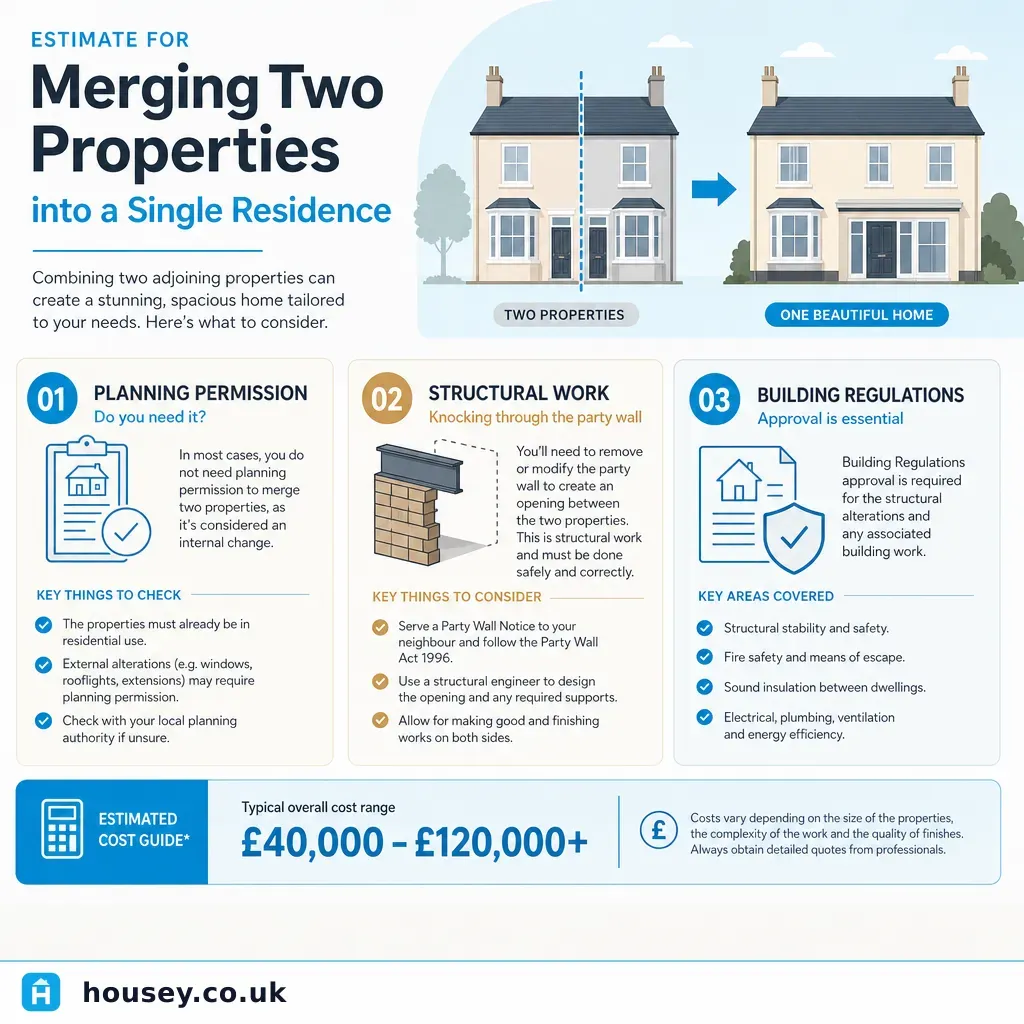
Estimate for Merging Two Properties into a Single Residence
Merging two properties into one typically costs £30,000–£120,000 or more, depending on property type, structural complexity, and professional fees.
 Improvement & Build
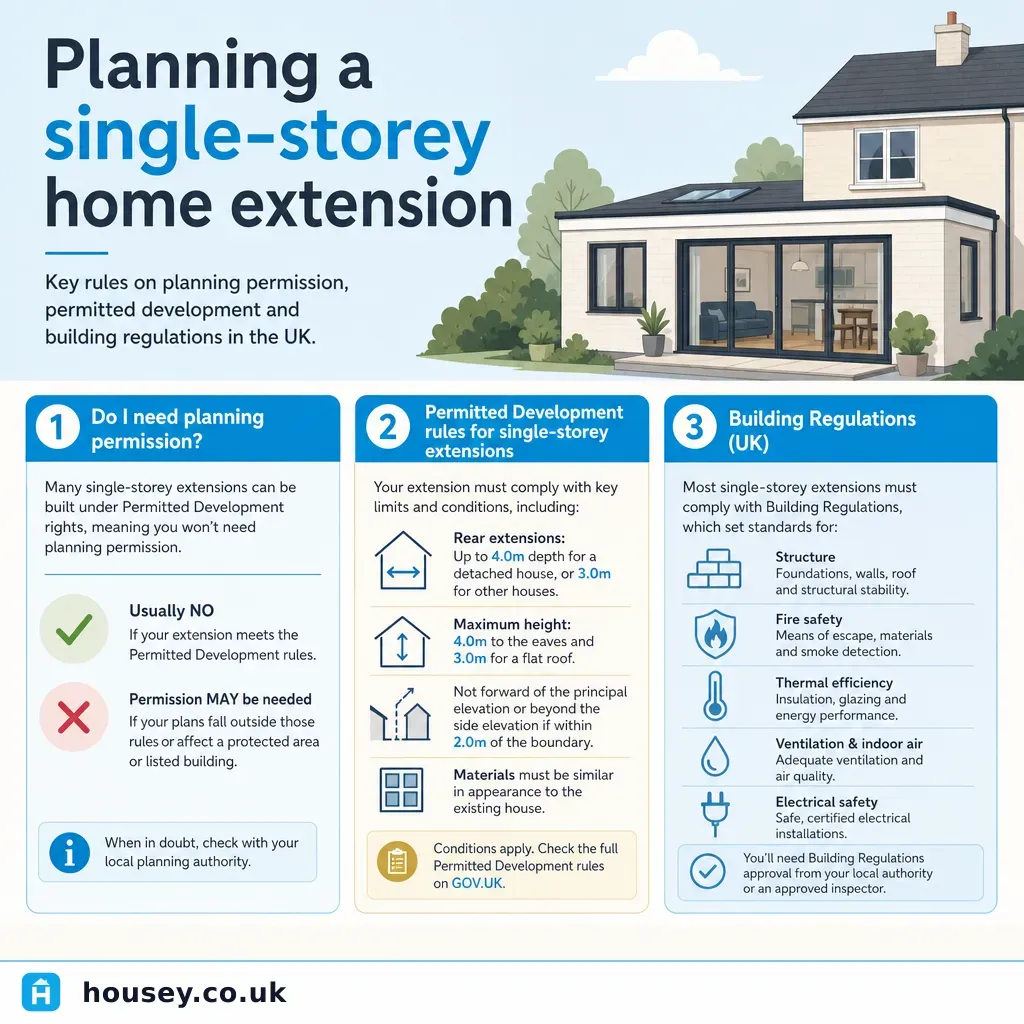
Planning a single-storey home extension
A single-storey extension may fall under permitted development rights, avoiding full planning permission, but only if it meets size, height, and boundary conditions simultaneously.