Replacing Patio Doors: Costs and Options for Homeowners
By Housey · Last reviewed 30th of May 2026
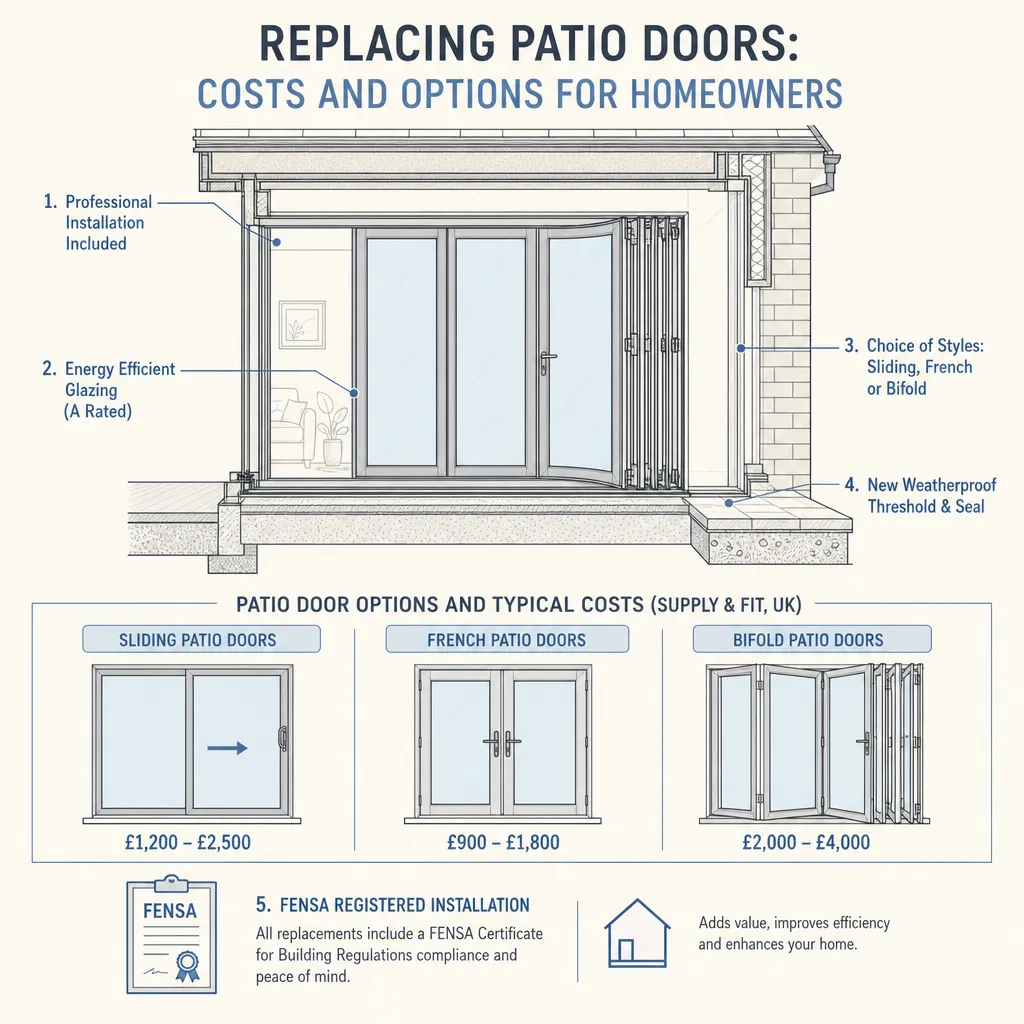
Replacing Patio Doors: Costs and Options for Homeowners
Patio doors are a significant element in any home — they affect thermal performance, security, natural light, and rear access. Replacement is typically triggered by misting between double-glazed panes, warped or rotting frames, a security upgrade, or a kitchen-diner remodel extending onto a garden. The cost varies considerably by door type, material, glazing specification, and whether the aperture needs structural alteration — understanding the options helps you make an informed choice before approaching installers.
Key points
- All replacement patio doors must comply with Building Regulations Part L (minimum whole-unit U-value of 1.4 W/m²K) and Part Q (security) — FENSA or CERTASS-registered installers self-certify compliance automatically.
- The three main patio door types — sliding, French (hinged), and bifold — differ in opening width, space requirements, cost, and suitability for different property types.
- FENSA or CERTASS certificates are required by solicitors and mortgage lenders at point of sale; always request and retain the certificate from your installer.
- Listed buildings and conservation area properties may require planning permission or listed building consent before replacing external doors — check with your local planning authority before ordering.
- Widening an existing aperture is notifiable structural work requiring a building regulations application and a structural engineer's lintel specification before work begins.
What do replacement patio doors cost in the UK?
Costs vary by door type, material, aperture size, and installation complexity. The figures below cover supply and standard installation; structural alterations, brickwork, making good, and internal decoration are additional.
Indicative UK costs, last reviewed 2026-05-30. Prices vary by region; London and the South East typically run 10–20% higher.
Door type | uPVC | Aluminium | Timber |
|---|---|---|---|
Sliding patio (2-panel, ~1.8 m wide) | £1,200–£2,500 | £2,500–£5,000 | £2,000–£4,500 |
French doors (pair, ~1.5 m wide) | £1,000–£2,200 | £2,000–£4,500 | £1,800–£4,000 |
Bifold doors (3 panels, ~2.1 m opening) | £2,500–£5,000 | £4,000–£9,000 | £4,000–£9,000 |
Bifold doors (4–5 panels, wider opening) | £4,000–£7,000 | £6,000–£14,000+ | £6,000–£12,000+ |
Comparing patio door types
Door type | Best for | Space requirement | Typical max opening | Main limitation |
|---|---|---|---|---|
Sliding patio | Limited outdoor space, contemporary styling | No outward clearance needed | ~3 m standard | Only 50% of the frame area opens |
French (hinged) | Traditional properties, narrower apertures, lower budgets | Outward or inward clearance required | ~1.5 m standard | Doors swing into or out of the space |
Bifold | Open-plan kitchen-diners, large rear apertures | Small clearance at folded stack end | 1.8 m to 6 m+ | Higher cost; more moving parts to maintain |
Decision tree: which patio door type suits your home?
- Choose sliding doors if you have limited outdoor clearance, want a clean contemporary look, and your aperture is up to approximately 3 metres wide.
- Choose French doors if you have a Victorian terrace, 1930s semi, or traditional cottage, the opening is narrower than 1.5 m, and you want a classic appearance at lower cost.
- Choose bifold doors if you are remodelling an open-plan kitchen-diner, need the doors to fold completely away, and have — or plan to create — an aperture of 2 m or wider. Assess structural and budgetary implications before ordering.
- Ask a structural engineer to specify the lintel before work starts if the aperture needs to be widened — the correct RSJ or steel beam must be calculated and installed under building regulations.
- Check with your local planning authority before ordering if your property is listed or within a conservation area.
Which door material should you choose?
Material | Advantages | Disadvantages | Typical lifespan |
|---|---|---|---|
uPVC | Low cost, low maintenance, good thermal performance | Less premium in appearance; limited slim sightline options | 20–30 years |
Aluminium | Slim sightlines, wide colour choice, high strength | More expensive than uPVC; must be thermally broken to avoid cold bridging | 30–40 years |
Timber | Premium appearance; well-suited to older and listed properties | Higher maintenance; susceptible to rot if not regularly painted or treated | 30+ years with maintenance |
Composite (timber-aluminium) | Timber interior, aluminium exterior; low external maintenance | Higher cost than either material alone | 30–40 years |
Building regulations and compliance
Replacing patio doors with a FENSA or CERTASS-registered installer means Parts L and Q of the Building Regulations are self-certified — you receive a compliance certificate usually within 30 days of installation. This is the standard route for like-for-like replacements with no structural alteration.
If you are widening the opening, this is notifiable structural work. You need either a building notice or full plans approval through your local authority building control or an approved inspector before work begins.
For listed buildings, replacing external doors — even like-for-like in appearance — typically requires listed building consent from your local planning authority. Conservation area properties may require planning permission if the doors are visible from a public road. Always check before ordering.
Homeowner checklist: before you order replacement patio doors
When to get professional help
Most straightforward patio door replacements — same aperture size, FENSA-registered installer — require no additional professional involvement beyond the installer. However, seek advice before committing in these situations:
- Aperture widening or new opening — instruct a structural engineer to calculate and specify the correct lintel before work begins; do not rely solely on the installer's assessment.
- Leasehold flat — check your lease before ordering; external alterations frequently require freeholder or management company consent.
- Damp or rot around the existing frame — investigate the extent of any damage before fitting new doors, or the problem will persist behind the new frame.
- Listed building — obtain listed building consent from your local planning authority before instructing any contractor.
How Housey can help
Housey connects homeowners with vetted window and door installers who are FENSA or CERTASS registered. Compare quotes from local specialists, check their compliance history, and ensure you receive all the documentation — including the compliance certificate — that your property records and any future buyer will need.
Frequently asked questions
Do I need planning permission to replace patio doors?
In most cases, replacing patio doors with a similar style and size is permitted development and does not require planning permission. Exceptions include listed buildings (where listed building consent is required), conservation area properties where the doors face a public road, and some new-build estates where permitted development has been restricted by planning condition. Check with your local planning authority if you are unsure.
What is a FENSA certificate and do I need one?
A FENSA certificate confirms that replacement glazing complies with Building Regulations Parts L and Q. It is issued by FENSA-registered installers after installation and is not optional — solicitors request it during property sales, and lenders may require evidence of compliance. If your installer is not FENSA or CERTASS registered, you must obtain separate building regulations approval and inspection through your local authority building control.
How long does patio door installation take?
A straightforward replacement of an existing patio door — same aperture size, no structural work — typically takes one to two days. Bifold installations with wider apertures, or projects involving structural alterations and new lintels, may take three to five days. Allow additional time if brickwork, internal plasterwork, or decoration is part of the project.
Can I replace patio doors myself?
Replacing patio doors is notifiable work under Building Regulations. DIY installation is not prohibited, but you would need to apply for a building regulations application and arrange a building control inspection rather than relying on a FENSA or CERTASS installer's self-certification. For most homeowners, using a registered installer is simpler and ensures the compliance certificate is issued automatically.
Sources and further reading
- Building Regulations Approved Document L (Conservation of fuel and power) — GOV.UK
- Building Regulations Approved Document Q (Security) — GOV.UK
- FENSA: find a registered installer — FENSA
- Windows, doors and roof: planning guidance — Planning Portal
- Listed buildings: making changes to your home — Historic England
Useful next reads
 Improvement & Build
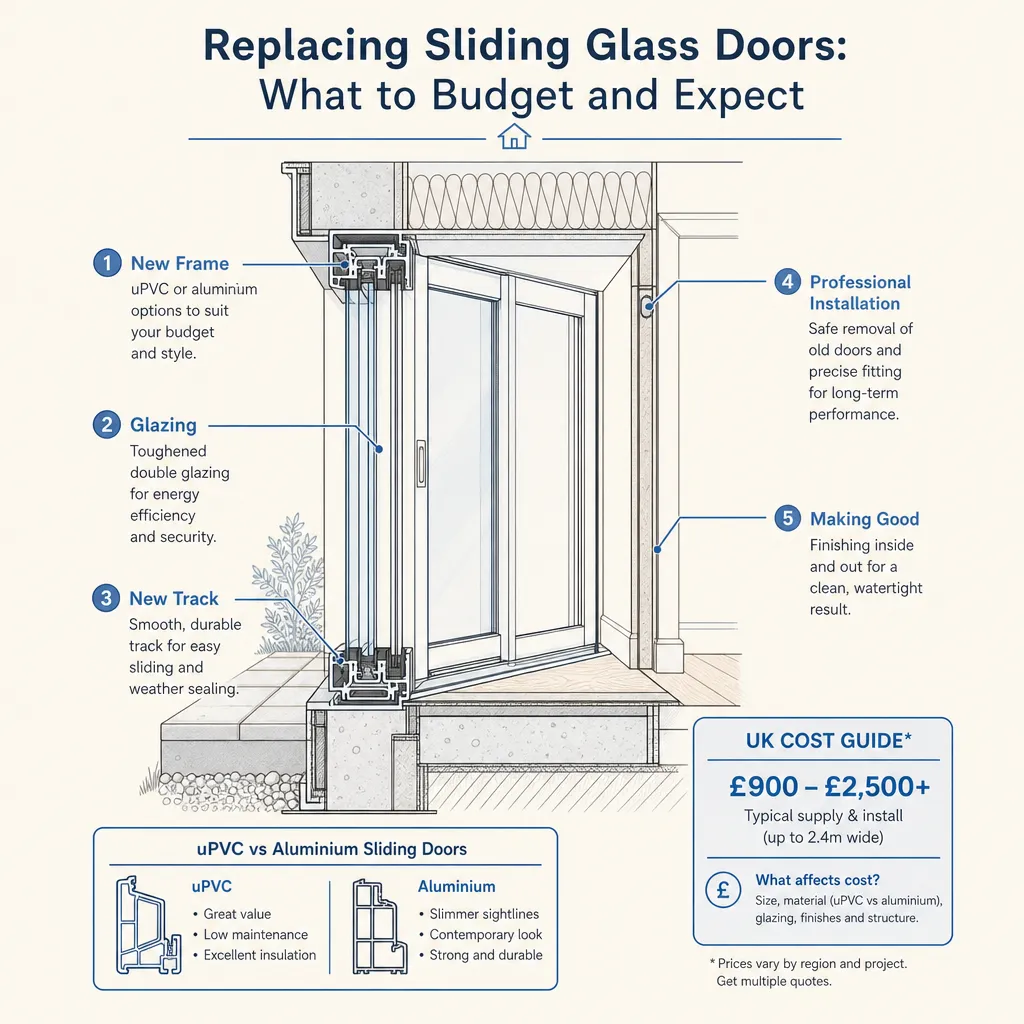
Replacing Sliding Glass Doors: What to Budget and Expect
Replacing sliding glass doors in a UK home typically costs £1,500–£4,500 depending on door size, glazing specification, and frame material.
 Improvement & Build
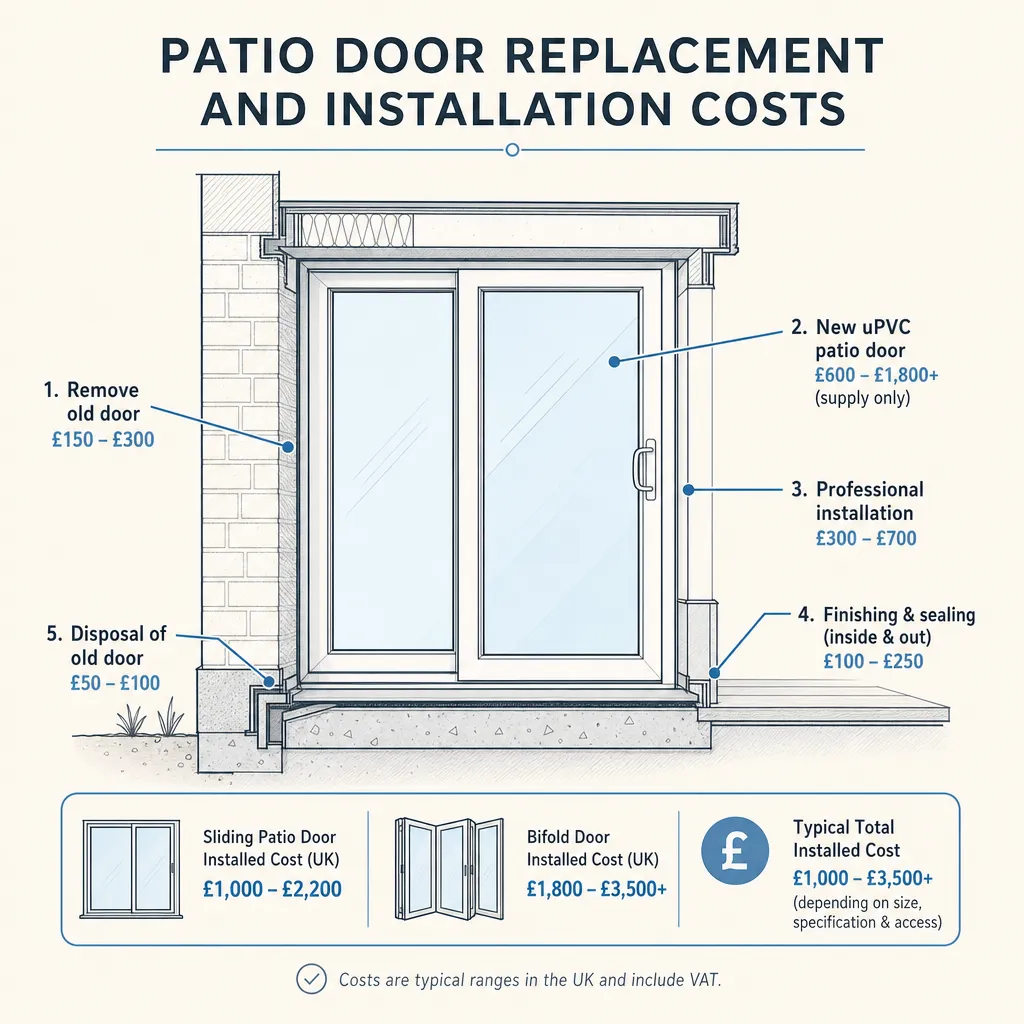
Patio Door Replacement and Installation Costs
Replacing patio doors in the UK typically costs £800–£2,000 installed for a standard uPVC sliding unit, rising to £3,000–£8,000 or more for aluminium bifold doors.
 Improvement & Build
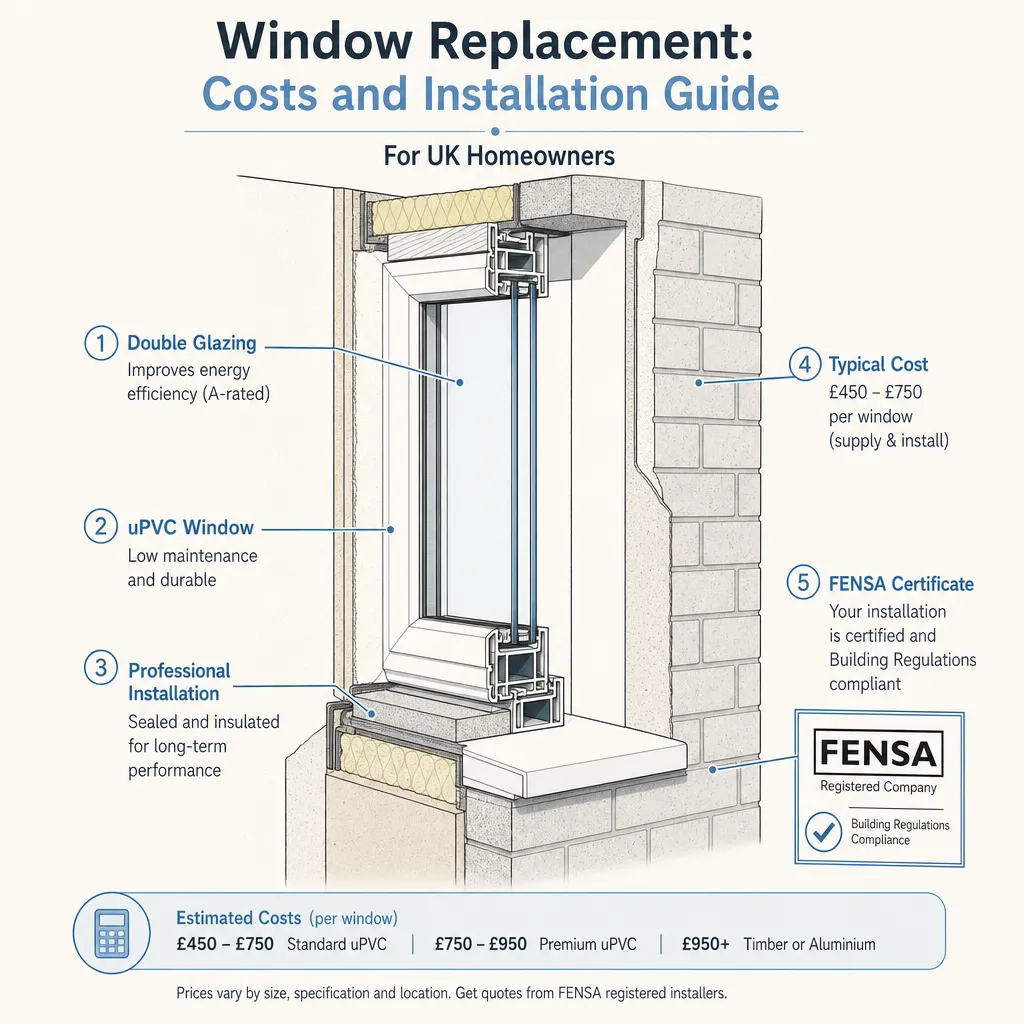
Window Replacement: Costs and Installation Guide
Replacing windows in a UK home typically costs £400–£900 per uPVC casement window installed, rising to £1,500–£3,000 for timber sash windows.
 Improvement & Build
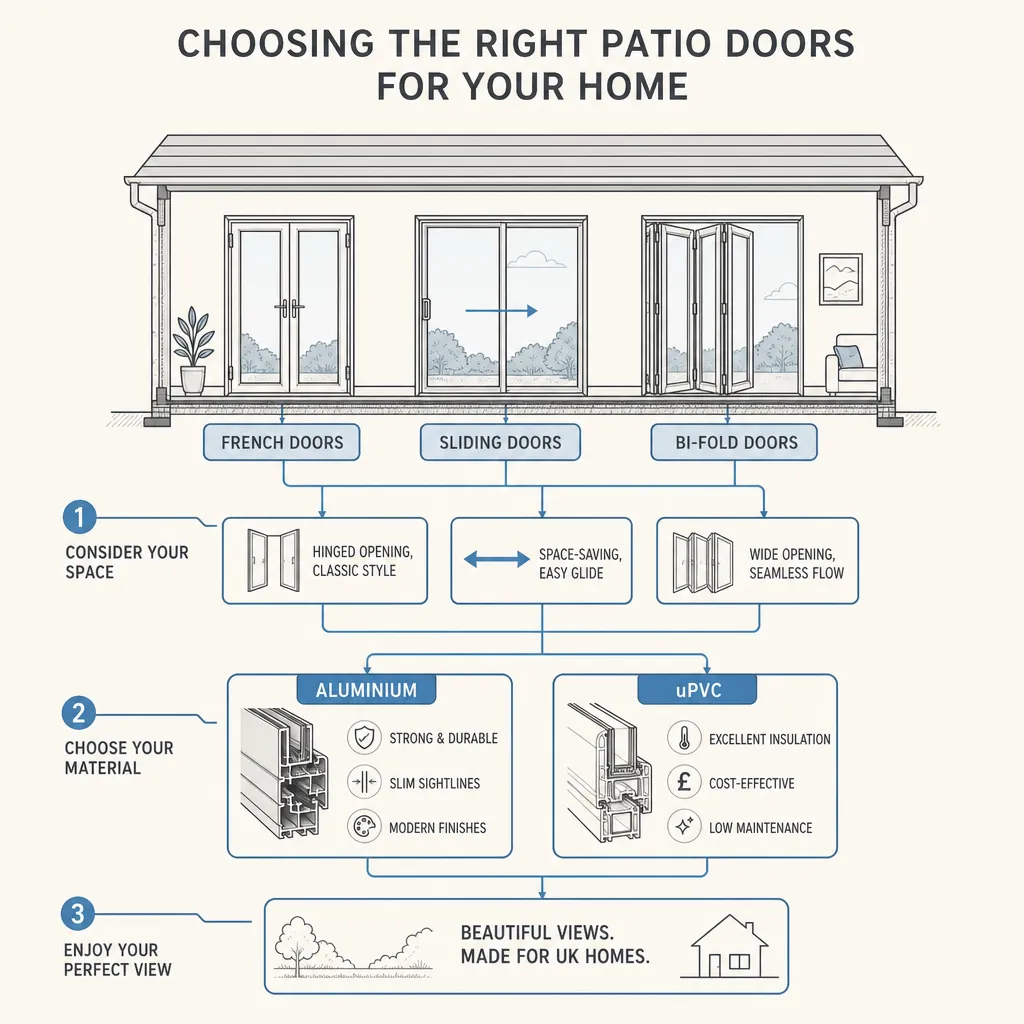
Choosing the Right Patio Doors for Your Home
The right patio doors depend on your opening width, available swing space, home style, and budget.
 Improvement & Build
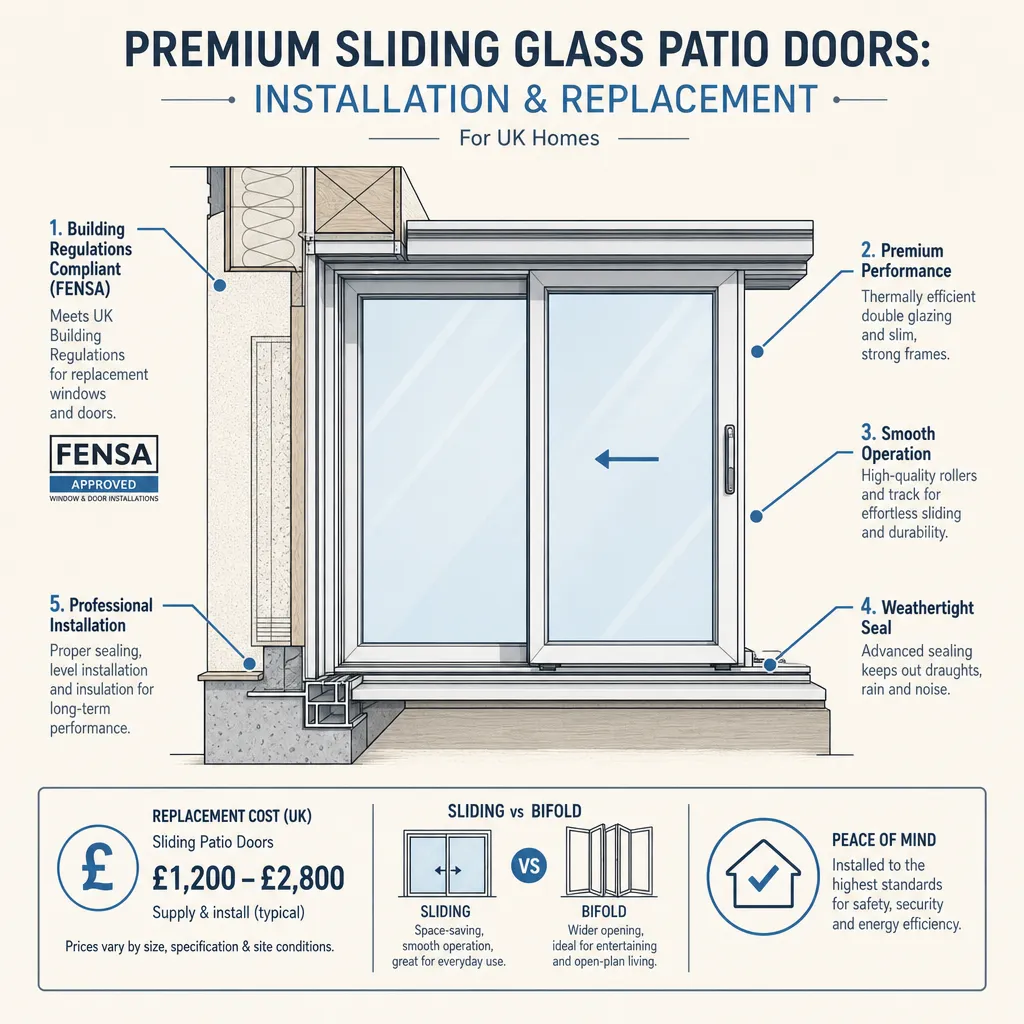
Premium Sliding Glass Patio Doors: Installation and Replacement
Sliding glass patio doors with more than 60% glazed area must meet a maximum whole-unit U-value of 1.